
Full profile
Celebrity divorce works differently because the case is rarely only a dissolution case. Privacy, valuation, custody, business continuity, and settlement timing arrive together, and each procedural choice changes the leverage around the next one. A private judge may reduce public exposure, but only within the authority of the forum. A nondisclosure agreement may restrain public statements, but it does not turn court filings into private correspondence. A prenuptial agreement may narrow the asset fight, but only if it was drafted and executed well enough to withstand the attack it will almost certainly receive.
The useful way to read a high-profile divorce is not to ask which spouse “won.” It is to ask which mechanism absorbed which pressure: public access, disclosure risk, business valuation, custody conflict, tax exposure, or timing. The same reported settlement number can mean very different things depending on whether it reflects prenup enforcement, mediated compromise, asset shielding through trusts, or a valuation discount caused by reputational damage.

| Pressure in the case | Mechanism commonly considered | What the mechanism actually changes |
|---|---|---|
| Public attention around pleadings, allegations, and financial disclosures | Private judging, arbitration, sealing motions, NDAs | Forum, access, and speech risk; not the public character of every court-related record |
| Uncertainty over separate and community property | Prenuptial or postnuptial agreement, trust review, forensic accounting | The scope of disputed assets and the cost of challenging ownership claims |
| Fast reputational deterioration or brand impairment | Mediation, private judging, interim confidentiality orders, coordinated valuation work | Settlement timing and the evidentiary record used to price business or endorsement income |
| Complex income streams and hard-to-value assets | Forensic accounting, business valuation, digital asset tracing | The asset picture before bargaining positions become anchored to incomplete numbers |
| Custody allegations that can spill into public narrative | Mediation, custody evaluation, temporary orders, limited sealing where available | The process for resolving child-related issues without assuming full-case secrecy |
The Forum Is Part of the Strategy
In ordinary divorce litigation, the court’s pace often dictates the parties’ pace. In a celebrity matter, delay itself can become an asset problem. A pending case may keep allegations in circulation, complicate endorsement negotiations, depress a business valuation, or create incentives for one side to litigate in the press while negotiating at the table.
That is why private judging receives so much attention in California celebrity divorce practice. Under California’s private judging framework, grounded in Cal. Const. art. VI, § 21 and Code Civ. Proc. § 638, a privately compensated neutral can operate in a hybrid role: facilitating confidential mediation while also issuing binding rulings on unresolved issues. Bremer Whyte describes that dual mediation-adjudication function as the central reason Hollywood parties use private judges rather than letting the matter proceed entirely through public court calendars.[1]
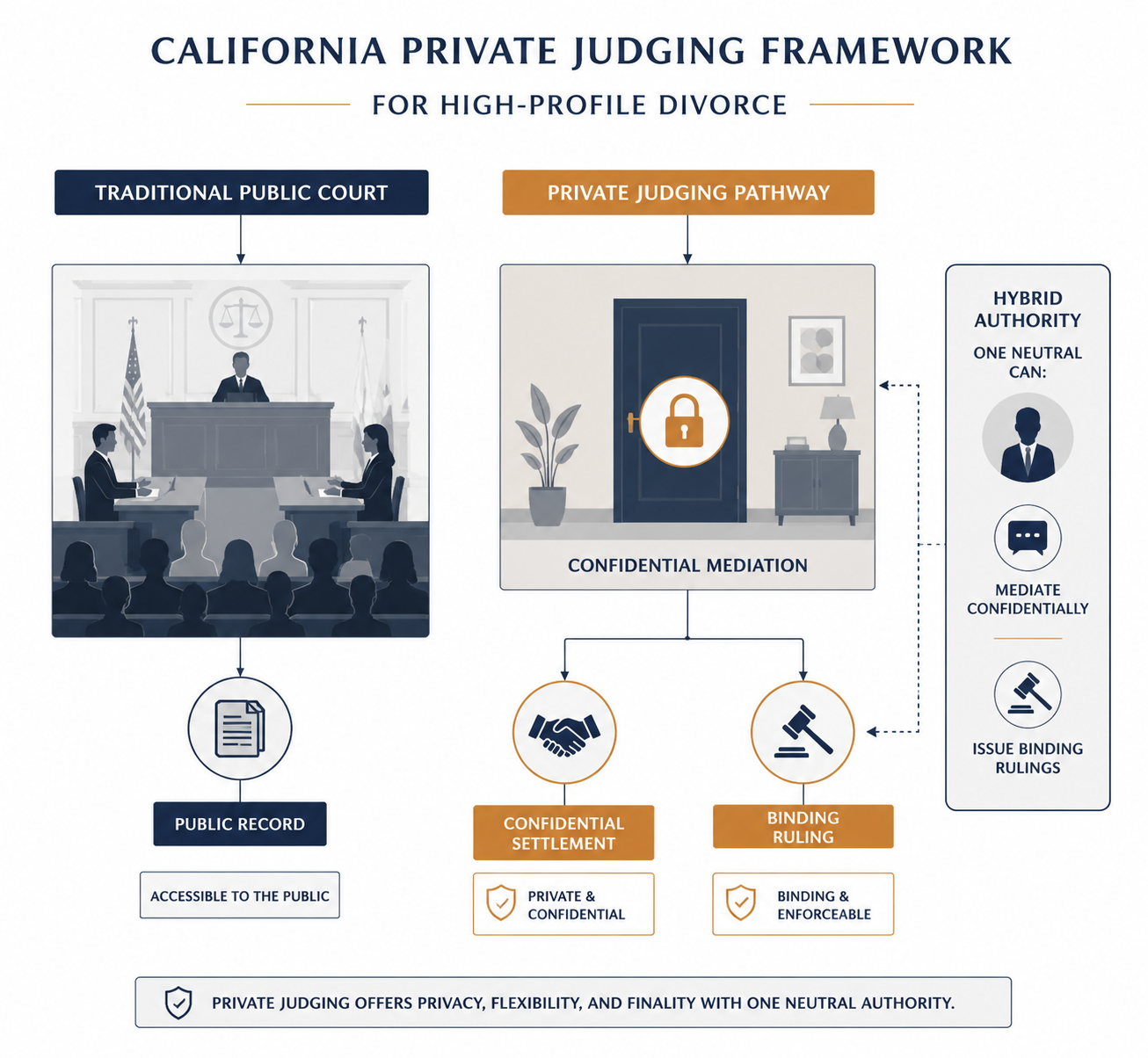
The practical advantage is not that the case becomes invisible. It is that the forum can change the rhythm of the matter. A private judge can help the parties test settlement positions in a confidential setting and, if settlement stalls, move unresolved issues toward a binding decision without waiting on the same public docket constraints. For counsel, that can change the cost of delay. A party who benefits from dragging out a public fight may have less room to do so when the process is built to move from mediation to adjudication before the same neutral.
Arbitration serves a related but distinct function. MDMB Law describes divorce arbitration as a confidential process producing binding outcomes outside the public court system, and notes that arbitration clauses are increasingly placed into prenuptial agreements as mandatory dispute-resolution provisions.[2] Used well, that clause is not decorative. It answers a procedural question before the marriage breaks down: if there is a dispute, where does it go, who decides it, and how much of the record is exposed?
The architectural temptation is to treat private judging, arbitration, and mediation as interchangeable privacy products. They are not. Mediation relies on agreement. Arbitration supplies a binding award through a private adjudicative process. California private judging can, in the account provided by the private-judging source, combine confidential settlement facilitation with binding rulings under a court-authorized framework.[1][2] The selection matters because it determines what happens when one spouse stops cooperating.
Privacy Tools Change Leverage, Not Public-Access Law
The weakest privacy planning in high-profile divorce starts with a vague wish: keep everything confidential. The better starting point is more exact: which information is likely to become public, through which channel, and who can be bound before the dispute begins?
Nondisclosure agreements can be useful, especially when they are integrated into prenups or postnups rather than introduced after trust has collapsed. Weinberger Law Group describes the rise of “social media prenup” clauses that restrict public statements during the marriage and after dissolution.[3] In a celebrity matter, that can address a real gap: the damaging disclosure may not be a formal pleading. It may be an interview, a post, a podcast appearance, or a leak routed through someone close to the household.
But an NDA is not a seal. The same source identifies limits that should be treated as drafting constraints rather than footnotes: court filings remain presumptively public; support staff, advisors, and former employees may sit outside privilege protections; and public-policy exceptions can apply where criminal activity is involved.[3] Those limits are not technicalities. They define whether a confidentiality plan is enforceable against the person most likely to disclose the information, in the place where disclosure is most likely to occur.
Sealing is the more formal tool, and in California it carries a high bar. Yang Law Offices describes sealing practice under Cal. Rules of Court 2.550–2.551 and Family Code § 214, with the privacy interest required to outweigh the public right of access; the same discussion notes that sealing more often reaches financial documents than an entire case file.[4] That distinction prevents a common overstatement. California procedure may protect specific sensitive records, but it does not convert a celebrity divorce into a wholly private transaction merely because both sides would prefer that result.
Confidentiality sanctions can still matter. Forbes reports that Quinta Brunson’s postnuptial agreement included monetary sanctions for confidentiality breaches.[5] As a mechanism, that does not promise secrecy. It changes the economics of disclosure. The clause gives counsel a concrete enforcement hook when a party or aligned source threatens to turn private bargaining into public theater.
Settlement Speed Is a Product of Pressure
High-profile matters often settle quickly not because they are simple, but because the alternative can be expensive in nonlegal currency. Forbes reports that Jennifer Lopez and Ben Affleck reached settlement in under one month through mediation.[5] That time frame is meaningful only if read procedurally: mediation gave the parties a way to resolve the asset and status questions before the public narrative could harden into a bargaining weapon.
The Kim Kardashian and Kanye West divorce illustrates the same pressure from a different angle. Forbes characterizes their California settlement as confidential despite substantial public conflict.[5] The public dispute did not prevent private resolution; it made process control more important. When one part of the matter is already being litigated culturally, the legal process has to preserve enough structure for custody, support, and property issues to be resolved without letting the public narrative become the docket.
The same Forbes account discusses Sia’s custody case, including competing substance-abuse allegations and court-ordered resumed mediation.[5] That example is useful because it resists the tidy privacy story. Mediation may be ordered or resumed, but allegations involving parenting capacity do not become harmless merely because the forum is less public. Custody disputes create their own procedural gravity. The privacy toolkit has to yield to child-centered adjudication when the court needs a record.
Prenups Do Their Most Important Work Before the Divorce Exists
A prenuptial agreement is often discussed as if its only job is to dictate who gets what. In celebrity divorce, its broader job is to reduce the number of issues available for public contest. It can classify property, assign business interests, route disputes into arbitration or private judging, and incorporate confidentiality obligations. If drafted with that architecture in mind, it affects forum, timing, evidence, and settlement posture at once.
The Dr. Dre example is the cleanest reported illustration of financial consequence. Forbes reports that his prenup saved an estimated $300 million-plus, framing the comparison as a $100 million settlement against a potential $400 million-plus exposure.[5] Those figures should be treated as media-reported estimates, not court-adjudicated valuations. Still, the mechanism is clear: the agreement narrowed the range of plausible outcomes and changed the settlement zone.
The opposite pattern appears in the reported Hugh Jackman matter. Forbes describes the absence of a prenup as contributing to a two-year, $250 million impasse.[5] Again, the number is a media-reported figure. The procedural lesson is narrower and more reliable than the dollar amount: when the agreement does not exist, classification and valuation disputes have more space to expand, and the parties may spend years bargaining over issues a premarital contract might have narrowed.
Prenups are not the only planning instrument. Forbes reports that David Geffen’s divorce involved a reported $9 billion estate, no prenup, California community property issues, and pre-marital trusts that shielded assets.[5] The example should not be flattened into “trusts beat prenups.” Trust structure, timing, funding, control, and jurisdiction all matter. What the report usefully shows is that asset protection in a celebrity divorce may come from several instruments operating before separation: trusts, property characterization, entity structure, and any marital agreement that defines how disputes will be handled.
Valuation Breaks When the Asset Is the Person
Conventional divorce checklists assume assets can be located, classified, and valued with enough expert work. Celebrity estates often add a harder question: what is the marital value of income streams tied to reputation, audience, likeness, endorsements, or a privately held business whose revenue depends on one spouse’s public identity?
Financial Poise describes this problem as “reputational cross-liability,” using Kanye West’s 2022 antisemitic remarks and the resulting loss of Yeezy’s Adidas and Gap partnerships as an example of reputation directly reducing marital estate value.[6] That is not merely a public-relations problem adjacent to divorce. It can become a valuation problem inside the divorce. If a business interest, royalty stream, or endorsement pipeline loses value during the dispute, counsel has to ask whether the decline is market-driven, conduct-driven, temporary, permanent, separate, or marital.
Digital and quasi-digital assets widen the gap between ordinary disclosure and useful valuation. Financial Poise identifies crypto, NFTs, restricted stock units, and influencer income as assets that resist conventional valuation methods.[6] The difficulty is not only that values move. It is that ownership, control, vesting, wallet access, platform monetization, and future income potential may sit in different places. A screenshot of an account balance is not a valuation analysis.
Forensic accounting becomes a case-management function, not an afterthought. Stahly LLC describes forensic accountants in high-asset divorce as tracing hidden assets, reconstructing income, and valuing closely held businesses.[7] In celebrity matters, that work should begin early enough to inform settlement posture. If the first serious valuation analysis arrives after public allegations have already affected brand income or after a private mediation has anchored the parties to incomplete numbers, the expert is no longer shaping the negotiation; the expert is trying to repair it.
A Coordinated Process Looks Different From a Menu of Tactics
The mechanisms are easiest to misuse when they are selected one at a time. An NDA drafted without a forum clause may leave the parties fighting publicly over enforcement. A private judge without a disciplined valuation plan may move the case faster toward a number neither side can defend. A prenup without dispute-resolution provisions may classify property but still leave the parties exposed to a public procedural fight.
A practical sequence usually starts with triage rather than drafting. Counsel needs to identify which pressure is most likely to damage the client before judgment: public filings, leaks by insiders, business-value decline, disputed custody allegations, hidden assets, or uncertainty over premarital property. Only then does the mechanism choice make sense.
- If public process is the immediate risk, the forum analysis comes first: private judging, arbitration, mediation, and targeted sealing each solve different problems.
- If disclosure through people is the immediate risk, the contract analysis comes first: NDAs, social media clauses, staff agreements, and sanctions must match the likely disclosure channel.
- If asset uncertainty is the immediate risk, the financial analysis comes first: forensic accounting and valuation need to precede serious settlement anchoring.
- If property classification is the immediate risk, the agreement and trust analysis comes first: prenups, postnups, entity documents, and trust instruments define the real battlefield.
- If custody allegations are the immediate risk, the child-related process comes first: privacy planning cannot outrun the court’s need to assess parenting issues.
This is also where source discipline matters. Media-reported divorce figures can illustrate how a mechanism appears to function, but they are not a substitute for pleadings, orders, expert reports, or settlement documents. Law firm explanations can accurately identify available tools, but they may naturally emphasize the usefulness of those tools more than their failure points. The practitioner’s job is to separate the mechanism from the marketing.
California Is Influential, Not Universal
Many prominent U.S. celebrity divorces are associated with California, and several mechanisms discussed here are California-specific. The private judging authority cited above comes from California constitutional and statutory provisions.[1] The sealing standards discussed above come from California court rules and Family Code authority.[4] California community property principles also shape the stakes in reported matters such as the Geffen example.[5]
That does not make California a portable template. A non-California practitioner has to re-run the analysis under local law: whether private judging is available, whether family arbitration is permitted and on what terms, what parts of the file can be sealed, whether marital agreements can mandate the selected forum, how custody issues are carved out, and how public-access rules apply to financial disclosures.
The transferable lesson is narrower and more useful. Celebrity divorce strategy succeeds when privacy, forum, contract, and valuation decisions are coordinated early enough to affect leverage. The mechanisms do not remove conflict. They decide where the conflict occurs, who can see it, how quickly it moves, and whether the asset record is reliable before reputational pressure starts setting the price.
References
- Why Hollywood Stars Use Private Judges for Divorces, Bremer Whyte
- Divorce Doesn't Have to Be Public: How Arbitration Keeps Your Personal Life Private, MDMB Law
- Non-Disclosure Agreements: Should Your Divorce Include An NDA?, Weinberger Law Group
- Divorce Trends 2026 California Kim Kanye, Yang Law Offices
- From Jennifer Lopez To Quinta Brunson: A 2025 Celebrity Divorce Guide, Forbes
- When Marriage Becomes a Business Liability, Financial Poise
- The Role of Forensic Accountants in High Asset Divorce Cases, Stahly LLC
Comments
Join the discussion with an anonymous comment.