
Full profile
The May 29, 2026 revocation of a Xinhua journalist’s U.S. visa is easiest to describe as retaliation and harder to analyze as law. China had expelled New York Times reporter Vivian Wang in February 2026, and the United States later answered by revoking the visa of a journalist working for China’s state news agency, Xinhua.[1][2] That chronology matters, but it does not by itself identify the legal authority. Visa records are protected from public disclosure, and the State Department has not publicly confirmed the exact statutory provision used.
That uncertainty should discipline the analysis, not end it. In a retaliatory journalist-visa case, the obvious machinery is the combination of INA §212(a)(3)(C), which makes certain noncitizens inadmissible where entry or proposed activities would have potentially serious adverse foreign-policy consequences, and INA §221(i), which gives the Secretary of State power to revoke a visa. The harder question is not whether foreign affairs gives the executive branch room to act. It is how much individualized process, speech protection, and legal intelligibility survive once a visa decision is placed inside that foreign-policy frame.
The Foreign-Policy Ground Does Most of the Work
INA §212(a)(3)(C) is a compact provision with unusually large consequences. As implemented in the Foreign Affairs Manual, the ground applies where the Secretary of State has reasonable ground to believe that a noncitizen’s entry or proposed activities in the United States would have “potentially serious adverse foreign policy consequences.” The FAM also states that no waiver is available for this inadmissibility ground.[3]
The phrase “potentially serious adverse foreign policy consequences” is doing several things at once. It does not require a completed harm. It does not require ordinary criminality. It does not require that the journalist personally engaged in espionage, threats, or unlawful conduct. It allows the government to treat admission itself, or the activities expected after admission, as the foreign-policy problem.
That makes the provision a natural fit for reciprocal measures. If the United States wants to answer China’s expulsion of an American reporter without announcing a broader sanction, it can frame the decision as an inadmissibility judgment about one visa holder. The action then looks individualized on paper while performing diplomatic signaling in practice. That dual character is the central feature of the case, not a drafting accident.
For a foreign journalist employed by Xinhua, the government’s argument is also not the same as it would be for an independent reporter, a dissident student, or a U.S.-based outlet’s correspondent. Xinhua’s status as China’s state news agency gives officials a ready foreign-policy vocabulary: reciprocity, state information operations, bilateral treatment of journalists, and diplomatic parity. None of that proves the revocation was wise or constitutionally clean. It does explain why the government would reach first for a foreign-policy inadmissibility provision rather than a theory that requires proving ordinary misconduct.
The Speech Safe Harbor Is Real, but It Has an Override Built Into It
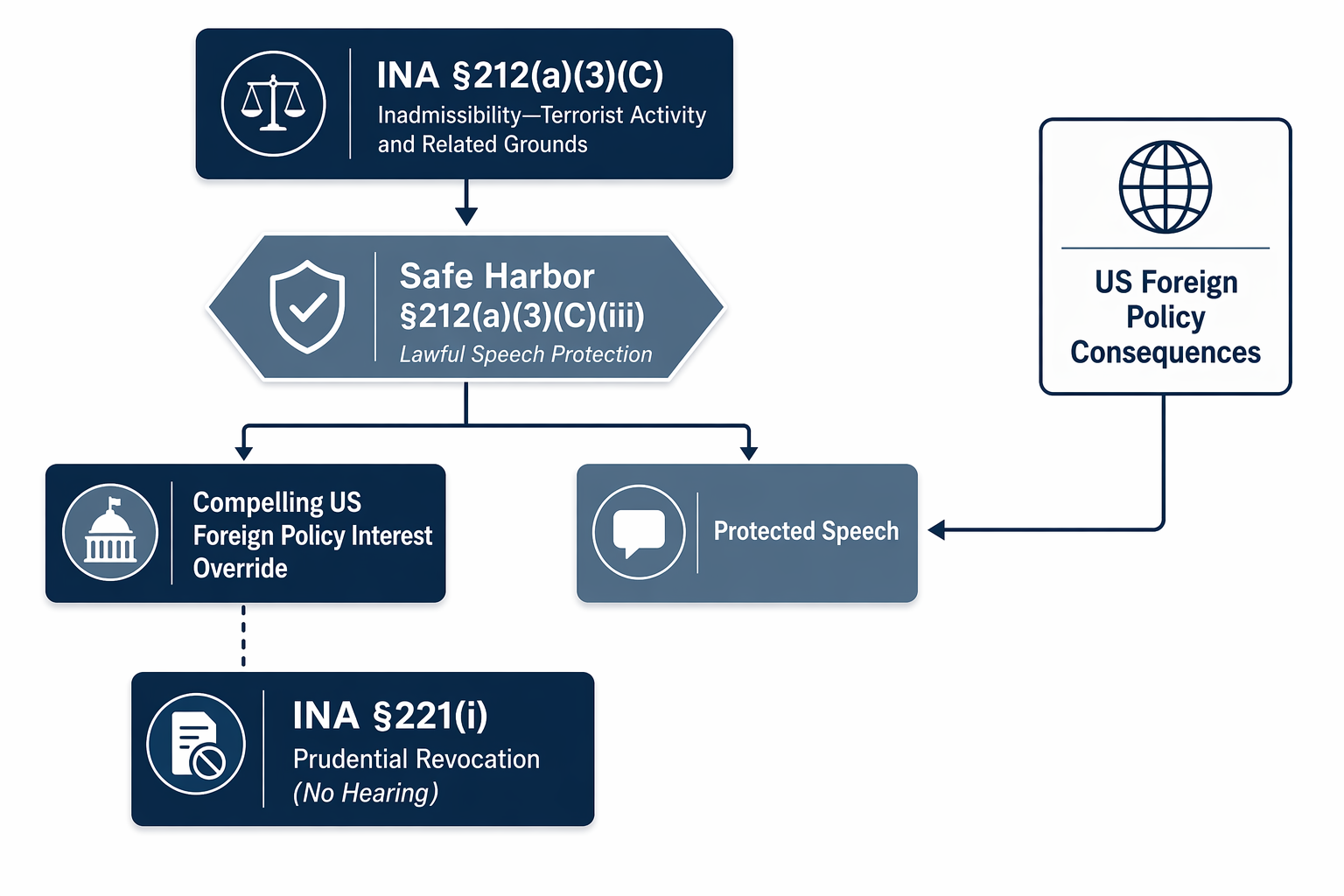
The important textual complication is §212(a)(3)(C)(iii). Congress did not leave the foreign-policy ground entirely open-ended. The provision says a noncitizen cannot be excluded or deported because of past, current, or expected beliefs, statements, or associations that would be lawful in the United States, unless the Secretary of State personally determines that admission would compromise a compelling United States foreign-policy interest.[3]
That safe harbor matters because journalism is usually speech and association before it is anything else. A journalist interviews sources, attends events, writes, edits, records, and transmits information. If the government’s objection is simply that a journalist’s reporting, affiliations, or institutional employer are politically undesirable, §212(a)(3)(C)(iii) is supposed to slow the machinery down.
But the same sentence that creates the protection also contains the escape hatch. A “compelling United States foreign policy interest” determination can override the safe harbor. In practice, that means the government may acknowledge that the underlying conduct is lawful speech or association and still conclude that admission itself produces foreign-policy consequences serious enough to justify exclusion.
This is where easy claims about legality become misleading. The existence of an override does not make every retaliatory visa action automatically valid. It means Congress supplied a path, but one that requires a particular kind of determination. The public record does not tell us whether the Secretary personally made such a determination in the Xinhua matter, whether the Department relied on a different ground, or whether the revocation was handled through prudential revocation without a public merits explanation.
The safe harbor also exposes the pressure point for litigation. If the real basis for action is a journalist’s lawful expressive activity, the statute tells courts and agencies not to pretend that foreign-policy magic erases the speech problem. Yet if the government invokes the compelling-interest override, the reviewing court is immediately pushed toward deference, secrecy, and consular nonreviewability. The protection exists in the text, but its practical force depends on whether any tribunal can see enough of the government’s reasoning to test it.
Revocation Under §221(i) Supplies the Procedural Shortcut
INA §212(a)(3)(C) explains why a journalist may be treated as inadmissible. INA §221(i) explains how the government can move quickly after a visa has already been issued. Section 221(i) authorizes the Secretary of State to revoke a visa at any time, and analogous cases describe that revocation power as requiring no hearing before the visa is cancelled.[4]
That difference matters. A denial at the front end keeps a person out. A revocation after issuance can strand someone, trigger detention or removal consequences if the person is already present, or convert a previously lawful professional placement into an immigration problem with little warning. The constitutional question often arrives after the administrative act has already changed the person’s legal position.
The 1986 Patricia Lara matter shows the older version of the same architecture. Lara, a Colombian journalist, was detained after her visa was revoked under an analogous national-security-related clause described as covering activity subversive to national security.[4] The point is not that the Xinhua case and Lara’s case are factually identical. They are not. The point is that visa revocation has long allowed the government to turn an admissibility judgment into an immediate control mechanism without first providing the kind of hearing that would ordinarily make the government state its case.
In the Xinhua revocation, this procedural posture is especially important because the public explanation is thinner than the legal consequence. The United States can say it is responding to China’s treatment of an American journalist. It can rely on visa confidentiality to withhold the exact record. It can invoke foreign-policy authority if challenged. And if §221(i) is the operational tool, the visa can be cancelled before any court has the occasion, jurisdiction, or classified record access to decide whether the lawful-speech safe harbor was respected.
| Legal Lever | Function in a retaliatory journalist-visa case | Main vulnerability |
|---|---|---|
| INA §212(a)(3)(C) | Labels entry or proposed activities as likely to create potentially serious adverse foreign-policy consequences | The standard is broad and can blur individual conduct with diplomatic signaling |
| INA §212(a)(3)(C)(iii) | Protects lawful beliefs, statements, and associations unless a compelling U.S. foreign-policy interest is found | The override may swallow the protection if courts cannot review the reasoning |
| INA §221(i) | Allows visa revocation after issuance, without a pre-revocation hearing | The action may be complete before meaningful process is available |
The July 2026 I-Visa Rule Makes Reassessment Routine
The May revocation was a discrete act. The July 16, 2026 DHS final rule changes the surrounding environment. By eliminating duration-of-status treatment for I visas and replacing it with fixed admission periods, the rule makes foreign journalists return to the government more often for continued authorization. Under the rule, foreign media representatives generally receive a 240-day period, while Chinese nationals receive a 90-day period.[5][6]
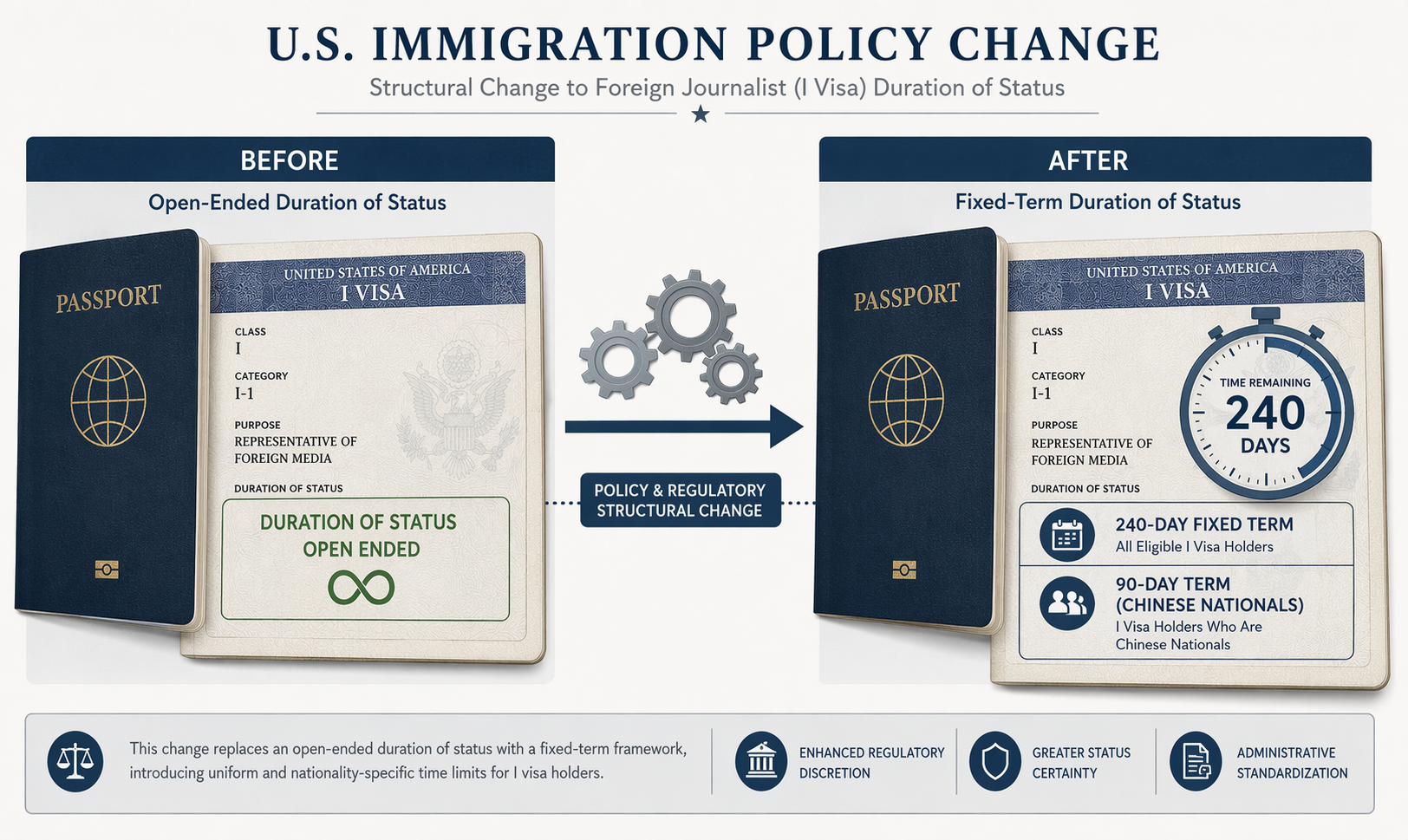
That is not just an administrative calendar change. Duration of status lets the qualifying assignment carry much of the practical weight. A fixed term requires renewal, extension, or departure on a recurring schedule. Each renewal point gives the government another chance to examine the applicant, the outlet, the assignment, and the foreign-policy atmosphere around the person’s work.
Press-freedom groups understood the structural nature of the change. The Committee to Protect Journalists criticized the rule and quoted its U.S., Canada, and Caribbean program coordinator describing it as “the behavior of a backsliding democracy.”[5] Reporters Without Borders likewise analyzed the rule as a threat to foreign correspondents’ ability to work in the United States, particularly because shorter authorized stays increase the leverage attached to immigration paperwork.[6]
The scale is not trivial. DHS data identify 37,330 I-visa admissions in FY 2024.[7] Admissions are not the same thing as unique journalists, and the figure does not prove that every visa holder will face political review. It does show that the rule applies to a substantial channel of foreign media access, not merely to a handful of adversarial-state correspondents.
For Chinese nationals, the 90-day term sharpens the point. A journalist who must repeatedly ask the government for renewed permission to continue working is easier to pressure than one whose status lasts for the duration of a qualifying assignment. The government need not stage a dramatic public revocation each time. It can wait for the next renewal event, request additional information, delay, deny, or rely on inadmissibility grounds that may never be fully aired outside the consular file.
That is why the rule belongs near the center of the legal analysis. The relevant change is not that DHS has openly announced a content-review regime for foreign journalists. The more durable shift is that the immigration system now creates more decision points at which foreign-policy concerns can be inserted into professional presence. A one-off revocation can be controversial. A renewal architecture can normalize the same pressure.
What Courts Have Begun to Question
Recent litigation has begun to expose the weak joints in this framework, though not in a way that yet settles the Xinhua scenario. In the Khalil litigation, a district court concluded that INA foreign-policy provisions were likely unconstitutionally vague as applied in that case.[8] That is a serious signal, but it is still a district court ruling, not a nationwide appellate settlement of the foreign-policy ground’s constitutionality.
The Öztürk habeas litigation raises adjacent process concerns: detention and immigration action allegedly tied to expressive activity, with challenges focused on whether the government provided adequate process and whether foreign-policy-based immigration tools were being used to punish protected expression.[8][9] Again, the lesson is not that every foreign journalist revocation is now unconstitutional. The lesson is that courts are being asked to examine a set of powers that previously benefited from the combined insulation of foreign affairs, immigration deference, and limited consular review.
The vagueness objection is easy to overstate and too important to dismiss. Foreign policy is inherently broad; Congress often writes broadly in this area; and courts traditionally give the political branches substantial room over admission of noncitizens. But a standard that turns on “potentially serious adverse foreign policy consequences” gives little public guidance about what conduct, affiliation, reporting topic, or diplomatic context triggers exclusion. If the person also receives no meaningful hearing before revocation, the breadth of the standard and the thinness of process reinforce each other.
The lawful-speech safe harbor makes the constitutional problem more pointed. Congress appeared to recognize that excluding people for beliefs, statements, and associations creates First Amendment-adjacent concerns, even when the affected person is a noncitizen seeking admission. But the compelling-interest override lets the executive branch reclassify the same protected sphere as a foreign-policy threat. If courts cannot inspect the basis for that override, the safe harbor may function less as a constraint than as a procedural formality.
The Strongest Legal Defense Is Also the Source of the Concern
The government’s best defense is textual and institutional. Congress enacted a foreign-policy inadmissibility ground. The FAM implements it. The provision contains an explicit override for compelling foreign-policy interests. Section 221(i) gives the Secretary revocation authority. The dispute arose in a reciprocal diplomatic setting after China expelled a U.S. journalist. A court inclined toward deference has plenty of material to sustain the executive branch’s room to act.
The legal vulnerability comes from the same cluster of features. The standard is broad. The protected-speech carveout is conditional. The revocation power is fast and procedurally spare. Visa-record privacy keeps the public from knowing the actual statutory basis. The new I-visa rule creates repeated opportunities for reassessment. Each piece may be defensible in isolation; together, they permit a visa decision to operate as a diplomatic sanction while still presenting itself as individualized immigration administration.
That distinction matters for the legal question: whether the Chinese journalist visa revocation was legal as U.S. retaliation. The cautious answer is that the government likely has statutory tools capable of supporting such a revocation, especially if it used §212(a)(3)(C), a compelling-interest determination under §212(a)(3)(C)(iii), and §221(i) revocation authority. The equally important qualification is that the public cannot verify which tool was actually used, whether the safe harbor was considered, or whether the journalist received any meaningful opportunity to contest the premise.
As of Q3 2026, the appellate courts have not squarely resolved whether this foreign-policy framework is void for vagueness or constitutionally adequate when applied to speech-linked immigration action in this setting. The framework remains largely intact. The margin is where the litigation now lives: lawful speech, vague foreign-policy standards, and no-hearing revocation authority occupying the same administrative file.
References
- US revokes visa for Chinese journalist in response to China’s expulsion of New York Times reporter, AP News / U.S. News & World Report, May 29, 2026, link
- US Revokes Visa of Xinhua Journalist in Retaliation for China Expelling NYT Reporter, La Voce di New York, May 29, 2026, link
- 9 FAM 302.14 Foreign Policy, U.S. Department of State Foreign Affairs Manual, link
- Patricia Lara visa revocation case materials, 1986, link
- CPJ condemns new DHS rule limiting foreign journalists’ visas, Committee to Protect Journalists, July 16, 2026, link
- RSF analysis of DHS I-visa rule for foreign journalists, Reporters Without Borders, July 2026, link
- DHS data on I-visa admissions in FY 2024, U.S. Department of Homeland Security, link
- The First Amendment, immigration law, and the Trump administration’s effort to deport pro-Palestinian student activists, Reporters Committee for Freedom of the Press, link
- Foreign Policy, Free Speech, and Deportation: The Cases of Mahmoud Khalil and Rumeysa Öztürk, Völkerrechtsblog, link
Comments
Join the discussion with an anonymous comment.