
Clio Manage AI Review: What the Evolved Clio Duo Actually Does, and What It Doesn't
A traceable, evidence-grounded evaluation of Clio Manage AI (formerly Clio Duo) for solo practitioners and small-firm attorneys on Clio Manage — covering its five workflow pillars, current pricing structure, data security disclosures, professional responsibility obligations, and the clear scope boundary between Manage AI's operational functions and the legal research capabilities of Clio Work and Vincent AI.
- Hallucination rate
- Not measured / undisclosed
Product Overview and Naming Clarification: From Clio Duo to Manage AI
If you have been searching for reviews of Clio Duo and landing on this page, that is by design. Clio Duo and Clio Manage AI are the same product at different points in its development. Clio Duo launched in late 2024 as a generative AI assistant embedded in Clio Manage. At ClioCon in November 2025, Clio rebranded and significantly feature-refreshed the product under the name Manage AI. As of mid-2026, Clio's own Help Center documentation uses Manage AI as the primary name, describing it as "the evolution of Clio Duo."
The naming gap matters for a practical reason: multiple live third-party reviews — including a 2026-dated piece on Lawyerist and an April 2026 piece on AI Vortex — continue to use the Clio Duo name as the primary product identifier. Both of those reviews also cite pricing figures ($39/user/month and $149/user/month respectively) that do not reflect the current add-on structure shown on Clio's pricing page as of June 2026. This evaluation uses Manage AI throughout, with "formerly Clio Duo" noted where helpful for reader orientation, and cites Clio's own documentation as the primary source for all product-level claims.

Ecosystem Placement: Where Manage AI Sits in Clio's Post-vLex Platform
The single most consequential misunderstanding in existing Clio AI reviews is treating Manage AI as a general legal AI tool. It is not. Understanding what Manage AI does requires understanding where it sits within Clio's broader platform — and that platform changed materially in November 2025 when Clio completed its $1 billion acquisition of vLex, the largest deal in legal tech history.
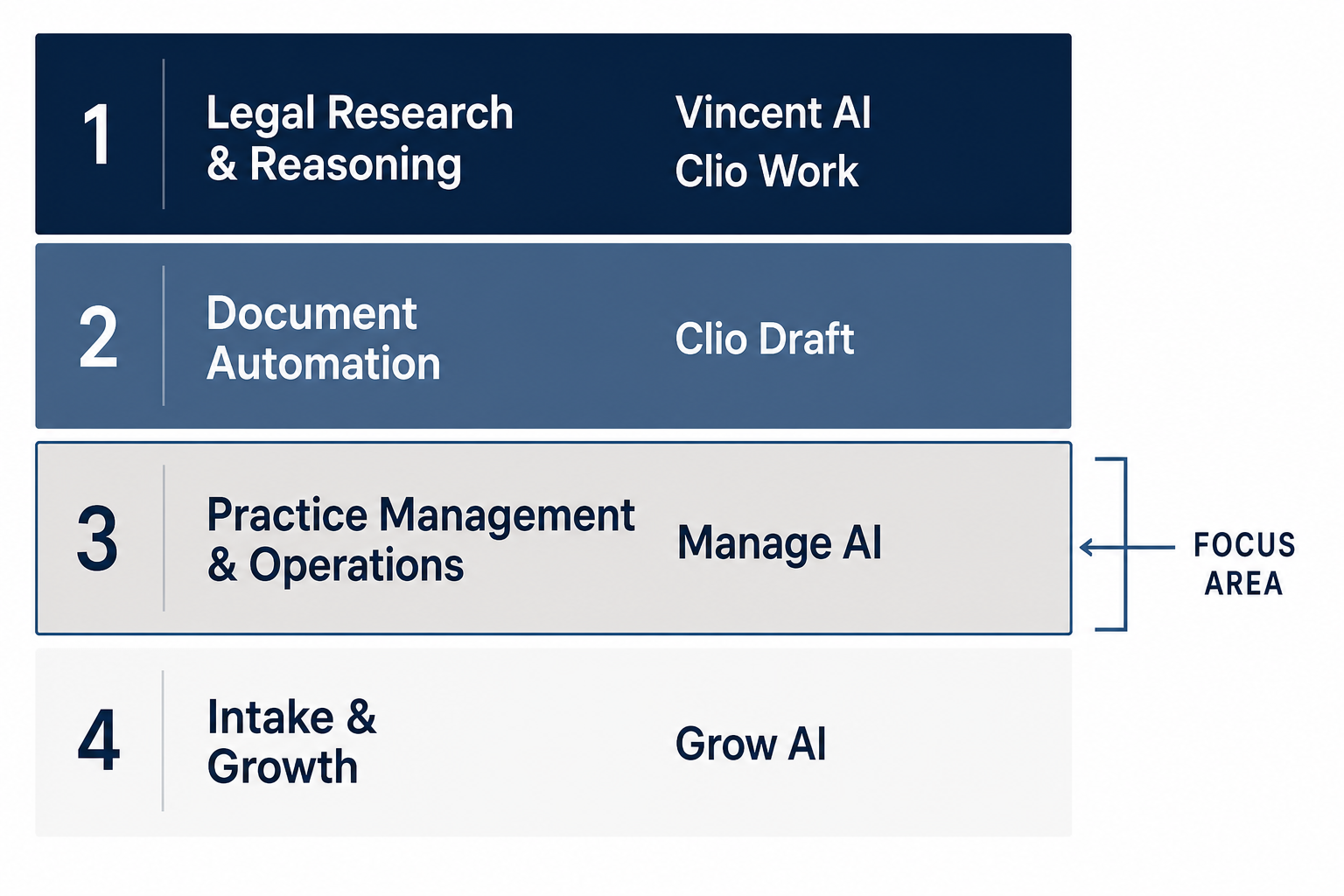
Clio now describes its offering as an Intelligent Legal Work Platform built across four distinct layers. Each layer serves a different function and is a separate product:
| Platform Layer | Product(s) | Function |
|---|---|---|
| Legal Research & Reasoning | Clio Work, Vincent AI, Clio Library | Legal research, case strategy, analysis — powered by vLex's global law library |
| Document Automation | Clio Draft | Template-based document generation and drafting workflows |
| Practice Management & Operations | Manage AI (formerly Clio Duo) | Scheduling, billing, communication drafting, matter organization — from firm data only |
| Intake & Growth | Grow AI | Client intake automation, lead management, and conversion workflows |
Manage AI operates exclusively on data stored inside Clio Manage — your matters, contacts, time entries, documents, and billing records. It has no connection to external legal databases, no access to case law or statutes, and performs no substantive legal analysis. Those functions are served by Clio Work and Vincent AI, which are separate products that require separate access and are powered by vLex's legal library.
Feature Evaluation: The Five Workflow Pillars
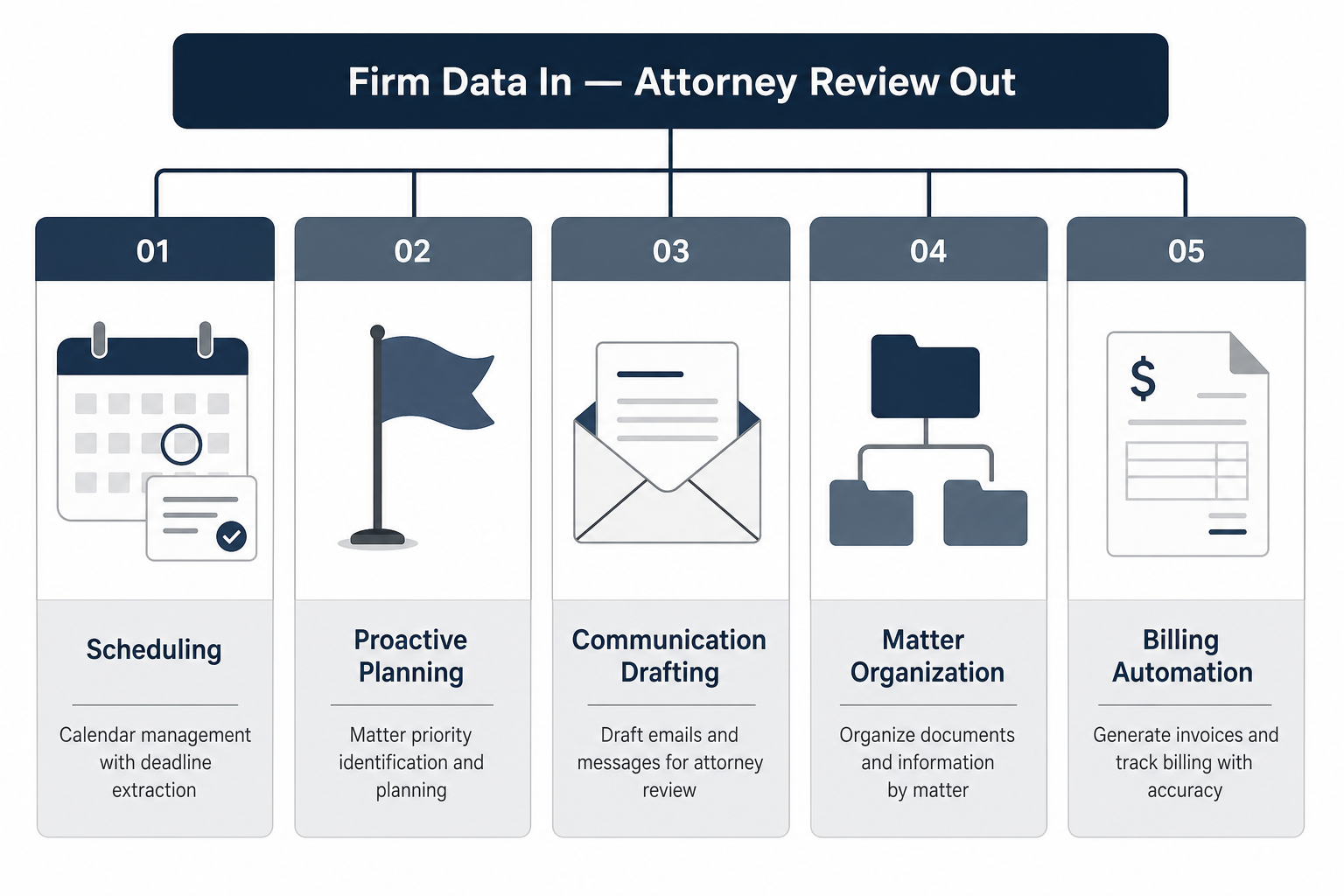
Clio's official product pages and press materials describe Manage AI as operating across five confirmed capability areas. The evidence basis for each is noted below. One structural caveat applies to all five: output quality is bounded by the completeness and accuracy of data already in the firm's Clio account. This is not a minor footnote — it is the central constraint on the product's usefulness, confirmed independently by multiple third-party reviewers and by Clio's own AI Principles documentation.
Scheduling Automation
Manage AI can extract deadline and hearing information from court documents uploaded to Clio Manage and convert that information into calendar events and tasks. The practical value is reducing the manual step of reading a scheduling order and then separately entering each date into the calendar. Source: Clio's Manage AI features page and the November 2025 platform press release.
The dependency caveat applies directly here: if court documents are not uploaded to the relevant matter in Clio, the feature cannot extract anything. Firms that receive documents outside Clio and do not upload them consistently will see no benefit from this pillar.
Proactive Planning and Matter Intelligence
This pillar surfaces prioritized task recommendations and risk flags based on matter activity patterns — for example, flagging matters with upcoming deadlines that have no recent activity, or identifying matters where billing has stalled. Source: Clio's features page and the 2025 Year in Review post, which describes Manage AI as "surfacing actionable insights contextualized to specific matters and clients."
The risk-flag function is only as useful as the underlying matter data. A matter with sparse time entries and incomplete notes will generate generic or low-signal recommendations. Firms that use Clio as a comprehensive matter record — rather than just a billing tool — will see more actionable output from this pillar.
Communication Drafting
Manage AI drafts client updates, emails, and SMS messages based on matter activity recorded in Clio. The drafts are generated in context — drawing on the matter's notes, recent activity, and client record — rather than from a blank prompt. Source: Clio's features page, which lists "AI-generated client updates" as a confirmed capability.
These drafts require attorney review before sending. This is not a discretionary step — it is a professional responsibility obligation under ABA Model Rules 1.6 and 5.3 (addressed in the professional responsibility section below). The quality of the draft is directly tied to the quality and recency of matter notes in the system.
Matter Organization
This pillar generates file naming suggestions and matter setup recommendations. Source: Clio's features page, which lists "Document analyser" as part of the Manage AI add-on. The practical use case is reducing inconsistency in how documents are named and filed across a firm's matters — a common friction point in small firms where naming conventions are informal or inconsistent.
Billing Automation
Manage AI drafts invoices from time entries recorded in Clio, populates expense entries from uploaded receipts, and routes draft invoices through an approval workflow. Source: Clio's features page and the platform press release, which states: "matter activity becomes high-quality client updates, and time and expense entries become payment-ready bills."
This is likely the highest-ROI pillar for high-volume billing practices. A firm that bills 20+ hours per attorney per day and has complete, accurate time entries in Clio will see material time savings on invoice preparation. A firm with inconsistent time entry practices will see incomplete or inaccurate draft invoices that require as much manual correction as a bill prepared from scratch.
Pricing and Access: Current Add-On Structure and Tier Eligibility
As of June 2026, Manage AI is a separately priced add-on to Clio Manage. It is not included in any base tier. Pricing requires direct contact with a Clio sales representative for all eligible tiers. The Clio pricing page (crawled June 2026) shows the following access structure:
| Clio Manage Tier | Manage AI Access | Pricing |
|---|---|---|
| EasyStart | Not available | — |
| Essentials | Available as add-on | Contact sales for pricing |
| Advanced | Available as add-on | Contact sales for pricing |
| Expand | Available as add-on | Contact sales for pricing |
The EasyStart exclusion is material for solo practitioners evaluating whether to adopt Clio at the entry tier. EasyStart users who want Manage AI must upgrade to Essentials at minimum before the add-on becomes available. The cost of that tier upgrade should be factored into any ROI calculation alongside the add-on cost itself.
Data Security and Privacy: What Clio Commits To, What Your Firm Must Verify
Clio makes several specific commitments about how Manage AI handles firm data. These commitments are documented on the Manage AI features page and the AI Principles page:
- Firm data is not used to train external large language models.
- All data is encrypted in transit and at rest.
- AI processing is described as being conducted in accordance with regional data protection laws.
- After processing, resulting data remains stored within the firm's region.
These commitments are meaningful. However, Clio's own Help Center documentation contains a material disclosure that practitioners outside the United States — and some US practitioners with state-specific data residency obligations — must read carefully.
"Depending on where your firm is located, Manage AI may process your queries on servers located outside your home jurisdiction. After your request is processed, any resulting data remains securely stored within your region, in line with Clio's standard data handling practices. Laws and regulations about AI and data handling vary from region to region. While Manage AI is designed to support legal professionals globally, it is up to you and your firm to ensure you align with your local compliance requirements. Consult with your internal compliance team or legal counsel before enabling Manage AI, especially if your firm has specific data residency or regulatory obligations."
Source: Clio Help Center, "Manage AI: The Evolution of Clio Duo".
The implication is direct: query processing — not just data storage — may occur outside a firm's home jurisdiction. For UK and EU firms operating under GDPR, for Canadian firms under PIPEDA, and for US firms in states with specific data residency requirements, this disclosure triggers an independent compliance verification obligation before the feature is enabled. Clio's commitment to regional storage after processing does not resolve the question of where processing itself occurs.
Professional Responsibility Obligations: ABA Model Rules 1.1, 1.6, and 5.3
Manage AI's legal-specific branding does not reduce or modify an attorney's professional responsibility obligations. Three ABA Model Rules apply directly to the outputs this product generates.
Rule 1.1 — Technological Competence
ABA Model Rule 1.1, Comment 8, requires attorneys to keep abreast of changes in the law and its practice, including the benefits and risks associated with relevant technology. For Manage AI, this means understanding what the tool can and cannot do before deploying it in a client matter. Specifically, attorneys must understand that Manage AI's scheduling output is only as accurate as the documents uploaded to Clio, that billing drafts require verification against actual time records, and that communication drafts require review for accuracy and privilege before sending.
Rule 1.6 — Confidentiality of Information
Rule 1.6(c) requires attorneys to make reasonable efforts to prevent the inadvertent or unauthorized disclosure of client information. When client matter data is processed by Manage AI — including billing narratives that reference client names and matter details, communication drafts that include privileged information, and documents uploaded for scheduling extraction — that data passes through Clio's AI processing infrastructure. The cross-border processing disclosure discussed in the data security section is a Rule 1.6 consideration, not just a regulatory one.
Rule 5.3 — Supervision of Non-Lawyer Assistance
Rule 5.3 requires attorneys to supervise the work of non-lawyer assistants and to take responsibility for conduct that would violate the Rules if engaged in by the attorney. AI-generated outputs — billing narratives, communication drafts, calendar events — fall within the scope of this supervision obligation. An attorney who sends a Manage AI-drafted client email without reviewing it, or who finalizes a billing invoice without verifying the AI-populated entries against actual time records, has not satisfied the supervision obligation.
Limitations and Honest Caveats
The following limitations are documented or directly inferable from primary sources. They are not softened here.
- No external legal database access. Manage AI has no connection to case law, statutes, regulatory databases, secondary sources, or any external legal information. This is confirmed by Clio's own product documentation and by multiple third-party reviewers. Legal research is a function of Clio Work and Vincent AI — separate products.
- Strict data-hygiene dependency. All five workflow pillars draw exclusively from data in the firm's Clio account. Incomplete matter records, sparse time entries, inconsistent document filing, and irregular data entry practices will produce low-quality or inaccurate AI outputs. This garbage-in-garbage-out constraint is confirmed by Clio's AI Principles documentation and independently noted by multiple third-party reviewers.
- No independent benchmark data on accuracy or hallucination rates. No third-party studies measuring Manage AI's output accuracy, error frequency, or hallucination rates were identified in research for this evaluation. All quality and accuracy claims originate from Clio's own documentation. Practitioners evaluating the tool cannot currently rely on independent benchmark evidence.
- Vendor-reported time savings without documented methodology. Clio's claim that Manage AI saves "up to five hours per week" is a vendor-reported figure. The methodology behind this figure is not publicly documented. It should not be used as a basis for internal ROI projections without independent verification.
- EasyStart tier exclusion. Manage AI is not available to EasyStart customers. This is a hard access boundary, not a feature limitation.
- Pricing requires direct sales contact. There is no self-serve pricing for the Manage AI add-on as of June 2026. Firms cannot evaluate cost without engaging Clio's sales process.
Firm-Profile Fit: Who Gets ROI and Who Doesn't
Manage AI's value proposition is not uniform across firm types. The following framework is based on the product's documented capabilities and constraints — not on vendor-reported outcomes.
| Firm Profile | ROI Likelihood | Primary Reason |
|---|---|---|
| Solo or small firm (1–20 attorneys), Essentials or above, 30+ active matters, 5+ billable hours/attorney/day, consistent Clio data entry | Strong | High billing volume, active matter load, and data completeness maximize output quality across all five pillars |
| Solo practitioner, Essentials tier, moderate volume (15–30 matters), disciplined data entry | Moderate | Billing and scheduling automation likely deliver value; planning and communication pillars depend on matter data depth |
| Small firm with inconsistent time entry or document filing practices | Low | Data-hygiene dependency will degrade output quality across all pillars; the firm needs data discipline before AI adds value |
| EasyStart tier customer | None | Manage AI is not available at this tier; tier upgrade required before add-on access |
| Low-volume practice (under 10 active matters, under 3 billable hours/day) | Unlikely | Tier upgrade cost plus add-on cost is unlikely to be recovered through time savings at low volume |
| Firm evaluating Clio for the first time, not yet on any tier | Deferred | Establish base Clio workflows and data hygiene before evaluating the AI add-on |
The data-hygiene prerequisite deserves emphasis as a standalone point. Firms considering Manage AI should audit their Clio data quality before committing to the add-on cost: Are time entries being recorded same-day or reconstructed at month-end? Are matter notes current and detailed? Are documents being filed into the correct matters consistently? If the answer to any of these is no, the AI layer will amplify those gaps rather than compensate for them.
Evaluation Verdict
Manage AI (formerly Clio Duo) is a coherent, purpose-built operational automation tool for law firms already running on Clio Manage. Its five workflow pillars — scheduling, planning, communication drafting, matter organization, and billing — address real administrative friction points that consume attorney time at high-volume small firms. For the right firm profile, the add-on is likely to deliver measurable time savings on billing preparation and deadline management.
The scope ceiling is equally clear and must not be overlooked. Manage AI does not conduct legal research, does not access external legal databases, and does not perform substantive legal analysis. Firms that need those capabilities are looking at Clio Work and Vincent AI — different products at different price points. Conflating the two is the most consequential error in existing SERP reviews of this product, and it creates real professional responsibility risk for practitioners who act on that misunderstanding.
Three conditions must be met before Manage AI delivers its stated value: the firm must be on Essentials tier or above, the firm must maintain consistent and complete data entry practices in Clio, and attorneys must treat all AI-generated outputs as drafts requiring review — not finished work product. Firms that meet all three conditions and have the billing volume to justify the add-on cost will find Manage AI a credible operational tool. Firms that do not meet these conditions should address those prerequisites before evaluating the add-on.
Chronological incident history
No sanction cases have named this tool in the tracked record set to date. This does not imply the tool is safe — see Risk Digest for ongoing monitoring.
← Compare peer toolsReport a correction or tip
Spotted an outdated figure, a misstated fact, or a ruling this tool profile should reflect? Public comments are disabled for this content given the professional cost of a misreported case outcome, penalty amount, or rule text — use the structured correction channel instead.
Report a correction or tip for this record →