
Full profile
After email, enterprise cloud migration for law firms stops being a tidy infrastructure story. The next systems carry matter economics, document governance, billing discipline, conflicts history, compliance controls, and years of small workarounds that never made it into a process map. That difference is already visible in adoption data: Epiq reports that 80% of law firm respondents have email in the cloud or expect it to be there within the next year, while ABA coverage of ILTA data reports only 57% with cloud DMS/ECM adoption.[1][2] Aderant's practice-management survey is even less settled: 34% of respondents are in the cloud or moving there, 37% have no foreseeable plans, and 28% are unsure.[3]
Those numbers are not a simple maturity ladder. They show that firms can be comfortable putting collaboration infrastructure in the cloud while still hesitating over the systems that define how a matter is opened, priced, staffed, billed, filed, secured, and later defended. That hesitation is not automatically backward-looking. Sometimes it is the only sign that someone in the room understands what will happen when a partner asks why a profitability report changed, a records team loses a familiar retention view, or a billing coordinator can no longer run the query that used to save month-end.

Why the second wave behaves differently
Email migration is not effortless, but it benefits from standardization. The user expectation is widely understood: send, receive, search, calendar, attach, collaborate, preserve. Legal-specific systems do not move with that same shared baseline. A document management system may include ethical walls, workspace templates, client-mandated naming conventions, mobility restrictions, matter-centric filing expectations, and integrations into email, records, search, litigation tools, and knowledge systems. A practice-management or financial platform may touch time entry, billing narratives, ebilling rules, collections, trust accounting, client intake, conflicts, rate approvals, budgeting, and partner compensation reporting.
The most important warning in the available material is not the usual cloud-security language. It is Epiq's point that many cloud legal platforms are ground-up rebuilds rather than feature-equivalent ports of the on-premises products firms already know. Reporting depth, ad hoc query capability, and third-party integration maturity may not match the older environment, and gaps can appear only after migration if they were not tested earlier.[1]
That is why a second-wave program cannot be run as a procurement exercise followed by a technical cutover. The firm has to decide, system by system, what it is preserving, what it is redesigning, what it is willing to lose, and who has authority to make those calls when a familiar function is not available in the cloud version. If that conversation waits until user acceptance testing, the calendar has already become a weapon.
Start with dependency order, not vendor enthusiasm
A practical sequence starts with the question that gets too little airtime in executive briefings: which failure can the firm isolate? Mindcore, writing from a managed-services perspective, recommends moving from email to DMS and then to practice management, a sequence that gives firms a way to separate collaboration, document governance, and business-system risk instead of changing all three at once.[4] It is a vendor framework, not a law of nature, but it matches how support pain usually arrives.
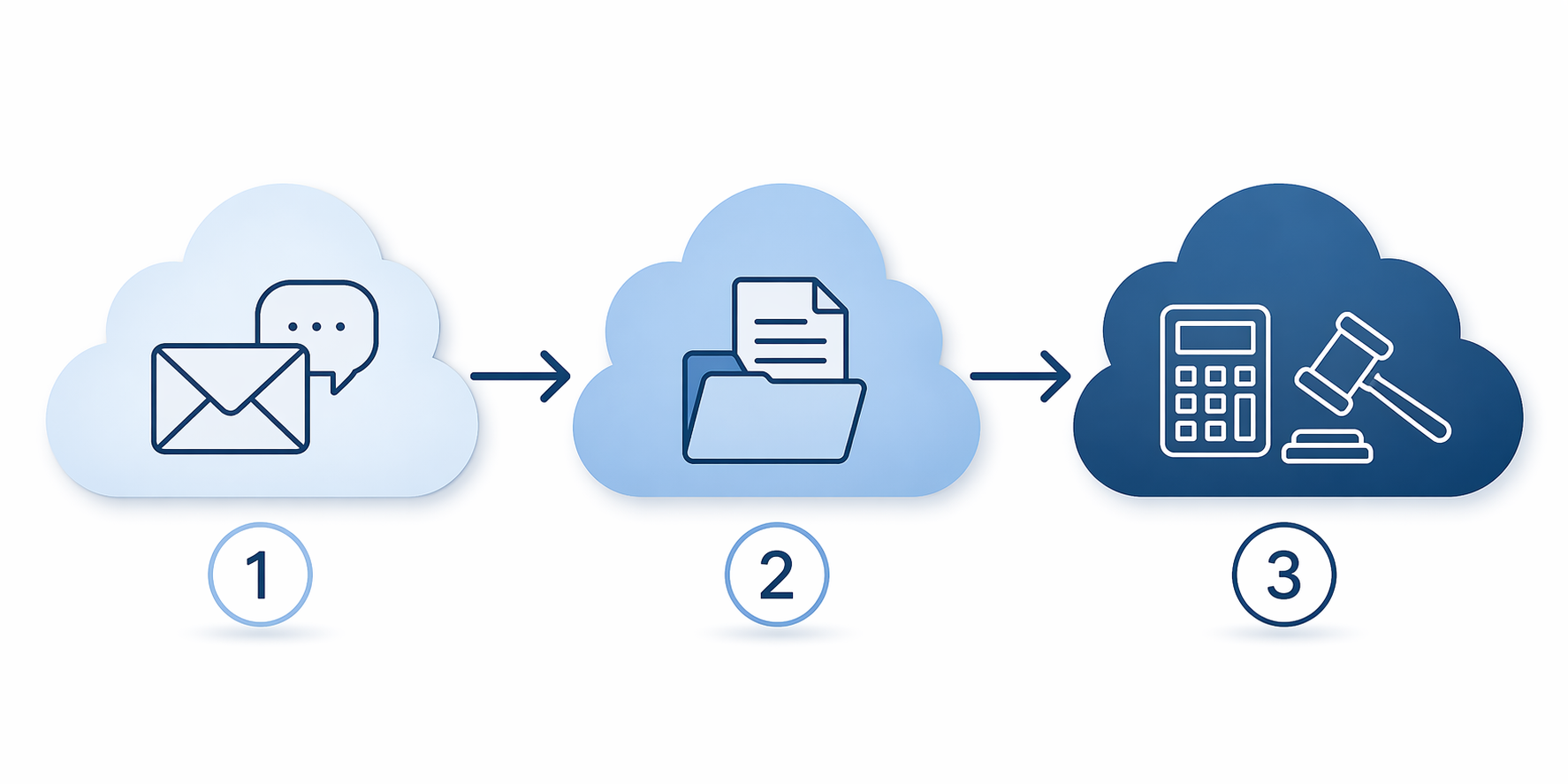
Email first gives the firm a cloud identity foundation and a user population accustomed to web-based access, multifactor prompts, and changed support patterns. DMS next is harder, but still bounded around documents, filing, search, metadata, and governance. Practice management and financial systems should usually wait until the firm has already learned how its users behave in cloud workflows, because those systems carry accounting periods, billing deadlines, partner dashboards, client reporting, and management decisions.
There will be exceptions. A firm with an unsupported financial platform, a client-driven compliance requirement, or a merger deadline may not have the luxury of the clean sequence. Leadership timelines matter. But compressed sequencing makes the dependency map more important, not less. If the DMS, billing system, conflicts database, records system, and data warehouse all exchange matter identifiers, client codes, user groups, or security flags, the firm needs to know which system becomes the source of truth during each phase and what happens when one platform changes before another is ready.
Use the migration options as a decision matrix
A law firm does not need a grand theory for every application. It does need a disciplined way to stop treating all systems as if they deserve the same migration path. Extech Cloud describes the familiar 6 Rs of migration - rehost, replatform, refactor, repurchase, retire, and retain - as part of its cloud-migration guidance.[5] For law firms, the value is not in reciting the model. The value is forcing a different conversation for each critical system before the contract is signed.
| Option | What it means in a law firm | Where the hard question usually sits |
|---|---|---|
| Rehost | Move an application with minimal change to cloud infrastructure. | Whether the firm is only relocating technical debt and preserving brittle integrations. |
| Replatform | Move to a cloud-capable version while adjusting databases, authentication, reporting, or integrations. | Whether the changed platform still supports daily legal finance, records, or DMS workflows. |
| Refactor | Redesign part of the application or workflow to work properly in the cloud. | Who funds and owns the redesign when old customizations no longer make sense. |
| Repurchase | Replace the system with a new SaaS product. | Whether feature gaps, data conversion, and process change have been priced honestly. |
| Retire | Shut down an application or archive its data. | Whether retention, audit, client, and litigation-hold duties are still satisfied. |
| Retain | Keep the system on premises or in its current hosted model for now. | Whether the decision has an owner, a review date, and a support plan. |
The matrix is useful because legal systems rarely divide cleanly into modern and obsolete. An old report writer may be ugly but essential. A niche conflicts integration may have no cloud equivalent yet. A records database may be quiet for months and then become critical during a client audit. A partner-facing dashboard may look like a convenience until compensation season. The right answer may be to repurchase one platform, refactor two workflows, retain an archive, and retire three applications that survived only because no one wanted the meeting.
The work should begin with a system inventory that includes more than application names and contract dates. For each system, the firm should capture primary business owner, technical owner, integrations, scheduled jobs, custom reports, downstream data consumers, authentication method, permission model, retention requirements, client-specific controls, month-end or year-end blackout periods, and known informal workarounds. The informal workarounds are where many migrations become expensive. They are also where the firm learns what users actually depend on.
Feature parity should be tested where people feel it
Feature lists are weak evidence in this phase. A vendor demonstration can show that reporting exists, search exists, APIs exist, and security controls exist. That does not prove the cloud product can produce the exact aged WIP view the CFO uses, support the DMS filing behavior a regulatory team expects, or feed the data warehouse in time for Monday's management report.
Epiq's warning about rebuilt cloud platforms belongs directly inside testing. Firms should validate the reports that drive partner conversations, the ad hoc queries used by finance and risk teams, the integrations that support matter opening and billing, and the exception workflows that happen at the edge of policy.[1] A clean test of ordinary transactions is not enough. Ordinary transactions are rarely what ruin the week after go-live.
A sensible test set includes current matters, closed matters, restricted matters, high-volume document workspaces, alternative fee arrangements, electronic billing clients, matters with unusual tax or trust treatment, matters with litigation holds, and reports used by executive, practice-group, finance, risk, and records teams. The point is not to make testing endless. The point is to test the workflows that would cause visible damage if they failed after cutover.
Negotiate the exit before the entrance
Second-wave cloud contracts should be read with a future migration in mind. The firm is not only buying functionality; it is placing operational dependency with a vendor. Mindcore warns that exit terms and data portability provisions vary widely and should be negotiated before signing, not when the firm is already trying to leave.[4] That advice is especially important for systems that hold matter histories, billing records, client documents, ethical-wall information, audit trails, or compliance evidence.
The contract should answer practical questions in plain terms. Who owns the data and metadata? In what format can the firm export it? Are documents, versions, audit histories, security labels, comments, and workspace structures included? What does egress cost? How long will the vendor assist after termination? What service levels apply during an exit? What happens if the firm needs a litigation hold preserved after the subscription ends? Are APIs subject to throttling that makes full export unrealistic on the required timeline?
This is also where integration obligations belong. If the platform is expected to feed a data warehouse, accept client and matter updates, enforce identity groups, exchange billing data, or preserve DMS links inside email and practice-management workflows, the statement of work should identify those integrations as deliverables. A vague promise of API availability leaves too much for the implementation team to discover later.
Epiq's point about reporting and integration gaps is uncomfortable in contract review because it turns a sales conversation into an evidence conversation.[1] That is exactly why it belongs there. If the firm cannot obtain proof that critical reports, exports, and integrations will work, it should not pretend the gap will become smaller after the project plan is locked.
Treat timelines as capacity claims, not calendar art
Elite Technology reports that the average financial management cloud migration now takes 8.4 months and projects that more firms will be on cloud than on-premises for these systems by the end of 2026.[6] Those figures are useful directional data from a vendor, not a neutral benchmark every firm can safely plug into a board deck. A firm with cleaner master data, fewer customizations, and decisive business owners may move faster. A firm with complex reporting, old integrations, merger history, or unresolved process disputes may need longer.
The better use of a timeline estimate is to test whether the organization has enough capacity to do the work. Legal finance cannot stop closing months so it can validate a new billing platform. Records cannot abandon retention reviews to clean migration data. Conflicts cannot pause intake while a new workflow is designed. DMS teams still have to support active matters while explaining why a workspace template changed. Most law firm migrations do not fail because no one made a Gantt chart. They fail because the same ten people are assigned every decision, every exception, every test script, and every partner complaint.
Capacity planning should identify named reviewers for each workstream, backup decision-makers, blackout dates, escalation routes, and the few decisions that partners or firm management must make personally. It should also separate vendor tasks from firm tasks. Data cleanup, workflow signoff, report validation, security review, communications, and user acceptance testing do not become vendor responsibilities just because the application is SaaS.
Partner readiness has to start before the project needs patience
Partner communication is often scheduled too late because the project team wants certainty before it starts explaining change. That instinct is understandable and usually costly. Intapp and Helm360 advise starting partner conversations 60 to 90 days before expecting to need implementation capacity.[7] The point is not to ask partners to design the system. It is to make sure the people who can slow or accelerate adoption understand what is changing before their assistants, billing teams, or clients encounter it.
The resistance problem is measurable enough to take seriously. Intellek's coverage of the ILTA 2025 Technology Survey reports user resistance to change as the single biggest barrier to emerging technology adoption, at 57%, up from 54%.[8] That number measures reported barriers, not actual refusal by a majority of users, but it matches the lived pattern: people may support modernization in the abstract and still resist when it changes the moment they enter time, save a document, open a matter, or review a bill.
Readiness work should be specific enough to be useful. A litigation partner does not need the same briefing as the director of billing. A practice-group leader needs to know what reports may look different and when to expect side-by-side validation. Assistants need to know which daily steps change. Finance users need to know which month-end procedures are frozen, replaced, or still under review. Records and risk teams need to know how holds, restrictions, and retention controls are being tested. Help desk staff need issue scripts that distinguish training questions from defects.
The most useful partner briefing is honest about tradeoffs. Some familiar screens may disappear. Some reports may need redesign. Some custom workflows may be retired because the firm has been paying to preserve a bad habit. Other functions may be non-negotiable because they support client commitments, billing accuracy, or risk controls. If leaders are told only that the cloud product is modern and intuitive, the implementation team inherits every exception as a broken promise.
Where the enterprise strategy actually lives
An enterprise strategy is not a declaration that every legal system must move to the cloud as soon as a vendor offers a path. It is a set of sequencing, ownership, contract, data, and adoption decisions that prevent each migration from becoming an isolated IT project. The firm should know which systems are moving first, which systems are deliberately retained, what data must remain portable, which customizations are worth rebuilding, which reports define acceptance, and who can decide when old behavior must give way to a redesigned process.
The governance model should include a small number of people with authority across technology, finance, risk, records, knowledge, and practice leadership. It should not become a ceremonial steering committee that receives green status reports until go-live week. Its job is to resolve conflicts that the project team cannot safely absorb: whether a reporting gap blocks launch, whether a client-specific workflow requires remediation, whether a retained system creates unacceptable support risk, whether an integration delay changes sequencing, and whether a practice group is ready enough to proceed.
The acceptance criteria should be written in operational terms. Can the firm open matters correctly? Can restricted documents remain restricted? Can lawyers file from email without breaking expected metadata? Can billing teams run the month-end process? Can finance reproduce the reports leadership uses? Can records retrieve and preserve what they are required to preserve? Can data be exported in a usable format if the vendor relationship later changes? These are better tests than whether the implementation stayed within the original slide-deck phases.
This approach does not make cloud migration painless, and it does not prove that a cloud practice-management or financial system will improve firm performance by itself. It does make surprises less likely to land on the people least able to defer them: the billing manager at close, the DMS analyst during a filing deadline, the records lead during an audit, the conflicts team during a lateral intake rush, and the help desk on the first Monday after cutover. Firms do not need to rush every legal system into the cloud. They do need to stop pretending that the second wave is just email with more integrations.
References
- Navigating the Move to Cloud: A Guide for Law Firm Technology Leaders, Epiq
- A Guide for Migrating On-Premise Legal Tech to Cloud-Based Solutions, ABA Law Technology Today
- The Great Law Firm Cloud Migration, Aderant
- How Law Firms Can Avoid Cloud Migration Mistakes, Mindcore
- Cloud Migration for Law Firms: 3 Key Stages to Success, Extech Cloud
- The Cloud Tipping Point Is Here, Elite Technology
- Why cloud migration plans stall - and how to move, Intapp
- Legal Tech Trends 2025: ILTA Technology Survey, Intellek
Comments
Join the discussion with an anonymous comment.