
Full profile
Coca-Cola’s July 16, 2026 Form 8-K does not try to answer the whole Fairlife ransomware story. It says the company is investigating, that the incident involved Fairlife’s information technology systems, and that Coca-Cola had not yet determined whether the incident was material to the company.[1] For securities lawyers, that sentence is not filler. It is the point at which the public record begins.
The difficult part is what sat beside that filing. Contemporaneous reporting said Fairlife’s U.S. production had been halted, that no restoration timeline had been announced, and that the affected brand had exceeded $3 billion in retail sales, with Newsweek describing it as a $4 billion milk brand.[2][3] Those facts do not automatically make the incident material under the federal securities laws. They do, however, make the materiality analysis harder to quarantine as a technical cybersecurity judgment.
That is the better way to read Coca-Cola’s current cyberattack legal and regulatory implications. The question is not whether Coca-Cola has violated a rule. The question is how quickly a single enterprise can find itself maintaining several legal records at once: an SEC disclosure record, privacy notification analyses, regulator communications, board materials, litigation holds, insurance submissions, and public statements by or about subsidiaries that may not line up neatly once the facts mature.
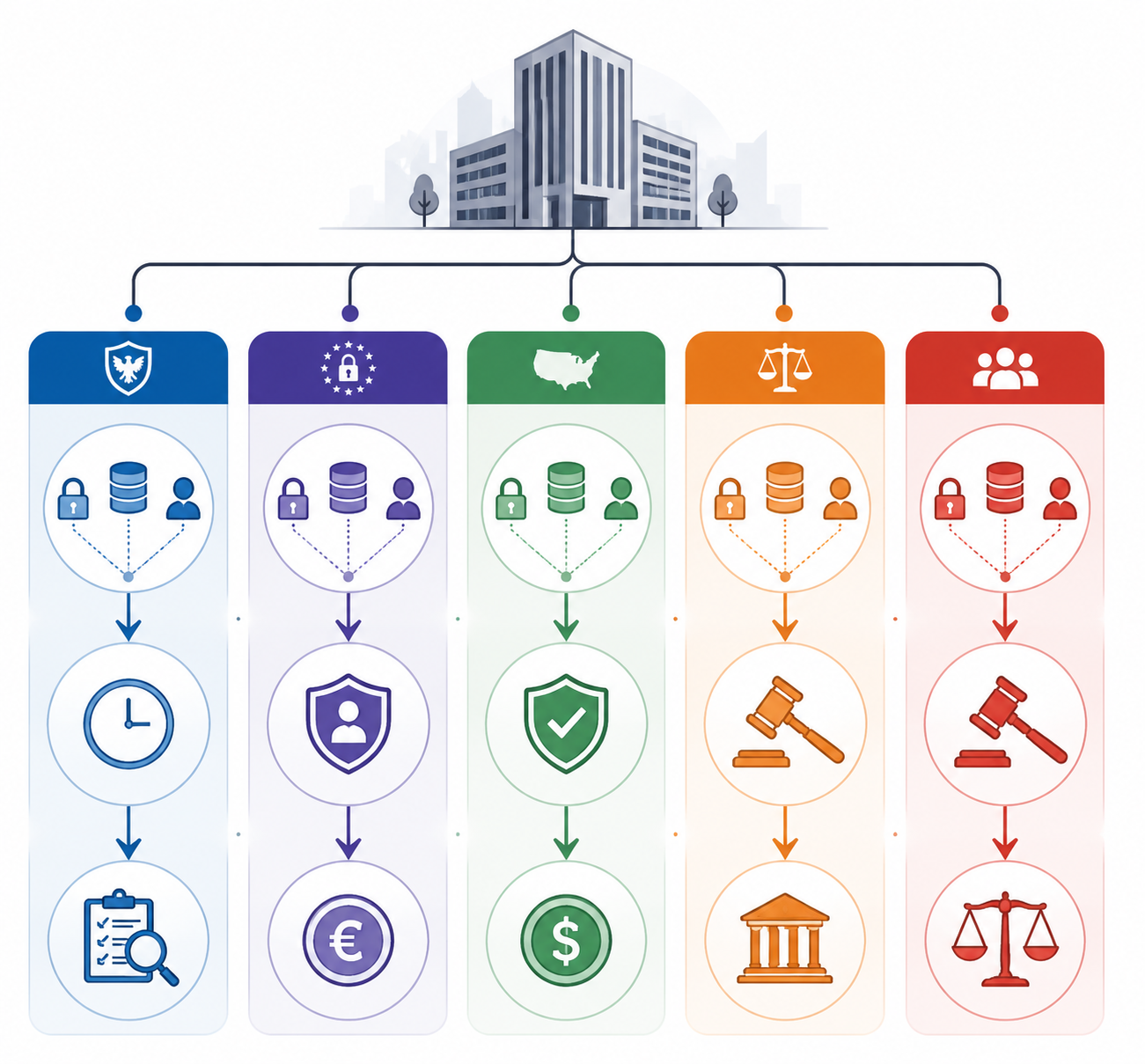
The Same Incident File Does Not Answer the Same Legal Question
A useful incident chart for Coca-Cola is not organized by threat actor name. It is organized by the question each legal channel asks.
| Pathway | Primary question | Coca-Cola fact pattern that matters |
|---|---|---|
| SEC Item 1.05 | Was a cybersecurity incident determined to be material, and was it disclosed within the required time? | Fairlife ransomware, production halt, no announced restoration timeline, and Coca-Cola’s July 16, 2026 statement that materiality had not yet been determined.[1][2] |
| GDPR and UK DPA | Did the incident involve personal data of EU or UK data subjects, and which controller or processor had the relevant obligations? | The claimed CCEP Salesforce compromise involving 23 million records, 64GB of data, records dating to 2016, and operations across EU and Asia-Pacific markets.[4] |
| CCPA | Did California residents’ covered personal information become subject to unauthorized access and exfiltration, theft, or disclosure? | The Everest employee-data exposure, including passports, Social Security numbers, and banking information, with California exposure inferred rather than company-confirmed.[5] |
| FTC and state enforcement | Were security practices unreasonable, and did public representations match actual controls? | A multi-incident history across subsidiaries in a sector drawing ransomware attention from federal regulators.[6] |
| Class actions | Can plaintiffs allege injury, causation, and a certifiable class based on the facts available? | Active attorney investigation of the Fairlife incident, plus employee and consumer data theories depending on which facts are confirmed.[7] |
The table is deliberately uneven because the exposure is uneven. The Fairlife incident is current, operational, and already in Coca-Cola’s securities record. The CCEP Salesforce materials are privacy-heavy but depend on claims not formally confirmed by CCEP. The Everest materials are employee-data-heavy but do not appear in a Coca-Cola SEC filing. Those differences are not caveats to be brushed aside. They are the legal analysis.
SEC Exposure Starts With Timing, But It Does Not End There
Item 1.05 of Form 8-K requires a registrant that determines it has experienced a material cybersecurity incident to disclose specified information within four business days of that materiality determination, not necessarily within four business days of intrusion discovery.[8] That distinction matters. Companies are allowed to investigate before deciding materiality. They are not allowed to let a materiality decision drift because the facts are inconvenient, dispersed across subsidiaries, or operationally messy.
Coca-Cola’s July 16 filing therefore creates two records at once. The first is the affirmative disclosure that Fairlife experienced a cybersecurity incident. The second is the negative or incomplete disclosure that materiality had not yet been determined.[1] If later facts show limited interruption, limited cost, and no investor-significant effect, that posture may look appropriately cautious. If later facts show a longer production halt, material lost sales, significant remediation costs, or supply-chain consequences, the earlier language will be reread against those facts.
That rereading is where many disclosure problems live. A company does not need perfect knowledge on day one, but it does need a defensible process for what it knew, when it knew it, who reviewed it, and why the disclosure said what it said. In a ransomware event that reportedly halted production, the materiality file should not be limited to forensic indicators. It should include operational status, inventory buffers, customer commitments, revenue exposure, restoration planning, insurer communications, and the information escalated to disclosure counsel and the board.
The Fairlife facts are also significant because they push the incident beyond the familiar personal-data breach script. Reporting that U.S. production halted and that no restoration timeline had been announced turns the event into an operational disruption for a high-performing consumer brand.[2][3] Investors do not need the name of the ransomware group to care about whether a revenue-generating business line can manufacture product.
The practical risk for Coca-Cola is not simply that the company might have to file another 8-K. It is that each later document may become a comparator: earnings remarks, risk factor updates, MD&A discussion, board minutes, customer notices, regulator submissions, and plaintiff pleadings. If one record says the effect was uncertain while another describes a known production stoppage with no timeline, counsel will be asked who reconciled the two and when.
The Privacy Record Is Fragmented Across Subsidiaries and Data Populations
The privacy analysis looks different because the most privacy-sensitive public materials are not the Fairlife 8-K. They are the 2025 materials concerning Coca-Cola Europacific Partners and Everest. Those matters raise data-subject, jurisdiction, and confirmation questions that do not fit cleanly inside one parent-company incident narrative.
CCEP and the Problem of Claimed Scale
The CCEP Salesforce compromise has been described as involving 23 million records, 64GB of data, and records dating back to 2016, affecting a business with 42 bottling plants, about 41,000 employees, and 2024 revenue of €20.44 billion.[4] That is the kind of fact pattern that immediately raises GDPR and UK Data Protection Act questions: whose personal data is included, which entity determined the purposes and means of processing, where the relevant data subjects are located, which supervisory authorities may expect notification, and whether the compromised system was controlled by the bottler, a vendor, or another group entity.
But the confirmation level matters. The CCEP incident was attributed in public reporting to a threat-actor claim, and CCEP has not formally confirmed the claim in the materials provided.[9] That prevents a clean statement that 23 million people were affected or that a GDPR notification duty was triggered. It supports a narrower point: if the claimed records are authentic and include personal data of EU or UK data subjects, the scale, age of data, and cross-border business structure would make the privacy response materially more complex than a local IT event.
That distinction is not lawyerly hedging. It is what keeps the analysis usable. A threat actor’s sample may be genuine, fabricated, recycled, or mixed. Vendor-system claims may identify a platform without proving the controller, the affected environment, or the data-subject population. A privacy team that treats every extortion post as confirmed risks over-notifying and misdescribing the incident. A company that treats every unconfirmed claim as irrelevant risks missing statutory clocks.
The GDPR fine point requires the same discipline. The statutory maximum is often summarized as up to 4% of annual global turnover, and CCEP’s reported €20.44 billion 2024 revenue makes that upper-bound number attention-grabbing.[4] But supervisory authorities apply a methodology to assess seriousness, culpability, mitigation, prior conduct, cooperation, data categories, and other factors. The cap is not a forecast. In a board deck, it belongs in an exposure range, not in the expected-loss column.
Everest and the Employee-Data Problem
The Everest materials point in a different direction. PKWARE’s May 2025 data breach reporting described 959 employees and 1,104 exposed files, including passports, Social Security numbers, and banking details.[5] That is not merely a headcount. Those data categories affect notification content, identity-protection decisions, privilege strategy, and potential private litigation theories.
For California residents, the CCPA private right of action can allow statutory damages of $100 to $750 per consumer per incident for certain unauthorized access and exfiltration, theft, or disclosure of nonencrypted and nonredacted personal information resulting from a business’s failure to implement and maintain reasonable security procedures and practices.[10] The current materials support only an inferred California angle for the Everest incident, not a company-confirmed California class. That narrower formulation still matters because employee data is often distributed across payroll, benefits, travel, immigration, and finance systems in ways that make residence and data-category analysis slow.
This is where corporate structure becomes more than an org chart. A parent company, a bottler, and a subsidiary may have different systems, different data subjects, different regulators, and different public disclosure obligations. Plaintiffs and regulators, however, may still read the incidents together if the same enterprise name appears repeatedly. Counsel then has to explain what is common, what is separate, and what was known at each level of the group.
FTC and State Enforcement Look for Patterns, Not Just Breach Notices
FTC Section 5 exposure is less about a single filing deadline and more about whether the company’s security practices and public representations were reasonable. The FTC’s February 2026 ransomware report to Congress signals continued federal attention to ransomware and data security practices.[6] That does not mean every ransomware victim becomes an FTC target. It means the regulator’s questions are likely to sound familiar: what controls were promised, what controls existed, what was known from prior incidents, and how quickly the company corrected gaps.
State attorneys general can approach the same record from consumer-protection, data-breach notification, and unfair-practices angles. The legal hook may differ by state, but the document problem is the same. If a subsidiary incident is described narrowly in one notice and a later enterprise-level record suggests broader recurring weaknesses, the earlier notice may be examined for omissions even if it was drafted before the broader picture was clear.
Sector context may also affect how regulators view the incident file. Food and Ag-ISAC data reported through Cybersecurity Dive counted 265 ransomware attacks on the food and agriculture sector in 2025 and about 205 in the first roughly seven months of 2026, with Qilin and Akira responsible for significant shares.[11] Those numbers do not prove anything about Coca-Cola’s controls. They do help explain why a production-affecting ransomware event at a food or beverage business may receive attention beyond a routine breach-notification queue.
Class Actions Will Follow the Facts That Become Certifiable
The Fairlife class-action risk is already visible. ClassAction.org reported on July 17, 2026 that attorneys at Bryson Harris Suciu & DeMay PLLC were investigating the Fairlife breach for a potential class action.[7] An investigation is not a complaint, and a complaint is not certification. Still, the timing tells counsel which facts plaintiffs will try to lock down early: outage duration, data access, consumer impact, employee impact, representations about security, and whether the company knew enough to warn affected groups sooner.
The litigation theories may not all point to the same injury. A production halt can support consumer-facing theories only if plaintiffs can connect it to cognizable harm. An employee-data exposure can support privacy and identity-theft-risk theories if the data categories and affected population are sufficiently defined. A Salesforce compromise can raise customer, employee, or business-contact claims depending on what the records actually contain. The legal exposure multiplies because the facts do not line up in one class definition.
The certification environment is also not static. Courts certified 40% of data breach class actions in 2024, up from 16% in 2023.[12] That trend should not be overstated into a prediction that any Coca-Cola-related case will be certified. It does mean defense counsel should assume certification discovery will be serious, especially where data categories, systems of record, and affected populations can be mapped with enough precision.
The class-action record will borrow from the regulatory record. Plaintiffs will quote the 8-K, public incident statements, breach notices, customer communications, dark-web descriptions if authenticated, and later corrective disclosures. A sentence written to preserve uncertainty in July can become an exhibit months later if it is not tied to a documented basis.
The Earlier Stormous Claims Matter Mostly as Fragmentation Evidence
The earlier Stormous claims should not be forced into a larger story than the available materials support. HackRead reported in May 2025 that Coca-Cola and CCEP were named in separate ransomware and data-breach claims involving Stormous and Gehenna.[9] Without stronger confirmation, those claims are not a basis for declaring a particular system compromised, a regulator deadline triggered, or a class exposed.
They do have a narrower legal implication. Repeated public claims across related entities create a fragmentation problem for the enterprise response. Someone has to know whether the claims involve the same environment, a vendor platform, a subsidiary-controlled system, old data, newly exfiltrated data, or recycled material. If that connective tissue exists only in forensic workstreams and never reaches disclosure, privacy, and litigation counsel in a usable form, the company can end up with accurate fragments and an indefensible whole.
What Counsel Should Take From the Coca-Cola Stress Test
The Coca-Cola materials show why a multi-incident enterprise needs governance before it needs perfect facts. The first decision is not whether to call every event material or notify every regulator. The first decision is who owns the cross-incident record.
- Disclosure counsel needs a live operational timeline, not only forensic summaries.
- Privacy counsel needs a data-subject and controller map that separates confirmed facts from threat-actor claims.
- Litigation counsel needs preservation decisions that cover subsidiaries, vendors, board materials, incident chat channels, and public communications.
- Regulator-response teams need one source of truth for what has been said to whom, and on what evidentiary basis.
- Management needs escalation criteria that treat production disruption, sensitive employee data, and cross-border personal data as separate triggers.
That structure should preserve uncertainty rather than hide it. The Fairlife data-compromise scope, threat-actor identity, and exfiltration status remain unconfirmed in the materials provided. The CCEP Salesforce claim remains a claim rather than a formal company confirmation. The Everest California exposure is inferred from employee-data facts rather than confirmed by Coca-Cola in an SEC filing. Those limits are exactly why the legal file has to show which conclusions were known, which were assumed for contingency planning, and which were not yet supported.
A single-incident response model is not built for that work. It tends to close around the first known system, the first business owner, and the first deadline. Coca-Cola’s public incident history illustrates the harder version: different subsidiaries, different systems, different countries, different data populations, and different public records accumulating before any one narrative is complete.
References
- Coca-Cola Form 8-K, Coca-Cola investor relations page, July 16, 2026.
- Fairlife ransomware reporting, Reuters, SecurityWeek, and BleepingComputer, July 16–17, 2026.
- Fairlife as a '$4 billion milk brand', Newsweek, July 17, 2026.
- CCEP Salesforce breach analysis, Gurucul.
- PKWARE Data Breach Report May 2025, PKWARE, May 2025.
- Second Report to Congress on Ransomware, Federal Trade Commission, February 2026.
- Fairlife class action investigation, ClassAction.org, July 17, 2026.
- SEC Item 1.05 cybersecurity disclosure rule framework, Securities and Exchange Commission.
- Coca-Cola and CCEP ransomware and data breach claims, HackRead, May 2025.
- CCPA private right of action, California Consumer Privacy Act.
- Food and Ag-ISAC ransomware data, Cybersecurity Dive, 2025–2026.
- Data breach class action certification data, 2024.
Comments
Join the discussion with an anonymous comment.