
Full profile
For a law firm asking the practical question behind the 2026 Colorado AI law and legal services coverage, the short answer is narrower than many headlines suggest: AI used directly to deliver legal services is no longer inside Colorado’s replacement disclosure-and-rights framework, because “legal services” was removed from the covered domains in the Automated Decision-Making Technology Act. That does not mean a law firm is outside the ADMTA whenever it uses AI. The same firm may still be covered when automated decision-making technology materially influences decisions in employment, financial services, insurance, housing, education, health care, or criminal justice-type domains identified in the replacement law.[1]
This is informational analysis, not legal advice. It also sits in an unfinished regulatory period. The ADMTA is scheduled to take effect on January 1, 2027, and Colorado Attorney General rulemaking remains pending, including details that will matter for notice, meaningful human review, and sector-specific adverse-outcome disclosures.[2][3]

What Changed: Legal Services Dropped Out of the Covered Domains
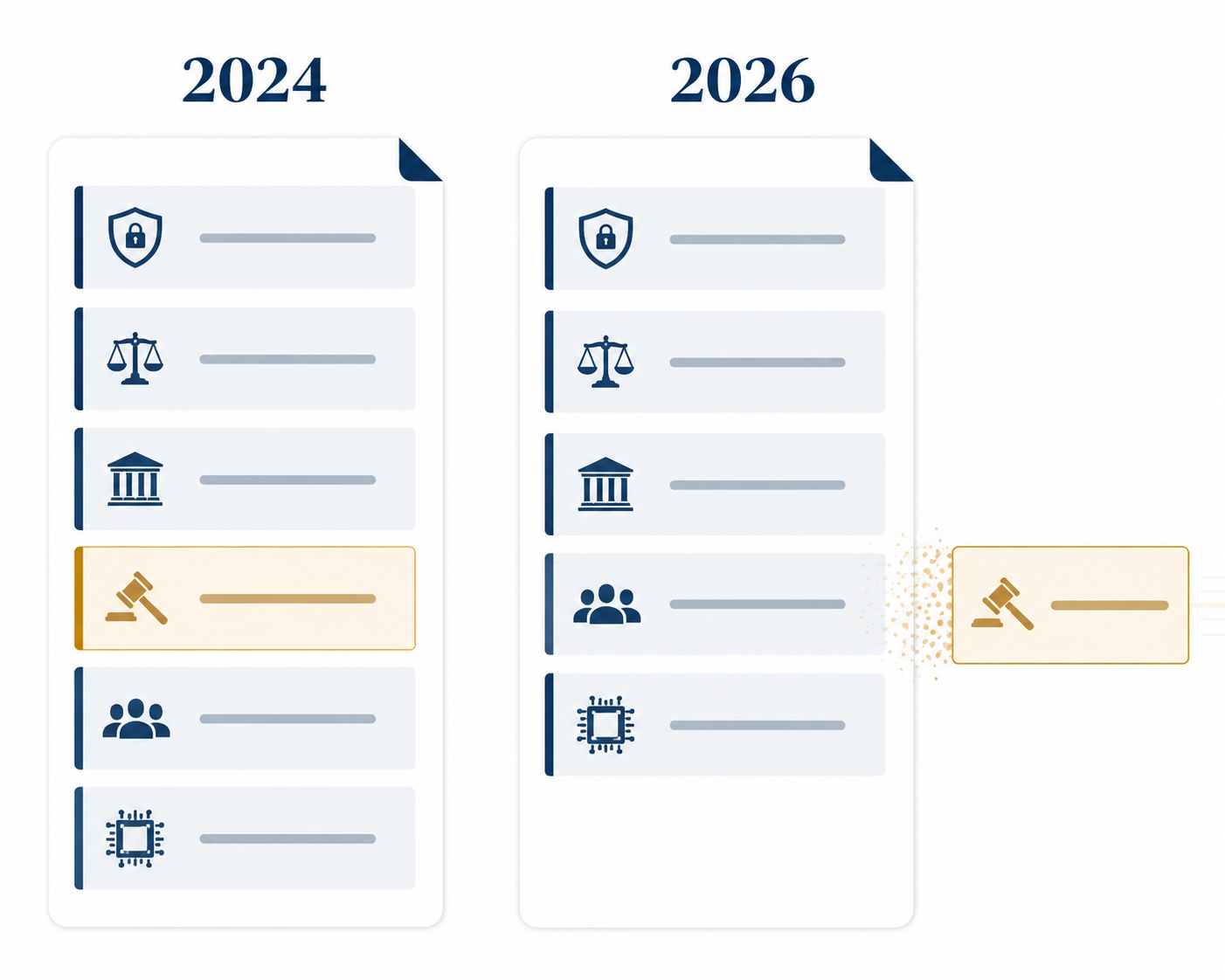
The operative change is not that Colorado stopped regulating every form of AI risk. It is that the replacement statute moved to a narrower domain list than the 2024 Colorado Artificial Intelligence Act. Mintz’s June 12, 2026 analysis flags the side-by-side statutory comparison: the 2024 law included “legal services” among covered domains, while the 2026 ADMTA does not.[1]
| Issue | 2024 Colorado AI Act | 2026 ADMTA |
|---|---|---|
| Legal services | Included as a covered domain | Removed from the covered-domain list |
| Core trigger | Focused on high-risk AI systems that were a substantial factor in consequential decisions | Applies where ADMT materially influences covered decisions |
| Law-firm significance | Could have pulled AI-assisted legal-service delivery into Colorado’s disclosure framework | Does not directly cover legal-service delivery, but may cover firm business functions in listed domains |
That domain deletion matters. A litigation team using an AI drafting assistant, a transactional lawyer using a contract-review tool to identify issues, or a research team using generative AI to summarize authorities is not, for that reason alone, making a covered-domain decision under the ADMTA’s legal-services category, because that category is gone. The disclosure-and-rights obligations tied to covered domains should not be read back into legal-service delivery simply because the user is a law firm.
The compliance mistake would be to turn that sentence into a firmwide exemption. A law firm is also an employer, a buyer of technology, sometimes an administrator of benefits, and sometimes a participant in client workflows touching regulated domains. The statute’s domain boundary follows the decision being influenced, not the professional identity of the organization using the tool.
The Boundary Law Firms Actually Need to Police
A workable internal policy should separate legal-work AI from business-function AI. The first bucket covers tools used to help lawyers provide legal services: research, drafting, summarization, contract review, deposition preparation, matter analysis, and similar client-service work. The second bucket covers tools used by the firm, or in firm-supported workflows, to influence decisions about people, money, insurance, housing, education, health care, or criminal justice-type outcomes.
The legal-work bucket is not directly captured merely because it involves law. The business-function bucket can be captured even when the user is a law firm. For example, AI-supported hiring tools sit much closer to the ADMTA because employment is a covered domain. Littler’s May 2026 analysis treats the replacement statute as materially reducing the employment-law AI burden compared with the earlier law, but not eliminating employment-focused obligations where the statute still applies.[4]
- Legal research and drafting: generally outside the ADMTA covered-domain framework when used to deliver legal services, though still subject to professional responsibility, confidentiality, supervision, and accuracy controls.
- Contract review for client legal advice: generally treated as legal-service delivery, not as a separate covered-domain decision merely because AI helps review text.
- Hiring, promotion, or screening at the firm: potentially within the employment domain if ADMT materially influences the decision.
- Financial-services underwriting or insurance claims processing supported by the firm for a client workflow: potentially covered depending on who deploys the tool and how the decision is made.
- Other covered-domain decisions: should be routed to compliance review based on the domain and decision effect, not based on whether a lawyer touches the workflow.
That distinction is especially important for firms that provide managed legal services, regulatory operations support, or embedded review teams for clients in financial services, insurance, health care, or employment. The lawyer’s task may be legal, but the client workflow may involve a covered decision. The ADMTA analysis then becomes role-specific: who is the developer, who is the deployer, what decision is being influenced, and whether the influence is material.
“Materially Influences” Is Not a Throwaway Phrase
The replacement law narrows the domain list but changes the trigger language in a way firms should not ignore. Mintz notes that the ADMTA moves from the original law’s “substantial factor” formulation to a “materially influences” standard, which Mintz characterizes as broader.[1] That matters because internal reviews often ask the wrong first question: “Did AI make the final decision?” The better first question is whether the system materially shaped the path to the decision.
For firm HR, that may mean looking past the formal decisionmaker. If an AI tool ranks applicants, screens resumes, flags candidates for interview, or meaningfully structures the candidate pool, the fact that a partner or HR manager clicks the final approval button may not end the inquiry. The open issue is where Colorado rulemaking draws practical lines around material influence and meaningful human review.[2][3]
For client-service teams, the same phrase cuts differently. A drafting assistant that proposes language for a brief does not become covered under the ADMTA simply because it influences a lawyer’s work product. The missing domain still matters. But if the same technology is embedded into an insurance claims workflow or financial-services underwriting process, the domain analysis changes.
Notice Mechanics Are More Practical, But Still Operationally Real
The ADMTA also changes notice mechanics in a way procurement and compliance teams will appreciate. Skadden describes a pre-use notice option that can be satisfied through a “prominent public notice reasonably accessible at points of consumer interaction,” rather than always requiring individualized pre-use notice.[2] Littler similarly identifies public notice as a key change in the amended Colorado framework.[4]
That is helpful, but it is not self-executing. A public notice still has to be placed where affected consumers can reasonably encounter it. For a law firm’s public website, careers portal, client intake platform, benefits interface, or managed-service portal, the operational question is where the consumer interaction actually occurs. A notice buried in a general AI policy may not answer that question if the decision workflow happens somewhere else.
The notice point also affects vendor onboarding. A firm buying an AI-enabled HR platform, claims-support tool, or financial-services workflow product should ask what notice artifacts the vendor supplies, whether they are configurable, and whether they align with Colorado’s final rules once issued. The legal team should not wait until an adverse-outcome request arrives to discover that the vendor’s model card, user documentation, and consumer notice were drafted for a different statute.
Developer, Deployer, and Vendor Risk
Norton Rose Fulbright frames the ADMTA around obligations for developers and deployers, a distinction that matters in law-firm operations because firms may occupy different roles in different workflows.[3] In most ordinary procurement settings, the firm is likely evaluating a third-party system as a deployer. In legal tech buildouts, internal innovation projects, or client-facing managed services, the role analysis can become less tidy.
The contract issue that deserves early attention is indemnification. Littler reports that the amended law voids indemnification clauses that shift liability for a party’s own ADMT acts or omissions.[4] For procurement teams accustomed to pushing broad AI risk back to vendors, that is a workflow change, not just a drafting curiosity.
A vendor can still be asked to stand behind its own product claims, documentation, security posture, and contractual promises. The problem is a clause that tries to make another party absorb liability for the firm’s own deployment choices. If the firm configures a screening threshold, ignores a required review step, fails to maintain a public notice, or uses the system outside the contracted domain, the indemnity may not do what the business sponsor expects.
- Client-service teams should identify when AI supports legal advice versus when it is embedded in a covered-domain operational decision.
- HR should treat AI screening, ranking, assessment, and promotion tools as a separate Colorado review track.
- Procurement should review indemnities, documentation commitments, audit support, notice materials, and role allocation.
- Compliance should map consumer-facing notices to actual interaction points, not just policy repositories.
- Legal operations should maintain an inventory that distinguishes legal-service AI from covered-domain business-function AI.
The Cure Period Is Limited Comfort
The ADMTA includes a 60-day cure period for certain first-time Colorado Attorney General enforcement matters, but the summaries agree on an important qualification: the cure period applies only where cure is possible.[2][3][4] That is useful for remediable notice or process failures. It is less reassuring where the alleged harm cannot be unwound.
For firms, the practical lesson is to document the deployment decision before the tool is live. A post-hoc memo may explain what happened, but it cannot always recreate a consumer’s pre-use notice, restore a missed opportunity for review, or change how an automated ranking affected a hiring pool. The cure period is a backstop, not an implementation plan.
What the Removal Does Not Change
Removing legal services from the ADMTA does not repeal a lawyer’s other duties. It does not change professional obligations around competence, supervision, confidentiality, client communication, candor, privilege, or conflicts. It also does not displace anti-discrimination law when AI is used in employment, lending, housing, insurance, or other regulated activity.
That distinction should be made explicit in firm policy. A Colorado ADMTA analysis answers one question: whether a particular automated decision-making use falls within the state’s covered-domain disclosure-and-rights framework. It does not answer whether a lawyer may rely on a hallucination-prone research output, upload client material into a vendor system, use AI-generated citations without verification, or delegate judgment to a tool without adequate supervision.
The result is a two-track governance problem. Colorado may not require ADMTA notices for core legal-service AI, but the firm still needs legal AI controls for confidentiality, privilege, human review, data retention, vendor access, and work-product quality. Those controls come from ethics, contract, client expectations, malpractice risk, and internal governance rather than from the removed Colorado legal-services category.
Why the 2024 Legal-Services Category Still Matters
The 2024 law’s inclusion of legal services is no longer the direct Colorado compliance rule for 2027. It remains important because it showed that a state legislature was willing to treat legal services as a domain where automated decision systems could trigger consumer-facing obligations. That is a policy precedent, even after repeal and replacement.
EPIC’s May 14, 2026 commentary criticized Colorado’s amendment process as removing safety-oriented features from the landmark AI law.[5] A law-firm compliance reader does not need to adopt that critique wholesale to recognize the signal. Public-interest groups may continue pressing for legal-services coverage elsewhere, especially where AI affects access to counsel, debt defense, immigration, benefits, housing, or other high-stakes legal needs.
For multistate firms, the removed category should therefore stay in the policy file. It can inform watchlists for other state bills, client alerts, procurement questionnaires, and internal risk taxonomies. Treating it as a dead issue would be too neat. Treating it as current Colorado law would be wrong.
A Sensible Firm Posture Before January 2027
The right near-term posture is not to freeze legal AI adoption because Colorado once listed legal services. Nor is it to delete Colorado from the AI compliance map because the replacement statute removed that category. The better approach is to classify each AI use by function, decision domain, role, and effect.
- Separate AI used for legal-service delivery from AI used in employment, finance, insurance, health care, education, housing, or criminal justice-type decisions.
- Flag any tool that may materially influence a covered-domain decision, even if a human remains formally responsible.
- Review public-notice placement at actual consumer interaction points before covered tools go live.
- Revisit AI vendor indemnities that purport to shift liability for the firm’s own deployment acts or omissions.
- Track Colorado Attorney General rulemaking before the January 1, 2027 effective date.
Colorado’s ADMTA no longer directly regulates AI used for core legal-service delivery through its covered-domain disclosure framework. Law firms should still keep the statute close: not because every legal AI tool is covered, but because the firm’s non-legal business functions, covered-domain client workflows, vendor contracts, and multistate policy watchlist can all be affected by the replacement law.
References
- Colorado’s Not Finished Regulating AI: Reenacted AI Law, Mintz, June 12, 2026.
- Colorado Repeals and Replaces Its AI Act, Skadden, June 2026.
- Colorado enacts revised AI law, Norton Rose Fulbright, 2026.
- Colorado Amends Its Artificial Intelligence Law, Substantially Reducing Compliance Obligations, Littler, May 2026.
- Colorado Legislature Again Amends Landmark AI Law, EPIC, May 14, 2026.
Comments
Join the discussion with an anonymous comment.