
Court Rules Requiring AI Certification: A Jurisdiction-by-Jurisdiction Guide
A structured reference to the growing patchwork of federal and state court rules requiring attorneys to disclose and certify AI use in filings, organized by jurisdiction and regulatory model with sample certification language and a practical compliance framework.
- Hallucination rate
- Not measured / undisclosed
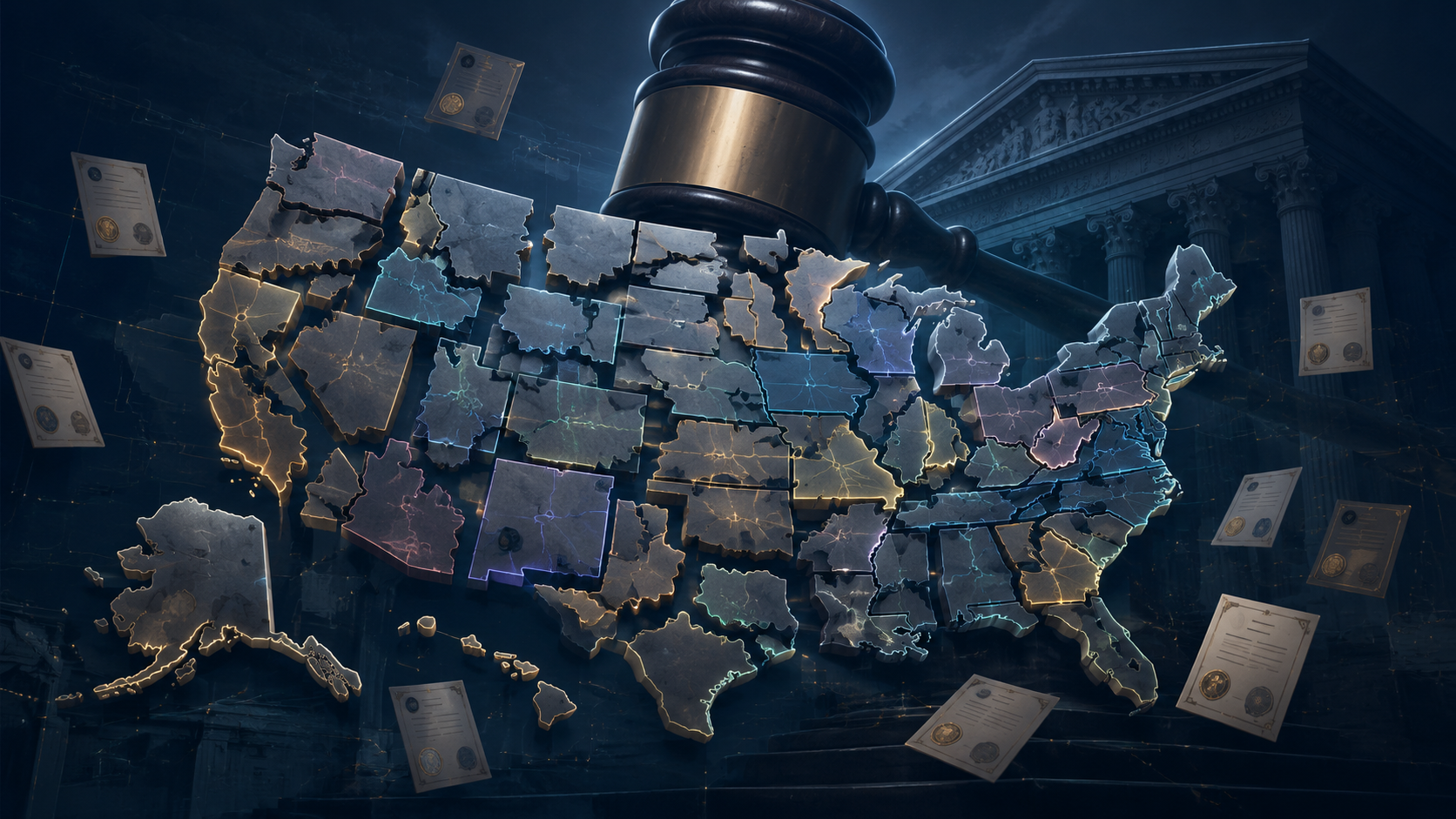
A lawyer looking for court rules requiring AI certification will not find a single national rule, a reliable federal template, or even a stable definition of the tools covered. The live landscape is a patchwork of standing orders, local rules, individual judicial preferences, ethics guidance, and proposed amendments. As of a March 2026 snapshot, the count of court directives requiring some form of AI disclosure or certification had exceeded 300, after starting from zero in May 2023; that number should be treated as a moving count, not a fixed total.[1]
The practical problem is not whether courts care about AI. They do. The harder question is whether the filing lawyer must disclose, certify, avoid a tool altogether, or simply remain responsible under the ordinary duties that already attach to every filing. In federal court, only Hawaii and Nebraska have district-wide rules identified in the cited sources; most other federal obligations still arise judge by judge through standing orders and courtroom-specific instructions.[2]
The three models behind AI certification orders
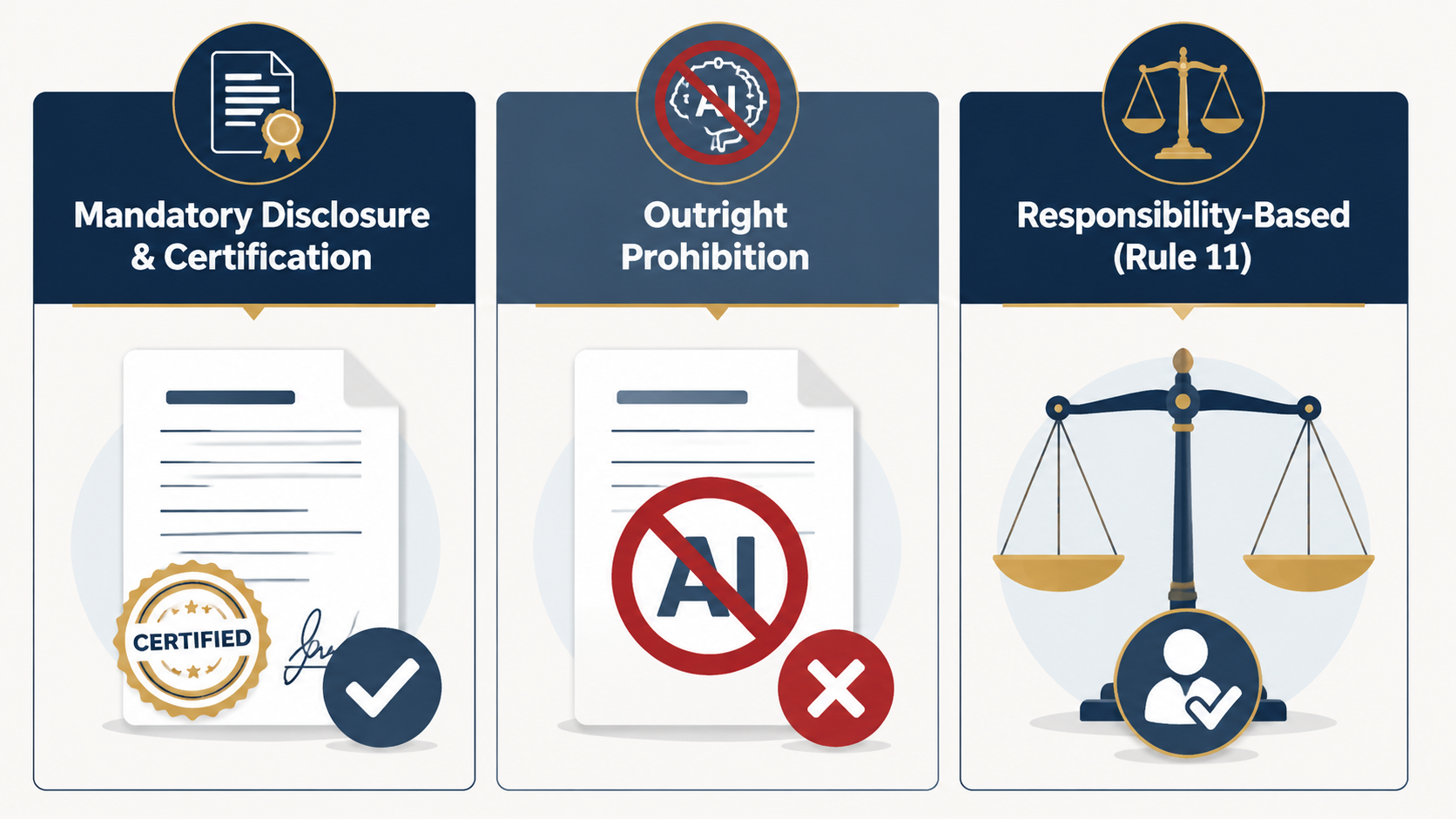
Most court orders fit into one of three models. The categories matter because two orders can both mention “AI” while creating very different work for the person preparing the filing.
| Model | What it usually requires | Compliance consequence |
|---|---|---|
| Mandatory disclosure and certification | The lawyer must disclose AI use, certify human review, or certify that no covered AI tool was used. | The filing checklist must include the judge’s exact trigger language and any required certification text. |
| Outright prohibition | The court or judge bars covered AI use in filings, or permits it only under narrow conditions. | The filing team must identify the ban before drafting begins, not after the document is ready to file. |
| Responsibility-based standards | The court declines an AI-specific rule and relies on Rule 11, candor, verification, and fraud-on-the-court principles. | No separate AI certificate may be required, but the lawyer still owns the accuracy of the filing. |
The mandatory disclosure-and-certification model is the most common in the current sources. Husch Blackwell describes federal courts as using standing orders and local rules to require lawyers to disclose generative AI use and certify that the filing has been reviewed for accuracy.[3] The ABA Litigation state snapshot likewise treats court-mandated disclosure as a live, jurisdiction-dependent filing issue rather than a uniform national obligation.[4]
The responsibility-based model is not indifference. Duke Judicature’s discussion of Chief Judge James Boasberg’s approach in the District of Columbia describes a view that existing obligations, including Rule 11 and duties against misleading the court, already reach AI-assisted filings without a special AI certification regime.[5] That distinction matters at filing time: a courtroom with no AI certificate requirement is not a courtroom where AI output can be filed unverified.
Sample language shows why scope cannot be assumed
Judge Brantley Starr’s standing order in the Northern District of Texas became one of the best-known examples because it translates the issue into a filing certificate. The order requires attorneys and pro se litigants to file a certificate stating either that “no generative artificial intelligence tool” was used to draft the filing or, if such a tool was used, that every statement was checked for accuracy by a human being.[1]
Judge Michael Baylson’s order in the Eastern District of Pennsylvania is broader in a different way. It covers “any type of AI,” and requires disclosure of which AI tool was used and how it was used.[1] That small wording change is not cosmetic. “Generative artificial intelligence tool” points the filing team toward drafting and content-generation systems. “Any type of AI” can pull in a wider set of products, features, and embedded functions unless the order supplies a carveout.
The ABA’s Formal Opinion 512, issued in July 2024, is described in the cited sources as setting a professional-responsibility baseline: lawyers may need to disclose AI use to a tribunal when that use is material to a factual representation.[4] That is not the same thing as a standing order requiring a certificate in every filing. It is a useful reminder that court-specific certification and ethics-based disclosure can overlap without being identical.
Federal courts: mostly judge-by-judge, with two district-wide exceptions
For federal practice, the safest starting assumption is that the district name alone is usually insufficient. The Ropes & Gray tracker is maintained around standing orders, local rules, and decisions on AI use, and the cited sources identify only Hawaii and Nebraska as having district-wide federal rules.[2] Elsewhere, the operative question usually becomes: which judge, which standing order, and which date?
| Federal layer | Current snapshot from cited sources | What to verify before filing |
|---|---|---|
| District-wide federal rules | Hawaii and Nebraska are identified as the only federal districts with district-wide rules in the current snapshot.[2] | Confirm the district local rule or court-wide order, then check whether the assigned judge adds separate requirements. |
| Individual federal judges | Most federal AI certification obligations remain judge-by-judge through individual standing orders.[2] | Check the assigned judge’s webpage, standing orders, case-management procedures, and any order entered in the docket. |
| No AI-specific order found | Some judges and courts rely on existing Rule 11 and professional-responsibility duties rather than AI-specific certificates.[5] | Do not add a certificate unless required or strategically appropriate; still preserve human review of factual, legal, and citation content. |
| Case-specific instructions | A judge may impose directions in a particular case even where no general standing order appears in a tracker. | Read scheduling orders, pretrial orders, ECF notices, and chambers procedures before filing. |
The federal problem is easy to underestimate because the most visible examples circulate as if they were representative. They are representative of a pattern, not of a rule. One judge may require a certificate only for generative AI drafting. Another may ask for the tool name and method of use. A third may refuse to create AI-specific obligations at all. The person filing the motion has to resolve those differences before the PDF is final.
Trackers help, but they do not replace the court’s own source. Tracelaw maintains a court AI disclosure requirements tracker, and the UNC Law Library has compiled judicial guidance on generative AI in court.[6][7] Those resources are useful for spotting likely obligations and locating orders. The final check still belongs in the court’s current local rules, the assigned judge’s chambers page, and the docket.
A federal filing check should move in this order
- Identify the court and assigned judge, not just the federal district.
- Check district-wide local rules and general orders for AI provisions.
- Check the assigned judge’s standing orders, chambers procedures, and case-specific docket orders.
- Compare the order’s trigger language against the tools actually used.
- Use the exact certification language supplied by the court if the order provides it.
- Record the rule, order date, webpage, or docket entry checked.
State courts: court-dependent rules, guidance, and task forces
State-court practice is no cleaner. The ABA Litigation snapshot identifies 12 states with court-dependent AI disclosure rules, including California, New York, Florida, Texas, Illinois, and Louisiana, while 36 states had no jurisdiction-wide rule in that snapshot, although many had issued bar or ethics guidance.[4] Several states, including Arkansas, Connecticut, Delaware, Rhode Island, Tennessee, and Washington, were identified as having active AI task forces.[4]
| State-court category | Snapshot described in cited sources | Practical reading |
|---|---|---|
| Court-dependent disclosure rules | 12 states had court-dependent AI disclosure rules in the ABA Litigation snapshot, including CA, NY, FL, TX, IL, and LA.[4] | Look below the state level: trial court, appellate court, judge, division, or case type may control. |
| No jurisdiction-wide rule | 36 states had no jurisdiction-wide rule in that snapshot, though many had bar or ethics guidance.[4] | Absence of a statewide rule does not mean absence of a local or judge-specific filing requirement. |
| Active task forces | AR, CT, DE, RI, TN, and WA were identified as having active AI task forces.[4] | Expect possible changes, but do not treat task-force activity as an operative filing rule unless adopted. |
| Potential prohibitions | The cited sources identify some Texas state courts as considering complete bans, but do not support treating such bans as a general Texas rule. | Verify the specific court’s current order before concluding that AI use is prohibited. |
State guidance also tends to blur two different questions: what lawyers should do as a matter of professional responsibility, and what a court requires as a condition of filing. A state bar opinion may tell lawyers to supervise AI use, protect confidentiality, and verify output. A court order may require a certificate, tool disclosure, or statement of human review. Both can matter, but they do not create the same checklist item.
The trigger language is where many checklists fail
The most awkward AI certification questions usually arise after someone says the tool was “just used for research,” “just used for cite checking,” or “built into a normal platform.” Many orders focus on generative AI and exclude traditional legal research platforms. That carveout may reduce disclosure obligations in some courts, but it is no longer a comfortable stopping point.
The Stanford/Magesh study cited in the sources found hallucination rates of 17% for Lexis+ AI and 33% for Westlaw AI-Assisted Research in legal-specific AI tools; Thomson Reuters and LexisNexis disputed aspects of those findings.[1] The useful compliance lesson is narrower than the debate over the study. A product name associated with legal research does not, by itself, prove that the court’s AI order is inapplicable or that the filing needs no verification.
The K&L Gates sanctions episode in the Central District of California makes the same point in a courtroom setting. The cited sources describe sanctions arising from reliance on CoCounsel, Westlaw Precision, and Google Gemini without adequate verification.[8] That case should not be stretched into a rule that every use of those products triggers disclosure in every court. It does show why a carveout for familiar legal platforms is not a substitute for checking the actual citations, quotations, and propositions filed under a lawyer’s signature.
| Order wording | Likely focus | Questions to ask |
|---|---|---|
| “Generative AI” | Drafting, summarizing, rewriting, or generating new text. | Was any filing text, argument, factual statement, or citation explanation generated or materially revised by the tool? |
| “Any AI” | Potentially broader use, including embedded AI features. | Does the order define AI, exclude ordinary search, or carve out legal research tools? |
| “AI-assisted research” | Research platforms, citation analysis, case retrieval, or summarization. | Does the court require disclosure of the tool, the task, the output relied on, or only human verification? |
| “No generative AI tool was used to draft” | The drafting process itself. | Did the team use AI to create language that entered the filing, even if later edited? |
| “Every statement has been verified” | Human review rather than mere disclosure. | Who checked legal citations, quotations, record cites, factual assertions, and procedural representations? |
A practical compliance framework for filings
A workable AI filing process starts before drafting and ends with a record of what was checked. It does not need to turn every motion into a memo about technology. It does need to prevent a last-minute filing team from discovering, after signature, that the assigned judge required a certificate or prohibited a tool that had already shaped the brief.
1. Start with the filing forum and assigned judge
The first question is not “Did we use AI?” It is “Which court and judge will receive this filing?” In federal court, district-wide rules are the exception in the current sources. In state court, statewide certainty is often unavailable. The same litigation team may have one filing that needs a certificate, one that needs no AI-specific statement, and one where the safest answer is to avoid a covered tool entirely.
2. Capture the tool and task, not just the vendor name
A checklist entry that says “Westlaw” or “ChatGPT” is too thin. The relevant facts are what the tool did and what entered the filing. Drafted argument, summarized deposition testimony, suggested case law, checked citations, translated text, generated a chronology, and rewrote a statement of facts can be treated differently depending on the order’s wording.
- Tool used: product name and, if relevant, AI feature name.
- Task performed: drafting, research, summarization, cite checking, translation, analysis, or formatting.
- Output relied on: text inserted, authorities selected, facts summarized, or citations checked.
- Human reviewer: the person who verified the output before filing.
- Rule source checked: standing order, local rule, docket order, or chambers procedure.
3. Match the order’s covered category to the actual work
If the order covers generative AI used to draft filings, the review should focus on whether generated language entered the filing. If the order covers any AI, the review must be broader. If the order exempts traditional legal research platforms, the team still has to decide whether the specific AI feature used fits inside that carveout. A familiar subscription service can contain multiple functions, and not every function has the same relationship to the filing.
4. Use the court’s certification language when supplied
Some orders supply language. Use it. Rephrasing a court-required certificate can create unnecessary ambiguity, especially when the order distinguishes between no covered AI use and covered AI use followed by human verification. If the order requires disclosure of the tool and how it was used, the certificate should not collapse that into a generic statement that counsel “complied with all obligations.”
5. Verify the filing as if no AI certificate existed
The certificate is not the verification. Citations still need to lead to real authorities. Quotations still need to match the source. Record cites still need to support the factual proposition. Procedural statements still need to match the docket. The sanctions materials collected in 2026 focus on courts penalizing filing failures tied to generative AI, but the operational failure is often the same old failure: nobody checked the proposition before filing it.[8][9]
6. Keep a short audit trail
The audit trail does not need to become a privileged technology diary. It should be enough for the firm or legal department to reconstruct the compliance decision if the filing is challenged: the order checked, the date checked, the tool and task, the reviewer, and the certificate used or not used. That is especially important where the rule count changes frequently and a tracker may have been updated after the filing date.
Pending items are not current filing obligations
Several pending or developing items belong on a watchlist, not in the current-obligation column. Proposed Federal Rule of Evidence 707 concerns machine-generated evidence admissibility; the comment period closed in February 2026, and the earliest effective date identified in the cited sources is December 1, 2027.[7] That proposal is not a present rule requiring lawyers to disclose AI drafting in briefs.
New York Part 161 and California ethics amendments are likewise described in the cited sources as pending or developing, not as final rules that can be applied across all filings today. They should be monitored, especially by multi-jurisdiction litigation teams, but they should not be blended into current court-specific certification requirements unless and until adopted by the relevant authority.
What the filing professional should record before submission
The meaningful unit of compliance is not “AI use in court.” It is the specific court, judge, order date, covered tool category, required disclosure language, and verification duty. A national AI policy can set the firm’s baseline, but it cannot tell the docketing manager whether Judge A’s certificate must be attached to tonight’s motion or whether Judge B’s order exempts the research feature used yesterday.
| Checklist field | What to enter |
|---|---|
| Court and case | Jurisdiction, court level, case number, and filing type. |
| Judge or panel | Assigned judge, magistrate judge, division, appellate panel, or other decision-maker whose procedures apply. |
| Rule source | Local rule, general order, standing order, chambers procedure, docket order, or tracker source used to locate the court material. |
| Date checked | The date the rule source was reviewed, because trackers and standing orders change. |
| Covered tool category | Generative AI, any AI, legal research AI, embedded AI feature, or no covered use. |
| Task performed | Drafting, research, summarization, citation checking, translation, factual analysis, or other use. |
| Certification required | Yes, no, prohibited, uncertain pending court confirmation, or responsibility-based/no AI-specific certificate. |
| Certification language | Exact court-supplied wording, if any. |
| Human verification | Reviewer responsible for authorities, quotations, record cites, factual assertions, and procedural statements. |
For a maintained litigation workflow, the first verification point is the court’s own current material. Trackers, bar articles, and law library guides are useful route maps. The filing obligation comes from the operative order, local rule, or case-specific instruction that applies to the filing being submitted.
References
- AI Disclosure in Court: 300+ Rules You Need to Track, Hintyr
- Standing Orders, Local Rules, and Decisions on the Use of AI, Ropes & Gray
- Navigating the New Frontier: How Federal Courts Are Regulating Generative AI in Litigation, Husch Blackwell
- What to Know about Court-Mandated Disclosure of Artificial Intelligence in Court Submissions, ABA Litigation
- Is Disclosure and Certification of the Use of Generative AI Really Necessary?, Duke Judicature
- Court AI Disclosure Requirements: A Tracker, Tracelaw
- Judicial Guidance on the Use of GenAI in Court, UNC Law Library, February 2026
- AI in litigation: Update on Gen AI sanctions in 2026, Norton Rose Fulbright, 2026
- The AI Sanction Wave: $145K in Q1 Penalties, EDRM, April 2026
Chronological incident history
No sanction cases have named this tool in the tracked record set to date. This does not imply the tool is safe — see Risk Digest for ongoing monitoring.
← Compare peer toolsReport a correction or tip
Spotted an outdated figure, a misstated fact, or a ruling this tool profile should reflect? Public comments are disabled for this content given the professional cost of a misreported case outcome, penalty amount, or rule text — use the structured correction channel instead.
Report a correction or tip for this record →