
Full profile
The filing problem usually arrives late and specifically: a brief is ready, the docketing entry is open, and someone asks whether this judge has a court standing order on AI filings. The answer cannot be guessed from the court name alone. It may be in a judge’s individual practices, a district-wide order, a local rule, a state-court policy, or nowhere at all.
As of March 2026, one commercial tracker described more than 300 AI-related court directives across federal and state courts, a category that includes standing orders, local rules, and general orders. A narrower Legal AI Governance tracker counted 113 orders binding attorney filings, including 82 requiring disclosure or certification, 10 prohibiting AI outright, and 14 cautioning on use.[1][2] Those numbers should not be blended. The broader count tells you the patchwork is large. The narrower count is more useful when the question is what a lawyer must do before filing.
The good news is that most orders are not conceptually unique. They use different wording, but they usually answer the same operational questions: what technology is covered, who must certify, what form the certification takes, and when the obligation is triggered. Once those questions are answered, the apparent disorder turns into a filing checklist.

Start With the Controlling Order, Not the Tool
A lawyer may want to ask whether ChatGPT, Claude, Copilot, Westlaw AI, Lexis+ AI, Grammarly, or an internal document tool is allowed. That is the wrong first question at filing time. The first question is whether the court or judge has imposed a filing-specific obligation. The same AI-assisted draft can require a separate certificate in one courtroom, an embedded representation in another, and no AI-specific disclosure in a third.
Use the caption as the search key. Check the court-wide local rules and general orders, then the assigned judge’s individual rules, standing orders, chamber practices, case-management orders, and any order already entered in the docket. If the matter has been reassigned, repeat the check. If the filing is in state court, check both statewide judicial guidance and the particular court or judge. If the filing is in federal court, do not assume a district-wide order displaces an individual judge’s order unless the documents say so.
This is also where timing matters. Trackers are helpful for triage, but they are not the filing authority. The obligation comes from the court source in effect when the filing is made. This article is current to Q3 2026, but the practical rule is simpler: recheck before each filing, especially in courts that have recently adopted, revised, or withdrawn AI guidance.
| Filing check | What to confirm | Record to keep |
|---|---|---|
| Court source | Local rules, general orders, statewide policy, and judge-specific standing orders | Date checked and links or saved PDFs |
| Case source | Scheduling orders, ECF notices, and case-specific directives | Docket entry number or saved docket text |
| Order status | Whether the AI directive is current, amended, withdrawn, or superseded | Version date and effective date if stated |
| Assigned judge | Whether reassignment changed the applicable individual practices | Name of judge and chambers page checked |
Classify the Order Into One of Three Models
Once the order is located, classify it before parsing every sentence. The major surveys and practice materials describe a recurring pattern: courts generally use disclosure-and-certification rules, prohibition rules, or responsibility-based rules that rely on ordinary attorney obligations rather than a separate AI certificate.[3][4][5]
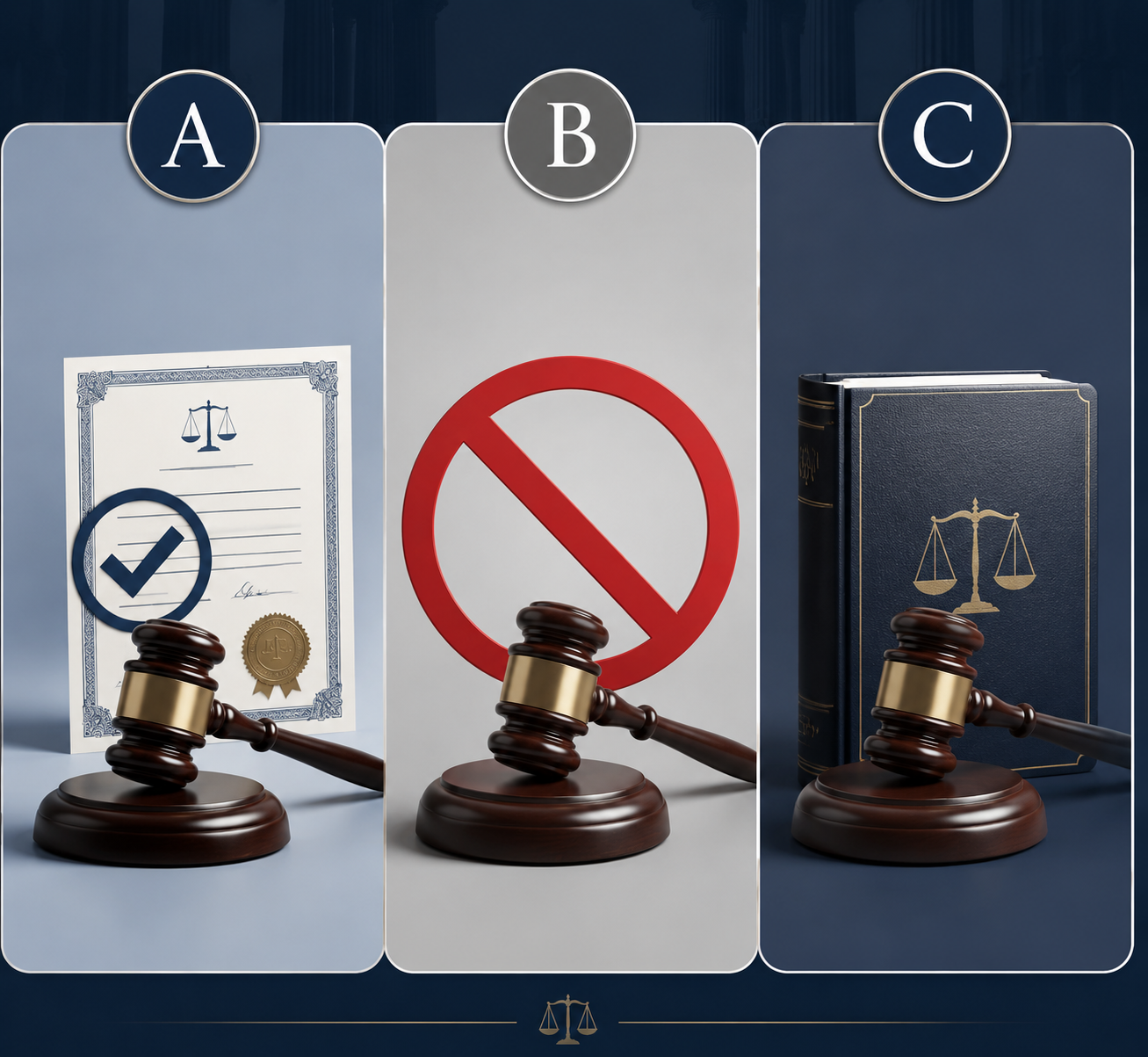
Model A: Disclosure and Certification
This is the most common attorney-filing model in the Legal AI Governance count: 82 of 113 tracked orders require some form of disclosure or certification.[2] The order may require a separate certificate, a notice, a statement in the filing, or a representation that no generative AI was used unless all AI-generated content has been verified. Judge Brantley Starr in the Northern District of Texas, Judge Vernon Broderick in the Southern District of New York, and Judge Latella in the Middle District of Pennsylvania are commonly cited examples of this disclosure-and-certification approach.[3][4][5]
Do not treat all Model A orders as interchangeable. Some require certification only when generative AI is used. Others require a statement in every filing, including a statement that no AI was used. Some focus on legal research and drafting. Others reach images, exhibits, translations, declarations, summaries, or any content submitted to the court.
Model B: Prohibition
A smaller group bars or sharply limits AI use in filings. The Legal AI Governance tracker counted 10 orders prohibiting AI outright.[2] Judge Michael J. Newman in the Southern District of Ohio, Judge Christopher A. Boyko in the Northern District of Ohio, and Judge Sharon Johnson Coleman in the Northern District of Illinois are examples cited in practice surveys for this stricter model.[3][4][5]
For Model B, the filing question is not how to word a disclosure. It is whether the prohibited tool or output was used at all, whether the order permits any exception, and whether the team can remove, redo, or independently recreate the affected work before filing. If the order is unclear, the risk is not solved by a clever certificate.
Model C: Responsibility-Based Permission
The third model does not add a special AI filing certificate. It permits AI use but emphasizes that lawyers remain responsible for accuracy, confidentiality, candor, and Rule 11 obligations. The Eastern District of Missouri, the District of Connecticut, and the Illinois Supreme Court are cited examples of more responsibility-based approaches.[4][5][6]
The Illinois Supreme Court’s January 2025 policy is the clearest state-level counterweight to mandatory-disclosure instincts: it states that AI use “should not be discouraged,” while still preserving attorney and judicial responsibility for work product.[6] That does not help a lawyer filing before a judge with a stricter standing order. It does, however, warn against assuming that every court wants an AI confession attached to every brief.
Answer the Four Questions the Order Is Really Asking
After classification, slow down. The next step is not to paste a generic AI certificate into the filing. The order has to be reduced to four answers that the filing team can act on.
| Question | Why it matters at filing time |
|---|---|
| What AI is covered? | Determines whether the actual tools used trigger the order |
| Who certifies? | Determines whether the signing attorney alone, all counsel, or another filer must review and approve |
| What form does certification take? | Determines whether the filing needs a separate notice, certificate, declaration, or embedded statement |
| When does the obligation apply? | Determines whether the rule applies to every filing, only AI-assisted filings, only briefs, or only substantive submissions |
1. What AI Is Covered?
Some orders cover “generative artificial intelligence.” Some refer to “artificial intelligence” more broadly. Some name examples such as ChatGPT or similar tools. Others focus on whether the tool generated legal analysis, citations, text, images, or evidence submitted to the court. The distinction matters because many filing teams use AI-adjacent tools without thinking of them as the kind of chatbot that prompted the order.
A traditional Westlaw or Lexis search is not the same as asking a generative system to draft a legal argument. But newer research products may summarize cases, generate answers, propose arguments, or draft language. Several surveys note that courts distinguish between generative AI and legal research tools, but the wording is not uniform.[4][5] If the order covers only generative AI, the team still has to decide whether a particular research feature generated content used in the filing.
Grammarly-type tools create a different gray zone. Basic spellcheck and grammar correction may feel ministerial. Rewriting, tone adjustment, sentence generation, and AI-assisted drafting are closer to content creation. If a standing order defines covered AI by function rather than brand, embedded writing assistance can fall inside the rule even if no one opened a separate chatbot window.
The practical move is to ask what the tool did, not what the vendor calls it. Did it generate new text? Suggest legal reasoning? Summarize authority? Supply citations? Translate a declaration? Create or alter an exhibit? The answer should be recorded in plain language because the person certifying may not be the person who used the tool.
2. Who Certifies?
Many orders place the burden on the signing attorney. Others may require all attorneys appearing on a filing, all counsel of record, or any party submitting AI-generated content to make or support the representation. Pro se litigants may also be covered when the order says so. This is not a technicality. The certificate is only useful if the certifying person has asked the people who actually drafted, researched, revised, and assembled the filing.
For a team filing process, assign the AI check before signature. The associate who drafted the argument, the paralegal who assembled exhibits, the docketing clerk who prepared the ECF entry, and the partner signing the filing may each know a different part of the answer. A late certificate signed on assumption is exactly the kind of preventable weakness these orders expose.
3. What Form Does Certification Take?
The form can be the easiest part to get wrong because it feels clerical. Some courts require a separate notice. Some require a certificate of compliance. Some require a statement in the body of the filing. Some require a statement only if AI was used, while others require a statement whether it was used or not. Legal AI Governance maintains disclosure templates, but a template should be checked against the controlling order before use.[7]
A defensible internal record should capture the exact language used, who approved it, and where it appears in the filing package. If the court requires a separate certificate, docket it as the order requires. If the court requires an embedded representation, make sure it survives final formatting and PDF conversion. If the order says the representation must accompany the filing, do not leave it in an internal email.
4. When Is the Obligation Triggered?
Some orders apply to every filing. Some apply only when AI was used. Some apply only to substantive briefs, memoranda, or filings containing legal citations. Others may reach evidence, exhibits, proposed findings, translations, or declarations. A notice of appearance, a motion for extension, and a summary judgment brief may not be treated the same way.
The trigger question should be answered for the specific filing being submitted, not for the case generally. A team may file a non-substantive document today and a heavily researched brief next week. The standing order may treat those filings differently.
Why the Checklist Matters: The Sanction Cases Are About Verification
The sanctions record is often described as an AI hallucination story. At the filing desk, the more useful lesson is verification failure. Courts have sanctioned lawyers and parties where fabricated authorities, unsupported citations, or unreliable AI-assisted work reached the court without adequate human review.
In Mata v. Avianca, the Southern District of New York imposed $5,000 in sanctions in June 2023 after fabricated cases generated through AI appeared in a filing.[8] Later sanctions reports and commentary describe a widening consequence range: attorney disqualification in Johnson v. Dunn in July 2025, six-figure fee awards in ByoPlanet v. Johansson in July 2025, and $15,000-per-attorney fines in Whiting v. City of Athens from the Sixth Circuit in March 2026.[8][9]
Ropes & Gray’s sanctions catalog counted 66 published sanctions opinions involving AI issues through October 2025.[1] That figure should be read as a cataloged body of published opinions, not as a complete measure of every AI-related filing problem. Many mistakes are corrected before filing, handled by court order without a published sanctions opinion, or never surface publicly.
The point for current filing practice is narrower and more useful than “AI is dangerous.” If a court order requires disclosure, certification, verification, or supervision, the filing system needs a step where that happens before submission. The lawyer cannot outsource Rule 11 responsibility to a vendor, a chatbot, a research platform, or a paralegal’s unrecorded assurance.
Handle Gray Zones Before the Filing Window Opens
The hardest calls are rarely the obvious ones. If a lawyer pastes a prompt into a generative model and files the resulting argument, most standing orders can be applied without much strain. The close calls involve AI-assisted research, embedded drafting tools, automated summaries, translation, and editing features that sit inside ordinary work software.
For legal research, separate retrieval from generation. Searching a database, reading cases, and citing verified authority is ordinary legal work. Asking a system to produce an answer, summarize the governing law, draft a paragraph, or recommend cases introduces output that must be checked against the order’s definition. If the order is limited to generative AI, the team still needs to know whether the research product generated text or analysis that entered the filing.
For writing assistance, separate correction from creation. A tool that flags a typo is different from one that rewrites a paragraph, supplies transitions, changes tone, or generates alternative language. If the order reaches “AI-generated content,” a rewritten paragraph may be covered even if the lawyer later edited it. If the order reaches only legal analysis, ordinary grammar correction may fall outside it. The order’s language controls.
For exhibits and evidentiary material, be more cautious. An AI tool that enhances, translates, summarizes, labels, or creates material submitted as evidence can raise issues beyond a filing certificate. The AI standing order may not be the only rule in play. Authentication, evidentiary accuracy, protective-order limits, privilege, and confidentiality may matter even if the court has no AI-specific filing order.
A Repeatable Filing Workflow
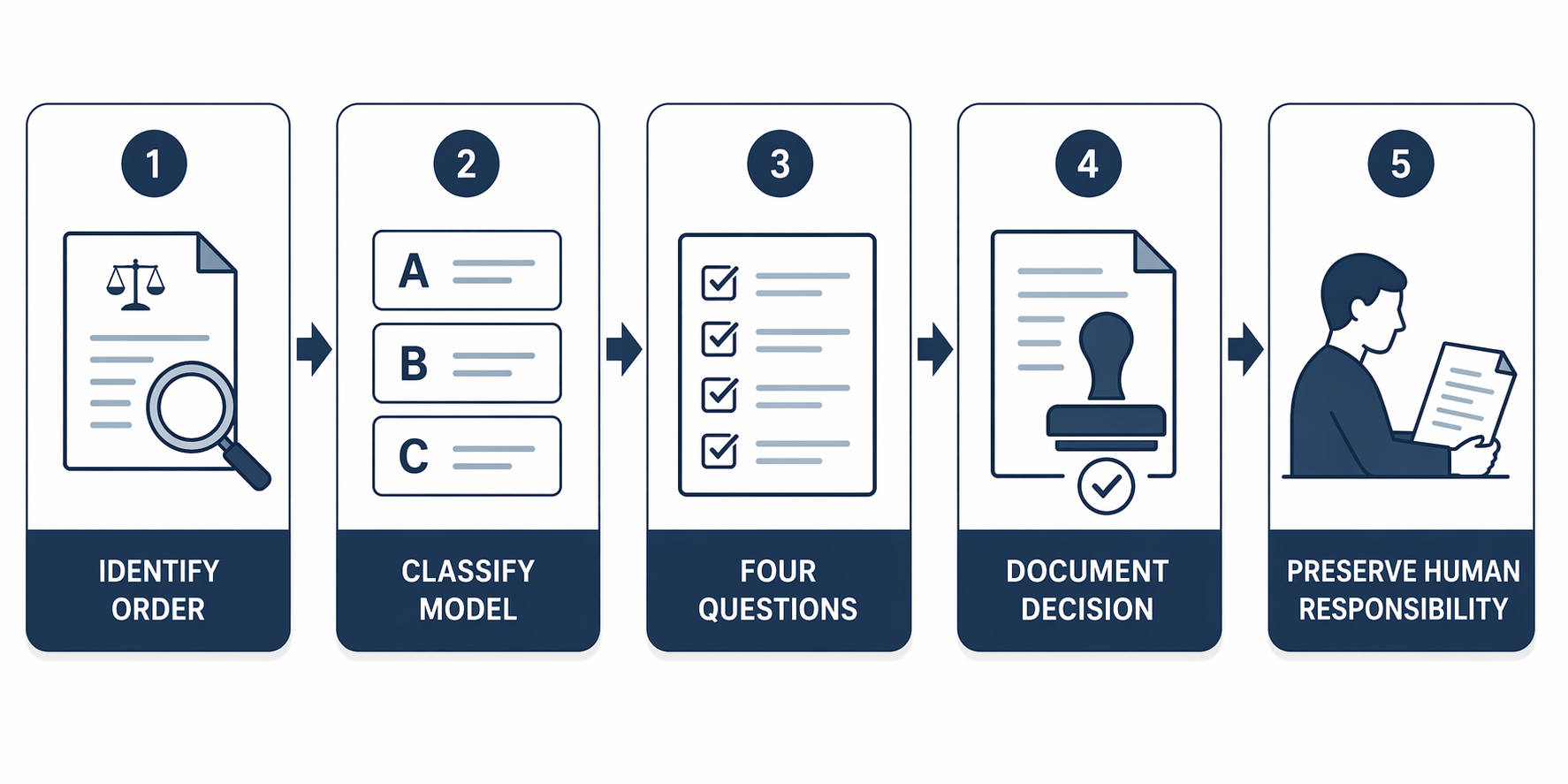
A workable system does not require a long memo for every brief. It requires a short, dated record showing that the team checked the right sources, classified the order, answered the operative questions, and preserved attorney responsibility.
- Identify the filing forum and assigned judge. Confirm court, division, judge, magistrate judge if relevant, and any recent reassignment.
- Locate current AI directives. Check local rules, general orders, judge-specific standing orders, chamber rules, case-management orders, and docket text.
- Classify the directive. Mark it as Model A disclosure/certification, Model B prohibition, Model C responsibility-based, or no AI-specific directive found.
- Inventory tool use. Ask the drafting and filing team what tools were used for research, drafting, editing, summarizing, translating, exhibit preparation, and citation work.
- Answer the four questions. Record scope, certifier, certification form, and trigger for this filing.
- Verify substance. Confirm citations, quotations, record references, factual assertions, and legal propositions through primary or reliable sources.
- Prepare the required statement. Use the court’s required language if provided; otherwise tailor the disclosure to the order and the actual tool use.
- Save the record. Keep the checked order, date of review, internal tool-use responses, verification notes, and final certificate or disclosure.
The record can be simple. A one-page filing checklist or matter note is often enough if it shows who checked what and when. What it should not be is a stale firmwide AI memo copied from a prior matter. The relevant obligation may change by judge, filing type, and date.
Disclosure Is Usually the Safer Default, With One Important Limit
Several practice sources report no known case sanctioning a lawyer for over-disclosing AI use.[1][9] That matters. When an order is ambiguous and disclosure is not prohibited, a clear, narrow disclosure is usually safer than silence. The disclosure should say what needs to be said: the tool category, the type of assistance, and the fact of human review. It should not volunteer privileged strategy, confidential client information, or unnecessary detail about internal workflows.
Over-disclosure is not the same as ritualistic disclosure. If the order does not require a certificate and the court has adopted a responsibility-based approach, adding an unsolicited AI notice to every filing may create confusion. If the order prohibits AI use, disclosure does not cure prohibited conduct. If client confidentiality or privilege is implicated, the disclosure has to be drafted with the same care as any other court statement.
A cautious default works best when it is paired with order-specific judgment: disclose when the order asks for it, disclose when the order is ambiguous and the disclosure can be made safely, and do not invent obligations where the court has deliberately chosen ordinary Rule 11 responsibility.
Do Not Assume the Patchwork Only Moves in One Direction
The regulatory map is not a straight line toward more certificates. The Fifth Circuit declined to adopt its proposed AI rule in June 2024.[6] Judge Gabriel A. Fuentes in the Northern District of Illinois withdrew his AI standing order after describing it as “no longer necessary and slightly burdensome.”[6] The Illinois Supreme Court’s 2025 policy expressly takes a permissive posture toward AI use while preserving professional responsibility.[6]
Those reversals do not eliminate the need for a filing check. They make the check more important. A lawyer who assumes every court requires disclosure may file an unnecessary statement. A lawyer who assumes withdrawals signal a national retreat may miss a judge-specific order still in force. The only reliable answer is the current controlling authority for the particular filing.
What to Keep in the File
The compliance file should be boring. That is its virtue. It should let someone reconstruct the decision without relying on memory, Slack messages, or the person who happened to be awake when the filing went out.
- The court and judge sources checked, with date and time if the filing deadline is tight.
- The version of any AI standing order, local rule, general order, or case-specific directive relied on.
- The model classification and four-question analysis for the specific filing.
- The team’s tool-use inventory, including research, drafting, editing, translation, summary, exhibit, and citation tools.
- The verification record for citations, quotations, record references, and factual assertions.
- The final disclosure, certificate, embedded statement, or note that no AI-specific filing obligation applied.
Court standing orders on AI filings are best treated as filing-specific obligations, not as a one-time research assignment. Identify the controlling order, classify the model, answer the four structural questions, document the decision, and preserve human responsibility. If the order is ambiguous and disclosure is not prohibited, transparency is usually the safer path. Then recheck before the next filing, because this is a maintained filing habit, not a memo to dust off once a year.
References
- Ropes & Gray AI Court Order Tracker, Ropes & Gray.
- AI Disclosure in Court: 300+ Rules You Need to Track, Hintyr, March 2026.
- Federal and State Court Orders on AI, Legal AI Governance.
- Navigating the New Frontier, Husch Blackwell, April 2026.
- Standing Orders: Courts' Nascent Governance of AI Practices, Ballard Spahr, February 2024.
- Judicial Guidance on the Use of GenAI in Court, UNC Law Library, February 2026.
- Court Disclosure Templates, Legal AI Governance.
- AI Hallucinations in Court Filings and Orders: A 2025 Review of Sanctions, Sterne Kessler, January 2026.
- Courts Get Proactive on AI, Drug & Device Law, April 2026.
Comments
Join the discussion with an anonymous comment.