
Full profile
A criminal defense lawyer usually does not first see an AI fugitive arrest as an AI case. The file arrives as a warrant pickup, a street arrest, a probation violation, or an extradition problem. The report says an officer identified the client through “investigative means,” or that another agency developed the lead. By then, the arrest has already hardened into a prosecution theory, and the defense is left asking a more basic question than admissibility: how did this person’s name enter the case at all?
That is the starting point for criminal defense analysis of AI-assisted fugitive arrests. The legal issue is not whether facial recognition or another AI-assisted search tool is always forbidden. It is whether the state can reconstruct the identification chain: the image submitted, the system queried, the candidate list returned, the score or ranking, the analyst’s review, the officer’s follow-up, and the role that output played in probable cause.
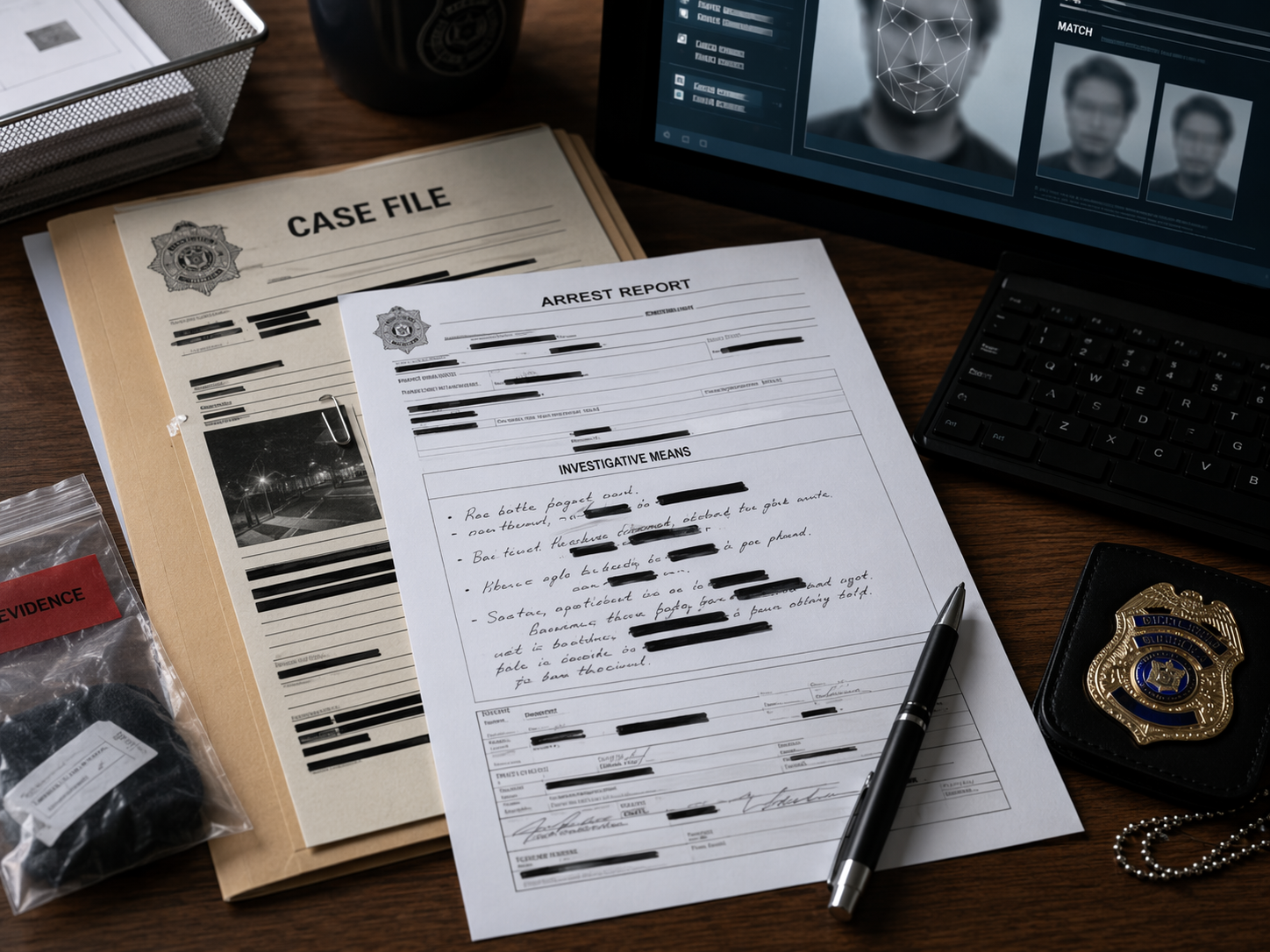
That chain is often missing from the ordinary case file. In New York, reporting on NYPD facial recognition practices described 2,878 arrests over five years that followed facial recognition technology use, while officers routinely attributed identifications to “investigative means” rather than naming the tool in police paperwork.[1] If the report does not disclose the machine step, counsel may never know to ask for the probe image, the candidate list, or the analyst notes.
The omission matters because a facial recognition lead is not a neutral clerical event. It can shape the rest of the investigation. Once a name appears, officers may search databases, build photo arrays, question witnesses, compare social media images, or draft warrant applications around the person the system surfaced. Even when prosecutors later insist that the arrest rested on human judgment, the first machine-generated name may have determined which human judgments were ever made.
What Has To Be Reconstructed
Defense challenges become more precise when the identification is broken into its working parts. Facial recognition is often described as though it produces a single “match.” In case litigation, that word is too blunt. A typical law-enforcement use may involve a probe image, an algorithmic search against a database, a ranked candidate list, a similarity score, some form of human analyst review, and then a separate investigative or arrest decision.
| Part of the identification chain | Why it matters in motion practice |
|---|---|
| Probe image | Poor angle, blur, compression, age, disguise, or cropping can affect reliability before the algorithm ever searches. |
| Database searched | The defense needs to know whether the system queried mugshots, driver-license photos, surveillance images, or another collection. |
| Candidate list and score | A ranked lead is different from a declared identification; low or close scores may support reliability challenges. |
| Human analyst review | The state may claim independent review, but counsel needs the analyst’s training, notes, comparison method, and exclusions. |
| Follow-up investigation | The later evidence may be independent, confirmatory, or contaminated by the first machine-generated lead. |
| Probable cause statement | If the AI output supplied a material link, omissions or exaggerations may matter under suppression and warrant doctrines. |
This division also prevents a common prosecutorial slide. The state may say it does not intend to introduce the algorithm at trial, only the witness identification, officer testimony, or recovered evidence that came later. But if the algorithm produced the suspect’s name, the defense still has disclosure, reliability, and taint questions. The tool may not be the exhibit, but it may be the reason the client became the accused.
The Reliability Record Is Specific Enough To Use
The strongest defense arguments do not depend on saying that every facial recognition system fails in every case. The more useful point is narrower: tested systems have shown measurable demographic false-positive disparities, and those disparities can bear directly on whether a particular identification method was reliable enough to support an arrest, a warrant, or trial evidence.
A Federation of American Scientists discussion of NIST evaluations reported that top-performing facial recognition systems produced 358 times more false positives for West African women over 65 than for Eastern European men aged 35 to 50.[2] That number does not prove any given defendant was misidentified. It does give counsel a concrete reliability hook: the question becomes which system was used, what version, what thresholds, what database, what probe image, and whether the state can show that this particular use met an admissible reliability standard.
The wrongful-arrest record gives the same argument human consequences. Public accounts differ on the exact count. FAS has referred to at least nine documented wrongful arrests tied to facial recognition, while ACLU and later reporting have described more than a dozen, including figures up to 15 as of 2026.[2][3][4] The discrepancy should not be smoothed over. It reflects different publication dates and counting methods, not a settled national registry. For litigation, the careful formulation is enough: multiple documented U.S. wrongful arrests have been tied to facial recognition misidentification, and the reported cases have predominantly involved Black people.[3]
Robert Williams’ Detroit arrest remains the cautionary example many lawyers know: a facial recognition lead helped send police toward the wrong man, and later investigation did not correct the error before the arrest.[3] Nijeer Parks’ New Jersey case shows another version of the same procedural failure, where an algorithmic lead became entangled with accusations that were not adequately tested before the criminal process took hold.[3] These cases are not useful because they prove that every algorithmic lead is false. They are useful because they show how quickly a tentative candidate can become a person in handcuffs.
Trevis Williams’ case is especially hard to square with ordinary probable-cause discipline. Reporting on NYPD facial recognition identified him as arrested despite being eight inches taller and 70 pounds heavier than the suspect description.[1] That is not an abstract bias debate. It is the kind of mismatch a defense lawyer can put into a suppression motion, a cross-examination outline, or a request for every note explaining why contrary physical descriptors did not stop the arrest.

Angela Lipps’ case adds the fugitive-arrest dimension. CNN reported that Lipps, a Tennessee grandmother, was jailed for six months and lost her home after facial recognition falsely linked her to a North Dakota fraud case.[5] The harm did not come from a courtroom exhibit labeled “AI.” It came from an identification that moved through the system with enough force to produce incarceration before the mistake was unwound.
The First Motion Is Often A Disclosure Motion
Before a Daubert hearing or a Fourth Amendment argument can become concrete, counsel usually has to force the state to admit whether an AI-assisted tool was used. That is not a minor sequencing problem. If the arrest report says only “investigative means,” the defense may not know that the missing discovery exists.
The statutory landscape is thin. NACDL has identified only Washington, Montana, and Maryland as states that require law enforcement to disclose facial recognition use to criminal defendants.[6] Everywhere else, disclosure may depend on local policy, prosecutor practice, court orders, Brady doctrine, state discovery rules, or the defense lawyer’s ability to ask targeted questions early.
A useful discovery request does not stop at “whether facial recognition was used.” It asks for the materials that let the defense reconstruct and test the identification:
- All requests submitted to any facial recognition, image-matching, biometric, predictive, license-plate, geolocation, or other AI-assisted search system.
- The probe image or images, including original files, metadata, edits, crops, screenshots, enhancements, and chain-of-custody information.
- The name and version of the system, vendor materials supplied to the agency, operating thresholds, confidence-score guidance, and agency policy.
- The complete candidate list, scores, ranks, nonmatches, analyst notes, peer review, quality-control review, and communications with outside agencies.
- All police reports, emails, audit logs, warrant materials, lineup materials, and prosecutor communications describing or relying on the AI-generated lead.
The Brady theory is straightforward but not yet uniformly accepted in this setting. If the tool produced a false lead, a weak score, multiple plausible candidates, a demographic reliability issue, or analyst hesitation, those facts may be favorable to the defense. They may impeach the investigation, undermine probable cause, or support an alternative-suspect theory. The harder fight is the state’s likely answer: the output was only an investigative aid, not evidence, and therefore not subject to the same disclosure obligations.
That answer should not end the inquiry. Brady is concerned with favorable, material information in the government’s possession, not only with exhibits the prosecutor plans to introduce. Where an AI-generated lead caused officers to select the defendant, exclude other candidates, shape a lineup, or omit contrary descriptors from a warrant application, the defense has a record-based argument that the material is discoverable even if the state avoids the word “evidence.” Courts have not resolved that question uniformly, which makes the factual record more important, not less.
Daubert, Frye, And The 2023 Rule 702 Burden
Once disclosure exposes an AI identification, evidentiary gatekeeping turns on what the prosecution wants to do with it. If the state offers expert testimony that a facial recognition system identified the defendant, Daubert or Frye is squarely in play. If the state offers only a human analyst’s opinion, gatekeeping may still apply if that opinion depends on specialized image-comparison methods, vendor outputs, or technical scores. If the state says the AI lead will not be introduced at all, counsel may shift from admissibility to suppression, taint, discovery, and cross-examination.
The 2023 amendments to Federal Rule of Evidence 702 matter because they emphasize that the proponent of expert testimony must show admissibility by a preponderance of the evidence, including reliable principles and methods reliably applied to the facts of the case.[7] In an AI identification dispute, that burden should not be treated as satisfied by a detective’s statement that the system is commonly used or that an analyst later reviewed the result.
The reliability hearing should be made case-specific. The defense can press for evidence on system testing, demographic performance, image quality, database composition, threshold settings, analyst training, and known error rates. The NIST/FAS disparity finding belongs here because it changes the hearing from a general fight over “AI bias” into a concrete question about false positives and the population characteristics relevant to the defendant or the searched image.[2]
The prosecution may respond that the algorithm did not make the arrest; humans did. Sometimes that will be true in a legally meaningful way. A system may return a candidate, an analyst may reject weak results, officers may obtain independent corroboration, and the arrest may rest on evidence that did not depend on the machine lead. But the state should have to identify those steps, not hide them inside a generic investigative label.
A focused gatekeeping challenge asks where expertise actually entered the case. Was the analyst applying a validated comparison method, or merely confirming the top-ranked candidate? Did the analyst know the suspect description before reviewing the image, or only after the algorithm suggested a name? Were other candidates preserved? Was the score high enough under the agency’s own policy to justify further investigation? Were disconfirming facts documented? These questions are often more useful than demanding the source code on day one, because they test the actual bridge between machine output and courtroom proof.
When The AI Lead Infects Probable Cause
The suppression problem is different from the trial-admissibility problem. A facial recognition lead may never be shown to the jury, yet still supply the missing link in an arrest warrant, fugitive pickup, extradition request, or search warrant. If the warrant affidavit says officers identified the defendant through investigation, while omitting that the identification began with a low-confidence or disputed AI candidate, the defense should examine whether the omission was material.
The same inquiry applies to later human identifications. A witness shown a photo array after officers already have an algorithmic suspect may be responding to a procedure shaped by that suspect selection. A detective who compares surveillance footage to a known booking photo may be performing a confirmation exercise rather than an independent identification. A lineup administrator may not know the algorithmic origin, but the array itself may exist only because the system selected the defendant.
This is where Trevis Williams’ reported height-and-weight mismatch has litigation value beyond the facts of one case. If an AI lead points to a person who does not match the original description, the defense can ask who noticed, who ignored it, whether the discrepancy appeared in the warrant papers, and whether later witnesses were asked to identify a person already selected by technology.[1] The answer may not be suppression in every case. But it can expose whether probable cause was built from independent facts or from a machine lead insulated from scrutiny.
Fourth Amendment Arguments Are Strongest When The Surveillance Is More Than A One-Off Search
Fourth Amendment doctrine is less settled for AI fugitive identification than the reliability and disclosure arguments. A one-time facial recognition query against a lawfully possessed image raises different questions from continuous camera networks, automated license-plate readers, geolocation analytics, or AI systems that assemble a person’s movements over time. Treating all of those tools as the same search question will overstate the law.
Carpenter v. United States supplies the most important frame for extended tracking: aggregation can change the constitutional character of information that might appear less sensitive in isolation. NYU Moot Court analysis has applied that mosaic theory to continuous AI surveillance, where automated systems can convert scattered observations into a detailed account of a person’s movements and associations.[8] For fugitive arrests, the useful question is whether police merely compared one image to a database, or whether they used algorithmic surveillance to locate, track, and seize a person over time.
Kyllo’s sense-enhancing technology reasoning points in a related direction. If the government uses technology not in general public use to obtain information that ordinary observation would not reveal, courts may ask whether the tool crossed a constitutional line. That analogy is most plausible where AI does more than accelerate a human glance—where it identifies unknown people at scale, links them across databases, or extracts location patterns unavailable to ordinary officers on patrol.
The Fourth Circuit’s decision in Leaders of a Beautiful Struggle, involving aerial surveillance, is useful by analogy rather than direct control. Its significance is not that it decides every facial recognition arrest. It shows judicial concern with persistent, retrospective surveillance that lets the government reconstruct movements in a way ordinary policing could not practically accomplish. For defense counsel, the analogy becomes stronger as the record shows duration, aggregation, automation, and retrospective search capacity.
A narrower Fourth Amendment argument may also target the seizure itself. If the AI lead was unreliable, contradicted by known descriptors, or unsupported by independent corroboration, the defense can argue that the arrest lacked probable cause even if the initial query was not a search. That argument does not require the court to decide the full constitutional status of facial recognition technology. It asks whether this arrest, on this record, rested on enough reliable facts.
The Proprietary Algorithm Problem
Vendor secrecy creates a different kind of pressure. The defense may be told that the system is proprietary, that the agency does not possess the source code, or that the algorithm’s internal weighting cannot be disclosed. Those claims do not automatically make the evidence inadmissible. They do, however, make it harder for the state to carry reliability burdens and harder for the defense to test confrontation, due process, and discovery concerns.
State v. Loomis is often cited in this area because it involved a confrontation and due-process challenge to proprietary algorithmic evidence in criminal sentencing. Later commentary has used Loomis to illustrate the tension between criminal adjudication and systems whose internal methods cannot be fully examined by the accused.[9] Loomis is not a facial recognition fugitive-arrest case, and it should not be stretched into one. Its value is more modest: it shows why courts should be uneasy when a proprietary tool influences criminal process while the defense cannot meaningfully inspect how the result was produced.
In facial recognition litigation, the defense may not always need the full source code to make progress. Audit logs, user manuals, confidence thresholds, validation studies, analyst notes, candidate lists, and agency policies may answer many of the immediate questions. If the state cannot produce even those materials, the proprietary label begins to look less like a trade-secret concern and more like a barrier to testing reliability.
A Practical Sequence For Defense Review
The order of operations matters. A defense lawyer who starts with a broad constitutional attack may miss the simpler record problem: the file does not reveal the identification source. A lawyer who treats the AI output only as trial evidence may miss its role in probable cause. The review should move from origin, to disclosure, to reliability, to taint.
- Look for origin clues: vague phrases such as “investigative means,” outside-agency leads, sudden suspect naming, missing witness basis, or a photo array built before ordinary identification evidence appears.
- Demand disclosure: ask specifically for AI-assisted identification, facial recognition, image matching, license-plate analytics, geolocation tools, predictive systems, and outside database searches.
- Preserve the machine record: seek the probe image, candidate list, scores, thresholds, analyst notes, audit logs, policies, and communications before systems overwrite or agencies lose them.
- Test reliability: connect system-specific information to Daubert, Frye, Rule 702, state evidentiary rules, demographic false-positive research, and case-specific image quality.
- Trace downstream effects: compare the AI lead with warrant affidavits, lineups, witness identifications, suspect descriptions, arrest reports, and later investigative steps.
- Separate remedies: exclusion, suppression, a Franks hearing, compelled discovery, expert funding, continuance, cross-examination, or limiting instructions may depend on different parts of the record.
The sequence is not a universal motion template. In a fugitive pickup, the urgent issue may be detention and extradition. In a trial case, it may be expert admissibility. In a post-arrest identification case, the key issue may be whether witnesses were exposed to a defendant selected by an undisclosed machine process. The common need is a record that shows what happened before the police report began telling the story.
What Current Law Already Lets Counsel Contest
No court has supplied a single rule for every AI-generated fugitive identification. That uncertainty cuts both ways. Prosecutors can argue that facial recognition is only a lead, that officers made the final decision, and that traditional probable-cause doctrine is enough. Defense counsel can answer that traditional doctrine is exactly why the state must disclose the lead, prove reliability when it offers technical identification evidence, and show that probable cause did not depend on an untested or misleading machine output.
The existing tools are not weak. Daubert, Frye, and amended Rule 702 let courts demand reliability before technical opinions reach the jury. Brady and state discovery rules let defendants seek favorable information that explains how they were selected. Fourth Amendment doctrine gives counsel a way to challenge arrests and searches built on unreliable identification, material omissions, or surveillance systems that aggregate more information than ordinary observation could produce.
The harder part is forcing the first disclosure. If law enforcement can translate a facial recognition candidate into “investigative means,” the defense may never reach the hearing where reliability, bias, proprietary limits, and probable cause can be tested. That is why undisclosed AI identification is not only a technology issue. It is a reliability problem, a discovery problem, and a constitutional record problem.
References
- NYPD’s Use of Facial Recognition Technology, Columbia Science and Technology Law Review, link
- Face Recognition Bias, Federation of American Scientists, link
- More Than a Dozen Wrongful Arrests Due to Police Reliance on Facial Recognition Technology, ACLU, link
- Wrongful arrest suit sparks fresh scrutiny of police facial recognition, Politico, June 10, 2026, link
- Angela Lipps AI facial recognition, CNN, March 29, 2026, link
- Artificial Intelligence, NACDL, link
- When AI Becomes Evidence: Legal Challenges Explored, RSB Law, September 2025, link
- Policing by Algorithm: Rethinking the Fourth Amendment in the Age of AI Surveillance, NYU Moot Court Proceedings, January 2026, link
- AI in the Criminal Courts: Balancing Innovation and Justice, NAPCO, June 2026, link
Comments
Join the discussion with an anonymous comment.