
How to Determine If Your Law Firm's AI System Is High-Risk Under the EU AI Act
A practical decision framework for law firms to classify their legal AI tools under the EU AI Act's Annex III, applying the Article 6(3) exceptions and the profiling trap to determine whether high-risk obligations apply.
- Hallucination rate
- Not measured / undisclosed
For a law firm asking whether its tools are AI Act high risk legal AI systems, the useful starting answer is narrower than the anxiety usually suggests: a document review tool, legal research assistant, or contract analysis tool is often not high-risk if its documented intended purpose is to help lawyers perform preparatory or limited procedural work and the lawyer remains responsible for the legal judgment. That does not mean “legal AI” is generally exempt. The classification changes quickly when the system is intended to interpret facts and law in the administration of justice, apply law to concrete facts in a way that materially shapes strategy, predict case outcomes, or profile natural persons.
This is classification guidance, not legal advice. The answer depends on the system’s documented intended purpose, the way the firm deploys it, and whether the Article 6(3) exceptions genuinely fit. A vendor’s “not high-risk” label helps only if the underlying documentation supports the same conclusion.
The Short Classification Frame
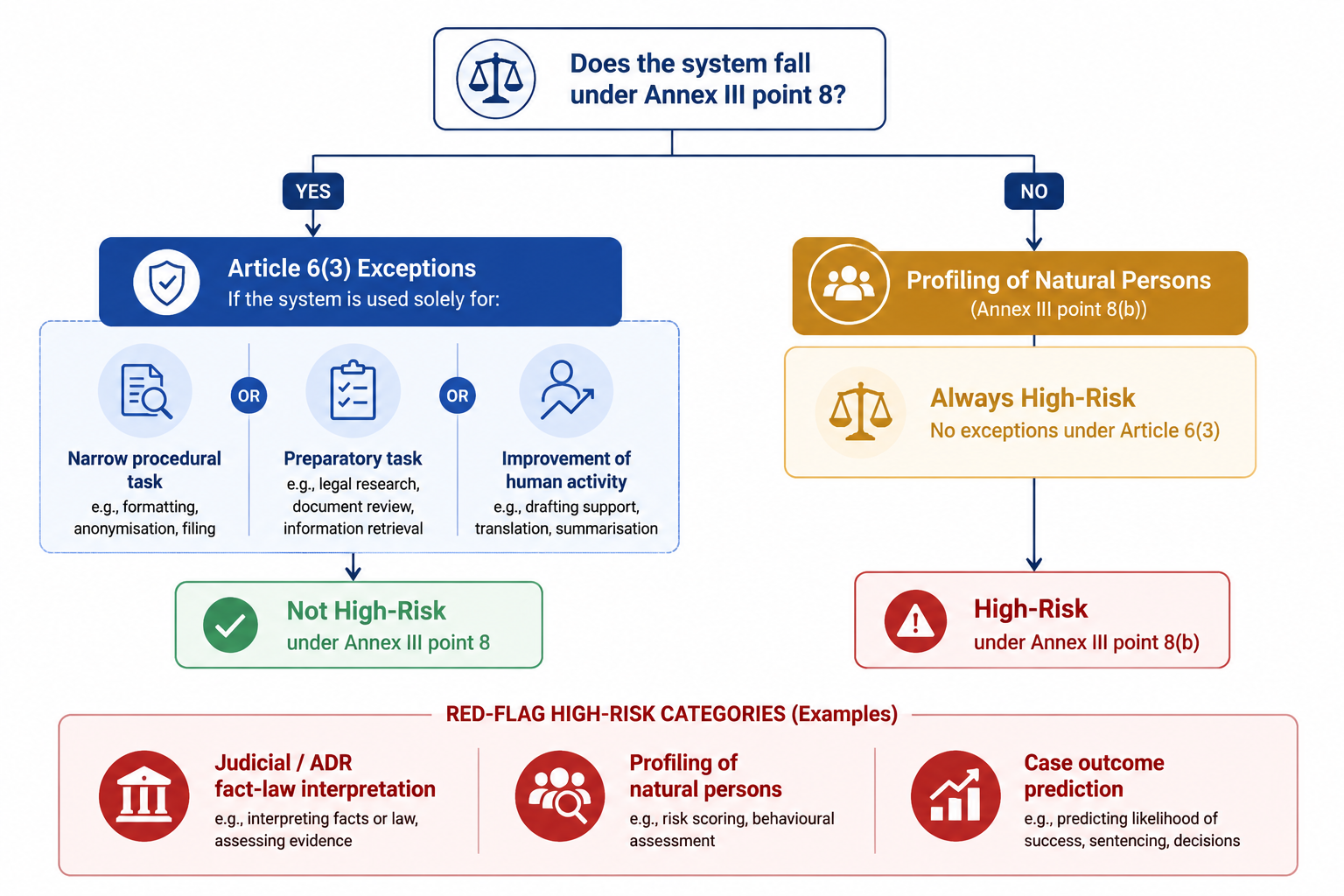
A workable first-pass review separates ordinary assistive use from three red flags. The question is not whether the tool is sold to lawyers. It is what the tool is intended to do inside the legal workflow.
| Use pattern | Likely classification direction | What to check |
|---|---|---|
| Document review, e-discovery triage, clause extraction, legal research support | Often outside high-risk if Article 6(3) applies | Is the task narrow, preparatory, or merely improving a human lawyer’s work? |
| AI used by a court or ADR body to research and interpret facts and law | High-risk trigger under Annex III point 8 | Is the system used in the administration of justice or democratic processes? |
| Case outcome prediction or fact-law application for a concrete dispute | Potentially high-risk, especially if it materially influences legal strategy | Does the system apply law to a concrete set of facts rather than merely retrieve or summarize information? |
| Any tool that profiles natural persons | High-risk despite Article 6(3) exceptions | Does it evaluate, categorize, or predict traits or behavior of identifiable people? |
That table is not a substitute for the statutory test. It is a way to stop the common overcorrection: treating every generative feature in a law firm as a high-risk system, or treating every internal legal assistant as harmless because a lawyer sees the output before it leaves the building.
What Annex III Point 8 Actually Catches
Annex III point 8 is the relevant hook for legal-sector anxiety. It covers AI systems intended to be used by a judicial authority, or on its behalf, to assist in researching and interpreting facts and the law and in applying the law to a concrete set of facts. It also reaches similar use in alternative dispute resolution, when the system is used for comparable administration-of-justice functions.[1]
Two parts of that language matter in firm classification work. First, the text is not triggered merely because a product touches legal documents. It is aimed at systems used in the administration of justice, including judicial or ADR settings. Second, the risky activity is not ordinary text handling. It is researching and interpreting facts and law, then applying law to concrete facts.
A litigation associate using an AI tool to summarize a deposition transcript is not the same classification problem as a tribunal using an AI system to evaluate evidence and apply legal standards. A research assistant that retrieves cases for a lawyer is not the same as a tool that recommends how a judge should resolve a factual dispute. The words “assist” and “legal” are too crude to carry the analysis.
For a deeper discussion of the justice-sector hook itself, see High-Risk AI Under the EU AI Act: What Annex III Section 8 Means for Law Firms Deploying Legal AI Tools. The narrower task here is the classification record a firm can defend for its own tools.
Article 6(3) Is Where Most Law Firm Tools Are Won or Lost
Article 6(2) brings Annex III systems into the high-risk category. Article 6(3) then creates exceptions where the AI system does not pose a significant risk of harm to health, safety, or fundamental rights because it does not materially influence decision-making. The text identifies exceptions for systems intended to perform a narrow procedural task, improve the result of a previously completed human activity, detect decision-making patterns or deviations without replacing or influencing the human assessment, or perform a preparatory task to an assessment that remains for a human decision-maker.[2]
That is the center of the law firm analysis. Many firm tools sit near Annex III vocabulary because they involve legal work, but they do not necessarily perform the covered decision function. A defensible file should show why the tool is limited, where the human lawyer’s judgment enters, and what the tool is not authorized to decide.
Document Review and E-Discovery
A document review tool that clusters documents, flags likely privilege, extracts dates, or ranks responsiveness usually has its strongest argument under the narrow procedural task and preparatory task exceptions. The system is organizing or surfacing material so that a lawyer can review it. The legal consequence still flows from the review protocol, the supervising lawyer’s decisions, and the production choices made by the firm.
The classification file should be precise. “AI-assisted discovery” is too vague. “The system groups documents by semantic similarity, identifies likely duplicates, and suggests privilege tags for attorney review before production” is materially better. If the tool is configured so that no document is withheld, produced, or characterized as privileged without attorney approval, the Article 6(3) argument is easier to document.
The risk changes if the firm lets the tool make final privilege calls, automatically exclude evidence from review, or generate merits conclusions from the document set. At that point, the intended use may no longer be a narrow procedural task. The record should not pretend the tool is only sorting documents if the deployment gives it practical control over legal judgments.
Legal Research Assistance
A legal research assistant that retrieves authorities, summarizes cases, drafts a research memo, or compares doctrines is usually easier to analyze if the firm describes it as research support rather than legal decision automation. The lawyer chooses the issue, evaluates the authorities, checks citations, and decides what argument to make.
The line is crossed less by polished language than by function. A tool that says “these are the leading cases on apparent authority” is doing a preparatory activity. A tool that says “on these facts, the client will likely lose because element two is not satisfied” is moving toward applying law to a concrete set of facts. The latter may still be used only by a lawyer, but the Article 6(3) file has more work to do because the system is influencing a concrete legal assessment.
Contract Analysis
Contract review tools often fall outside high-risk classification when they identify clauses, compare language against a playbook, surface missing provisions, or generate redline suggestions for a lawyer or contract manager. The strongest description is again preparatory: the system helps a human review a document faster or more consistently.
A contract tool becomes harder to classify if it automatically approves counterparties, rejects individuals, scores natural persons, or determines rights and obligations without meaningful human review. Not every aggressive contract workflow is an Annex III justice-system issue, but the firm should then evaluate other Annex III categories and the profiling rule rather than relying on the comforting fact that “it is only contracts.”
The Profiling Trap
Article 6(3) has an important limit: the exception does not apply where the AI system performs profiling of natural persons. In that situation, the “we only assist lawyers” answer is not enough.[2]
This matters because profiling can enter a legal workflow quietly. A litigation tool that ranks opposing witnesses by predicted credibility, a claims tool that scores individual claimants by suspected fraud risk, or a labor-and-employment tool that predicts which employees are likely to sue are not just sorting legal text. They are evaluating natural persons. Even if a lawyer reviews the output, the system’s intended purpose may still involve profiling.
The harder cases are less theatrical. A tool might enrich a matter profile with information about an individual’s location, role, litigation history, or behavior and then use those attributes to prioritize settlement strategy. Whether that is profiling will depend on what the tool actually evaluates and why. The classification file should not leave this to implication. It should state whether the system evaluates or predicts aspects of identifiable natural persons and, if so, for what legal or operational purpose.
This is also where vendor questionnaires often underperform. “Does the system make automated decisions?” is not the same as “does the system profile natural persons?” A system can avoid final decision-making and still profile people. The procurement record should ask both questions.
Case Prediction Is Not Just Better Research
Case outcome prediction deserves separate treatment because it is often marketed as analytics while functioning as legal assessment. A dashboard showing historical win rates by court, claim type, or motion posture is one thing. A system that ingests the facts of a pending dispute and predicts the likely outcome, settlement range, or best procedural move is much closer to applying law to a concrete set of facts.
The practical question is how the output is meant to be used. If the system is intended to provide background market context, the firm may be able to describe it as preparatory. If it is intended to determine litigation strategy, advise whether to settle, or rank clients’ legal positions by predicted judicial outcome, the high-risk analysis becomes more serious. The fact that a partner still signs the advice letter does not automatically restore the Article 6(3) exception.
A useful internal distinction is retrieval versus application. Retrieval finds materials a lawyer may consider. Application uses facts from the matter and legal rules or patterns to produce a conclusion about the matter. The latter is where Annex III point 8 starts doing real work.
The Timing Update: More Time, Not No Work
The Digital Omnibus timing issue matters for 2026 planning. Gibson Dunn reported that the Council approved a delay moving compliance for Annex III high-risk AI systems to December 2, 2027, but also noted that formal publication in the Official Journal remains the binding step.[3]
That timing wrinkle should change project sequencing, not the classification discipline. Firms still need to know which systems they are treating as outside high-risk, which systems may fall inside Annex III, and which vendor claims they are relying on. Transparency obligations under Article 50 also have their own application path, including obligations relevant from August 2, 2026, so a delayed high-risk compliance date does not make every AI Act question disappear.[4]
Enforcement infrastructure is still maturing. A European Parliament Think Tank analysis in March 2026 reported that only 8 of 27 member states had designated contact points at that time.[5] That is a reason to expect uneven implementation questions, not a reason to leave classification undocumented.
What the Firm Should Be Able to Produce
A classification decision does not need to become a universal AI governance program. It does need to be a record that another lawyer, regulator, client, or insurer can follow without reconstructing the procurement conversation from calendar invites.
- System identification: product name, version if available, provider, deployer, business owner, and legal workflow.
- Documented intended purpose: what the tool is intended to do, what it is not intended to do, and which users may rely on it.
- Annex III analysis: whether the tool is used in administration of justice, ADR, or another Annex III area, and whether it researches or interprets facts and law or applies law to concrete facts.
- Article 6(3) rationale: whether the tool performs a narrow procedural task, improves a completed human activity, detects patterns without replacing the human assessment, or performs a preparatory task.
- Profiling determination: whether the system evaluates, categorizes, predicts, or otherwise profiles natural persons.
- Deployment controls: required human review, prohibited uses, logging, training, escalation, and the person responsible for approving changes in use.
The provider side also matters. Article 6 requires providers who consider an Annex III system not to be high-risk to document that assessment before placing the system on the market or putting it into service.[2] A law firm should ask for that analysis when a vendor claims an exception. If the vendor will not provide enough information to support the classification, the firm should not fill the gap with optimism.
If the system is classified as high-risk, the next question is Chapter III obligations rather than another round of classification debate. Those obligations include risk management, data governance, technical documentation, recordkeeping, transparency, human oversight, accuracy, robustness, and cybersecurity requirements. For that broader compliance path, see The EU AI Act and Your Law Firm: A Practical Compliance Guide for Legal Practitioners. For firms still mapping the Act’s broader risk tiers, see How the EU AI Act's Risk Classification Maps to Legal AI Use Cases.
A Defensible Decision Point
The cleanest classification record answers four questions in order: What is the system’s documented intended purpose? Does that purpose fall into Annex III, especially the point 8 language on researching and interpreting facts and law or applying law to concrete facts? If so, does an Article 6(3) exception genuinely remove it because the task is narrow, preparatory, or human-assistive without materially influencing the decision? And does the system profile natural persons?
Most ordinary law firm tools can be classified with that sequence. The uncomfortable systems are the ones whose documentation says “assistant” while the deployment lets them shape legal outcomes, settlement posture, witness treatment, or individual risk scores. That is where classification stops being a label and becomes a governance fact.
References
- Annex III — High-risk AI systems referred to in Article 6(2), artificialintelligenceact.eu
- Article 6 — Classification rules for high-risk AI systems, artificialintelligenceact.eu
- Digital Omnibus deferral analysis, Gibson Dunn, June 29, 2026, Gibson Dunn
- Article 50 — Transparency obligations for providers and deployers of certain AI systems, artificialintelligenceact.eu
- European Parliament Think Tank analysis on AI Act implementation contact points, March 2026, European Parliament Think Tank
Chronological incident history
No sanction cases have named this tool in the tracked record set to date. This does not imply the tool is safe — see Risk Digest for ongoing monitoring.
← Compare peer toolsReport a correction or tip
Spotted an outdated figure, a misstated fact, or a ruling this tool profile should reflect? Public comments are disabled for this content given the professional cost of a misreported case outcome, penalty amount, or rule text — use the structured correction channel instead.
Report a correction or tip for this record →