
Full profile
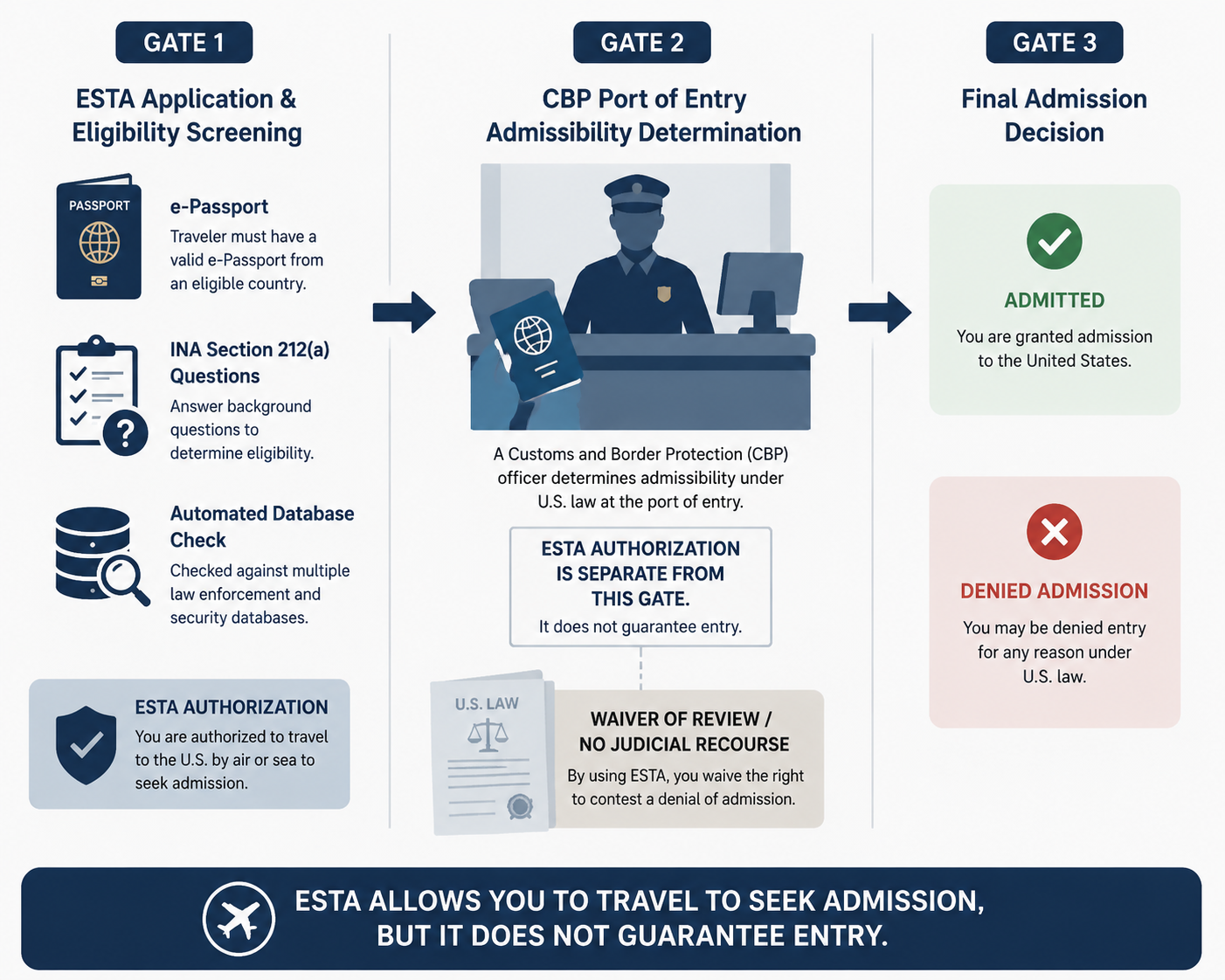
For an attorney reviewing an ESTA form application, the first legal requirement is to stop treating the approval screen as the operative event. ESTA is the electronic mechanism Congress required for Visa Waiver Program screening, but the governing bargain is INA § 217: a traveler may seek admission without a visa only if the statutory conditions are met, the required waiver is executed, and CBP later admits the person at inspection. The authorization permits travel to a U.S. port of entry to request admission; it is not itself an admissibility determination.
That distinction matters because the system is built to be strict before travel and narrow after an adverse decision. ESTA is codified at 8 USC § 1187(h)(3), and the regulation implementing the application process appears at 8 CFR § 217.5 within the Visa Waiver Program regulations.[1][2] The legal requirements therefore do not begin and end with biographic fields, passport upload, and fee payment. They include VWP eligibility, automated screening against inadmissibility-related information, a mandatory waiver of review or appeal rights, and a statutory bar on judicial review of ESTA determinations.
The Governing Sources Are INA § 217 and 8 CFR Part 217
INA § 217, codified at 8 USC § 1187, authorizes the Visa Waiver Program and sets the conditions under which nationals of participating countries may apply for admission without first obtaining a B-1/B-2 visa. ESTA is the automated travel authorization component of that program. Congress directed the Secretary of Homeland Security to establish an electronic system to collect information and determine, before travel, whether an alien is eligible to travel to the United States under the VWP and whether such travel poses a law enforcement or security risk.[1]
The implementing regulation, 8 CFR § 217.5, gives the application mechanics their legal effect. It addresses when ESTA must be obtained, the period of authorization, when a new authorization is required, the legal effect of an authorization, review limitations, and the fee provision currently appearing in the regulation.[2] For a maintained regulatory reference, the point is not that the form is difficult. It is that a simple-looking online process is attached to a waiver-based admission category.
| Issue | Controlling Source | Practical Legal Meaning |
|---|---|---|
| ESTA authority | 8 USC § 1187(h)(3) | ESTA exists as the electronic screening system for VWP travel. |
| Application regulation | 8 CFR § 217.5 | The regulation controls validity, renewal triggers, effect of authorization, review limits, and fee text. |
| Waiver of rights | INA § 217(b), 8 USC § 1187(b) | The VWP traveler must waive rights to review or appeal most admissibility determinations. |
| No judicial review of ESTA determinations | 8 USC § 1187(h)(3)(C)(iv); 8 CFR § 217.5(f)(3) | ESTA determinations are exempt from judicial review. |
| Inadmissibility framework | INA § 212(a), 8 USC § 1182 | Eligibility questions track inadmissibility-related grounds rather than ordinary travel preferences. |
ESTA Approval Is Permission to Travel, Not Admission
The regulation is explicit on a point that still gets flattened in practice: an ESTA authorization does not determine admissibility. 8 CFR § 217.5(f)(2) states that a travel authorization is not a determination that the applicant is admissible to the United States, and that admissibility remains determined by CBP officers at the port of entry.[2] A client can therefore hold a valid authorization, board transportation, and still face refusal at inspection.
This is not a semantic distinction. A pre-travel authorization answers a narrower question: whether the person may travel under the VWP to seek admission. The port-of-entry decision answers the harder question: whether the person is admissible when inspected. In a routine business-travel setting those events may collapse into a single uneventful trip. In an adverse case, they separate sharply.
The minimum orientation is still useful. A VWP traveler generally seeks admission for business or pleasure for no more than 90 days and must use an electronic passport meeting program requirements.[1] ESTA then functions as the required pre-travel authorization layer. But neither the 90-day limit nor the passport technology requirement converts approval into an entitlement to enter.
The Eligibility Questions Are a Legal Screening Device
The ESTA form’s eligibility questions should be read against INA § 212(a), not as informal travel-risk prompts. The nine eligibility questions derive from INA § 212(a) inadmissibility grounds, including questions associated with crimes involving moral turpitude, controlled-substance violations, prior immigration violations, communicable diseases, and national security concerns.[3] A lawyer does not need to overstate the point: the form does not adjudicate every possible inadmissibility issue. But it does require answers in categories that map directly onto statutory inadmissibility concepts.
That mapping is where checklist advice becomes risky. A traveler may understand a question as asking about a colloquial “criminal record,” while the legal issue may turn on whether conduct falls within a statutory inadmissibility category. A corporate mobility team may understand a prior refusal or overstay as old travel history, while the ESTA question is designed to surface prior immigration violations. A health-related answer may look administrative, but the statutory source sits in the health-related inadmissibility grounds.
The professional task is not to invent a universal answer key. It is to recognize when a form answer cannot be responsibly evaluated without the underlying INA § 212(a) analysis. If the answer changes, 8 CFR § 217.5(e) also makes that change legally operational: a new ESTA is required when there is any change to the answers to the eligibility questions.[2]
Validity, Renewal, and the Events That Require a New ESTA
Under 8 CFR § 217.5(d)(1), an ESTA travel authorization is generally valid for two years or until the traveler’s passport expires, whichever occurs first. The regulation also recognizes a six-month passport-validity exception for certain countries.[2] That validity period is often described as if it were the whole compliance answer. It is only the starting point.
- A new ESTA is required when the traveler obtains a new passport.[2]
- A new ESTA is required after a name change.[2]
- A new ESTA is required after a gender change.[2]
- A new ESTA is required after a citizenship change.[2]
- A new ESTA is required after any change to an answer to an eligibility question.[2]
The last trigger is the one most likely to matter in legal review. Passport replacement and name changes are usually visible in travel operations. A changed eligibility answer may be known only to the traveler, a local HR contact, or counsel who learns about the issue after an automated denial or a secondary-inspection event.
The Waiver Is Not Fine Print
The most important legal requirement for a valid ESTA application is not a data field. It is the VWP waiver. INA § 217(b) requires the alien to waive any right to review or appeal an immigration officer’s determination as to admissibility at the port of entry, other than on the basis of an application for asylum, and to waive contest of removal action other than on the basis of an asylum application.[1] This waiver is not an ESTA website preference. It is a statutory condition of admission under the Visa Waiver Program.
For lawyers, the waiver changes the advice posture before the traveler clicks through the application. A client who appears to be a low-friction VWP traveler may in fact be choosing a route that deliberately limits later procedural options. That may be acceptable in the ordinary case. It is dangerous when the attorney has not evaluated whether the traveler has a potential inadmissibility issue, prior violation, unresolved criminal-history question, or other fact that could become decisive at inspection.
This is also why ESTA denial and port-of-entry refusal should not be treated as mere customer-service problems. By the time counsel is called, the relevant legal posture may already be constrained by the statutory waiver. The system is not designed to preserve the same review pathways that might exist in other procedural settings.
ESTA Determinations Are Exempt From Judicial Review
The review bar deserves separate treatment because it is the provision most often missing from ordinary ESTA explanations. Under 8 USC § 1187(h)(3)(C)(iv), determinations under the ESTA subparagraph are not subject to judicial review. The regulation repeats that ESTA determinations are exempt from judicial review.[1][2] That is a statutory design choice, not merely a discretionary CBP practice.
There is a difference between saying a traveler may reapply after correcting certain information and saying the traveler has review rights over the determination. The former may be operationally possible depending on the issue. The latter is barred by the governing framework. Advising on an ESTA problem without naming that distinction leaves the client with a false sense that denial, revocation, or refusal can be escalated like an ordinary administrative error.
The practical consequence is uncomfortable but straightforward. The highest-value legal work often occurs before submission or travel, when counsel can decide whether VWP travel is appropriate at all. After an adverse ESTA determination or an inspection problem, the attorney may be left explaining why the available procedural space is smaller than the client expected.
Fee Text Requires Current-Status Checking
The fee provision is a useful example of why maintained regulatory references must be checked against later statutory changes and agency implementation. 8 CFR § 217.5(h) still lists a $21 fee through September 2027, while the Travel Promotion Act fee is identified as $40 effective September 30, 2025.[2] The better practice is to disclose the inconsistency rather than silently selecting one number and calling it current.
CBP’s ESTA page should be checked for the operational fee presented to applicants at the time of filing, but the discrepancy remains legally relevant for practitioners maintaining internal guidance.[4] If an internal checklist cites only the CFR amount, it may be outdated in practice. If it cites only the payment-screen amount, it may fail to explain why the regulation appears different.
2025–2026 Data-Collection Changes: Verify the Current Implementation Status
ESTA should not be described as a static form. In a Federal Register notice published December 10, 2025, CBP cited more than 2,400 poor-quality passport uploads and more than 8,000 invalid passport photos submitted through the ESTA website, stating that these were being exploited to bypass facial comparison screening.[5] The cited figures matter because they show why CBP was moving to tighten the identity-capture process, not because every ESTA article needs to become a technology-policy essay.
The same notice is also the reason Q3 2026 guidance should be careful about tense. Proposed social-media and biometric data expansions completed a 60-day comment period on February 9, 2026.[5] Practitioners should verify whether the proposed changes have been finalized, modified, or remain pending before treating them as current filing requirements.
That verification point is not clerical. If the live system changes the manner of passport capture, photo submission, or other data collection, an attorney’s compliance memo that accurately described ESTA last year may still be wrong for a traveler filing today. The legal framework remains INA § 217 and 8 CFR Part 217, but the operational implementation can move faster than a stale intake checklist.
What a Valid ESTA Application Requires in Legal Terms
A legally sound ESTA review does not require turning every business traveler into a full inadmissibility memorandum. It does require knowing when the form answer is no longer merely administrative. The controlling questions are whether the traveler is eligible for VWP travel, whether the passport and trip fit the statutory and regulatory limits, whether any INA § 212(a)-related issue is implicated, whether a new ESTA is required because a triggering fact changed, and whether the traveler understands the waiver and review consequences.
- Confirm VWP eligibility before relying on ESTA as a travel route.
- Treat the 90-day limit and e-Passport requirement as VWP conditions, not convenience details.
- Review eligibility-question answers against INA § 212(a) concepts when any answer is uncertain.
- Check whether a new ESTA is required because of passport, name, gender, citizenship, or eligibility-answer changes.
- Advise on the statutory waiver and the absence of judicial review before submission or travel.
- Verify current CBP implementation for fees and any data-collection changes.
The disciplined conclusion is narrow but important: a valid ESTA application is not just accurate form completion. It is compliance with a statutory VWP bargain that combines eligibility screening, a waiver of review or appeal rights, and CBP’s retained admissibility discretion. The time to understand INA § 217 is before denial, revocation, or inspection, because after that point the framework deliberately leaves little room for ordinary review.
References
- 8 USC § 1187, Cornell Legal Information Institute
- 8 CFR Part 217, eCFR
- 8 USC § 1182, Cornell Legal Information Institute
- Electronic System for Travel Authorization, U.S. Customs and Border Protection
- Agency Information Collection Activities; Revision; Electronic System for Travel Authorization, Federal Register, December 10, 2025
Comments
Join the discussion with an anonymous comment.