
The Ethics of Free AI for Lawyers: How to Use ChatGPT, Claude, and Gemini Without Violating Confidentiality or Getting Sanctioned
This article provides attorneys, compliance officers, and law firm leaders with a practical, case-law-grounded framework for using free AI tools ethically. It covers the hard boundaries set by the Mata v. Avianca sanctions, the Heppner privilege ruling, and ABA Formal Opinion 512, offering a jurisdiction-specific guide and a privilege-safe workflow.
- Hallucination rate
- Not measured / undisclosed
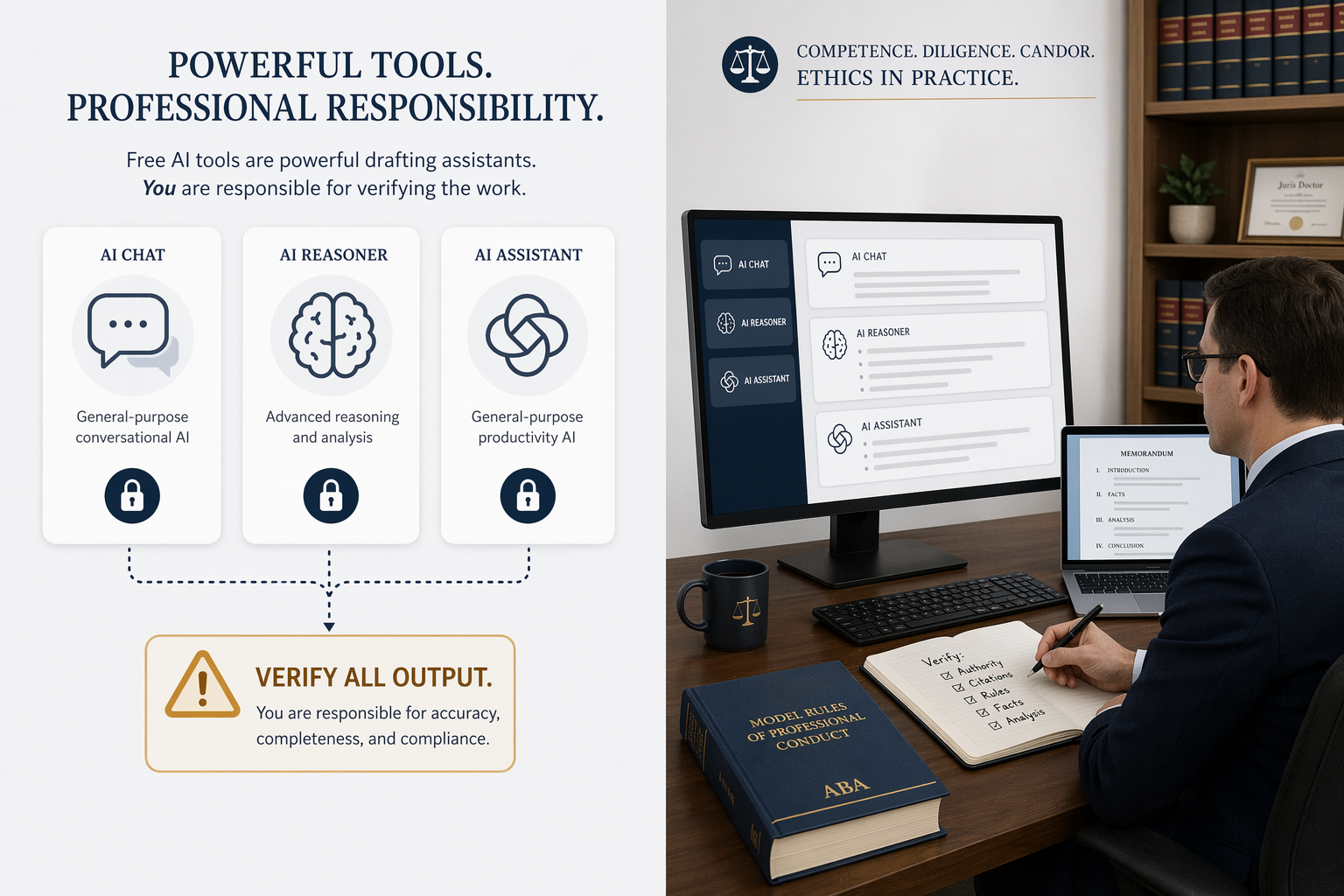
Introduction: The Narrow Path for Free AI in Legal Practice
The proposition that a lawyer can use a free, consumer-grade AI chatbot without violating ethical duties or risking sanctions is not a contradiction in terms — but it is a high-wire act with a narrow margin for error. Two court rulings and one ABA opinion have drawn the boundaries with increasing clarity over the past three years, and every attorney who opens a free ChatGPT, Claude, or Gemini session needs to know where those lines fall.
The 2023 sanctions in Mata v. Avianca — where a lawyer submitted six hallucinated judicial opinions generated by ChatGPT — demonstrated that treating AI output as finished legal research is sanctionable conduct. The February 2026 ruling in United States v. Heppner established that, under current consumer terms of service, exchanges with an AI chatbot may carry neither attorney-client privilege nor work-product protection. And ABA Formal Opinion 512, issued in July 2024, confirmed that generative AI use is permissible under existing ethics rules only when the lawyer maintains competence, supervision, and confidentiality.
This article is not a tool comparison. For a detailed assessment of what each free platform can and cannot do, see our companion guide, Free AI Tools for Lawyers: What Works, What Doesn't, and Where the Risks Are. Here, we focus on the professional responsibility framework: the case law, the ethics opinions, the data-retention realities, and the practical workflows that keep a lawyer on the right side of the line.
The Two Rulings Every Lawyer Must Know: Mata v. Avianca and Heppner
Two judicial decisions form the backbone of the current risk landscape for free AI tools in legal practice. Neither was a close call on the facts, and together they establish principles that apply to every consumer-grade chatbot.
Mata v. Avianca: The Hallucination Precedent
In 2023, a federal court sanctioned a lawyer and his firm for submitting a brief that cited six nonexistent judicial opinions. The lawyer had used ChatGPT to generate legal research and had not verified a single citation against a primary source. The presiding judge characterized the conduct as an abuse of the judicial process and imposed monetary sanctions. The case became the defining cautionary tale for the profession — not because the lawyer was malicious, but because he treated AI output as equivalent to verified research.
The lesson from Mata is straightforward but frequently ignored: generative AI models hallucinate. They produce plausible-sounding citations to cases, statutes, and regulations that do not exist. A lawyer who submits AI-generated legal research without independent verification against Westlaw, LexisNexis, or a primary-source database has violated the duty of competence under Model Rule 1.1 and risks sanctions, malpractice exposure, and disciplinary action.
United States v. Heppner: The Privilege Ruling
On February 17, 2026, Judge Jed S. Rakoff of the Southern District of New York issued a ruling that sent a shockwave through the legal AI community. In United States v. Heppner, the court held that a criminal defendant's written exchanges with Claude carried neither attorney-client privilege nor work-product protection.
Judge Rakoff's reasoning ran on three independent tracks. First, the AI is not an attorney — the privilege attaches only to communications with a licensed lawyer. Second, the confidentiality prong of the privilege failed because the consumer-tier terms of service in effect at the time did not guarantee that the user's inputs would remain private. Third, Heppner's counsel had not directed him to use Claude, so the use fell outside the scope of counsel-supervised work.
The court did leave one door open. Under the Kovel doctrine, communications with a non-attorney expert or consultant may be privileged if the expert is assisting counsel in providing legal advice. Judge Rakoff suggested that counsel-directed use of AI on a platform with contractual confidentiality guarantees might preserve privilege. This is a critical distinction for law firms evaluating whether to deploy free or paid AI tools.
ABA Formal Opinion 512: The Three Duties Applied to Free Tools
ABA Formal Opinion 512, issued in July 2024, confirmed that generative AI use by lawyers is permissible under existing ethics rules — but only if the lawyer maintains three core duties: competence, supervision, and confidentiality. Each duty takes on specific contours when applied to free, consumer-tier AI tools.
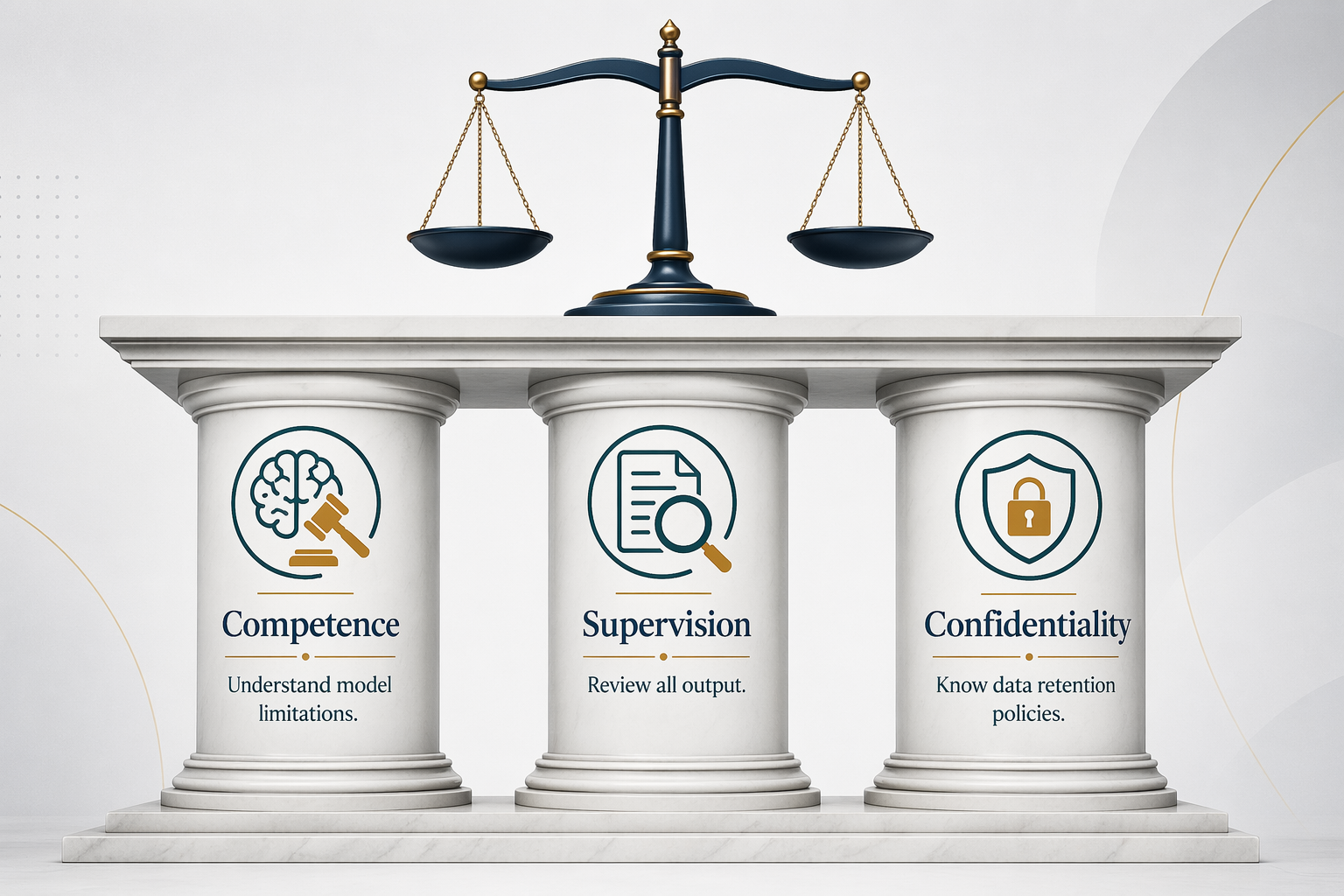
| Duty | What It Requires for Free AI Tools | Common Failure Mode |
|---|---|---|
| Competence (Model Rule 1.1) | Understand that free-tier models hallucinate, lack jurisdiction-specific training, and may produce outdated or fabricated legal content. Know the model's limitations before using it for any legal task. | Treating AI output as equivalent to Westlaw or LexisNexis research without independent verification. |
| Supervision (Model Rule 5.1, 5.3) | Review all AI-generated output against primary sources. Treat AI output as a junior associate's first draft — never as a final product. Verify every citation, statute reference, and legal conclusion. | Submitting AI-generated briefs or memos without human review, as in Mata v. Avianca. |
| Confidentiality (Model Rule 1.6) | Know what the platform does with your input data. Consumer free tiers may train on conversations, retain input indefinitely, or share data with third parties. Never input client-identifying information into a platform that lacks contractual confidentiality guarantees. | Inputting client names, case numbers, or confidential facts into ChatGPT's free tier, which trains on conversations by default. |
The competence duty is particularly demanding for free tools. Unlike legal-specific AI platforms that are fine-tuned on legal corpora and cite primary sources, general-purpose chatbots like ChatGPT, Claude, and Gemini are trained on broad internet data. They may produce confident-sounding legal analysis that is jurisdictionally wrong, based on outdated law, or entirely fabricated. A lawyer who does not understand this limitation cannot satisfy the competence requirement.
Free-Tier Data Retention: What Each Platform Does With Your Input
The confidentiality duty under Model Rule 1.6 requires lawyers to make reasonable efforts to prevent the disclosure of client information. When using a free AI tool, the first question is not what the tool can do — it is what the tool does with the data you enter. The answer varies significantly across platforms.
| Platform | Free Tier Data Retention Policy | Confidentiality Risk Level | Source |
|---|---|---|---|
| ChatGPT (Free Tier) | Trains on conversations by default. Opt-out available in settings. Business and Enterprise tiers do not train on user data. | High — default setting exposes client data to model training. Opt-out reduces but does not eliminate risk. | Clio; 2Civility |
| Claude (Free & Pro) | Does not train on user conversations. Anthropic states it does not use prompts or responses for training without explicit permission. | Lower — but consumer terms of service may not provide contractual confidentiality guarantees for privilege purposes. | ABA; GC AI |
| Gemini (Free Tier) | Uses input data for training. Google's privacy policy permits use of conversations to improve services. | High — input data is used for model improvement. Not appropriate for confidential client information. | ABA |
| Consumer AI Platforms (General) | May retain user input indefinitely. Terms of service often permit review, storage, and sharing of content. | High — Thomson Reuters warns that consumer platforms may create permanent records of confidential attorney-client information. | Thomson Reuters |
The practical implication is clear: a lawyer who inputs client-identifying information into ChatGPT's free tier or Gemini's free tier has likely violated the duty of confidentiality. The platform's terms of service explicitly permit the use of that data for training, and the user has no contractual guarantee of privacy. Even on platforms like Claude that do not train on conversations, the Heppner ruling demonstrates that consumer terms of service may be insufficient to establish the confidentiality required for privilege.
The Anonymous Prompt Technique and Its Limits
Many practitioners have adopted the anonymous prompt technique as a workaround for confidentiality concerns. The approach involves redacting all client identifiers — names, case numbers, court names, specific dates — and using fictionalized or generalized facts when constructing prompts. The goal is to obtain the drafting or analytical benefit of the AI tool without exposing client-identifying information.
The technique has genuine value as a risk-reduction measure. It protects against the most obvious form of confidentiality breach: the disclosure of a client's identity or case-specific details to a platform that may retain or train on that data. For routine drafting tasks — a demand letter template, a standard discovery objection, a generic contract clause — anonymized prompts can be reasonably safe.
However, the anonymous prompt technique has hard limits that every lawyer must understand.
- It does not guarantee privilege. The Heppner ruling's first two prongs — the AI is not an attorney, and consumer terms of service undermine confidentiality — apply regardless of whether the prompt is anonymized. Anonymity does not create an attorney-client relationship.
- It may not prevent re-identification. A sufficiently detailed set of anonymized facts — a merger between two specific industry players, a patent dispute involving a unique technology, a family law matter with an unusual custody arrangement — may still be traceable to a particular client by anyone with context.
- It does not protect against model memorization. Even anonymized prompts may be retained by the platform and could theoretically appear in future training data or outputs to other users.
- It does not satisfy the competence duty. Anonymizing a prompt does not make the AI's output more accurate. Every legal conclusion and citation must still be independently verified.
Jurisdiction-by-Jurisdiction Guide: CA, NY, FL, DC, IL, TX
State bar guidance on AI use varies significantly. While a full 50-state survey is beyond the scope of this article, the following summary covers six key jurisdictions where bar associations have issued formal or informal guidance. Practitioners in other states should consult their local bar's ethics committee.
| Jurisdiction | Key Guidance | Confidentiality Emphasis | Competence Emphasis |
|---|---|---|---|
| California | State Bar has issued practical guidance emphasizing that lawyers must understand AI limitations and protect client confidentiality. No formal ethics opinion as of Q2 2026. | High — California's duty of confidentiality (Bus. & Prof. Code § 6068(e)) is among the broadest in the nation. | High — lawyers must understand the technology they use. |
| New York | New York State Bar Association has published multiple resources on AI ethics. NY rules on supervision and competence are well-established. | High — NY Rule 1.6 prohibits disclosure of confidential information without client consent. | High — NY courts have been active in sanctioning AI-related misconduct. |
| Florida | Florida Bar has issued ethics guidance reminding lawyers of their obligations under Rules 4-1.1 (competence) and 4-1.6 (confidentiality). | High — Florida's confidentiality rule is strict and includes a duty to safeguard client data. | Moderate — guidance focuses on understanding AI limitations. |
| District of Columbia | D.C. Bar has not issued a formal AI-specific ethics opinion but applies existing rules. D.C. Rule 1.6 permits disclosure only in narrow circumstances. | High — D.C.'s confidentiality rule is among the most protective of client information. | Moderate — competence duty applies under D.C. Rule 1.1. |
| Illinois | Illinois Rules of Professional Conduct 1.6 on confidentiality apply directly. 2Civility has published guidance warning that ChatGPT terms do not guarantee privacy. | High — Illinois Rule 1.6 requires reasonable efforts to prevent disclosure. | Moderate — guidance emphasizes understanding AI risks. |
| Texas | Texas State Bar has not issued a formal AI ethics opinion. Texas Disciplinary Rules of Professional Conduct 1.05 (confidentiality) and 1.01 (competence) apply. | High — Texas Rule 1.05 broadly protects confidential client information. | Moderate — competence duty applies under Texas Rule 1.01. |
A Privilege-Safe Workflow: Redaction, Fictionalization, and the No-Client-Identifiers Rule
Drawing together the lessons from Mata, Heppner, and ABA Formal Opinion 512, a privilege-safe workflow for free AI tools can be defined. This workflow does not eliminate risk — no workflow can, given the current state of the law — but it substantially reduces the likelihood of a confidentiality breach or a privilege waiver.
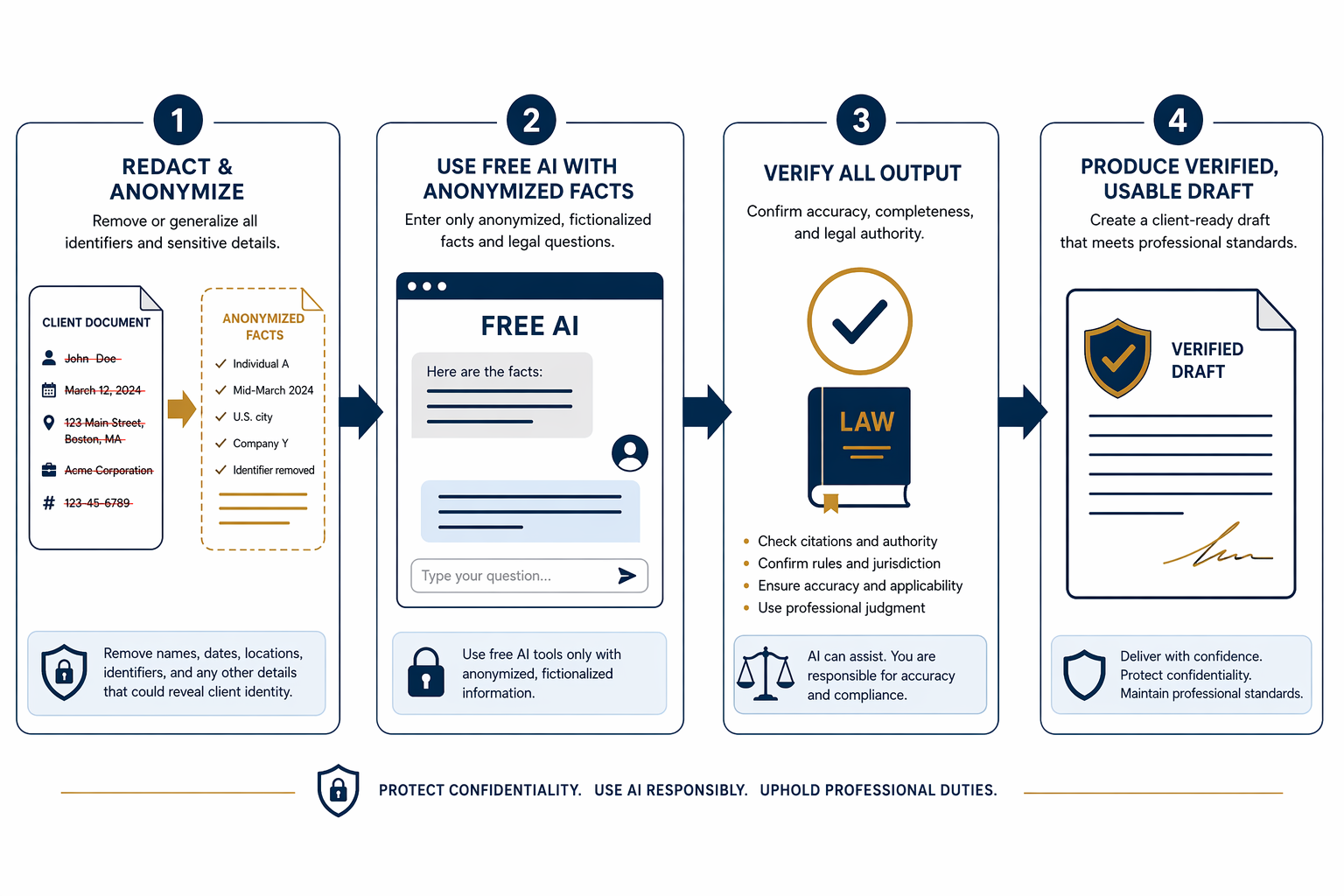
Step 1: Redact All Client Identifiers
Before entering any information into a free AI tool, remove all client names, case numbers, court names, opposing party names, specific dates, and any other information that could identify the client or the matter. Use generic placeholders: Client A, Defendant Corp., Jurisdiction X.
Step 2: Fictionalize Case-Specific Facts
For prompts that require factual context, change non-material details. Alter dates by a few days or weeks. Change dollar amounts by a reasonable margin. Modify industry or product descriptions if they are not central to the legal question. The goal is to preserve the analytical structure of the query while making the specific facts untraceable.
Step 3: Never Input Client Names or Case Numbers
This is the hard rule. No client name, no case number, no docket number, no court name, no opposing counsel name. If a prompt requires this level of specificity to be useful, the task should not be performed on a free consumer-tier AI platform.
Step 4: Treat All Output as a Junior Draft
Every piece of AI-generated output must be independently verified against primary sources. Verify every citation. Check every statute reference. Confirm every legal conclusion. The AI is a drafting assistant, not a research associate. This step is non-negotiable under the competence and supervision duties.
The Kovel Doctrine Workaround After Heppner
For work that touches privileged matter — litigation strategy, settlement analysis, opinion letters — the anonymous prompt technique is insufficient. The Heppner court left open the possibility that privilege could attach under the Kovel doctrine if two conditions are met: (1) the AI use is directed by counsel, and (2) the platform provides contractual confidentiality guarantees. This means using a paid business or enterprise tier with a data-processing agreement, not a free consumer tier.
Checklist for Law Firm AI-Use Policies and When Free Crosses Into Sanctionable Territory
Every law firm that permits the use of free AI tools should have a written AI-use policy. The following checklist covers the essential elements based on the case law and ethics opinions discussed above.
Essential Policy Elements
- Approved tools list: Specify which free AI tools are permitted and which are prohibited. Include data-retention policies for each approved tool.
- Data input rules: Prohibit inputting client-identifying information, confidential facts, or privileged material into any free consumer-tier AI tool.
- Output verification requirements: Mandate independent verification of every citation, statute reference, and legal conclusion against a primary source before the output is used in any work product.
- Training requirement: Require all attorneys and staff to complete training on AI limitations, hallucination risk, and confidentiality obligations before using any AI tool.
- Privilege protocol: Define when free tools may be used (non-privileged, non-confidential tasks only) and when paid business tiers with data-processing agreements are required.
- Supervision chain: Designate who is responsible for reviewing AI-generated output before it is incorporated into client work.
When Free Crosses Into Sanctionable Territory
The line between permissible use and sanctionable conduct is defined by three bright-line rules derived from Mata, Heppner, and ABA Formal Opinion 512.
| Conduct | Ethical Violation | Potential Consequence |
|---|---|---|
| Submitting AI-generated legal research without verifying citations against primary sources. | Violation of Model Rule 1.1 (competence) and Rule 3.3 (candor to the tribunal). | Sanctions, as in Mata v. Avianca. Monetary penalties, adverse credibility findings, potential malpractice exposure. |
| Inputting client-identifying or confidential information into a free consumer-tier AI platform that trains on user data. | Violation of Model Rule 1.6 (confidentiality). | Disciplinary action, loss of privilege (as in Heppner), malpractice liability, client trust account issues. |
| Failing to supervise AI-generated output before it reaches a client or court. | Violation of Model Rule 5.1 (supervisory responsibilities) and Rule 5.3 (non-lawyer assistant supervision). | Firm-level sanctions, vicarious liability for subordinate's misconduct, disciplinary action against supervising attorney. |
| Using a free consumer-tier AI tool for work that touches privileged matter without a data-processing agreement. | Risk of privilege waiver under Heppner reasoning. | Loss of attorney-client privilege, disclosure of confidential strategy to opposing counsel or the court. |
The practical takeaway is that free AI tools are not toys, but they are not traps either. They are powerful drafting assistants when used within well-defined boundaries. The lawyer who understands the model's limitations, protects client confidentiality, and verifies every output can use these tools productively. The lawyer who treats a free chatbot as a legal research engine or a confidential data processor is courting sanctions, privilege waiver, and professional discipline.
Chronological incident history
No sanction cases have named this tool in the tracked record set to date. This does not imply the tool is safe — see Risk Digest for ongoing monitoring.
← Compare peer toolsReport a correction or tip
Spotted an outdated figure, a misstated fact, or a ruling this tool profile should reflect? Public comments are disabled for this content given the professional cost of a misreported case outcome, penalty amount, or rule text — use the structured correction channel instead.
Report a correction or tip for this record →