
Full profile
What EvenUp Is and Why It Matters in Q2 2026
EvenUp was founded in 2019 by three co-founders with direct plaintiff-side personal injury backgrounds. CEO Rami Karabibar came from Waymo and mobility startups; CPO Saam Mashhad is a practicing attorney who observed case value being lost without proper documentation tools; COO Raymond Mieszaniec was motivated in part by a family member's difficult personal injury experience. The company launched as an AI-first operation focused on a single high-value task: generating demand letters grounded in actual settlement data rather than verdict databases.
By October 2025, EvenUp had raised a $150 million Series E round at a valuation exceeding $2 billion — its fourth financing round in roughly two years, bringing total capital raised to $385 million. The round was led by Bessemer Venture Partners, with participation from REV (the venture capital arm of RELX, which owns LexisNexis), B Capital, SignalFire, and Bain Capital, among others. According to EvenUp's own figures, its ARR was doubling year-over-year at the time of the Series E, and its newest AI products accounted for nearly 90% of new sales.
The development that makes a Q2 2026 evaluation particularly timely is the May 13, 2026 launch of PLAAS — Pre-Litigation as a Service. PLAAS converts EvenUp from a software tool into a hybrid AI-plus-staffed managed service that handles the full pre-litigation lifecycle on a firm's behalf. That structural shift — from SaaS vendor to outsourced operations partner — changes the evaluation calculus for any firm considering adoption or renewal. The platform that buyers evaluated in 2024 is not the same platform they are evaluating today.
Full Product Map as of Q2 2026
EvenUp has expanded from a single demand-letter product to a nine-product suite plus a managed service offering in roughly three years. Buyers evaluating the platform need an accurate current inventory before assessing fit. The table below maps the full suite as of Q2 2026 based on EvenUp's own product announcements and blog posts.
| Product | Primary Function | Key Capability |
|---|---|---|
| Demands | AI-generated demand letters | Draws on case file data and anonymized settlement benchmarks to produce structured demand packages |
| Express Demands | Accelerated demand generation | Faster-turnaround variant for straightforward cases; reduced review cycle |
| AI Drafts — Mirror Mode | Style-matched document generation | Firms upload a winning draft; subsequent documents mirror its language, structure, and tone (announced Oct 2025) |
| AI Drafts — Firmwide Knowledge Base | Institutional standards enforcement | Applies a firm's documented standards automatically across all AI-drafted outputs (announced May 2026) |
| MedChrons | Medical chronology generation | Extracts and structures treatment timelines from uploaded medical records |
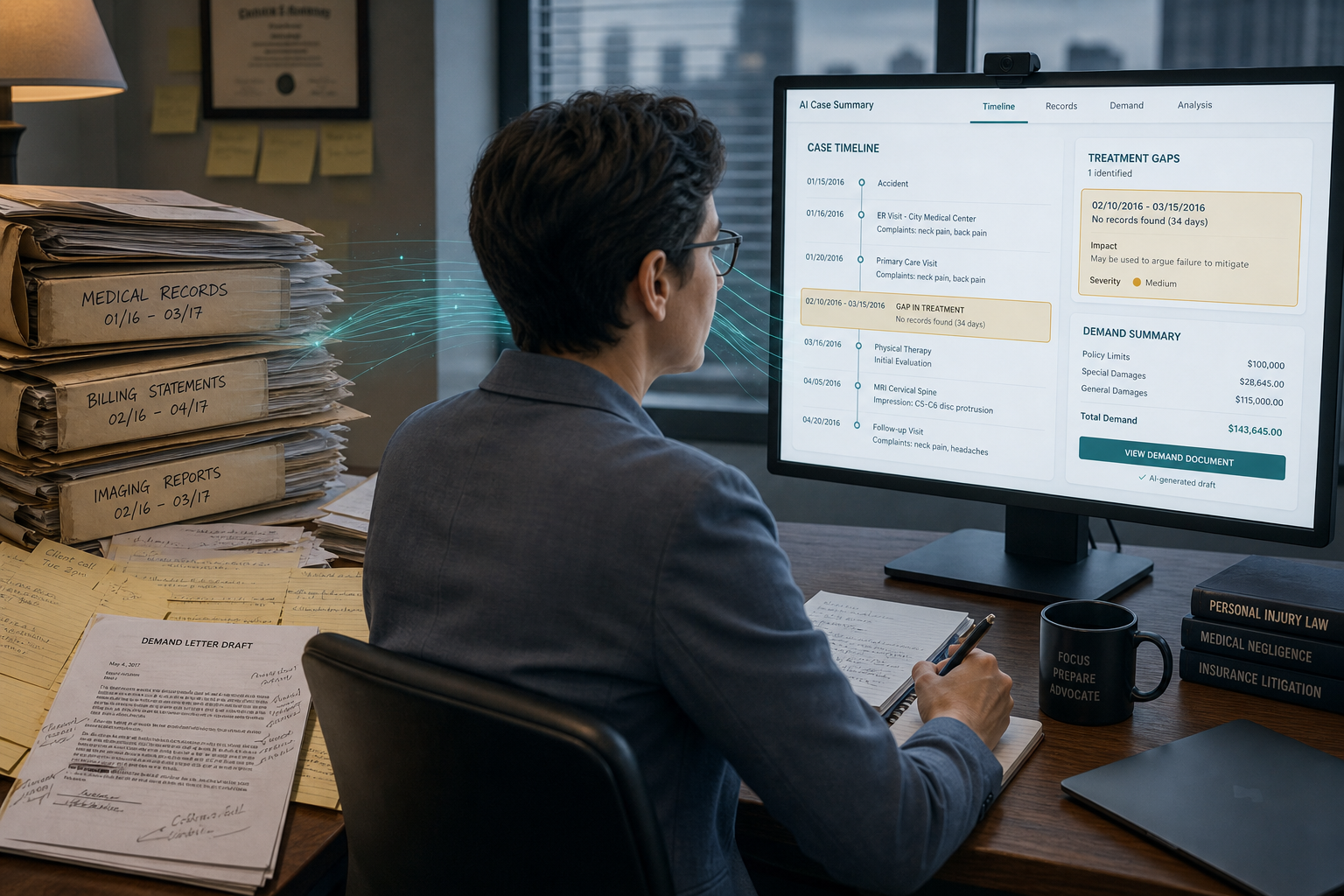
| Medical Management | Treatment gap monitoring | Interactive timeline of client treatment history, expenses, and upcoming appointments; flags 30-day treatment gaps |
| Treatment Check-In Agents | Automated client check-ins | AI-powered SMS and voice check-ins in English and Spanish; part of Communication Agents suite |
| Case Companion / Companion AI | Firmwide operating center | Updated to surface high-value cases, flag missing MRIs or undiagnosed TBIs, and prioritize docket attention (updated May 2026) |
| Smart Workflows | Proactive case lifecycle management | Sends demands at optimal timing, follows up on treatment gaps, flags missing documentation |
| PLAAS | Managed pre-litigation operations | Full pre-litigation lifecycle managed by EvenUp's U.S.-based staff plus AI: claim setup through settlement negotiation (launched May 2026) |
The Piai Architecture: How EvenUp's AI Works
EvenUp calls its underlying AI system Piai. According to EvenUp's own technical blog, the architecture has two distinct layers designed to address a specific problem: general-purpose language models generate outputs from broad world knowledge, which in legal contexts produces plausible-sounding but factually unreliable content. EvenUp's design attempts to constrain outputs to what is actually in the case file.
- Reading Layer: Processes unstructured legal documents — medical records with varied formats, handwriting, checkboxes, faxed pages — and extracts structured, domain-specific data: medical provider names, dates of service, treatment sequences, and treatment alignment. Each entity type has its own dedicated model. EvenUp states this layer is refined by thousands of expert user edits daily, drawing on feedback from attorneys, paralegals, and internal legal specialists.
- Writing Layer: Generates document outputs — demand letters, medical chronologies, negotiation sheets — using the structured extractions from the Reading Layer as its factual constraint. EvenUp describes this as outputs being "constrained by the output of the Reading Layer rather than general world knowledge." The intent is that the Writing Layer cannot fabricate a treatment that is not in the medical records, because it is drawing on extracted case-file data rather than probabilistic text generation.
EvenUp states the system has been trained on hundreds of thousands of PI cases and millions of medical records. The daily feedback loop — where user corrections and expert edits are incorporated into the Reading Layer models — is the mechanism EvenUp cites for continuous accuracy improvement.
The design rationale is meaningful: a two-layer extraction-then-generation architecture does reduce the hallucination surface compared to prompting a general-purpose LLM directly. However, the residual error surface lies in the Reading Layer itself. If the extraction is wrong — a misread date, a missed provider, an incorrectly classified treatment — the Writing Layer will generate a document that is internally consistent but factually incorrect relative to the underlying records. EvenUp's human-review layer is intended to catch these errors before documents leave the platform, but the architecture does not eliminate the risk; it relocates it.
Performance Claims: What EvenUp Reports and What the Evidence Supports
EvenUp publishes a set of performance figures across its marketing materials, press releases, and investor communications. These figures are widely cited in coverage of the company. Buyers should understand what each figure represents, where it comes from, and what it does not tell them.
| Claim | Figure | Source | Evidence Quality |
|---|---|---|---|
| Cases resolved on platform | 200,000+ | EvenUp press releases and blog (Oct 2025, May 2026) | Self-reported; no independent audit |
| Total damages secured | $14 billion | EvenUp PLAAS launch announcement (May 2026); earlier figure was $10B+ | Self-reported; methodology not disclosed |
| Cases processed per week | 10,000+ | EvenUp PLAAS launch announcement (May 2026) | Self-reported |
| Top 100 PI firm penetration | 30% of top 100 U.S. PI firms | EvenUp PLAAS launch announcement (May 2026); was 20% as of Oct 2025 | Self-reported; ranking methodology not specified |
| Policy-limit likelihood improvement | 69% greater likelihood of reaching policy limits | EvenUp blog post on AI accuracy | Self-reported; comparison baseline not specified |
| Missing document reduction | 75% reduction in missing documents per case | EvenUp blog post on AI accuracy | Self-reported; baseline methodology not disclosed |
| Settlement case study | $50,000 initial offer → $1.75 million settlement | Bain Capital Ventures investor blog post | Investor-sourced; single anecdote, not representative sample |
| PLAAS policy-limit recovery | 95% of available third-party policy limits | EvenUp PLAAS launch announcement (May 2026) | Self-reported early results; no independent verification |
The 69% policy-limit figure deserves particular scrutiny. EvenUp states that firms using its platform have a 69% greater likelihood of reaching policy limits on every case. The claim does not specify the comparison population, the time period, whether it controls for case mix, or whether it reflects a pre/post analysis of the same firms or a cross-sectional comparison. A 69% relative improvement in policy-limit outcomes would be a substantial effect; without a disclosed methodology, buyers cannot assess whether the figure reflects causal platform impact or selection effects (i.e., that higher-performing firms are more likely to adopt EvenUp).
The $50,000-to-$1.75 million settlement anecdote, cited in a Bain Capital Ventures blog post, describes a single attorney using EvenUp's Case Companion to dismantle opposing arguments at mediation, resulting in a dramatically improved settlement. Bain Capital is an EvenUp investor. The anecdote illustrates a plausible use case but is not evidence of typical outcomes.
Pricing Model: Per-Case Economics and What Buyers Should Know
EvenUp moved to a per-case pricing model in May 2025. The structure aligns with the economics of contingency-fee personal injury firms: rather than paying a flat monthly subscription regardless of case volume, firms pay per case processed. For high-volume practices with predictable caseloads, this model makes cost forecasting more straightforward — the platform cost scales with the revenue-generating activity.
EvenUp does not publish a public rate card. Actual per-case pricing is not disclosed on the company's website, and the announcement of the per-case model did not include specific rates. Competitive analysis from ProPlaintiff.ai — a direct EvenUp competitor, so the observation should be treated accordingly — confirms that EvenUp does not publish fixed self-serve pricing and that the platform increasingly positions as a broader enterprise sale rather than a lightweight subscription. Firms should expect a premium quote and plan for a direct sales engagement rather than a self-serve signup.
PLAAS Deep Dive: When Your Vendor Becomes Your Operations Partner
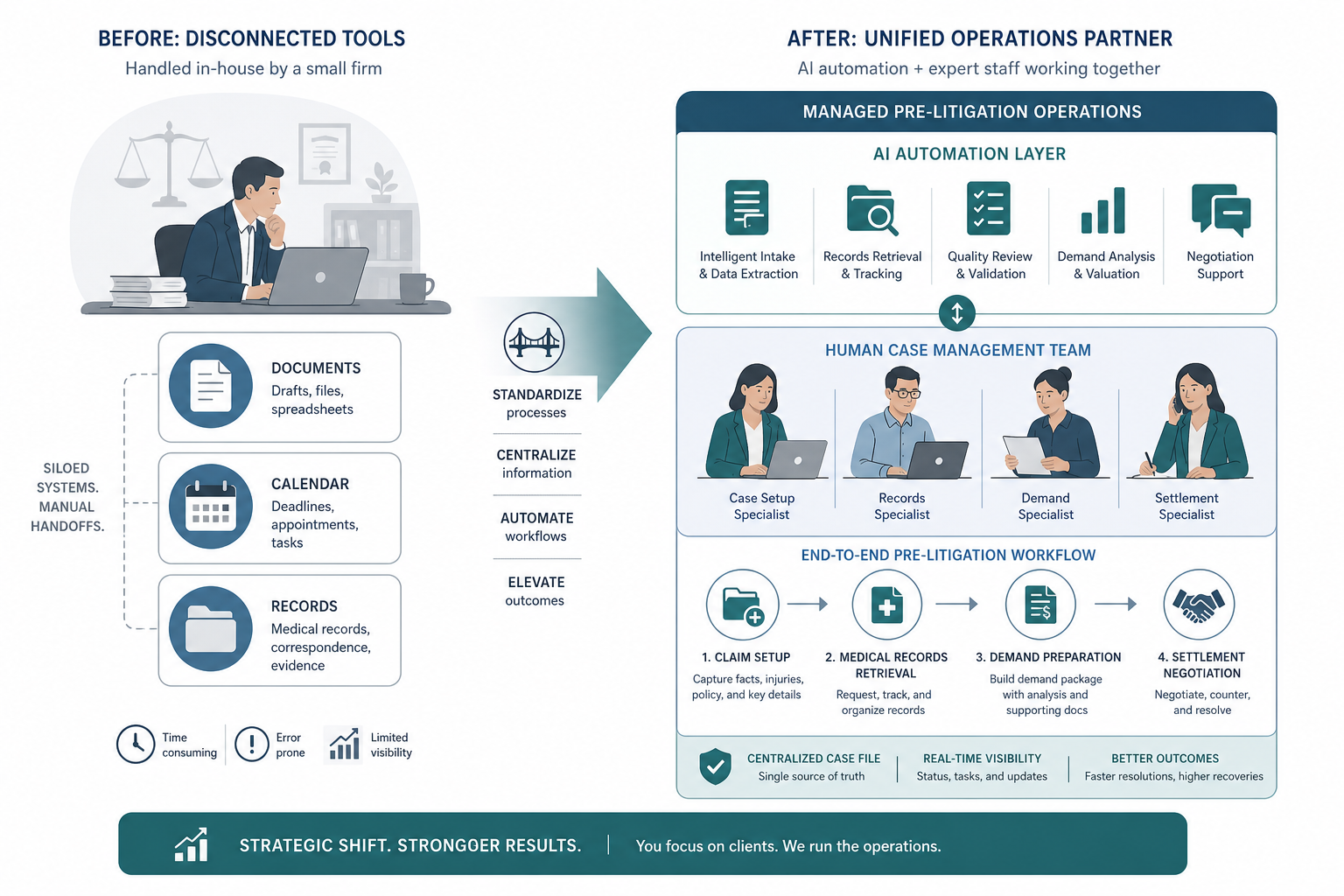
PLAAS — Pre-Litigation as a Service — was publicly launched on May 13, 2026. It combines EvenUp's AI platform with U.S.-based case management staff employed by EvenUp to manage the full pre-litigation lifecycle on behalf of subscribing firms. The scope covers claim setup and investigation, care coordination, medical records and bills retrieval, demand preparation to the firm's documented standards, settlement negotiation with carriers, and optional lien resolution.
EvenUp frames PLAAS as a response to structural pressures in the PI industry: private equity consolidation, national firm expansion, staffing shortages, rising attrition among case managers, and growing caseload complexity. Its launch blog post describes case managers as "often responsible for hundreds of files requiring coordination across treatment, medical records, and drafting, making consistency difficult" — and positions PLAAS as "not a tool layered onto existing workflows, but a fundamentally different way of operating."
Early Outcome Figures (EvenUp-Sourced)
- 95% of available third-party policy limits recovered (EvenUp launch announcement; methodology not disclosed)
- Medical records requested 66 days faster than baseline (EvenUp launch announcement; baseline definition not specified)
- Demands delivered 47 days faster (EvenUp launch announcement)
- Time a case sits on a desk reduced by up to three months (EvenUp launch announcement)
- Approximately $1,000 per case in carrying cost savings (EvenUp launch announcement)
- More than $10 million in PLAAS subscriptions sold before public launch (EvenUp launch announcement)
What the Model Shift Means for Firms
The PLAAS structure introduces dynamics that are qualitatively different from a SaaS subscription. When EvenUp's staff is conducting settlement negotiations on a firm's behalf, the firm is not simply licensing a tool — it is delegating substantive case management functions to a vendor. Several implications follow:
- Supervision obligations: Attorneys retain professional responsibility for the work product and case outcomes regardless of who performs the underlying tasks. Delegating to a vendor's staff does not transfer the supervising attorney's ethical obligations under ABA Model Rules 5.1 and 5.3.
- Vendor dependency: Firms that integrate PLAAS deeply into their operations are building dependency on EvenUp's continued service, pricing stability, and staffing quality. Exit costs — rebuilding internal case management capacity — will be higher than switching a SaaS tool.
- Liability surface: When a vendor's staff makes a case management error, the question of how liability is allocated between the firm and EvenUp will depend on contract terms that are not publicly disclosed. Firms should obtain and review PLAAS service agreements before signing.
- Client relationship: Settlement negotiations conducted by EvenUp staff are conducted on the firm's behalf. Clients may not know that a vendor's employees — not the firm's attorneys — are negotiating their settlements. Disclosure and consent considerations should be reviewed with ethics counsel.
Attorney Supervision and Ethics Obligations
EvenUp's platform includes a human-review layer: its own legal professionals review AI-generated outputs before they are delivered to firms. This is a meaningful quality control step, but it does not satisfy the attorney's independent professional obligation to review work product before using it in a client matter.
Under ABA Model Rule 1.1 (Competence), attorneys are required to understand the technology they use in client matters sufficiently to supervise it. Under Model Rule 5.3, attorneys who use nonlawyer assistance — including AI tools and vendor staff — must ensure the work is conducted in a manner consistent with the attorney's professional obligations. EvenUp's human-review layer is EvenUp's quality control process; it is not a substitute for the attorney's own competent review.
The Communication Agents Question
EvenUp's Treatment Check-In Agents conduct routine client check-ins via SMS and voice in English and Spanish. These are described as AI-powered tools — meaning the communication is initiated and conducted by an AI system, not a human case manager.
This raises an ethics question that published bar guidance has not fully addressed as of Q2 2026: when an AI system conducts communications with a client in the context of an attorney-client relationship, what disclosure obligations apply? Who is the communicating party from the client's perspective? Does the client understand they are interacting with an AI rather than a human?
ABA Model Rule 1.4 requires attorneys to keep clients reasonably informed about the status of their matter and to communicate in a way that enables clients to make informed decisions. Whether AI-conducted check-ins satisfy that obligation — and whether they require disclosure that the communication is AI-generated — is not definitively resolved in any published formal ethics opinion as of this review date.
Competitive Context: Where EvenUp Leads and Where Alternatives Are Stronger
This section provides brief competitive orientation only. A full multi-platform comparison of plaintiff-side PI AI tools is a separate editorial direction. Competitive characterizations of EvenUp's rivals are drawn in part from competitor-published sources and carry self-promotional framing; they are noted accordingly.
| Platform | Relative Strength | Source of Characterization |
|---|---|---|
| EvenUp | Settlement operations, document generation, full pre-litigation workflow coverage, PLAAS managed service | EvenUp press materials; corroborated by funding scale and adoption figures |
| Supio | Deep medical record analysis, litigation preparation support | ProPlaintiff.ai (competitor source; self-promotional framing) |
| Eve Legal | AI-agent orchestration across the full plaintiff lifecycle; raised $103M Series B at $1B+ valuation (Sept 2025) | Artificial Lawyer trade press coverage |
Fit Assessment: Which Firm Profiles Benefit Most — and Least
EvenUp's platform is not a universal fit. The following criteria are based on the platform's documented capabilities, pricing structure, and PLAAS model — not on EvenUp's marketing characterizations of its target customer.
Firms That Benefit Most
- High-volume plaintiff-side PI firms processing 50 or more cases per month, where per-case pricing aligns cost with revenue and where documentation consistency across a large docket is a genuine operational problem.
- Contingency-fee practices that need to scale case output without proportional headcount growth — the core value proposition of both the AI suite and PLAAS.
- Firms experiencing staffing pressure in case management roles, where the PLAAS model offers an alternative to recruiting and retaining internal staff in a competitive labor market.
- Firms that have already standardized on a documented demand style and can supply EvenUp with the training material needed to activate Mirror Mode and the Firmwide Knowledge Base effectively.
- Firms comfortable with managed-service dependency and willing to engage in detailed contract review of PLAAS terms, including liability allocation and exit provisions.
Firms That Benefit Least
- Small firms or solo practitioners with low case volume, where per-case pricing at a premium rate may not produce a favorable cost-per-case ratio compared to lighter-weight alternatives.
- Firms that need post-litigation support — legal research, deposition preparation, trial strategy, or appellate work. EvenUp does not cover these stages.
- Firms with existing case management infrastructure they are not prepared to restructure, where PLAAS integration would require significant workflow redesign rather than additive tooling.
- Firms that require transparent, self-serve pricing to complete a procurement process — EvenUp's opaque pricing model requires a direct sales engagement that may not fit all buying cycles.
- Firms with significant concerns about AI-initiated client communication and no bandwidth to conduct the ethics review that Communication Agents deployment requires before rollout.
| Fit Dimension | Strong Fit | Weak Fit |
|---|---|---|
| Case volume | 50+ cases/month | Under 20 cases/month |
| Fee structure | Contingency-fee plaintiff practice | Hourly or hybrid billing |
| Litigation stage | Pre-litigation through settlement | Trial preparation, appellate, post-judgment |
| Staffing model | Seeking to scale without headcount | Stable internal case management team |
| Vendor relationship tolerance | Comfortable with managed-service dependency | Preference for lightweight, replaceable SaaS tools |
| Pricing process | Can engage in direct enterprise sales | Requires self-serve pricing transparency |
Editorial Assessment and Methodology Note
EvenUp occupies a distinctive position in the plaintiff-side PI market. Its two-layer Piai architecture represents a meaningful design departure from general-purpose LLM use. Its product suite is more complete than any comparable platform in the pre-litigation PI workflow. Its funding trajectory — $385 million raised at a $2 billion valuation, with a fourth round in two years — reflects sustained institutional conviction that is unusual even in a well-funded legal tech sector. The PLAAS launch extends the platform's ambition further than any competitor has matched publicly.
At the same time, an honest evaluation requires stating clearly what this profile cannot confirm. Every headline performance figure — the 69% policy-limit improvement, the 75% missing-document reduction, the 95% PLAAS policy-limit recovery, the $14 billion in damages — is self-reported by EvenUp or sourced from EvenUp investors. No independent third-party benchmark study of the platform's accuracy or outcome impact has been published. PLAAS is weeks old as of this review and has no independent performance record. The ethics questions around AI-initiated client communication have not been resolved by published bar guidance.
Firms that find EvenUp a plausible fit should request firm-specific outcome data, ask EvenUp to disclose the methodology behind its headline metrics, obtain and review PLAAS service agreement terms before signing, and conduct an ethics review of Communication Agents deployment with qualified ethics counsel. The platform's market position is well-supported by observable evidence; its performance claims are not yet independently verifiable.
Comments
Join the discussion with an anonymous comment.