
Full profile
As of Q3 2026, Coca-Cola’s Fairlife ransomware disclosure is still a story with too many open facts to support tidy conclusions. The July 16, 2026 Form 8-K says Coca-Cola learned that Fairlife LLC, its wholly owned subsidiary, experienced a ransomware incident, that the company was investigating, and that it had not yet determined whether the incident was reasonably likely to materially impact Coca-Cola’s financial condition or results of operations.[1] That is the legal problem in miniature: the parent company spoke before the facts had settled.
The point is not that Coca-Cola has admitted materiality. It has not. Nor is the point that every subsidiary ransomware event automatically becomes a parent-company securities event. The better reading is narrower and more useful: when the compromised subsidiary is operationally important, and when the incident reaches production systems rather than only office IT, the parent’s lawyers may have to make disclosure, board-process, contract, insurance, and supply-chain judgments before the final incident report exists.

That makes the Fairlife ransomware attack different from the usual data-breach discussion, and it sharpens the legal implications for businesses with operating subsidiaries. Public reporting described a production suspension at Coca-Cola’s U.S. dairy unit, not merely an investigation into stolen files.[2] Dairy-sector reporting likewise treated the incident as a shutdown affecting U.S. production and discussed the knock-on questions for food producers, suppliers, and force majeure planning.[3] Those facts do not prove liability. They do explain why a subsidiary incident can climb quickly from plant management to the parent company’s disclosure committee.
The Filing Matters Because It Came Before Certainty
Coca-Cola filed the Fairlife disclosure under Item 8.01, not Item 1.05.[1] That distinction matters because Item 8.01 is the general voluntary disclosure bucket, while Item 1.05 is the specific cybersecurity incident item used when a registrant determines that a cybersecurity incident is material. Coca-Cola’s filing language preserved that distinction: it disclosed the existence of the incident while saying the company had not yet determined materiality.[1]
For counsel who want a narrower treatment of that timing issue, Coca-Cola’s Fairlife Breach Tests the SEC Materiality Clock goes deeper on the Item 8.01 versus Item 1.05 question. The governance point here is adjacent but not identical: a parent company may need a disclosure channel for a subsidiary cyber event before it can responsibly finish the materiality analysis.
That is not an eccentric approach. Greenberg Traurig’s 2025 review of cybersecurity Form 8-K filings found that, among 41 companies filing cyber incident 8-Ks between April 2024 and early 2025, 26 used Item 8.01 and 15 used Item 1.05.[4] The numbers do not tell us whether Coca-Cola’s judgment was correct; they show that companies have been using Item 8.01 to say something publicly while materiality analysis remains in motion.
The hard part for parent-company legal teams is that the materiality file is rarely clean in the first day or two. The security team may not know whether data left the environment. The plant may know that production is down but not how long it will stay down. Commercial teams may be guessing which customers will receive short shipments. Finance may be working from ranges that are too preliminary for comfort. Meanwhile, investor-relations, the disclosure committee, and outside counsel are asking whether silence itself has become risky.
| Known from the public materials | Still uncertain as of the early public record | Governance consequence |
|---|---|---|
| Coca-Cola disclosed a ransomware incident involving wholly owned subsidiary Fairlife. | Whether Coca-Cola would ultimately determine the incident to be material. | The parent needed a process for public disclosure before final materiality certainty. |
| The disclosure used Item 8.01 rather than Item 1.05. | Whether an Item 1.05 amendment would later become necessary. | Counsel had to preserve the distinction between incident existence and materiality determination. |
| Public reporting described a production suspension at the dairy unit. | The final duration, financial effect, data-exfiltration status, attribution, and ransom details. | The legal review had to include operations, contracts, supply, and insurance, not only privacy. |
Subsidiary Separateness Does Not End the Parent’s Reporting Problem
Lawyers are trained to respect entity boundaries. That habit is useful until it becomes a substitute for analysis. In a securities disclosure setting, the question is not whether the subsidiary has its own officers, payroll, plant managers, contracts, and insurance program. The question is what the incident means for the registrant that reports to the market on a consolidated business.
Coca-Cola’s filing is instructive precisely because it did not treat Fairlife’s subsidiary status as the end of the conversation. The parent company made the disclosure. It described the incident at Fairlife. It stated that the company was evaluating the impact.[1] Those are procedural facts, but governance lawyers should not dismiss procedural facts. In cyber events, process is often the only thing available before technical certainty arrives.
This is where Item 106 of Regulation S-K matters. The SEC’s cybersecurity rules require registrants to disclose processes, if any, for assessing, identifying, and managing material risks from cybersecurity threats, including whether such risks have materially affected or are reasonably likely to materially affect the registrant.[5] The SEC also stated that the rules require disclosure about management’s role in assessing and managing material cybersecurity risks and the board’s oversight of those risks.[5]
The rule does not create a special subsidiary-ransomware doctrine. It does not say that every plant outage at a subsidiary is material to the parent. But it does pull subsidiary cybersecurity into the parent’s governance field when subsidiary operations can affect the registrant’s risk profile. A board cannot credibly oversee cybersecurity risk at the parent level if the most consequential production dependencies sit in subsidiaries that never appear in the board materials except as financial line items.
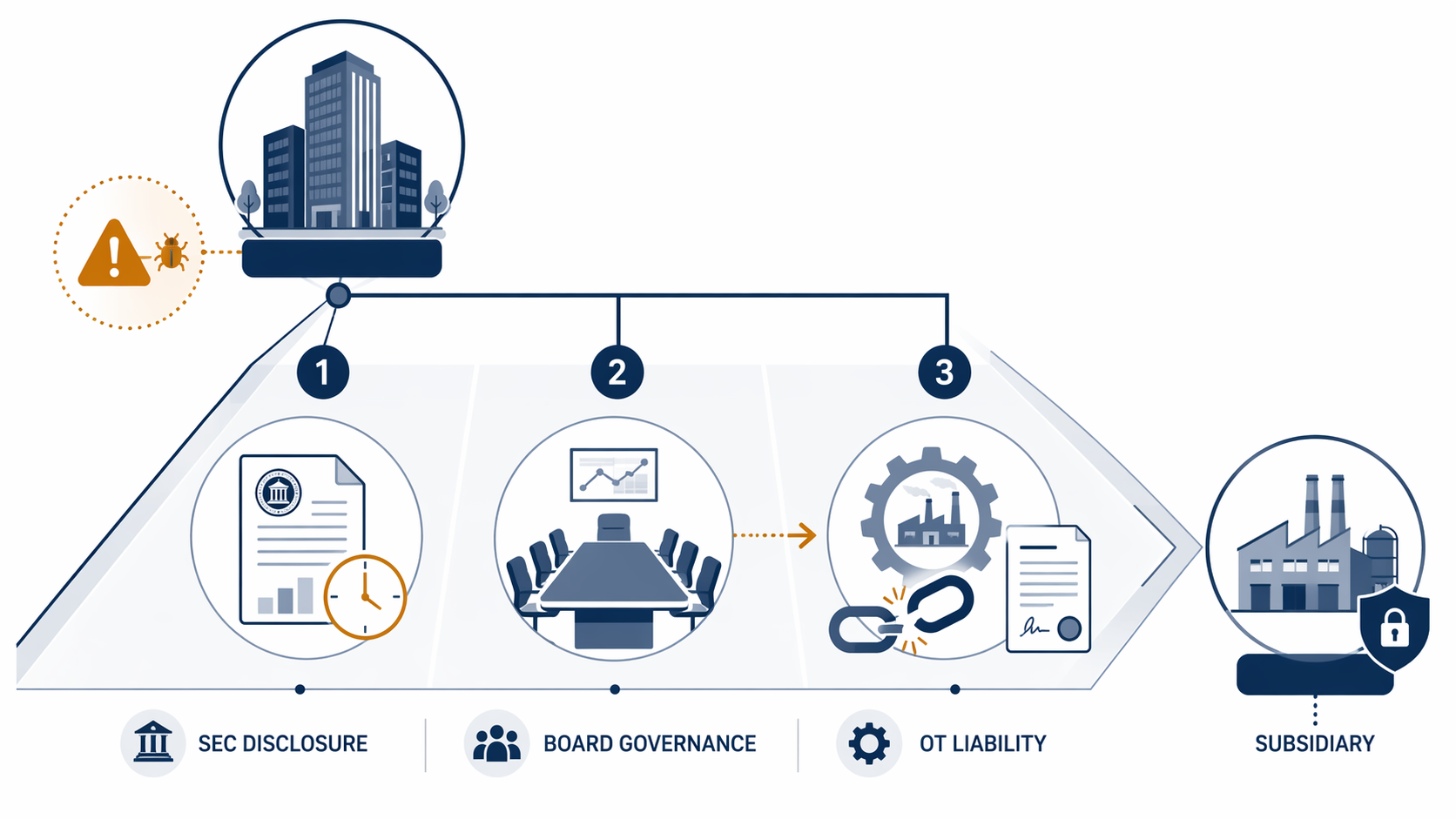
That is the first governance blind spot exposed by the Fairlife incident: some organizations can produce a subsidiary org chart faster than they can produce a cyber escalation map. The plant may know whom to call for incident response. The parent legal department may know whom to call for securities disclosure. What is often less clear is who translates a frozen production line into revenue exposure, customer obligations, insurance notice, board reporting, and draft disclosure language.
Board Oversight Has to Reach the Plants That Can Move the Numbers
A parent board does not need to manage a subsidiary’s security tools. It does need a reporting structure that tells directors which subsidiary systems can interrupt consolidated operations, which management body owns that risk, and how quickly a serious incident reaches the right committee. In a manufacturing group, that means the board’s cyber oversight cannot stop at enterprise email, cloud identity, and personal information databases.
Operational technology changes the oversight question. A corporate laptop outage and a production-system outage may both involve ransomware, but they create different legal consequences. The first may begin with containment, credentials, notifications, and data review. The second adds product flow, customer allocation, spoilage or quality controls, carrier schedules, supplier commitments, and plant restart governance. The legal department that waits for the forensic report before asking those questions is already late.
Item 106 makes this more than good practice. It asks registrants to describe board oversight and management processes for cybersecurity risk.[5] If a company’s disclosed process says management evaluates material cybersecurity risks across the enterprise, but in practice subsidiary production systems report through a separate operational chain with no tested path to the disclosure committee, the paper process will look better than the real one. That is usually where governance problems begin.
The Fairlife facts available now do not prove that Coca-Cola had such a gap. Coca-Cola’s public filing shows an escalation occurred. It does not reveal the internal board process, the subsidiary reporting cadence, or the speed of operational impact assessment.[1] The lesson is not an accusation against Coca-Cola. It is a reminder that parent companies should be able to answer, before an incident, which subsidiary outage scenarios are board-reportable, disclosure-committee-reportable, insurer-reportable, and customer-reportable.
The OT Problem Is Legal, Not Just Technical
The most important feature of the Fairlife incident is not the ransomware label. It is the reported production suspension.[2][3] Manufacturing lawyers understand why that distinction matters. Once production stops, the incident is no longer contained inside the security function. Sales asks what can be shipped. Procurement asks whether alternative inputs or facilities are available. Commercial lawyers read supply agreements. Insurance counsel checks notice language. Finance tries to convert downtime into exposure. Someone eventually asks whether the board has been told.
That is why OT ransomware tends to expose legal work that should have been done months earlier. A company can negotiate a force majeure clause without deciding who will determine whether a cyber-caused plant outage qualifies. It can buy business interruption coverage without testing whether subsidiary downtime, contingent business interruption, restoration costs, and waiting periods line up with the actual manufacturing footprint. It can promise customers allocation procedures without rehearsing who has authority to invoke them when production data is incomplete.
- Contract review should identify which customer, supplier, tolling, logistics, and private-label agreements are triggered by delayed production rather than data compromise.
- Insurance review should test whether the named insureds, subsidiaries, covered systems, waiting periods, and notice obligations fit an OT outage scenario.
- Disclosure review should connect operational downtime to revenue, margin, customer concentration, and reputational exposure without waiting for final forensic attribution.
- Board reporting should distinguish ordinary incident-response updates from outage scenarios that can affect consolidated results or strategic supply relationships.
Food and agriculture is not an exotic corner case for this work. Food and Ag-ISAC reported an 82% surge in ransomware, from 3,508 total attacks in 2024 to 6,377 in 2025, and described roughly 205 food and agriculture attacks in 2026, about 4.9% of all attacks.[6] Those figures measure reported ransomware activity, not legal liability. Still, they make it difficult for food, beverage, and agriculture boards to treat production ransomware as an unforeseeable novelty.
The recent history is familiar enough to be uncomfortable: JBS in 2021, Dole in 2023, UNFI in 2025, and now Fairlife in 2026. The factual details differ, and those examples should not be flattened into one template. Their shared lesson is more modest: ransomware affecting food and distribution operations can become an enterprise continuity issue, not merely an IT security event.
What Parent Legal Teams Should Have Mapped Before the Outage
The practical failure mode is usually not that nobody cared about cybersecurity. It is that each function held a different map. Security had an incident map. Operations had a plant map. Legal had an entity map. Finance had a consolidation map. Commercial had a customer-priority map. The parent company needs one escalation map that can survive the first forty-eight hours of uncertainty.
That map does not need to answer every question in advance. It does need to identify the questions that become legally important before they become technically settled: which subsidiaries operate systems whose outage could affect consolidated results; which contracts treat cyber events, plant shutdowns, labor disruption, supplier failure, or governmental action differently; which insurance policies require notice from the subsidiary, the parent, or both; and which officers can authorize disclosure when materiality is still being evaluated.
| Governance area | Question to test before an incident | Why Fairlife makes it visible |
|---|---|---|
| SEC disclosure | Can the parent disclose incident existence without prematurely claiming a materiality determination? | Coca-Cola used Item 8.01 while stating that materiality had not yet been determined. |
| Board oversight | Do directors receive reporting on subsidiary OT systems that can affect consolidated operations? | The reported production suspension made subsidiary operations relevant to parent-level risk assessment. |
| Contracts | Which agreements are triggered by delayed output rather than stolen data? | A plant-level outage can create performance questions before any privacy analysis is complete. |
| Insurance | Do cyber, property, business interruption, and contingent business interruption policies align across the parent-subsidiary structure? | An OT incident can create overlapping notice and coverage questions. |
| Supply chain | Who decides allocation, substitution, customer communications, and restart priorities? | Food and beverage production interruptions can move quickly into customer and supplier relationships. |
There is a discipline to keeping these questions separate. A securities lawyer should not dress up every operational inconvenience as material. A privacy lawyer should not assume the legal center of gravity is exfiltration. A commercial lawyer should not wait for the ransom note to decide whether delivery obligations are in play. A board advisor should not accept “subsidiary issue” as a complete answer when the subsidiary sits inside the registrant’s consolidated risk profile.
The Fairlife incident does not establish that Coca-Cola failed in any of these respects. It does not settle materiality, attribution, ransom demand, data exfiltration, coverage, customer claims, or litigation exposure. It does show why a parent company’s legal team cannot wait for a clean post-incident narrative before deciding whether a subsidiary OT outage has become a parent-company governance problem.
References
- Form 8-K, The Coca-Cola Company, July 16, 2026, SEC EDGAR
- Ransomware attack forces Coca-Cola to suspend US production at dairy unit, Cybersecurity Dive
- Fairlife Cyberattack Shuts Down U.S. Production, Dairy Herd
- SEC Cybersecurity Disclosure Trends: 2025 Update, Greenberg Traurig
- SEC Adopts Rules on Cybersecurity Risk Management, Strategy, Governance, and Incident Disclosure by Public Companies, U.S. Securities and Exchange Commission
- Navigating the 2025 Food and Agriculture Sector Ransomware Landscape, Food and Ag-ISAC
Comments
Join the discussion with an anonymous comment.