
Full profile
The hard part is rarely knowing whether generative AI was used. The hard part is the five minutes before filing, when the team has a court, an assigned judge, a deadline, and a document that may trigger a judge-specific AI disclosure or certification requirement. For that job, the best starting point is the Ropes & Gray AI Court Order Tracker: free, practical, and built around the kind of court-and-judge lookup a filing team actually needs. It is still only a starting point.
As of March 2026, more than 300 federal and state judges required some form of AI disclosure or certification, but that figure should be treated as a moving operational signal rather than a stable legal count. The number changes as judges issue, revise, and withdraw standing orders, and the available materials do not independently verify every order one by one. The more important compliance fact is narrower and more useful: only Hawaii and Nebraska have district-wide federal AI disclosure rules; in most federal courts, the obligation remains judge by judge.[1]
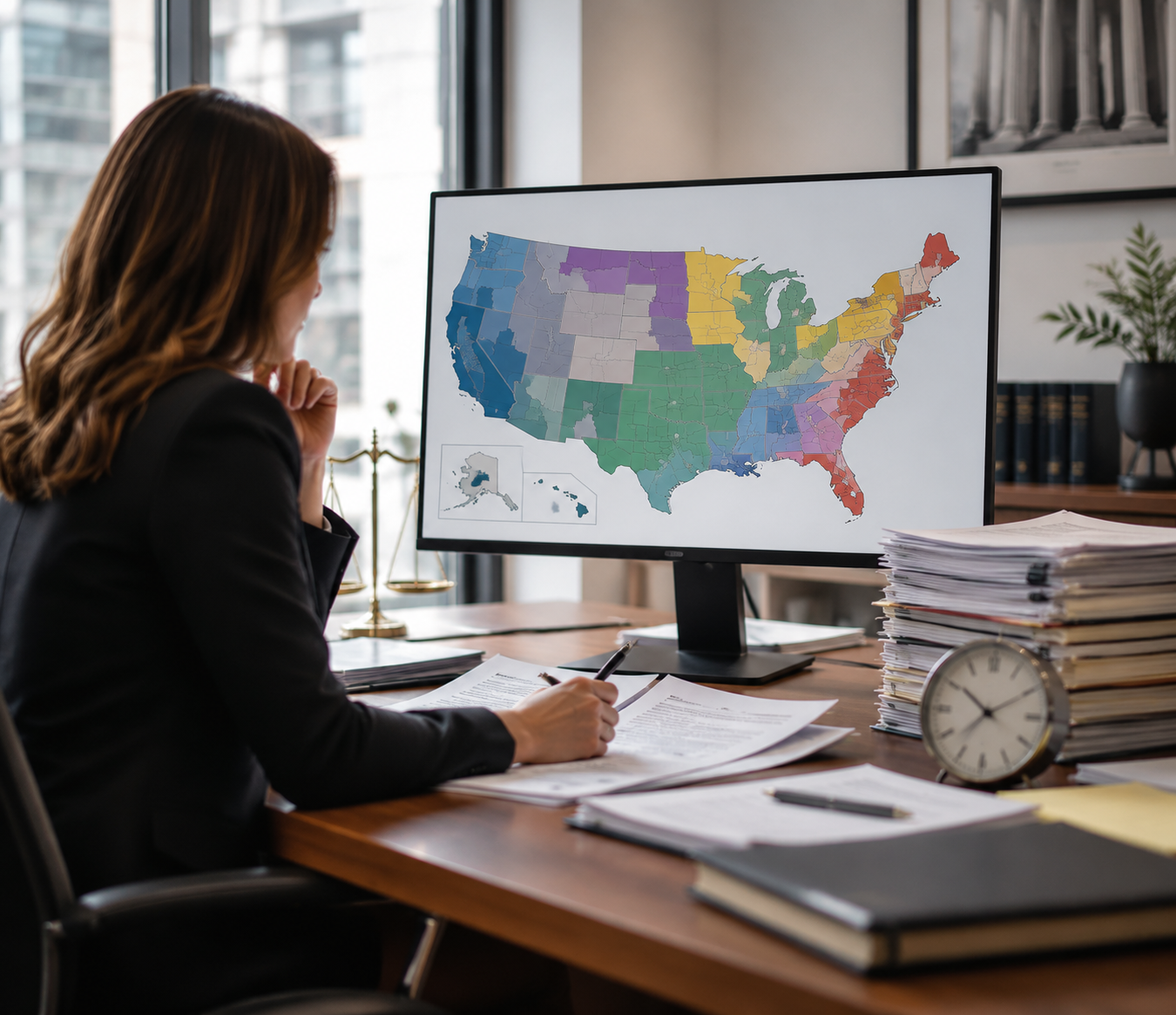
Tracker Options Before a Federal Filing
| Tracker | Best use | Main limit |
|---|---|---|
| Ropes & Gray AI Court Order Tracker | Primary day-to-day lookup for court and judge-level AI orders; free interactive map with color-coded requirement types | Tracker details are partly described through secondary summaries, and the order itself still controls |
| Law360 Pulse | Subscription-based monitoring with a federal-court focus | Paywalled; not a replacement for reading the standing order |
| Bloomberg Law | Subscription comparison table for legal research teams already using Bloomberg Law | Paywalled; useful as a cross-check rather than the only control |
| LexisNexis | Subscription coverage across state and federal developments | Broad coverage can be valuable, but the filing question still turns on the assigned court and judge |
| RAILS | Open-source historical view of AI legal rules and court materials | No longer updated after May 2025, so it should not be used as the current filing check |
| Law Tech AI Policy Tracker | Free broader policy monitoring beyond federal court standing orders | Broader policy scope makes it less direct for last-mile federal filing compliance |
Ropes & Gray carries the main compliance load because it matches the filing problem: find the jurisdiction, find the judge, identify the type of AI requirement, then move to the actual order. Its value is not that it is law. Its value is that it reduces the chance that a team overlooks a judge-level requirement while searching scattered standing orders under time pressure.[1]
Subscription tools can still matter. Law360 Pulse may be useful for teams that want federal court monitoring inside a news and litigation intelligence workflow.[2] Bloomberg Law’s comparison table can help research teams that already work in that platform and want a second organized view.[3] LexisNexis is relevant where state and federal AI requirements both matter to the same practice group.[4] Those tools are not inferior because they sit behind paywalls; they are simply harder to standardize as the office-wide first stop if not every filer has access.
RAILS and the Law Tech AI Policy Tracker serve different purposes. RAILS is open-source, but because it is no longer updated after May 2025, it is risky as a current pre-filing control.[5] The Law Tech AI Policy Tracker is useful for broader AI policy awareness, but a federal filing team needs a tighter answer: what does this court, this judge, and this order require today?[6]
A Pre-Filing Workflow That Does Not Depend on Memory
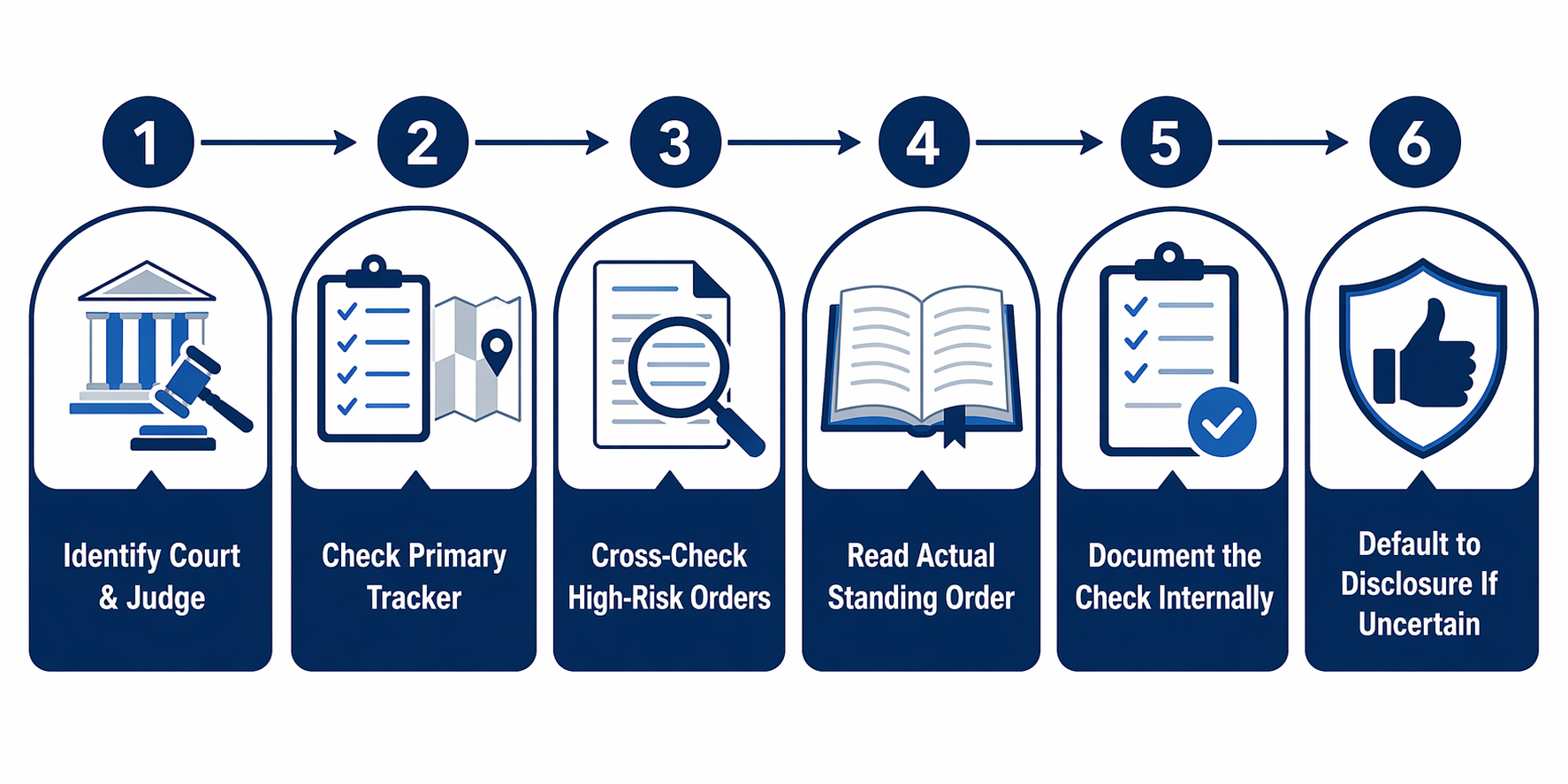
A workable AI disclosure process should be boring enough to repeat on every federal filing. It should not depend on whether the associate remembers a webinar, whether the paralegal has seen that judge before, or whether the partner happens to know that a standing order was revised.
- Identify the court, division if relevant, assigned judge, magistrate judge if involved, and filing type.
- Check the Ropes & Gray tracker first for the court and judge.
- Cross-check with a subscription tracker or court source when the filing is high-stakes, the judge is unfamiliar, or the tracker entry is unclear.
- Read the actual standing order, local rule, or court-wide rule before deciding what to file.
- Document the check internally: date, source checked, judge, order reviewed, and disclosure decision.
- When uncertainty remains, default to a conservative disclosure rather than silence.
The fourth step is the one that saves the file. A tracker can tell the team where to look; it cannot interpret the exact wording of an order for a specific filing. Some judges require disclosure when generative AI was used to draft or prepare a filing. Some require certification that citations and legal content were checked by a human. Some orders reach broader “AI assistance” language. Some are narrower. The filing decision belongs to the actual text.
The fifth step is the one that saves the process. If a question later comes from chambers, a client, or a malpractice reviewer, “we usually check the tracker” is not much of an answer. A short internal note is better: who checked, when, what source was checked, what court order was opened, and why the team disclosed or did not disclose. That note does not need to be elaborate. It needs to show that the decision was made, not assumed.
For teams that want to study the wording of common federal standing orders rather than only compare trackers, the internal guide Federal Court AI Standing Orders: Disclosure Requirements Explained is the better next stop.
Why Judge-Level Variation Changes the Compliance Burden
Uniform local rules are easier to operationalize. Judge-by-judge orders are not. A firm can train once on a district-wide rule in Hawaii or Nebraska, but in most federal courts the filing team still has to identify the assigned judge and check that judge’s current requirements. That is why an AI disclosure rules federal courts tracker is not just a research convenience; it is a calendar-adjacent filing control.[1]
The orders now visible in federal practice generally fall into three patterns. The most common is mandatory disclosure and certification. Orders associated with judges such as Judge Brantley Starr in the Northern District of Texas and Judge Vernon Broderick in the Southern District of New York are examples of this model: the lawyer must disclose certain AI use and/or certify that AI-generated content has been reviewed.[1]
A much less common model is outright prohibition. Orders associated with Judge Michael Newman in the Southern District of Ohio and Judge Christopher Boyko in the Northern District of Ohio are examples cited in current tracker summaries. These are the entries a tracker needs to surface clearly because a disclosure form will not fix a filing that violates a no-use order.[1]
The third model is responsibility-based: the court does not impose a special AI disclosure requirement but emphasizes existing duties such as Rule 11 review, verification, and lawyer responsibility. The Eastern District of Missouri, District of Connecticut, Southern District of Texas, and Fifth Circuit are identified with this approach in available summaries.[1]
Those categories are useful only up to the point where the team opens the order. A tracker label may say “certification” or “disclosure,” but the actual burden may turn on whether AI drafted text, summarized authorities, generated citations, translated material, edited style, or assisted in research. If the order’s trigger is broader than the team’s internal AI policy, the order wins.
Why Conservative Disclosure Is the Safer Tie-Breaker
The enforcement pattern is not subtle. Courts have sanctioned lawyers for AI-related filing failures, hallucinated authorities, and breakdowns in verification. Reported examples do not identify sanctions imposed because a lawyer conservatively disclosed AI use when disclosure was not strictly required.
In Mata v. Avianca, the Southern District of New York imposed a $5,000 sanction in 2023 after a filing relied on fabricated cases generated through AI use.[7] That case became the basic warning label for legal AI: the problem was not curiosity about a new tool; it was filing unverifiable legal authority with the court.
Johnson v. Dunn shows the escalation. In 2025, the Northern District of Alabama ordered disqualification and a bar referral in connection with AI-related litigation conduct.[8] Whatever the precise local wording, that is no longer the posture of a court treating AI misuse as a harmless novelty.
Whiting v. City of Athens pushed the point to the appellate level. In March 2026, the Sixth Circuit imposed $15,000 per attorney in sanctions in an AI-related matter.[9] For a filing team, the lesson is operational: the cost of a missed order or unverified AI output is borne after the deadline, when the record is already made.
Disclosure-by-default does not mean confessing irrelevant technology use in every document. It means that when an applicable order is ambiguous, when the team cannot tell whether a tool’s role fits the trigger language, or when the filing is high-stakes and the judge has signaled concern about AI, silence should not be the default. A short, accurate disclosure is usually easier to defend than a later explanation that no one was sure the order applied.
State Rules Confirm the Direction, but Federal Filing Still Starts With the Judge
Statewide developments matter because they show that AI disclosure and certification are moving from individual experimentation toward formal procedural governance. Florida Supreme Court Rule 2.515(d)(2), effective June 15, 2026, is one example.[10] New York has also adopted a statewide rule addressing AI use.[11]
Those developments should not distract from the federal filing task. If the case is in federal court, the team still needs the district, assigned judge, and current order. Statewide movement may support a broader firm policy, but it does not answer whether today’s federal filing needs a certification, disclosure, prohibition analysis, or ordinary Rule 11 treatment.
The Operating Rule
Use Ropes & Gray as the primary tracker for routine federal AI disclosure checks. Use Law360 Pulse, Bloomberg Law, LexisNexis, or another paid source as a cross-check when access and risk justify it. Do not rely on RAILS for current compliance after May 2025. Use broader policy trackers for awareness, not as the final filing control.
Then open the actual order. No tracker is authoritative enough to replace the standing order, local rule, or court instruction that governs the filing. The defensible process is to check the best available tracker, verify the primary source, document the decision, and disclose conservatively when the line is unclear. The documented sanction risk sits on non-disclosure, misuse, and unverifiable AI-generated work, not on careful transparency.
References
- AI Court Order Tracker — Ropes & Gray
- Law360 Pulse federal AI court order coverage — Law360 Pulse
- Bloomberg Law AI court rules comparison table — Bloomberg Law
- LexisNexis AI legal developments tracker — LexisNexis
- RAILS AI legal tracker — RAILS
- Law Tech AI Policy Tracker — Law Tech
- Mata v. Avianca, Inc. — U.S. District Court for the Southern District of New York, 2023
- Johnson v. Dunn — U.S. District Court for the Northern District of Alabama, 2025
- Whiting v. City of Athens — U.S. Court of Appeals for the Sixth Circuit, March 2026
- Florida Supreme Court Rule 2.515(d)(2) — Florida Supreme Court, effective June 15, 2026
- New York statewide AI rule — New York courts
Comments
Join the discussion with an anonymous comment.