
Full profile
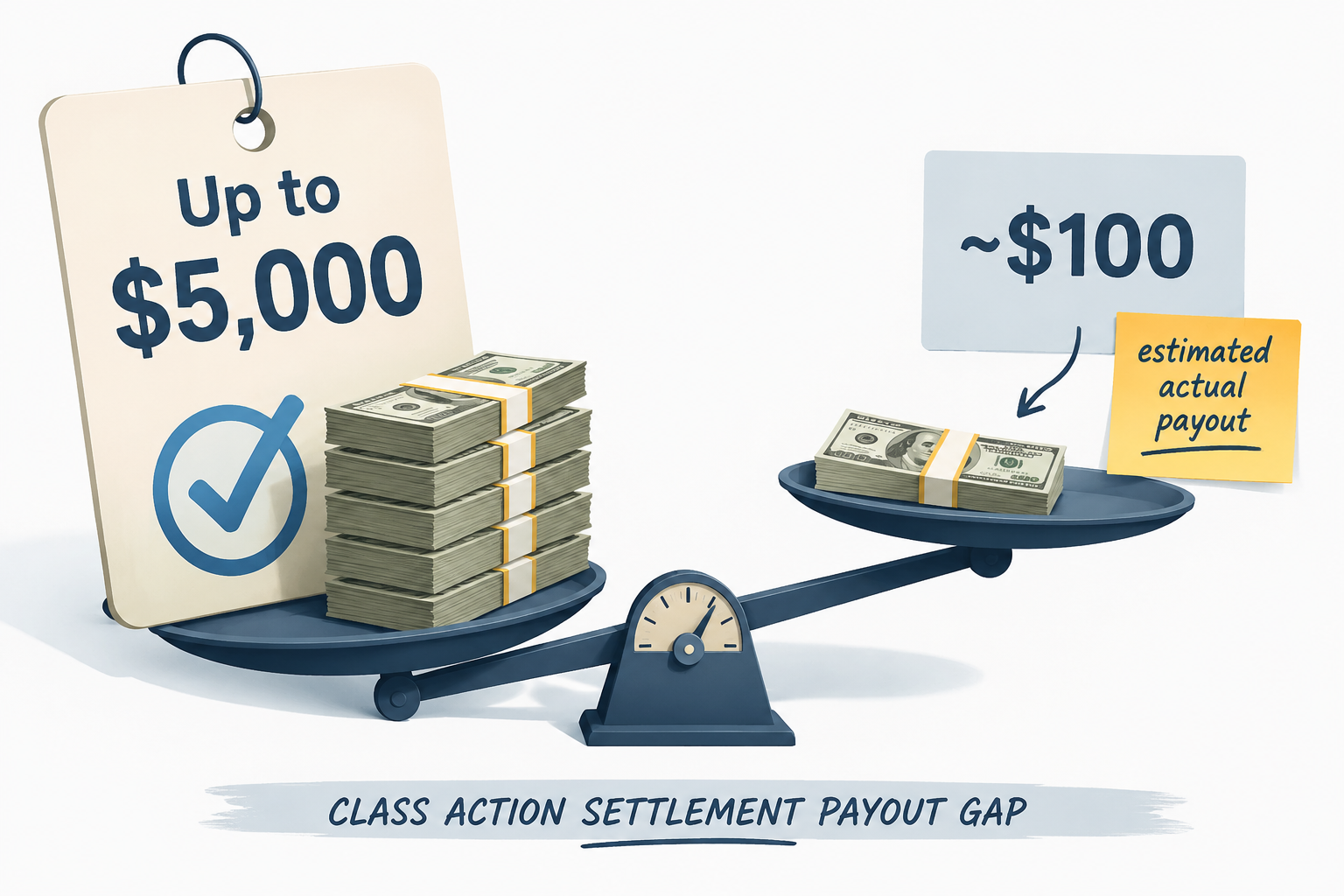
The first correction to make in any conversation about Fidelity data breach payout eligibility is the headline number. The settlement advertises reimbursement of up to $5,000, but that tier is for class members who can document qualifying out-of-pocket losses. A class member who files without documented losses is looking instead at an estimated pro rata cash payment of about $100 or less, with the final amount changing based on how many valid claims are submitted.
The controlling place to start is the official settlement website, not a news headline. The site identifies the July 27, 2026 claim deadline, the available benefits, and the basic filing mechanics for the $2.5 million Fidelity data breach class action settlement.[1] The official FAQ adds the practical detail that estimated cash payments may be larger or smaller depending on claim volume.[2]
For a lawyer, compliance officer, or client-service professional fielding a worried Fidelity customer’s question, the working answer is narrow: determine whether the person falls into one of the settlement class paths, ask whether they have proof of breach-related losses, check whether California statutory relief applies, and make sure any cash claim is submitted by July 27, 2026. This is an administrative answer, not a fault determination.
Who Qualifies
The settlement class is not limited only to people who remember receiving a notice email or postcard. The official materials describe eligibility through direct notice from Fidelity and through exposure of financial account and routing numbers in the incident.[1][2] That distinction matters because a client who did not receive, kept, or recognize a notice may still need to check whether their information falls within the exposed-account-number group.
Public reporting places the class at roughly 155,000 to 163,000 people, combining 77,099 individuals directly notified by Fidelity with about 86,000 people whose financial account and routing numbers were exposed.[3][4] Those are useful scale estimates for counseling, but they should not be treated as a final claims count. The number that affects ordinary cash payments is the number of valid claims actually filed by the deadline.
- Direct-notice path: the person received notice from Fidelity or the settlement administrator identifying them as part of the settlement class.
- Exposed-account path: the person’s financial account number and routing number were exposed, even if they were not directly notified.
- California path: a qualifying California resident may also be eligible for a separate CCPA statutory payment, depending on the settlement criteria.
- Cash-claim path: anyone seeking a cash payment must submit a valid claim rather than assume inclusion alone produces a check.
This is also where client counseling should slow down. “I bank with Fidelity” is not the same thing as “I am in the settlement class.” The claim form and notice materials should be checked against the client’s identifiers, notice information, and exposure category before any expectation of payment is created.
The Benefit Tiers Are Doing Most of the Work
The settlement’s structure explains why the $5,000 figure and the likely ordinary payout sit so far apart. The official materials identify several forms of relief: documented-loss reimbursement up to $5,000, an estimated pro rata cash payment for claimants without documented losses, a California CCPA payment, and two years of CyEx Financial Shield Complete credit monitoring with $1 million in fraud insurance.[1][2]
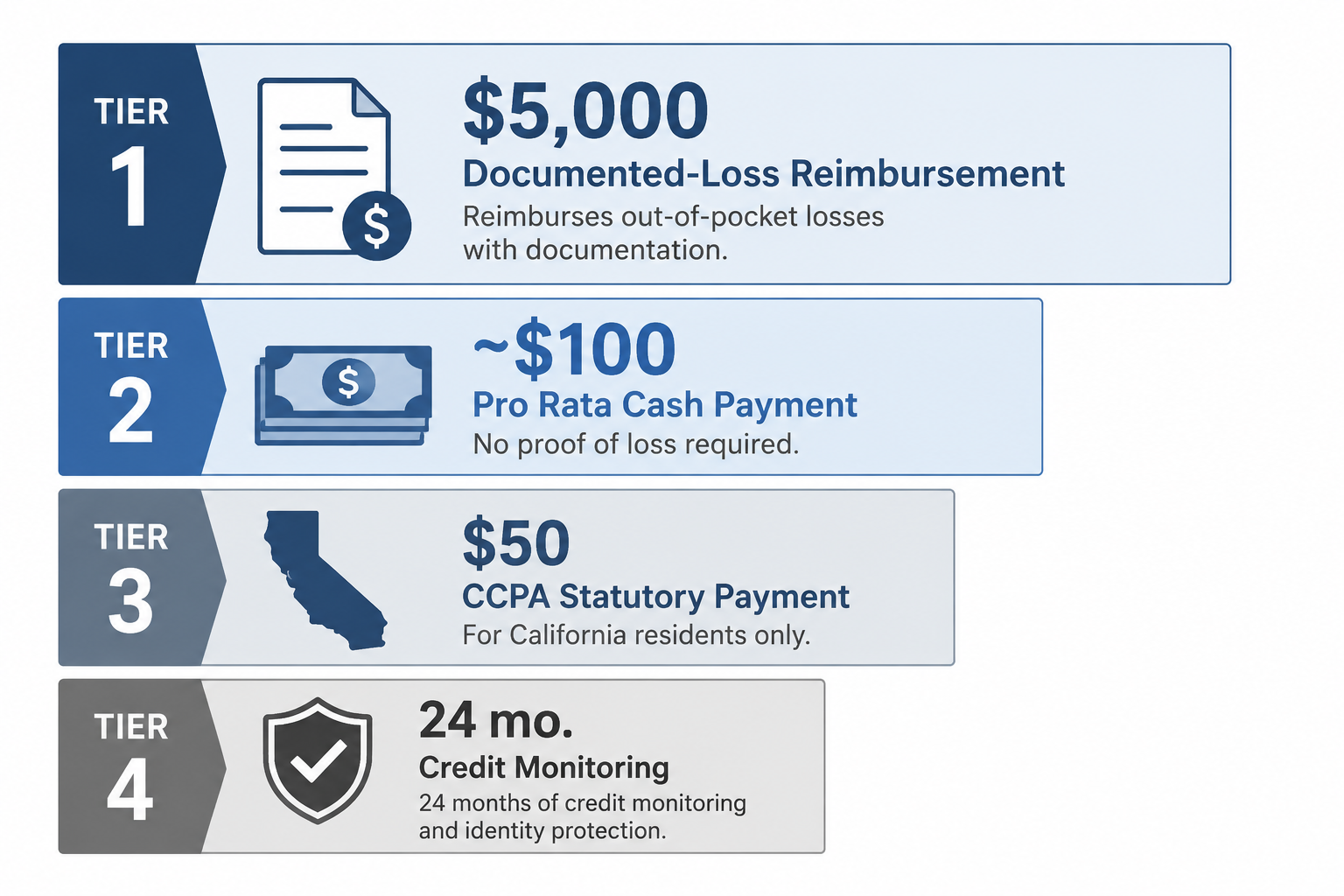
| Benefit | Who It Is For | What The Client Must Show | Practical Expectation |
|---|---|---|---|
| Up to $5,000 documented-loss reimbursement | Class members with qualifying losses tied to the breach | Documentation of losses and required claim information | Potentially meaningful, but proof-dependent |
| Estimated pro rata cash payment | Class members without documented losses who submit a valid claim | No documented loss required, but a claim must be filed | Estimated around $100 or less; final amount depends on claim volume |
| $50 California CCPA payment | Qualifying California residents | California eligibility under the settlement criteria | A separate statutory-style payment, subject to the settlement terms |
| Two years of credit monitoring | Class members under the settlement materials | Enrollment or availability as described by the administrator | Identity-protection relief, not a cash substitute |
The documented-loss tier is the only place the “up to $5,000” number belongs. It is not a default payment, a guaranteed payment, or a ceiling that most claimants should expect to approach. The class member needs proof: records showing an unreimbursed loss that fits the settlement’s requirements, not just anxiety after learning that personal or financial information may have been exposed.
The no-proof cash option is different. It is designed for class members who qualify for the settlement but cannot document losses. The estimated amount is about $100 or less, and the FAQ warns that the payment may increase or decrease depending on the total number of valid claims.[2] That is the number most likely to matter in an ordinary eligibility call.
California residents need a separate check of the CCPA component. The settlement materials and public reporting describe a $50 California statutory payment for eligible California class members.[2][3] That should not be confused with the CCPA’s statutory damages range generally; this settlement resolves claims at negotiated amounts rather than paying every affected person the maximum statutory measure.
Credit monitoring is useful, but it answers a different problem than a cash claim. Two years of monitoring with fraud insurance may help a class member watch for later misuse, yet it does not reimburse time, inconvenience, bank follow-up, or documented unreimbursed loss. A client asking whether the settlement is “worth filing” is usually asking about the cash tiers, not only monitoring.
Why the Ordinary Payment Is So Much Smaller Than $5,000
The gross settlement fund is $2.5 million.[1] Reported settlement terms include attorney fees of up to one-third of the fund, about $833,000, plus $45,000 in costs and $2,500 service awards for each of five named plaintiffs.[5] Before any tiered distribution, a rough per-capita view of a 155,000-to-163,000-person class puts the fund at only about $15 to $16 per person, and that is before fees, costs, service awards, administrative expenses, documented-loss claims, California payments, and claim-rate effects.
That arithmetic does not make the settlement meaningless. It does make the headline maximum a poor shorthand for client expectations. A small claims-made payment may still be rational for someone who would otherwise recover nothing, especially if the claim form is straightforward. But a professional should not let a client hear “up to $5,000” as “I am likely to receive thousands.”
This gap is common in data breach settlements. General settlement-economics commentary notes that data breach resolutions often use claims-made structures, proof requirements, and negotiated funds that do not translate into equal per-person payments.[6] That observation is useful background only; the Fidelity payout analysis still has to come from this settlement’s actual fund, class definition, benefit tiers, and filed-claim volume.
How to File Before the Deadline
Claims must be submitted by July 27, 2026.[1] The safest practical instruction is to use the official settlement website and claim form, review the FAQ before choosing a benefit tier, and keep a copy of what was submitted. If a class member is claiming documented losses, the supporting records should be gathered before filing rather than described from memory.
- Confirm class membership through the notice, claim identifiers, or exposed-account-number eligibility path.
- Decide whether the client has documented losses or should use the no-proof pro rata cash option.
- Check whether California residency and the settlement’s CCPA criteria apply.
- Submit the claim by July 27, 2026, and retain confirmation and supporting records.
- Explain that the final payment amount cannot be known until valid claims and any post-approval issues are resolved.
The final approval hearing was held on July 9, 2026.[1][5] That does not mean checks necessarily go out immediately. Distribution timing depends on the court’s final approval process and whether appeals are filed, a point that should be stated plainly to anyone expecting a near-term payment.
The best file note for a professional is not “client wants Fidelity payout.” It is the benefit election, the basis for eligibility, the evidence reviewed, the deadline communicated, and the rights consequence discussed. In a settlement like this, those details are the difference between useful guidance and a vague promise of recovery.
What Happened in the Breach, Briefly
Fidelity previously disclosed that personal data of 77,099 customers was exposed in a 2024 incident.[7] Later settlement reporting describes a broader population that includes people whose financial account numbers and routing numbers were exposed.[3][4] For eligibility work, the second point matters more than the technical description of the intrusion, because it affects who may be able to claim even without a direct notice.
The settlement also sits beside regulatory scrutiny. Wealth Management reported that Massachusetts Secretary of State William Galvin fined Fidelity $1.25 million in an April 2026 consent order and required remediation measures, including hiring an independent cybersecurity consultant. The same report said hackers accessed about 373,000 unique document images through 23.7 million automated requests after creating two fake customer accounts.[8]
Those facts explain why clients may be alarmed. They do not change the claims analysis. Settlement eligibility and payout amounts turn on the class definition, claim form, benefit tier, documentation, state-specific relief, and deadline.
The Waiver Problem
The most easily missed counseling point is not the amount of the ordinary payment. It is the consequence of doing nothing. Settlement materials explain that class members who do not exclude themselves are bound by the settlement’s release of breach-related claims.[2] In practical terms, a class member may receive no cash payment because they did not file a claim, while still losing the ability to bring released claims against Fidelity over the incident.
That does not mean every class member should object, opt out, or file an individual case. It means the choice should be conscious. A person with no documented loss may decide that a modest pro rata payment is enough. A person with documented unreimbursed loss needs to evaluate whether the reimbursement tier fits their records. A person considering separate litigation needs legal advice on exclusion and claim preservation, not just settlement-administrator instructions.
The cleanest professional answer is therefore restrained: if the client is eligible and wants any cash recovery from the settlement, a claim must be filed by July 27, 2026; if they have documented losses, proof matters; if they are a qualifying California resident, the CCPA payment should be considered; and if they do nothing, they should understand the release consequence. This article is informational and is not legal advice for any individual claimant.
References
- In re: Fidelity Investments Data Breach Litigation — Official Settlement Website
- Official FAQ
- Fidelity Data Breach Settlement: How to Claim Part of the $2.5M Payout — CNBC Select
- Fidelity settlement payouts up to $5K. See who qualifies — USA Today
- $2.5M Fidelity Investments Settlement Ends Litigation Over August 2024 Data Breach — ClassAction.org
- Value of Personal Information and Data Breach Class Action Settlements — Edgeworth Economics
- Fidelity says data breach exposed personal data of 77,000 customers — TechCrunch
- Fidelity to Pay $1.25M Over 2024 Data Breach — Wealth Management
Comments
Join the discussion with an anonymous comment.