
Full profile
The most useful entry point into Flock Safety’s privacy litigation and AI surveillance legal issues is not a law-school hypothetical. It is Los Angeles, where the LAPD suspended use of 138 Flock cameras on July 11, 2026, after questions about how plate data could be accessed and shared through the system.[1] A suspension is not a merits ruling, and it does not prove that a camera network is unlawful. It does show something more immediate for public agencies and their lawyers: the legal status of an ALPR program can become a procurement problem before an appellate court supplies a clean answer.
That matters because Flock’s appeal to cities is operationally obvious. Police departments use automated license plate readers to search for stolen vehicles, locate suspect vehicles, and move faster than a patrol officer manually reading plates. The legal trouble begins when a local camera network, adopted through a municipal agenda item or private-property contract, becomes part of a much larger query layer. The legal surface area is not just the camera on the pole. It is the policy document that may not exist, the sharing toggle that may have been enabled, the out-of-state query that leaves no city councilmember’s district, and the downstream agency that uses the hit for a purpose the original purchaser never debated.

The Five Fronts Now Moving At Once
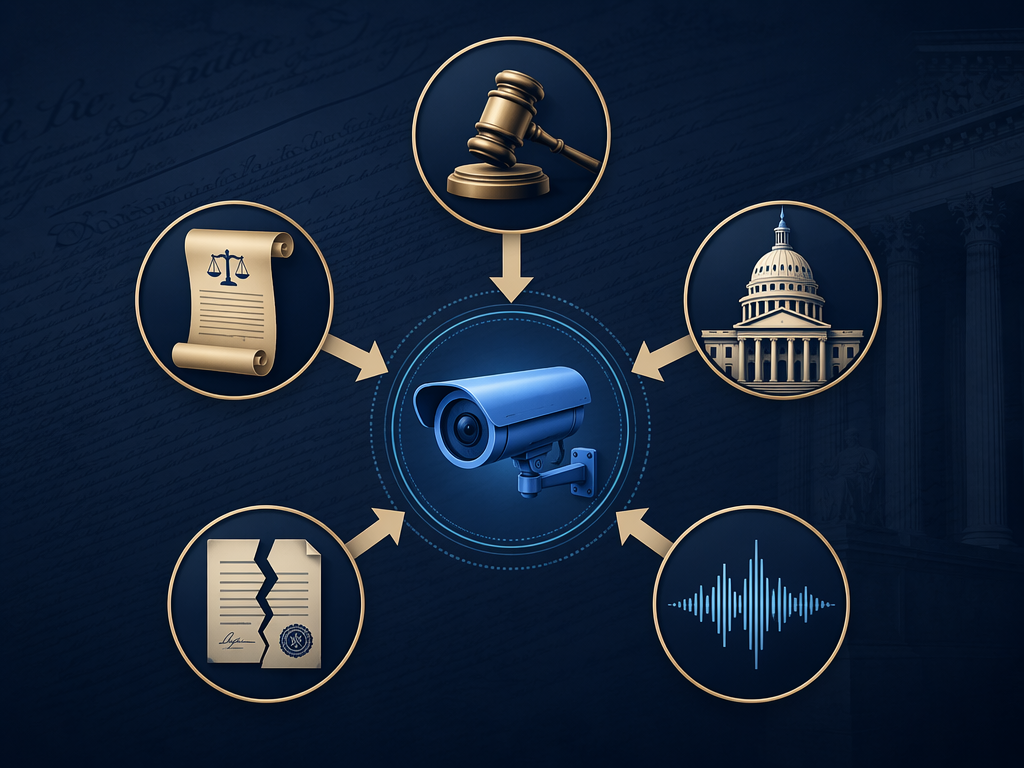
As of mid-July 2026, Flock’s legal exposure is not reducible to one privacy complaint, one constitutional challenge, or one city contract fight. The public record points to five fronts moving at the same time: California private litigation over statutory ALPR duties, Fourth Amendment challenges to warrantless database searches, state enforcement and new ALPR statutes, municipal withdrawals or suspensions, and emerging liability around audio detection and credibility representations.
| Front | What Is Being Tested | Why It Matters |
|---|---|---|
| California private actions | Whether ALPR operators and users face statutory damages for missing or deficient privacy policies | Bartholomew turns a compliance omission into alleged private harm with a statutory minimum. |
| Fourth Amendment challenges | Whether warrantless Flock searches become a Carpenter-style mosaic of vehicle movement | Courts are distinguishing sparse camera facts from denser networks while warning that the line may move. |
| State regulation and enforcement | Whether legislatures, attorneys general, auditors, and public-records courts impose duties beyond contract terms | Compliance risk increasingly comes from state-specific ALPR statutes and disclosure rules. |
| Municipal contract battles | Whether cities continue, suspend, or terminate deployments after discovering sharing or governance issues | Procurement consequences can arrive before definitive constitutional doctrine. |
| Audio and credibility risks | Whether adjacent sensor products and disputed vendor representations create new legal claims | The next front may not be license plates alone. |
Scale explains why these disputes are not staying local. Publicly reported customer figures vary, but Flock has been described as operating across roughly 5,000 law enforcement agencies, about 6,000 communities, and 49 states.[2] That number does not answer any constitutional question by itself. It does explain why a sharing setting in one town, a missing policy at one shopping center, or a state-law audit can have consequences that spread faster than ordinary municipal compliance cycles.
California Converts Policy Failure Into Litigation Exposure
The California class-action wave is the most concrete private-liability front because it does not depend on proving that every plate read was abusive. It begins with a simpler question: did the entity using an automated license plate recognition system comply with California’s ALPR privacy-policy requirements?
In Bartholomew v. Parking Concepts, a California appellate court held on February 5, 2026, that failure to post an ALPR privacy policy can itself constitute actionable harm under state law, with a $2,500-per-person statutory minimum and no pre-suit cure requirement.[3] The California Supreme Court declined review on May 13, 2026, leaving the appellate ruling in place unless later limited by further proceedings or another court.[3]
That procedural posture is why Bartholomew deserves more attention than a generic “privacy lawsuit” label. It gives plaintiffs a liability theory that starts with the paperwork: notice, policy posting, and statutory compliance. If the alleged class is large enough, statutory damages can become the main event before anyone reaches a full evidentiary fight over actual misuse.
The follow-on filings arrived quickly. Reporting in February 2026 described class-action activity after Bartholomew, including a case filed against Simon Property Group on February 17, 2026.[4] Rain Intelligence’s analysis described the ruling as creating potentially large exposure for ALPR operators, while noting that the damages model depends on the affected population and the statutory theory surviving litigation.[5] Gibbs Mura’s amended complaint materials from April 3, 2026, concerning Bishop Ranch show the same basic pattern: plaintiffs are treating deficient ALPR disclosures as a class-wide statutory problem rather than as an individualized stop or search dispute.[6]
The significance for Flock customers is not that every complaint will succeed. Complaints plead allegations, and compliance alerts are not judgments. The point is narrower and more practical: after Bartholomew, a California property owner, municipality, or contractor using ALPR cameras can face litigation over the absence or inadequacy of an ALPR privacy policy even without a plaintiff proving that a specific officer misused a specific plate read.
That is a different risk profile from the constitutional cases. A city attorney can believe a search was reasonable under the Fourth Amendment and still have a statutory compliance problem. A private-property operator can believe it merely installed a security tool and still inherit duties attached to collection, retention, access, and disclosure. For compliance officers, the unpleasant feature of this front is that it is auditable after the fact: either the policy was posted and adequate at the relevant time, or it was not.
The Fourth Amendment Cases Are Not Producing A Single Rule
The constitutional front is more unsettled because courts are not just asking whether an ALPR camera may read a plate visible on a public road. They are asking when a network of reads, searchable after the fact, begins to resemble the long-term location tracking that concerned the Supreme Court in Carpenter.
United States v. Martin illustrates the narrow end of the current doctrine. In that Eastern District of Virginia case, commentary described the court as rejecting a warrant requirement where 188 cameras captured three images over 30 days.[7] Those facts matter. Three images over a month do not present the same record of movement as persistent, dense, multi-jurisdictional tracking. A court can decide that set of facts without blessing every future database search.
The Norfolk litigation, reported after a January 27, 2026 ruling by Judge Jamar K. Walker Davis, sits closer to the fault line. The court rejected the challenge to Norfolk’s 176-camera deployment, but the reported ruling also warned that the system did not violate privacy “yet,” signaling concern that increasing camera density could change the constitutional analysis.[8] For litigation watchers, that “yet” does real work. It keeps the city’s program standing on the record before the court while refusing to freeze Fourth Amendment doctrine at today’s camera map.
The same problem appears in advocacy audits and public-records disclosures, though they must be read for what they are. The Electronic Frontier Foundation reported audit data showing more than 12 million Flock searches across 83,345 cameras in connection with a single Texas abortion investigation query, and described other uses involving protest surveillance and searches targeting Romani people.[9] Those figures do not themselves equal an adjudicated Fourth Amendment violation. They show the architecture courts are being asked to evaluate: not a camera, not a department, but a searchable national or near-national layer of vehicle-location observations.
San Jose presents the same pressure from another angle. EFF has alleged 3.96 million warrantless searches in litigation challenging the city’s use of Flock data.[9] Again, an allegation is not a holding. But for lawyers assessing exposure, search volume is not decorative. It bears on standing arguments, injunctive relief, discovery scope, retention practices, and the practical question courts keep circling: when does short-term public-road observation become long-term movement surveillance?
Bridgewater, Virginia, shows how a small deployment can produce a large downstream-access story. WHRO and the Virginia Center for Investigative Journalism reported that Bridgewater, a town of about 6,600 people, had five Flock cameras whose data were accessed 6.9 million times by out-of-state agencies over 12 months.[10] A town council can approve five cameras and still end up governing a dataset queried at a scale that no ordinary local procurement memo would make intuitive.
Ventura County supplies the immigration-enforcement variant of the same problem. EFF reported more than 364,000 unauthorized queries there, including 299 explicitly for immigration enforcement.[9] The legal issue is not merely whether Flock’s technology can help locate a vehicle. It is whether the agency that collected the data, the vendor platform that shared it, and the downstream users that queried it all operated within the legal permissions attached to that data.
State Law Is Becoming The Faster-Moving Layer
Federal constitutional doctrine moves case by case. State law is moving through statutes, attorneys general, audits, and public-records rulings, often on timelines that matter more immediately to a municipal program.
Washington’s SB 6002 is the clearest example in the current record. MRSC described the law as effective March 30, 2026, with a warrant requirement for law enforcement access to private-entity ALPR data, system registration by September 30, 2026, and policy adoption by December 1, 2027.[11] Those are not abstract privacy principles. They are calendar dates that procurement staff, police departments, private camera operators, and public-records officers must build into compliance systems.
Oregon moved in the same general direction with SB 1516, reported in April 2026 as creating ALPR limits that include a citizen-suit provision.[12] A citizen-suit mechanism changes the enforcement environment because compliance is not left solely to prosecutors or regulators. It invites private enforcement and therefore litigation planning by the entities operating or using the cameras.
California’s state enforcement posture also matters. California v. El Cajon, filed in October 2025, belongs in the same regulatory escalation layer as the private Bartholomew litigation, even though the posture and remedies differ.[9] Illinois has also seen Secretary of State audit activity concerning ALPR practices.[9] These matters are not interchangeable, but together they show state institutions treating ALPR governance as a compliance subject rather than a purely local policing choice.
Public-records law is another pressure point. In November 2025, EFF reported a Washington Court of Appeals ruling that Flock data are public records, rejecting efforts to shield the records from disclosure.[13] That kind of ruling does not decide whether a search was constitutional. It affects who can inspect the logs, how journalists and litigants can reconstruct data-sharing patterns, and whether a city can plausibly say it does not know what its system is doing.
Contract Risk Is Arriving Before Final Doctrine
The municipal disputes are easy to underrate because they are not always lawsuits. But contract suspension, cancellation, or emergency review can be the legal system’s first practical remedy when a city discovers that a surveillance arrangement does not match what elected officials, police administrators, or residents thought they had approved.
Mountain View is the cleanest example of a dashboard setting becoming a governance failure. EFF reported that the city terminated its Flock contract after learning that “nationwide” sharing had been enabled, leading to more than 600,000 unauthorized searches by more than 250 agencies.[9] If those facts are taken as reported, the important legal lesson is not simply that sharing occurred. It is that the contract, local authorization, and actual platform configuration appear to have diverged in a way that exposed the city to outside use it had not meaningfully approved.
Oshkosh, Wisconsin, produced the procurement shorthand version: EFF described it as Flock’s shortest contract ever, lasting one day.[9] Wisconsin communities have also seen cancellations and resistance tied to ALPR concerns.[9] These episodes are not appellate precedents, but procurement files have their own force. They shape what neighboring cities ask during due diligence, what indemnity clauses vendors face, and what city attorneys insist on seeing before a council vote.
The LAPD suspension now sits on that same shelf, with the added weight of scale and timing. A 138-camera suspension in July 2026 tells other jurisdictions that this is not a stale 2020s privacy debate.[1] It is an active operational and liability question for agencies using Flock today.
The Next Edge: Audio Detection And Vendor Credibility
The audio-surveillance material is less developed than the ALPR litigation, so it should be treated with less certainty. It still belongs in the landscape because adjacent sensors can change the legal theory. EFF reported in October 2025 that Flock’s Raven audio-detection microphones were moving toward human-voice recognition capabilities, raising wiretapping and consent concerns.[14] A license-plate reader captures vehicle-location information. A microphone that detects, classifies, or recognizes human voices can trigger a different set of statutory and constitutional questions.
Vendor credibility is also becoming a legal fact, not just a public-relations problem. The ACLU has documented what it characterizes as a pattern of misleading Flock statements to city councils concerning matters such as heat maps, federal contracts, and ICE access.[2] Those assertions are advocacy-source claims and should be checked against meeting records and vendor responses before being used in litigation. But if a city relied on inaccurate representations when approving a system, the issue can migrate into contract formation, council procedure, public-records disputes, and remedial votes.
This is where the gap between a contract clause and a dashboard setting becomes more than a metaphor. A vendor may state one policy; a city may adopt another; a platform may enable broader access; a downstream agency may query for a purpose that conflicts with local expectations. The liability question then splinters. Who collected the data? Who controlled access? Who had the statutory duty to post a policy? Who made the representation to the council? Who queried the database? Who can produce the audit log?
What The Current Record Supports
The strongest supported conclusion is not that Flock has already lost the surveillance-technology wars in court. It has not. Courts have rejected some Fourth Amendment challenges on the records before them, and many complaints remain allegations rather than adjudicated facts. The stronger conclusion is that Flock and its customers now face a multi-jurisdictional exposure environment that no single ruling can settle.
California plaintiffs can pursue statutory-damages theories based on ALPR policy failures. Federal courts are deciding Fourth Amendment challenges while openly watching camera density and query volume. States are adding warrant rules, registration duties, policy deadlines, citizen suits, audits, and public-records access. Municipalities are suspending or terminating contracts when the actual sharing architecture does not match local authorization. Audio detection and disputed council representations are beginning to form adjacent liability theories.
That is the present legal shape of Flock Safety’s privacy litigation and AI surveillance issues as of July 19, 2026: not one dispositive case, but an accumulating record of statutory, constitutional, regulatory, contractual, and evidentiary risk. Any live matter should be checked against current filings, operative statutes, contracts, audit logs, and primary-source orders. This article is an informational litigation landscape, not legal advice.
References
- LAPD suspension, Los Angeles Times, July 11, 2026
- Flock Safety Credibility Lost, ACLU
- Bartholomew compliance analysis, Fisher Phillips
- Class-action report, KTVU, February 2026
- Billion-Dollar Surveillance Wave, Rain Intelligence
- Bishop Ranch amended complaint materials, Gibbs Mura via ClassLawGroup, April 3, 2026
- United States v. Martin Fourth Amendment analysis, Texas Bar Journal
- Norfolk ruling coverage, WHRO, February 11, 2026
- 2025 in Review, Electronic Frontier Foundation
- Bridgewater data-sharing investigation, WHRO and Virginia Center for Investigative Journalism, September 2025
- Washington SB 6002 analysis, MRSC, April 2026
- Oregon SB 1516 coverage, OPB, April 2026
- Washington public-records ruling coverage, Electronic Frontier Foundation, November 2025
- Raven microphones report, Electronic Frontier Foundation, October 2025
Comments
Join the discussion with an anonymous comment.