
Full profile
The immediate impact of Florida's 2024 property tax amendment on libraries is not a single dramatic closure notice. It is a new fiscal baseline. Amendment 5 is already reducing non-school local government revenue, and its annual effect is projected to grow from about $22.8 million in FY2025-26 to about $111.8 million by FY2028-29, with county-by-county losses varying by tax base and homestead patterns.[1] For a courthouse regular, that matters less as an abstract tax preference than as a chain of substitutions: a county absorbs less revenue, a department head delays a database renewal, a reference desk shortens hours, and the person who cannot buy a commercial legal research subscription waits longer for help.
The larger threat is not yet enacted. Amendment 3, scheduled for the 2026 ballot as SJR 2-F, would greatly expand the non-school homestead exemption. If voters approve it, Florida would move from the 2024 amendment’s incremental pressure to a much larger property-tax reduction that library advocates, county officials, and fiscal analysts are already treating as a service-level event. The EveryLibrary Institute identifies public libraries, county law libraries, and court libraries among the local institutions exposed to the proposal, and it points to the basic imbalance in the funding model: Florida public libraries received about $900 million in local property tax revenue in 2024, compared with $17.7 million in state aid.[2]
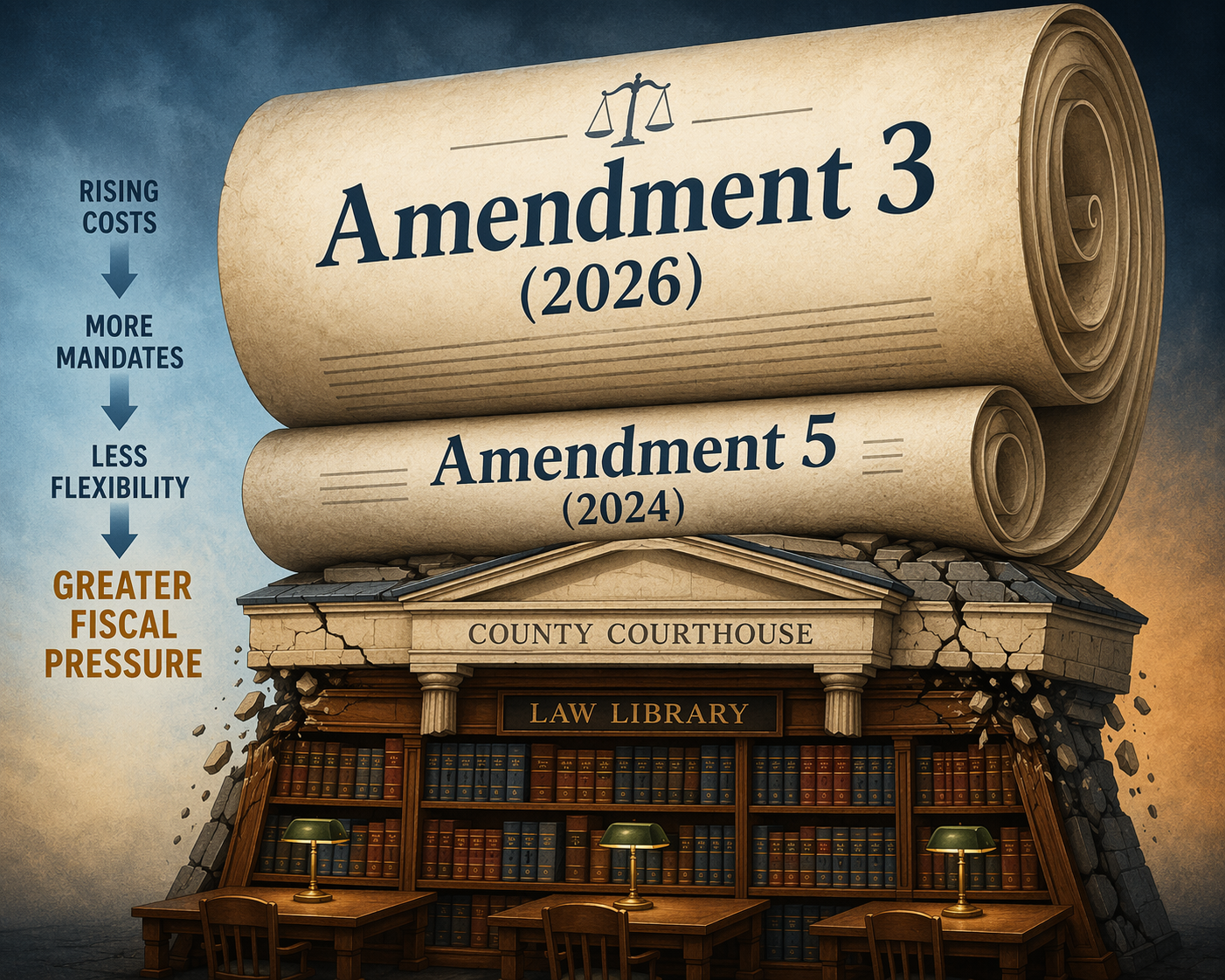
The Amendment 5 Baseline
Amendment 5 did not abolish local property taxes, and it should not be described as having already gutted law libraries. Its importance is more mechanical. The 2024 amendment indexed Florida’s second homestead exemption to inflation for non-school property taxes, meaning the exempt value rises over time instead of remaining fixed. That removes taxable value from county, municipal, and special-district tax bases while leaving school taxes outside the exemption.
Florida Policy Institute’s county-level analysis estimates that the Amendment 5 revenue loss begins at about $22.8 million statewide in FY2025-26 and rises to about $111.8 million annually by FY2028-29.[1] The early-year number is modest beside most county budgets. The later number is not. It arrives inside the same local government budgets that pay for public libraries, courthouse facilities, clerk-facing public service operations, and, in some counties, law library resources.
That distinction is important because library cuts rarely announce themselves first as constitutional consequences. They show up as procurement choices. A print supplement is not replaced. A treatise set waits another year. A legal database seat count is trimmed. A branch reference specialist covers more ground. No single line item proves a statewide access-to-justice failure, but the direction of travel is visible when the revenue source is narrowed and no replacement stream is identified.
Amendment 3 Would Change the Scale
Amendment 3 is the measure that turns a manageable budget pressure into a structural question for library systems. The proposal would increase the non-school homestead exemption to $150,000 in 2027 and $250,000 in 2028, with annual inflation adjustments beginning in 2029.[3] Because the exemption applies to non-school property taxes, the burden would land on the local revenue streams that support county and municipal services rather than on school districts.
| Measure | Status | Main Fiscal Mechanism | Documented Scale |
|---|---|---|---|
| Amendment 5 | Approved in 2024; now in effect | Indexes the second homestead exemption to inflation for non-school property taxes | About $22.8 million in FY2025-26, rising to about $111.8 million annually by FY2028-29 |
| Amendment 3 / SJR 2-F | Pending for the 2026 ballot | Raises the non-school homestead exemption to $150,000 in 2027 and $250,000 in 2028, then indexes it | Estimated local revenue loss ranges from $4.6 billion to $12 billion annually, depending on estimate and assumptions |
Florida Policy Institute reports that Amendment 3 would reduce local revenue by an estimated $4.6 billion to $12 billion annually and that county-level losses could range from 2 percent to 24 percent depending on homestead concentration.[3] That spread is not a rounding error. A county with a high share of homesteaded property and limited fiscal flexibility faces a different problem than a county with a broader commercial tax base. Library systems sit directly inside that variation.
The core-services argument from proponents needs to be acknowledged. Supporters have disputed claims that the measure would “defund” essential public services, and the 2026 proposal includes a framing that local governments should continue funding core services.[6] But a core-services instruction is not the same thing as a state backfill. If the property-tax base shrinks and state aid remains small, local officials still have to decide which services count as core, which contracts can wait, and which public-facing hours can be reduced.
Why Libraries Are Exposed
The library exposure is unusually traceable because the funding mix is so lopsided. EveryLibrary’s issue brief reports about $900 million in local property tax support for Florida public libraries in 2024 and only $17.7 million in state aid.[2] In practical terms, there is no comparable state library funding stream waiting to absorb a large local-property-tax cut. When the local base drops, library leaders are not choosing between identical pots of money. They are asking whether counties, municipalities, library districts, and voters will replace lost local revenue through other taxes, fees, reserves, or service cuts.
That matters for legal research because Florida’s legal information network is not limited to formal county law libraries. Public libraries often carry legal self-help materials, provide access to public computers, help patrons locate government forms, and serve as the first stop for people who do not know whether they need a clerk’s office, a legal aid provider, a bar referral, or a statute. A person facing eviction, probate paperwork, family-law forms, or a small-claims dispute may not describe the need as “legal research.” The staff member helping them often recognizes it that way.

County law libraries are the more specialized part of the same infrastructure. They serve attorneys who do not work inside large firms, members of the public who are representing themselves, and court-adjacent users who need reliable legal materials close to the courthouse. EveryLibrary expressly names county law libraries and court libraries among institutions affected by SJR 2-F, but it does not provide separate dollar figures for law-library-only losses.[2] That absence should narrow the claim, not weaken the concern: the available record supports a funding-model risk to the ecosystem around county law libraries, not a precise statewide estimate of law library cuts.
The County Numbers Show the Mechanism
Volusia County is the clearest example now in the public record. Spectrum News reported that Volusia library officials warned Amendment 3 could mean a $7 million hit, amounting to about 30 percent of the library system’s budget.[4] A cut of that size does not stay confined to back-office accounting. It pushes directly into staffing, branch operations, materials, technology, and the mix of services that can be maintained across a countywide system.
Miami-Dade has a larger-dollar exposure. WLRN reported that the Miami-Dade Public Library System could face a $20 million cut under the proposed homestead expansion, while also describing broader concerns about how the measure would affect local governments and renters who do not receive the direct homestead benefit.[5] The legal-research consequence is not that every dollar lost would have been spent on law books. It is that large systemwide reductions force library administrators to rank services against one another, and specialized research support rarely has the political visibility of hours at a neighborhood branch.
Orange County illustrates another vulnerability: dependency. Central Florida library officials have warned that property-tax changes could cut services, and reporting has described Orange County’s library funding as almost entirely dependent on property taxes.[4] In that setting, even a technically neutral exemption can operate like a service-design decision. The less diversified the revenue stream, the less time a library has to treat the loss as temporary turbulence.
Those county examples should not be stretched into a statewide schedule of law-library cuts. They are better read as evidence of the pathway. A homestead-heavy tax base reduces non-school local revenue. Local governments look for reductions or replacement revenue. Public libraries and law libraries compete with sheriff’s offices, fire services, roads, parks, and general administration. The final cut may appear as a shorter public service day rather than a line labeled “Amendment 3.”
Legal Research Access Is a Budget Line Before It Is a Principle
Lawyers with enterprise research platforms can misunderstand what is at stake because they have already exited the shared system. A county law library subscription, a public terminal, a self-help collection, or a librarian who knows where the local forms live may seem peripheral from a large-firm desk. For a solo lawyer, a small firm, a legal aid clinic, or a self-represented litigant, that same resource can be the difference between locating current authority and relying on a stale web page.
The substitution problem is uneven. A homeowner who receives a larger exemption may save on taxes, but the person waiting at a law library terminal is not necessarily that homeowner. Renters may not receive the same direct benefit, and WLRN’s reporting has specifically placed renters inside the debate over who gains and who absorbs downstream consequences.[5] Self-represented litigants are even harder to price into the fiscal argument because their costs appear later: incomplete filings, longer clerk interactions, continued hearings, and judges spending courtroom time on problems that earlier legal information access might have reduced.
Print collections are part of this, but the more fragile layer is staffed navigation. A library can keep a shelf of materials and still lose access if hours shrink, if the person who knows the difference between a statute, a rule, a form packet, and a secondary source is reassigned, or if public computers are too few for the volume of users. Legal information infrastructure is not simply content ownership. It is the local capacity to help users find the right material without giving legal advice.
What Is Still Uncertain
The largest uncertainty is political and legal: Amendment 3 has not been approved by voters. Three lawsuits have challenged the ballot language, and Florida Politics reported that a Leon County judge fast-tracked the dispute with a July 29, 2026 hearing before Judge Angela Dempsey.[7] The Tallahassee Democrat has also reported on a bipartisan lawsuit targeting the property-tax measure.[8] Those reports are useful for timing and context, but the precise legal arguments should be checked against the filings before anyone treats the litigation as resolved.
The second uncertainty is quantification at the law-library level. The public record now supports statewide and county-level revenue concerns, and it supports documented library-system exposure in places such as Volusia, Miami-Dade, and Orange County.[2][4][5] It does not yet provide a Florida-wide dollar estimate for county law libraries as a separate category. That is a real gap for bar associations and court administrators, because by the time a law library line item becomes visible in a final adopted budget, the broader fiscal decision may already have been made.
The third uncertainty is local choice. Counties can make different decisions under the same constitutional rule. Some may use reserves, adjust other revenue sources, protect library systems, or phase in changes. Others may treat libraries as flexible compared with public safety or infrastructure. The amendment does not dictate that a specific legal database be canceled. It changes the revenue environment in which that renewal has to be defended.
The Professional Risk for Florida Lawyers
For Florida legal professionals, the useful distinction is simple. Amendment 5 is enacted and already reduces non-school local revenue, with projected losses growing over time.[1] Amendment 3 is pending for 2026 and would produce a much larger reduction if approved, with estimates reaching into the billions annually and county-level losses varying sharply by homestead concentration.[3] Public libraries are demonstrably dependent on local property taxes, with state aid far too small to function as an automatic replacement.[2]
The quantified library exposure is strongest at the public-library-system level, not the county-law-library-only level. Volusia, Miami-Dade, and Central Florida reporting show real service warnings tied to the 2026 proposal.[4][5] EveryLibrary identifies county law libraries as affected institutions, but current public materials do not isolate their dollar losses.[2] That is exactly why the issue should not wait for a closure notice. Shared legal information infrastructure is easier to thin out quietly than to rebuild after the subscription, staff position, or public service model is gone.
The risk is therefore not that every Florida law library has already been defunded by the 2024 amendment. The risk is that Florida has begun layering property-tax exemptions onto the revenue source that pays for much of the library network, while the larger 2026 measure could multiply the pressure without a comparable state replacement. Counties with high homestead concentration, constrained budgets, and already-thin legal research services should be treated as the first places to watch.
References
- Amendment 5: Potential Revenue Loss in Florida by County, Florida Policy Institute
- Issue Brief: SJR 2-F and the Future of Florida Libraries, EveryLibrary Institute
- Florida Property Tax Amendment Ballot Language Summary, Florida Policy Institute
- Central Florida libraries warn property tax change could cut services, Spectrum News 13, July 17, 2026
- Florida property tax reform could impact libraries, renters, WLRN, June 26, 2026
- Fact-checking claims that Florida's property tax amendment will defund essential public services, WLRN, June 5, 2026
- Judge fast-tracks challenge to Florida property tax ballot language, Florida Politics
- Bipartisan lawsuit targets Florida property tax measure, Tallahassee Democrat, July 8, 2026
Comments
Join the discussion with an anonymous comment.