
Full profile
When a client asks whether an ai lawyer free app can review a lease, draft a demand letter, fight a traffic ticket, or answer a family-law question, the safest answer is not a joke and not a referral to the app store. The practical answer is narrower: some tools may help a user understand general legal concepts, organize facts, or generate a rough document. They should not be treated as a substitute for licensed counsel, and they should not be represented to the client as a confidential attorney-client relationship.
That distinction matters because the phrase "free AI lawyer" usually appears when someone has a real legal problem and little money. The user may not care whether the product calls itself a chatbot, document assistant, legal information platform, or robot lawyer. The consequences, however, turn on exactly those distinctions: unauthorized practice of law, privilege, confidentiality, missed deadlines, bad filings, and overconfident advice that nobody licensed has reviewed.
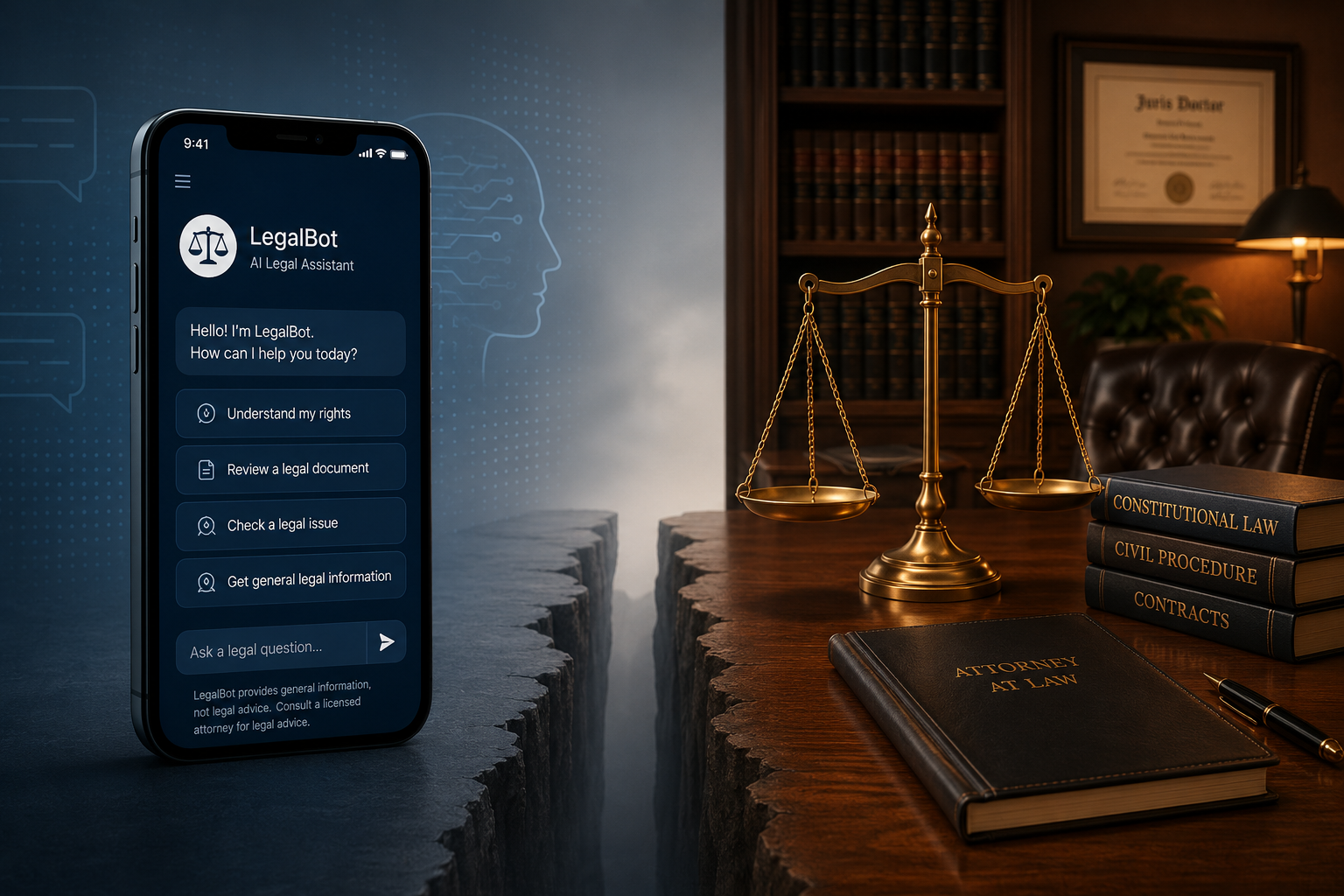
What Clients Usually Mean By a Free AI Lawyer
Most consumer-facing legal AI products sit somewhere between search, form automation, and a conversational intake tool. A client may encounter DoNotPay, LawConnect, AI Lawyer, Justee, auxiliary.ai, or another product with similar positioning. The names matter less than the representation being made to the user: is the tool providing general legal information, helping complete a form, routing the person to a lawyer, or implying that it can evaluate the person’s rights and choose a legal strategy?
| Product or category | How a client may understand it | Ethics issue for the attorney answering the question |
|---|---|---|
| DoNotPay | A consumer tool associated with "robot lawyer" claims | FTC enforcement makes substantiation and marketing claims central, not cosmetic. [1] |
| LawConnect | A legal technology platform a consumer may associate with lawyer access or legal help | The attorney should separate lawyer referral or workflow functions from legal advice. |
| AI Lawyer, Justee, auxiliary.ai | Consumer-facing AI legal help or document-assistance experiences | The question is whether the tool is giving information, generating documents, or crossing into personalized legal judgment. |
| General chatbots used for legal questions | A free place to paste facts and ask what to do | The biggest risks are confidentiality, privilege, accuracy, and false confidence. |
A practicing lawyer does not need to memorize every feature in this market. The lawyer does need to listen for claims that sound like legal advice without a lawyer: "tell me if I can break my lease," "write the complaint," "decide whether I should settle," "fight this ticket for me," or "find the loophole." Those are not merely product-design questions. They are professional-responsibility questions with consumer-protection consequences.
The FTC Has Already Drawn a Line Around Robot-Lawyer Claims
The most concrete enforcement record is the Federal Trade Commission’s finalized February 2025 order against DoNotPay. The order imposed $193,000 in monetary relief, prohibited deceptive claims that the company’s AI could perform legal services "like a real lawyer" without substantiation, and required notice to past subscribers.[1]
That order is useful in client conversations because it moves the discussion away from taste. Whether a lawyer personally finds the phrase "robot lawyer" silly is beside the point. A federal regulator objected to unsubstantiated representations that an AI product could perform like licensed counsel. For attorneys, that is a cleaner warning than a general complaint about hallucinations: if a product’s sales language blurs legal information, document automation, and legal advice, the problem starts before the user ever receives an answer.
The order does not mean every consumer legal AI tool is unlawful. It also does not answer every state-law question about unauthorized practice. But it does support a disciplined response to clients: do not rely on a marketing label as proof that the tool is competent, supervised, or legally authorized to advise on your specific facts.
UPL Risk Is Not Settled Just Because the Tool Is Software
Unauthorized practice of law analysis remains state-specific, fact-specific, and often uncomfortable around automation. A static book or public website can explain legal principles. A form library can help a person fill in blanks. But a tool that receives a user’s facts, applies legal standards, and tells the user what to do begins to look less like information and more like individualized legal advice.
State bar materials have been moving toward that line without pretending that every consumer use case is resolved. Florida Opinion 24-1, California’s Practical Guide on generative AI, and Texas Opinion 705 are among the bar-guidance materials collected in a March 2026 roundup covering more than 35 states.[2] Those materials chiefly frame how lawyers may use AI: competence, supervision, confidentiality, candor, billing, and review. They are not blanket approvals for unsupervised consumer products to dispense personalized advice.
ABA Formal Opinion 512 points in the same professional-responsibility direction. It treats generative AI as a tool lawyers may use only consistently with existing duties, including competence, confidentiality, communication, supervision, and reasonable fees.[3] The opinion does not become less relevant because a tool is free. A free output can still be wrong, confidentially dangerous, or inadequately supervised.
There is an important difference between lawyer use and consumer use. When a lawyer uses AI to summarize records or draft a first version of a memo, the lawyer remains responsible for review and judgment. When a consumer uses an AI tool alone, there may be no licensed professional in the loop, no conflict check, no malpractice coverage, no duty of loyalty, and no one accountable for spotting that the user asked the wrong question. That is why an attorney’s client-facing answer should avoid both extremes. The tool is not automatically useless. It is also not a lawyer.
The Privilege Problem Is Quieter Than a Bad Answer
Accuracy gets most of the attention because hallucinated cases are easy to understand. Privilege is often the more damaging issue because the client may not know anything has gone wrong until discovery, motion practice, or a dispute over waiver.
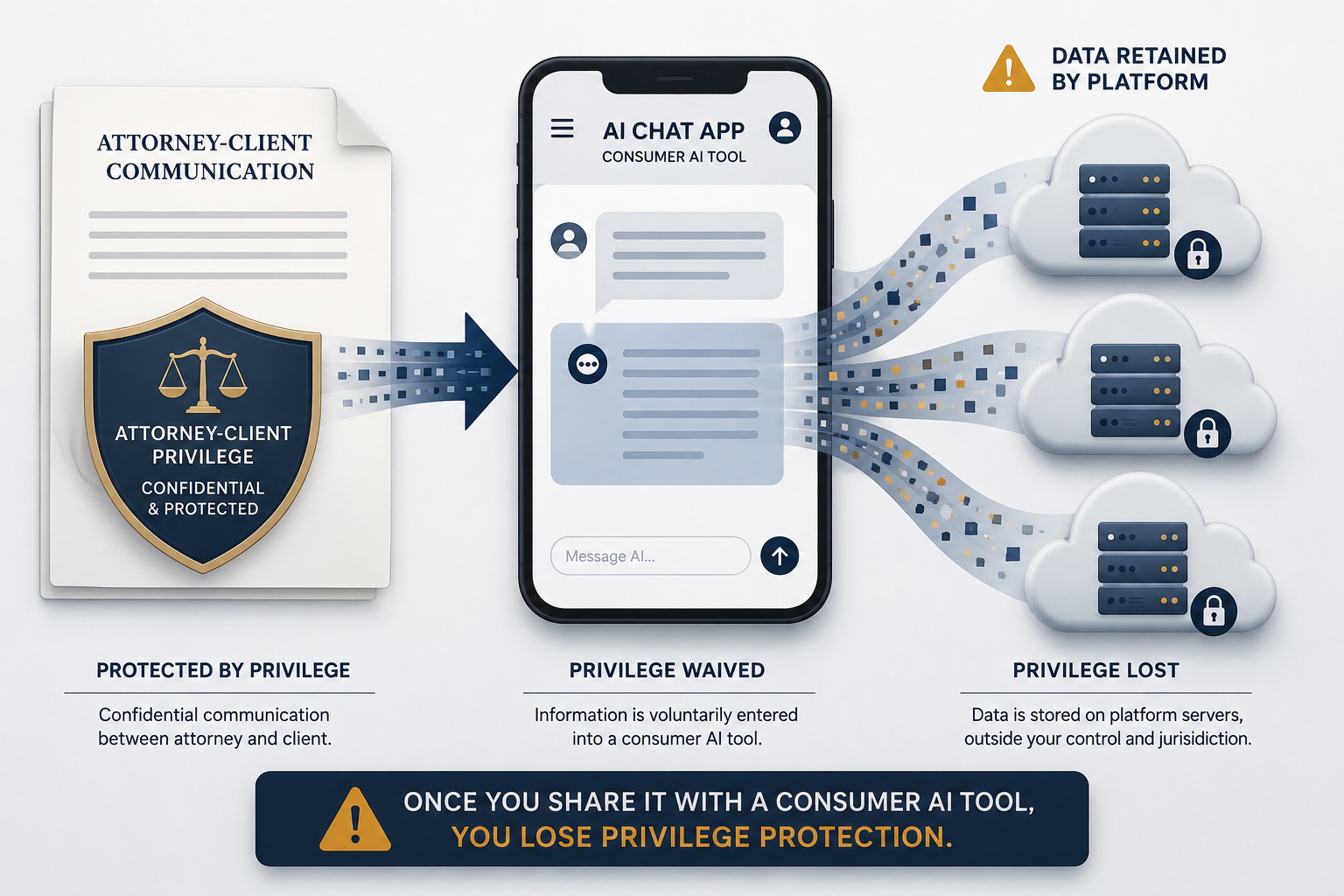
The privilege concern sharpened in Heppner v. Heppner, a Southern District of New York ruling from February 2026 discussed in Clio’s AI data privacy materials. The reported issue was not merely that an AI provider suffered a breach. The concern was that use of a consumer AI tool whose terms permitted data retention could independently destroy attorney-client privilege.[4]
That distinction is critical. Many clients think confidentiality risk means, "What if the company gets hacked?" The more immediate legal question can be, "Did you voluntarily disclose privileged facts to a third party under terms that allow retention or use?" A consumer may paste a draft settlement email, medical history, immigration facts, employment details, or litigation strategy into a chatbot because the interface feels private. A clean interface is not a confidentiality agreement. A helpful answer is not a privilege screen.
This is where lawyers should be especially blunt. Before a client enters sensitive facts into any consumer AI legal tool, someone needs to assess the tool’s terms on data retention, training, sharing, deletion, confidentiality, and legal-use disclaimers. If nobody has done that assessment, the advice should be simple: do not paste privileged or sensitive facts into it.
Hallucination Harm Is Showing Up Where Lawyers Would Expect It
The documented hallucination record also deserves a sober place in the conversation. Damien Charlotin’s independent tracker, cited by Clio, identified about 955 documented U.S. court cases involving AI hallucinations out of roughly 40 million filings since January 2023, with more than 60% involving pro se litigants.[5] That is not an official court database, and it counts only incidents that were caught and documented. It also should not be inflated into a claim that most AI-assisted legal work fails.
The narrower conclusion is more useful: the vulnerable user segment is real. Pro se litigants are exactly the people most likely to search for free legal help, trust a polished answer, and lack the training to recognize a fake citation, wrong jurisdiction, expired deadline, or procedural mismatch. A lawyer cleaning up the problem later may be dealing not only with a wrong document, but also with a missed opportunity to preserve a claim or avoid disclosure.
Lawyer Adoption Does Not Validate Consumer Substitution
Clients may reasonably point out that lawyers themselves are using AI. They are right. Clio’s 2026 Legal Trends data, as reported in its materials on free legal AI tools, found AI adoption at 71% among solo firms and 75% among small firms, while 44% lacked formal AI governance policies.[6] That data supports two separate observations, not one broad permission slip.
- Adoption is not effectiveness. A firm may use AI frequently and still need human review for every legal conclusion.
- Lawyer use is supervised use. The professional obligation remains with the lawyer, not the model.
- Lack of governance is itself a risk signal. If many firms have not formalized AI policies, consumers should not assume free tools have solved confidentiality, review, and accountability problems.
A firm risk committee will see the issue differently from a desperate tenant or consumer debtor, but both are looking at the same underlying problem: AI can lower friction before it raises reliability. It can make a draft appear faster than a person can verify whether the draft should exist.
A Better Client Answer
The attorney’s response should be practical enough that the client can use it. A lecture about unauthorized practice will not help someone who needs to answer an eviction notice or understand a demand letter by Friday. A permissive shrug is worse.
A sound answer can be short:
- You may use a public AI tool for general legal information, the way you might use a legal encyclopedia or public website, but do not treat it as your lawyer.
- Do not enter privileged, confidential, or highly sensitive facts unless the tool’s data terms have been reviewed.
- Do not rely on it to calculate deadlines, select claims, file documents, decide strategy, or evaluate settlement without licensed review.
- Be especially careful if the tool claims it can perform like a real lawyer or resolve a legal problem without attorney supervision.
- If cost is the issue, look first to licensed legal aid, court self-help centers, limited-scope representation, or bar-sponsored programs.
For U.S. clients who cannot afford counsel, the ABA’s Free Legal Answers program is a more appropriate referral path than a consumer app marketed as a robot lawyer. The ABA describes Free Legal Answers as a way for income-eligible users to submit civil legal questions for volunteer lawyer responses, alongside state-specific legal aid resources.[7]
That referral will not solve every access problem. It may not cover the client’s jurisdiction, deadline, subject matter, or urgency. But it preserves the most important boundary: the person understands when they are dealing with a licensed lawyer and when they are dealing with software.
What Attorneys Should Watch For
The right question is not whether every free AI legal tool should be condemned. Some may help users organize questions, learn vocabulary, or prepare for a consultation. The more useful screening question is whether the tool or the client is treating the interaction as individualized legal advice under a false sense of confidentiality.
Attorneys advising clients, intake teams, or institutions should pay attention to four signals: claims that the tool performs like a lawyer; prompts that invite detailed confidential facts; outputs that recommend a legal course of action; and missing or unclear disclosures about attorney involvement, data retention, and review. Those signals do not require panic. They require correction before the client mistakes a marketing label for a protected attorney-client relationship.
References
- FTC Finalizes Order Against DoNotPay, Prohibits Deceptive AI Lawyer Claims, Imposes Monetary Relief, and Requires Notice to Consumers, Federal Trade Commission, February 2025, link
- AI Legal Ethics: Bar Association Guidelines, The Legal Prompts, March 2026, link
- Formal Opinion 512: Generative Artificial Intelligence Tools, American Bar Association, link
- AI Data Privacy, Clio, link
- AI Hallucinations in Law, Clio, link
- Free Legal AI Tools, Clio, link
- AI 101 for Lawyers, American Bar Association, 2026, link
Comments
Join the discussion with an anonymous comment.