
Full profile
A fugitive arrest is the visible part of a longer legal sequence. By the time defense counsel gets the call, the client may be held on a bench warrant, a magistrate-issued fugitive warrant, a governor’s warrant, a federal arrest warrant, a provisional international arrest request, or some combination of local and out-of-state process. The first question is not whether the client “ran.” It is which procedural gateway created custody.
The scale matters because this is ordinary criminal administration, not an exotic corner of practice. The U.S. Marshals Service reports that its fugitive work produced more than 73,000 fugitive arrests and cleared nearly 88,000 warrants in 2025.[1] Its fugitive network includes 58 local task forces and 8 regional task forces.[2] Those numbers explain why small distinctions in paperwork matter: the same courthouse holding cell may contain people arrested under very different legal authorities.

| Gateway | Typical source of authority | Immediate defense question |
|---|---|---|
| Triggering event | Failure to appear, bail violation, escape, flight, or statutory fugitive status | What event legally converted the person’s status? |
| Warrant issuance | Bench warrant, arrest warrant, fugitive warrant, or governor’s warrant | Who issued the warrant, on what information, and for what purpose? |
| Apprehension | Local arrest authority, federal task-force operation, or exigent circumstances | Was the entry, stop, arrest, and transfer supported by valid authority? |
| Interstate extradition | Uniform Criminal Extradition Act procedure, requisition, waiver, governor’s warrant | Is the person being held before or after the demanding state’s formal requisition? |
| International extradition | Treaty, 18 U.S.C. § 3184, provisional arrest, extradition hearing, surrender decision | Is custody based on treaty extradition, immigration removal, foreign prosecution, or another path? |
The Triggering Event: How Ordinary Criminal Status Becomes Fugitive Status
The word “fugitive” covers more than the person who crosses a border after indictment. Legal fugitive status can arise after a failure to appear, a violation of release conditions, escape from custody, or flight to avoid prosecution or punishment. LII describes a fugitive from justice as a person who, after committing a crime, leaves the jurisdiction where the crime occurred or conceals themselves to avoid arrest or prosecution.[3] Federal law also uses the concept in specific statutory settings, including provisions addressing flight to avoid prosecution, custody, confinement, or giving testimony.[4]
For counsel, the triggering event sets the file search. A missed misdemeanor court date may have produced a bench warrant in the same county. A felony charge from another state may have produced fugitive-from-justice paperwork in the asylum state. An escape or failure to surrender may carry its own substantive exposure. A client detained near an airport or at a traffic stop may be in custody not because officers investigated the old case, but because an outstanding warrant surfaced through database confirmation.
This is also where labels can mislead. “Bail jumping,” “failure to appear,” “absconding,” and “fugitive from justice” may describe overlapping conduct, but they do not all perform the same procedural function. Some labels explain why a warrant issued; others describe a new charge; others support extradition. The difference affects bond, charging exposure, extradition waiver advice, and whether the client is fighting identity, legality of custody, or return to the demanding jurisdiction.
Warrant Issuance: Identify the Paper Before Arguing the Arrest
The arrest may look the same from the client’s perspective: officers arrive, confirm a name, place the client in handcuffs, and transport them to a jail. Legally, the warrant may be doing very different work. A bench warrant usually directs arrest for failure to appear or violation of a court order in the issuing court. A standard arrest warrant authorizes custody based on probable cause for an offense. A fugitive warrant in the asylum state holds the person temporarily because another state seeks them. A governor’s warrant follows a more formal interstate extradition demand.
That distinction is not decorative. The UNC School of Government’s extradition guidance describes a two-warrant interstate system: a fugitive warrant may issue from a magistrate based on reliable information that the person is wanted by another state, while a governor’s warrant issues after the demanding state’s governor makes a formal requisition and the asylum state’s governor grants it.[5] A police communication network entry or teletype may be enough reliable information for the fugitive-warrant stage under the authority discussed in that guidance.[5]
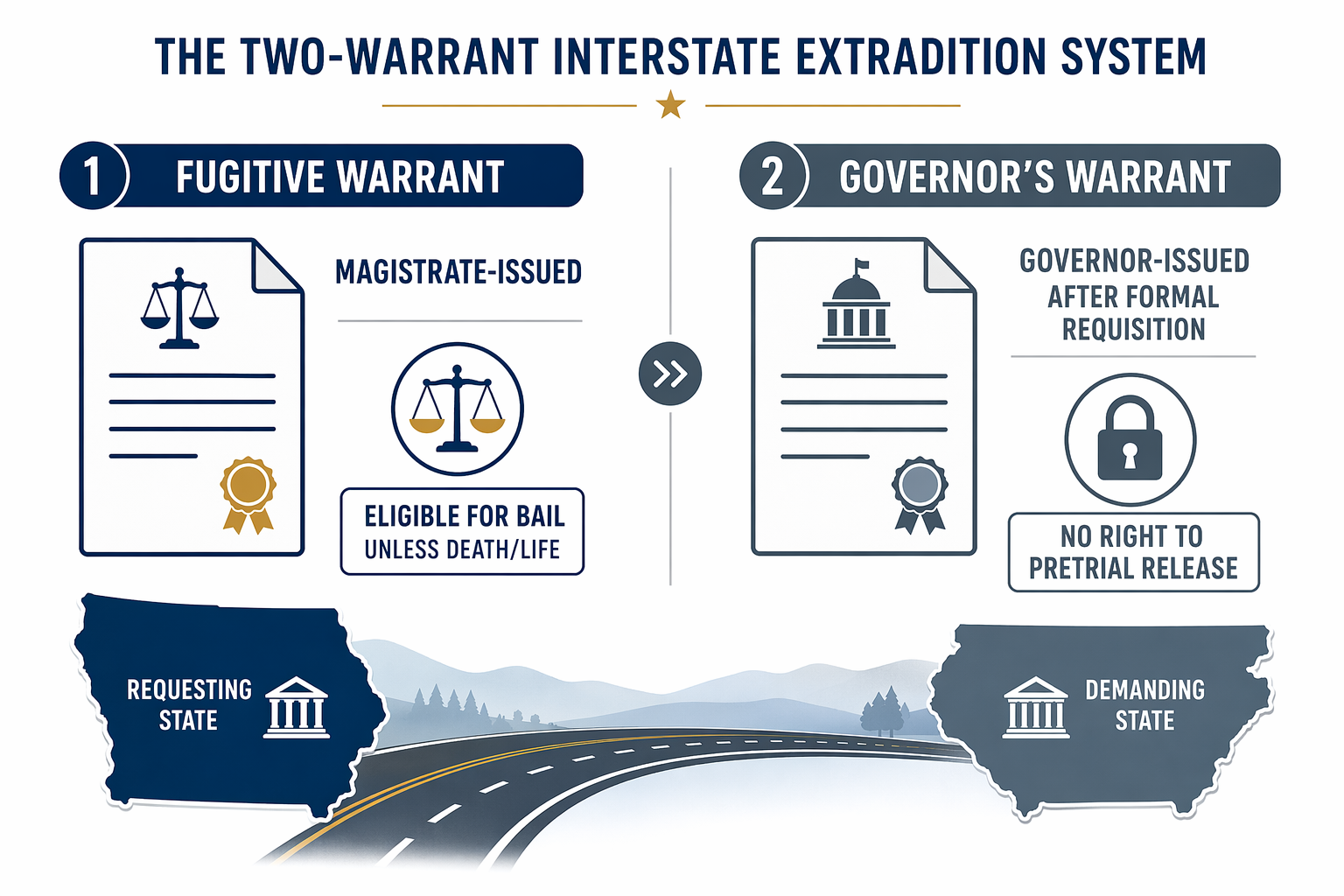
The practical sequence is often compressed. The asylum-state officer or magistrate may see only the demanding state’s database hit, warrant confirmation, or charging information. The formal requisition packet may not yet have arrived. If the client is held on a fugitive warrant, counsel should ask whether the demanding state has begun the governor’s warrant process, what deadline applies locally, whether the client can waive extradition, and whether bail is available before the governor’s warrant issues.
The bail point deserves careful handling. The UNC School of Government states, under North Carolina law, that a person arrested on a fugitive warrant may be eligible for bail unless the underlying offense is punishable by death or life imprisonment, while a person arrested on a governor’s warrant has no right to pretrial release.[5] That is a critical practice distinction, but it is not a national bail rule. Counsel should verify the asylum state’s statute, local extradition practice, and the actual warrant status before advising the client that release is available or foreclosed.
The same caution applies to the scope of review. A fugitive-warrant hearing is not a trial on the demanding state’s case. A governor’s-warrant challenge is usually narrower still. The defense may be able to contest identity, facial validity, whether the person is substantially charged, whether the person is the person named, or whether the person is a fugitive, depending on the governing jurisdiction. But the merits of the underlying prosecution generally belong in the demanding state, not in the asylum-state extradition hearing.
Apprehension: The Capture Is Still a Fourth Amendment Event
Once a warrant exists, apprehension may be carried out by local officers, state agencies, federal officers, or fugitive task forces. Congress authorizes fugitive apprehension task forces to locate and apprehend fugitives, including those wanted for violent felony offenses or other serious crimes.[6] The U.S. Marshals Service describes itself as the federal government’s primary agency for fugitive investigations and operates task-force structures that combine federal, state, and local participation.[1][2]
Operationally, this means the arresting officer may not be the officer who investigated the original case, obtained the warrant, or prepared extradition paperwork. Counsel should separate those roles. One agency may have entered the warrant; another may have confirmed it; a task-force officer may have made the stop; a local jail may be holding the client; and a prosecutor in the demanding jurisdiction may be waiting for waiver or requisition. Each handoff is a place to request records.
- Ask for the warrant itself, not just the booking sheet.
- Identify the entering agency, confirming agency, arresting agency, and holding authority.
- Preserve dispatch logs, warrant confirmation messages, body-camera footage, and jail intake records.
- Determine whether officers entered a home, stopped a vehicle, arrested in public, or relied on consent.
- Confirm whether extradition paperwork had already moved from fugitive warrant to governor’s warrant.
The Fourth Amendment issue belongs here, at the moment of apprehension. Under Payton v. New York, the home receives special protection: absent consent or exigent circumstances, police generally need a warrant to enter a home to make an arrest. Constitution Annotated summarizes the exigent-circumstances doctrine as allowing warrantless action in certain urgent settings, but the doctrine remains fact-specific and tied to the reason officers could not reasonably obtain a warrant before acting.[7]
The available defense argument depends on the location and authority. An arrest in a public place on a valid warrant raises different issues than entry into a third party’s residence, forced entry into the client’s home, a pretextual stop that led to warrant discovery, or a warrantless arrest justified by emergency conditions. Criminal procedure doctrine is concerned with how the government investigates, arrests, charges, tries, and punishes people; it is not a single suppression rule that fits every fugitive arrest.[8]
If an arrest involved warrantless home entry justified by an emergency, counsel should verify the current status of any 2025–26 Supreme Court development before relying on older exigent-circumstances formulations. The question is not whether exigency exists in the abstract; it is what the controlling law required at the time officers crossed the threshold.
Interstate Extradition: The Custody Question Changes After the Governor’s Warrant
Interstate extradition is where the single word “extradition” causes the most damage. A person arrested in State B because State A wants them may be at an early holding stage, a waiver stage, or a post-governor’s-warrant stage. The client may be eligible for release today and ineligible tomorrow. The client may have a meaningful deadline running even though the underlying felony file sits hundreds of miles away.
The UNC School of Government account is useful because it keeps the two documents separate. First, the asylum state may issue a fugitive warrant based on reliable information that another state has charged or convicted the person and seeks return. Second, the demanding state may submit a formal requisition to the asylum state’s governor; if granted, the asylum state’s governor issues a governor’s warrant authorizing arrest and delivery.[5]
| Issue | Fugitive warrant stage | Governor’s warrant stage |
|---|---|---|
| Purpose | Temporary custody while the demanding state pursues extradition | Custody and delivery after formal executive requisition |
| Issuing authority | Typically magistrate or judicial officer in the asylum state | Governor of the asylum state after demand by the demanding state |
| Information basis | Reliable information that the person is wanted elsewhere | Formal requisition and supporting documents |
| Bail practice | May be available in some jurisdictions, subject to statutory limits | May be unavailable as of right in some jurisdictions, including the North Carolina rule described by UNC |
| Defense focus | Identity, warrant confirmation, release, deadlines, waiver advice | Facial validity, identity, fugitive status, habeas or statutory challenge as permitted locally |
Waiver advice also changes with the stage. A client may want to waive extradition to resolve the demanding-state case faster, avoid prolonged local detention, or return to a jurisdiction where counsel is already retained. Another client may need time to contest identity, arrange bond if legally available, challenge defective paperwork, notify immigration counsel, or coordinate pending cases in the asylum state. Waiver is not merely a transportation preference; it can surrender procedural objections in the asylum state.
The demanding state’s case does not become stronger because the asylum state issued a fugitive warrant. Nor does the asylum-state court become a forum for litigating every defect in the demanding state’s prosecution. Defense work at this point is narrower and more time-sensitive: confirm identity, inspect the warrant chain, determine whether statutory deadlines are running, preserve any Fourth Amendment issue from apprehension, and decide whether contesting extradition serves the client’s actual interests.
Local law controls many of the details. The Uniform Criminal Extradition Act creates a common framework in many jurisdictions, but state statutes, court forms, bail practices, detention deadlines, and habeas procedures vary. A North Carolina bail rule or hearing practice should not be assumed to apply in Texas, Florida, Pennsylvania, or California. The defense file should identify the asylum state’s extradition statute first, then the demanding state’s charging posture.
International Extradition: Treaty Custody, Provisional Arrest, and Surrender
International fugitive capture uses a different legal architecture. Under 18 U.S.C. § 3184, extradition proceedings depend on treaty authority or other lawful extradition arrangement; a judge or magistrate judge determines whether the legal requirements for certification are met, but the final surrender decision belongs to the executive branch.[9] That division matters. The court’s role is not the same as a criminal trial, and certification is not the same as physical surrender.
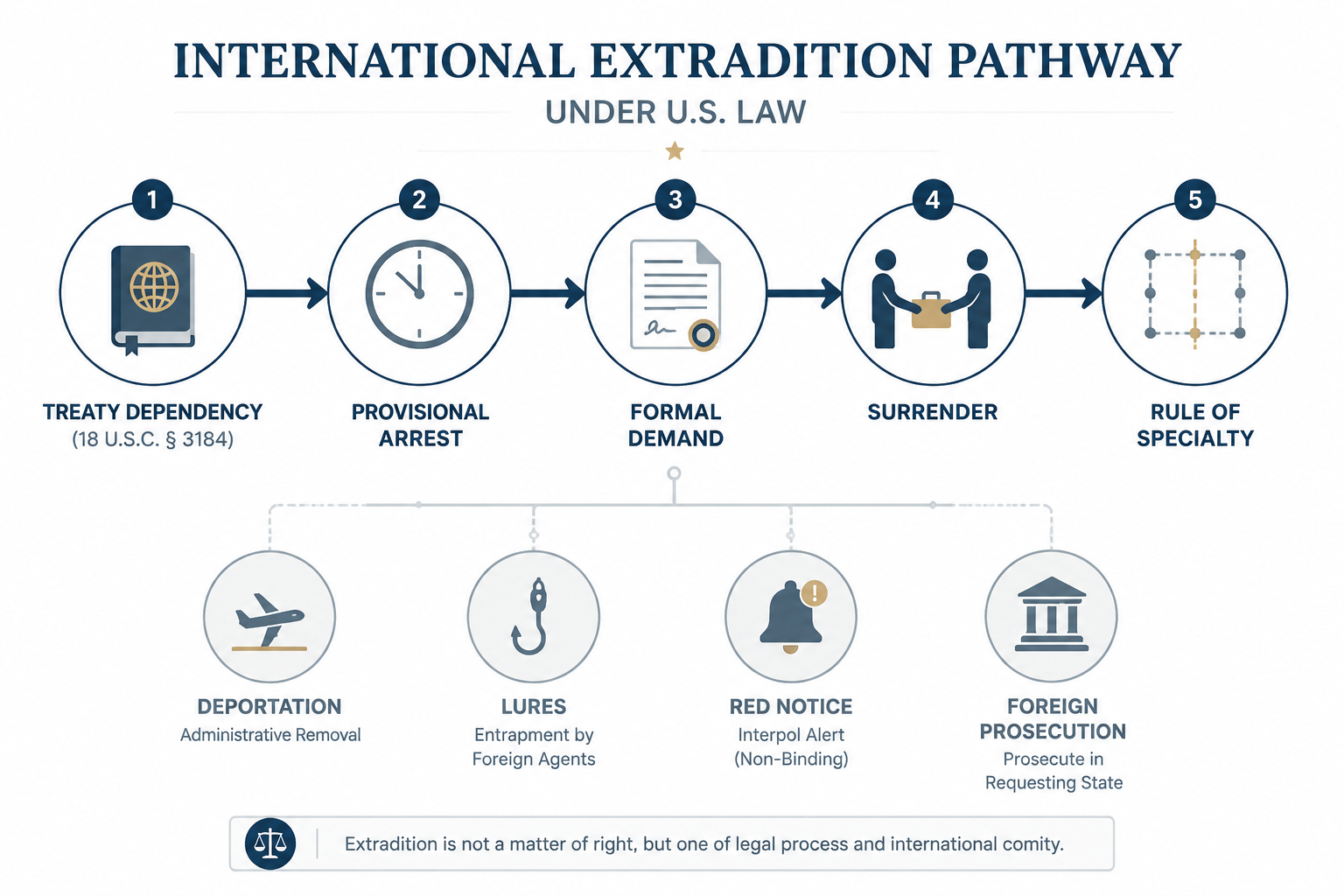
The DOJ Justice Manual describes international extradition as treaty-based and emphasizes that prosecutors should work through the Office of International Affairs. It also explains provisional arrest: in urgent cases, the United States may seek temporary arrest before the full extradition package is submitted, with formal documents generally due within the treaty’s deadline; the Justice Manual describes deadlines ranging from 30 days under many treaties to three months in some non-treaty-related contexts.[9]
The Council on Foreign Relations describes extradition as a process that can take more than a year on average from request to surrender, depending on treaty terms, court proceedings, appeals, diplomatic review, and the requested state’s law.[10] That time frame is not a promise in any individual case. It is a reminder that international custody can involve parallel tracks: criminal defense, immigration status, diplomatic communication, detention review, and foreign counsel’s litigation strategy.
- Confirm treaty coverage and whether the charged conduct is extraditable under the treaty.
- Identify whether custody began with provisional arrest or a full formal demand.
- Review the complaint, affidavits, translations, charging documents, and certification materials.
- Separate extradition defenses from merits defenses that belong in the requesting country.
- Track specialty, because surrender for one offense may limit later prosecution for another.
Specialty is often the overlooked protection. In general terms, the rule of specialty prevents the requesting country from prosecuting the surrendered person for offenses outside the extradition grant, subject to treaty terms and exceptions. Counsel should read the actual treaty, the surrender order, and any diplomatic assurances rather than relying on a generic specialty description.
Not every cross-border capture is extradition. The Justice Manual discusses alternatives and related mechanisms, including deportation, expulsion, lures, and foreign prosecution, while warning that certain operations require high-level review and approval.[9] The Council on Foreign Relations likewise distinguishes extradition from other tools governments may use to obtain or pursue a suspect.[10] INTERPOL Red Notices add another layer: a Red Notice is a request to law enforcement worldwide to locate and provisionally arrest a person pending extradition, surrender, or similar legal action; it is not itself an international arrest warrant.[11]
The Ker-Frisbie line of cases is best treated as a boundary rule, not a field manual. The doctrine is commonly understood to permit a court to exercise jurisdiction over a defendant even when the defendant’s presence was obtained through forcible abduction, and Alvarez-Machain applied that principle in the international setting where the treaty did not prohibit the abduction at issue. But the Justice Manual’s operational restrictions and approval requirements are the practice point: legality of jurisdiction is not the same as permission for agents or prosecutors to use an irregular method.[9]
Where Constitutional Arguments Fit
Constitutional arguments are strongest when attached to the correct gateway. A home-entry challenge belongs at apprehension. A due-process challenge to detention conditions or delay may belong in the asylum-state custody proceeding. A challenge to identity or facial sufficiency may belong in extradition habeas practice. A specialty argument belongs after surrender or in response to charges beyond the extradition grant. A fugitive disentitlement issue belongs when a court is asked to dismiss a fleeing defendant’s claim, not when counsel is simply trying to understand the arrest paperwork.
LII’s fugitive-from-justice overview notes that fugitive status can affect a person’s ability to invoke judicial relief, including through fugitive disentitlement doctrine.[3] That doctrine should not be converted into a general rule that a fugitive has no rights. The useful question is narrower: which court is being asked to act, what relief is requested, and whether the client’s flight frustrates that court’s authority.
The same discipline applies to suppression. An unlawful entry may support suppression of evidence obtained from that entry, but it does not automatically erase the demanding state’s prosecution, invalidate every warrant, or defeat extradition. Counsel should preserve the issue, identify the remedy available in the relevant court, and avoid promising that a capture defect will end the underlying case.
A Working File Map for Defense Counsel
The useful defense file is organized by authority, not by narrative. Instead of starting with the client’s account of movement across jurisdictions and then searching for doctrines, start with the legal source of custody and work outward.
| File item | Why it matters |
|---|---|
| Booking record and holding authority | Shows whether the jail is holding the client for local charges, an out-of-state warrant, a federal warrant, immigration custody, or multiple authorities |
| Warrant copy and confirmation messages | Identifies the issuing jurisdiction, warrant type, date, offense, and confirmation chain |
| Arrest reports, body-camera footage, and dispatch logs | Preserves Fourth Amendment issues tied to stop, entry, consent, force, and timing |
| Extradition waiver form or advisement transcript | Shows whether the client knowingly waived return procedures and which objections may remain |
| Governor’s warrant and requisition packet | Defines the formal interstate extradition posture and the available habeas or statutory challenge |
| Treaty, complaint, provisional arrest request, and formal extradition package | Defines the international extradition posture and separates certification issues from surrender issues |
This map also prevents overreading institutional labels. A U.S. Marshals task-force arrest does not automatically make the prosecution federal. A Red Notice does not automatically authorize a local officer to bypass domestic law. A governor’s warrant does not decide guilt. A treaty certificate does not itself put the person on an airplane. Each document does a particular job, and the defense response should match that job.
Fugitive capture under U.S. law is best analyzed as a sequence of procedural gateways: triggering event, warrant issuance, apprehension, interstate extradition, and international extradition. The client’s rights, deadlines, release options, and objections are not determined by the word “fugitive.” They are determined by the gateway that currently holds the client.
References
- U.S. Marshals Service — Fugitive Investigations
- U.S. Marshals Service — Fugitive Task Forces
- Legal Information Institute, Cornell Law School — Fugitive from Justice
- U.S. Code — 18 U.S.C. Chapter 49 — Fugitives from Justice
- UNC School of Government, April 8, 2026 — Extradition Basics: Fugitive Warrants and Governor’s Warrants
- U.S. Code — 34 U.S.C. § 41503 — Fugitive Apprehension Task Forces
- Constitution Annotated, Congress.gov — Exigent Circumstances and Warrants
- Legal Information Institute, Cornell Law School — Criminal Procedure
- U.S. Department of Justice — Justice Manual 9-15.000 — International Extradition And Related Matters
- Council on Foreign Relations — What Is Extradition?
- INTERPOL — About Red Notices
Comments
Join the discussion with an anonymous comment.