
General-Purpose vs. Legal-Native AI: What Every Lawyer Needs to Know About the Risks
This article helps practicing attorneys and in-house counsel distinguish between general-purpose LLMs (ChatGPT, Claude, Gemini) and legal-native AI platforms (CoCounsel, Lexis+ with Protégé, Harvey, Spellbook), providing a risk-calibrated decision framework based on hallucination benchmarks, confidentiality exposure, and professional responsibility obligations.
- Hallucination rate
- Not measured / undisclosed
The Two Categories of Legal AI — and Why the Distinction Matters
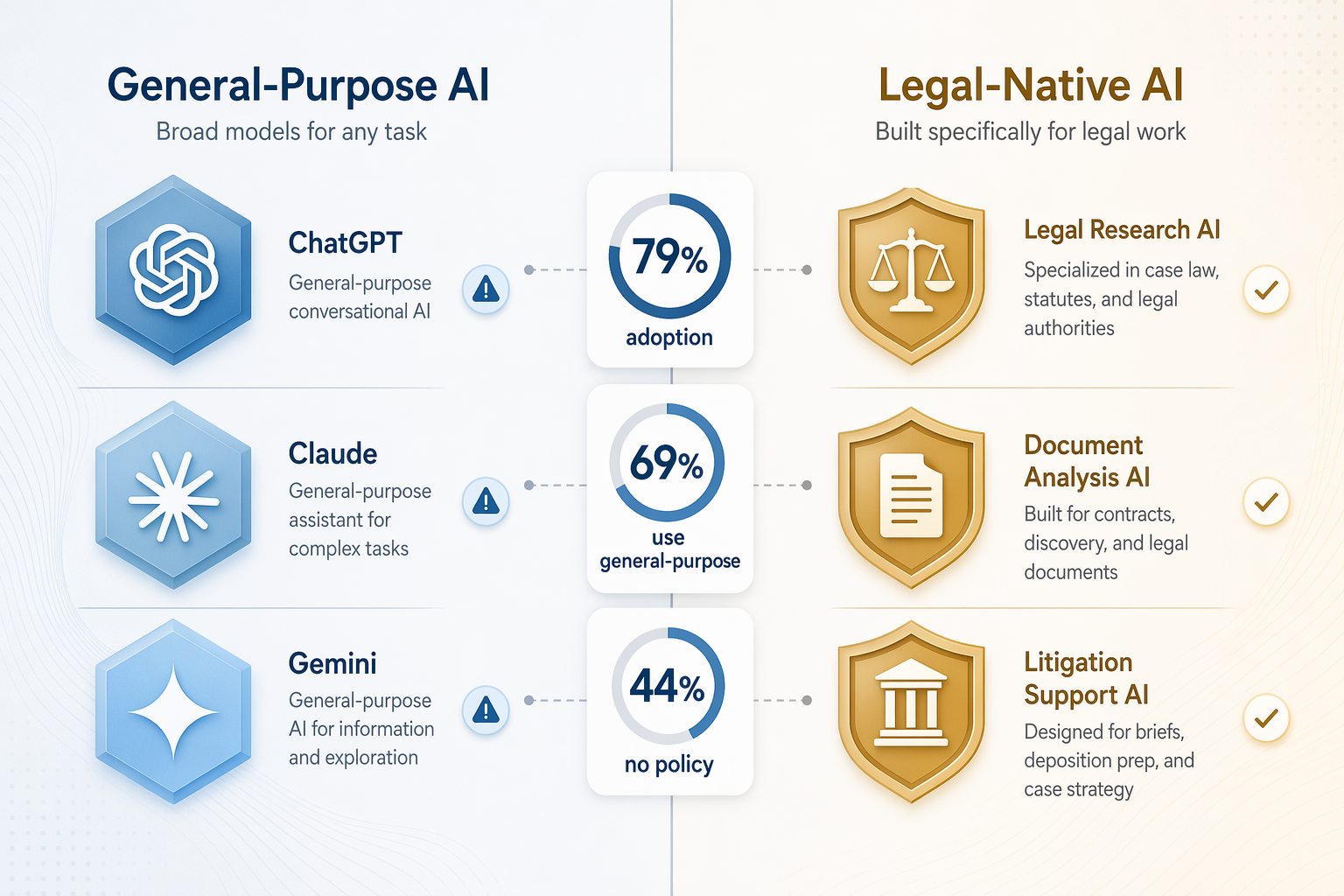
The legal profession's relationship with artificial intelligence has reached an inflection point. According to the 2026 Legal Industry Report from 8am, 69% of legal professionals now use general-purpose AI tools for work — more than double the 31% reported in 2025. The Wolters Kluwer Future Ready Lawyer Report puts the figure even higher, finding that over 90% of surveyed legal professionals use at least one AI tool daily. Yet beneath these adoption numbers lies a distinction that most coverage ignores: the difference between general-purpose large language models and legal-native AI platforms.
General-purpose LLMs — ChatGPT, Claude, Gemini — are trained on broad internet corpora and designed for open-ended conversation. They are fast, flexible, and cheap. Legal-native platforms — Westlaw CoCounsel, Lexis+ with Protégé, Harvey, Spellbook — are built on top of foundation models but are fine-tuned on legal corpora, augmented with retrieval-augmented generation (RAG) against vetted legal databases, and designed with professional responsibility constraints baked in.
The core thesis of this article is straightforward: the most important AI decision a lawyer makes is not which tool to buy, but which category of tool to use for which task. Using a general-purpose LLM for client-facing legal work introduces risks — hallucinated citations, confidentiality breaches, and ethical violations — that legal-native platforms are specifically designed to mitigate. Understanding this distinction is the foundation of competent AI use under ABA Model Rule 1.1, which requires attorneys to maintain competence in the benefits and risks of relevant technology.
Where Each Category Excels: A Use-Case Comparison
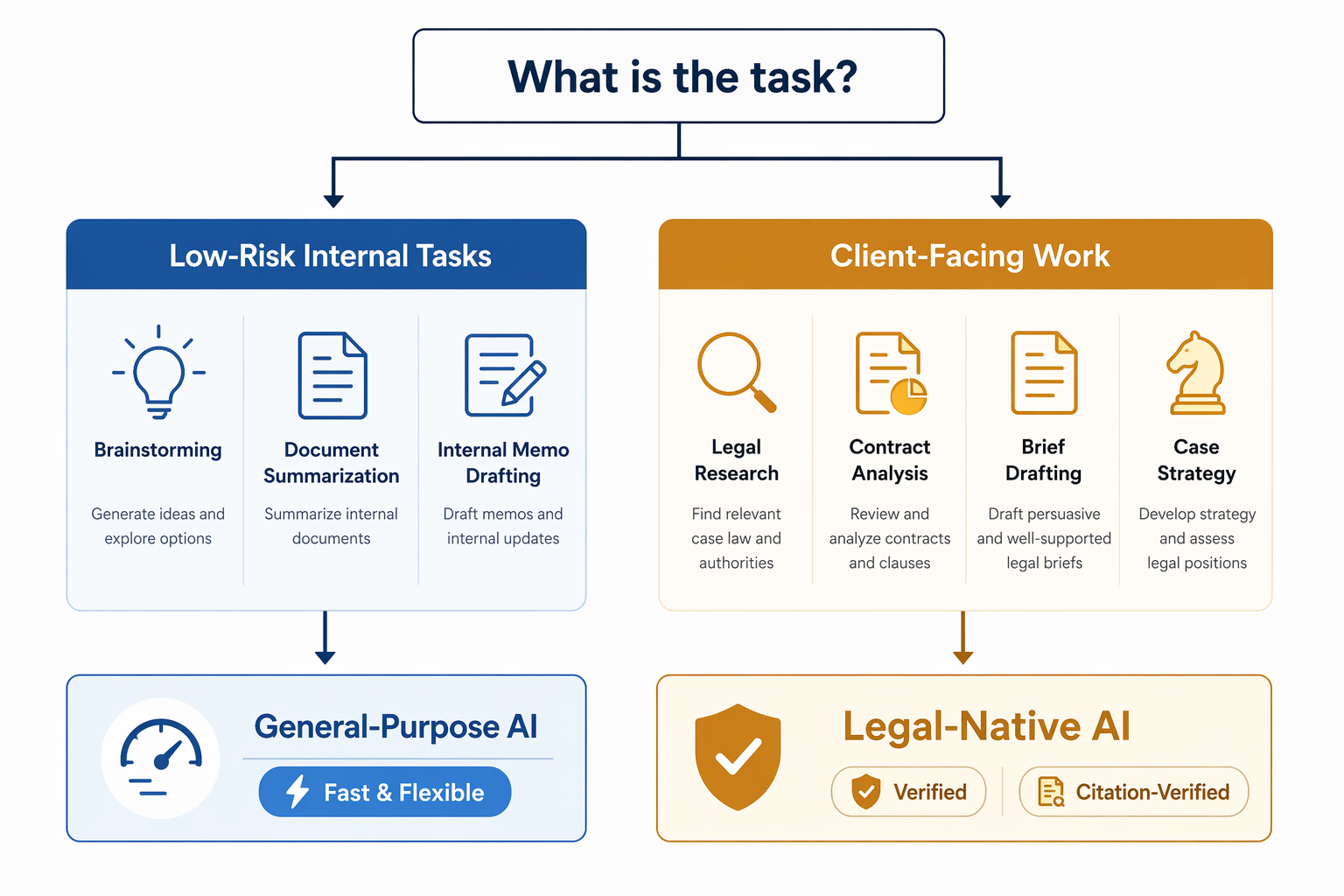
Not every legal task carries the same risk profile. Brainstorming settlement strategies with a general-purpose LLM poses a different level of exposure than using one to draft a motion that will be filed with a court. The table below maps common legal tasks to the appropriate tool category, with explicit risk notes drawn from documented incidents and professional responsibility guidance.
| Task | General-Purpose LLM | Legal-Native Platform | Risk Note |
|---|---|---|---|
| Legal research & citation verification | Not recommended | Recommended | Stanford RegLab found hallucination rates of ~33% for Westlaw Precision AI and ~17% for Lexis+ AI on test queries. General-purpose LLMs hallucinate at higher, unmeasured rates on legal citations. |
| Contract review & redlining | Use with caution | Recommended | General-purpose LLMs lack structured citation output and may miss jurisdiction-specific clauses. Legal-native tools like Spellbook integrate with Word and flag risks against trained models. |
| Internal memo drafting (non-client) | Acceptable | Optional | Low-risk if no confidential client information is input. Still verify all citations manually. |
| Client communication drafting | Not recommended | Recommended | Inputting client facts into a general-purpose LLM may violate confidentiality obligations under Model Rule 1.6 unless an enterprise zero-retention agreement is in place. |
| Brainstorming & ideation | Acceptable | Optional | Low-risk if no client-specific facts are disclosed. Useful for generating alternative arguments or settlement ranges. |
| E-discovery document review | Not recommended | Recommended | General-purpose LLMs lack the structured privilege logging and chain-of-custody features required in litigation. |
| Compliance monitoring | Not recommended | Recommended | Regulatory changes require up-to-date, jurisdiction-specific training data that general-purpose models cannot guarantee. |
The Hallucination Problem: Benchmarks and Documented Incidents
The most visible risk of using general-purpose AI for legal work is hallucination — the generation of confident-sounding but entirely fabricated information. In the legal context, this most often manifests as fake citations: cases, statutes, and docket numbers that look real but do not exist.
The most rigorous public benchmark comes from the Stanford RegLab study (2024), which tested legal research AI tools on a set of legal queries. The results were sobering: Westlaw Precision AI hallucinated approximately 33% of its test queries, while Lexis+ AI hallucinated approximately 17%. These figures apply to the predecessor products that have since been updated — Thomson Reuters and LexisNexis have released improvements — but the study established a baseline for the problem.
The real-world consequences are not theoretical. In Mata v. Avianca, a federal court sanctioned attorneys for submitting a brief that contained six fabricated citations generated by ChatGPT. The case became a watershed moment, prompting courts across the country to issue standing orders requiring attorneys to disclose AI use and verify all AI-generated citations.
The scale of the problem is larger than many practitioners realize. AI legal scholar Damien Charlotin has tracked over 750 documented instances where lawyers were reprimanded for submitting AI-generated fake citations, as reported by the Filevine AI Trust Index. These range from informal judicial warnings to monetary sanctions and, in some cases, referrals to state bar disciplinary authorities.
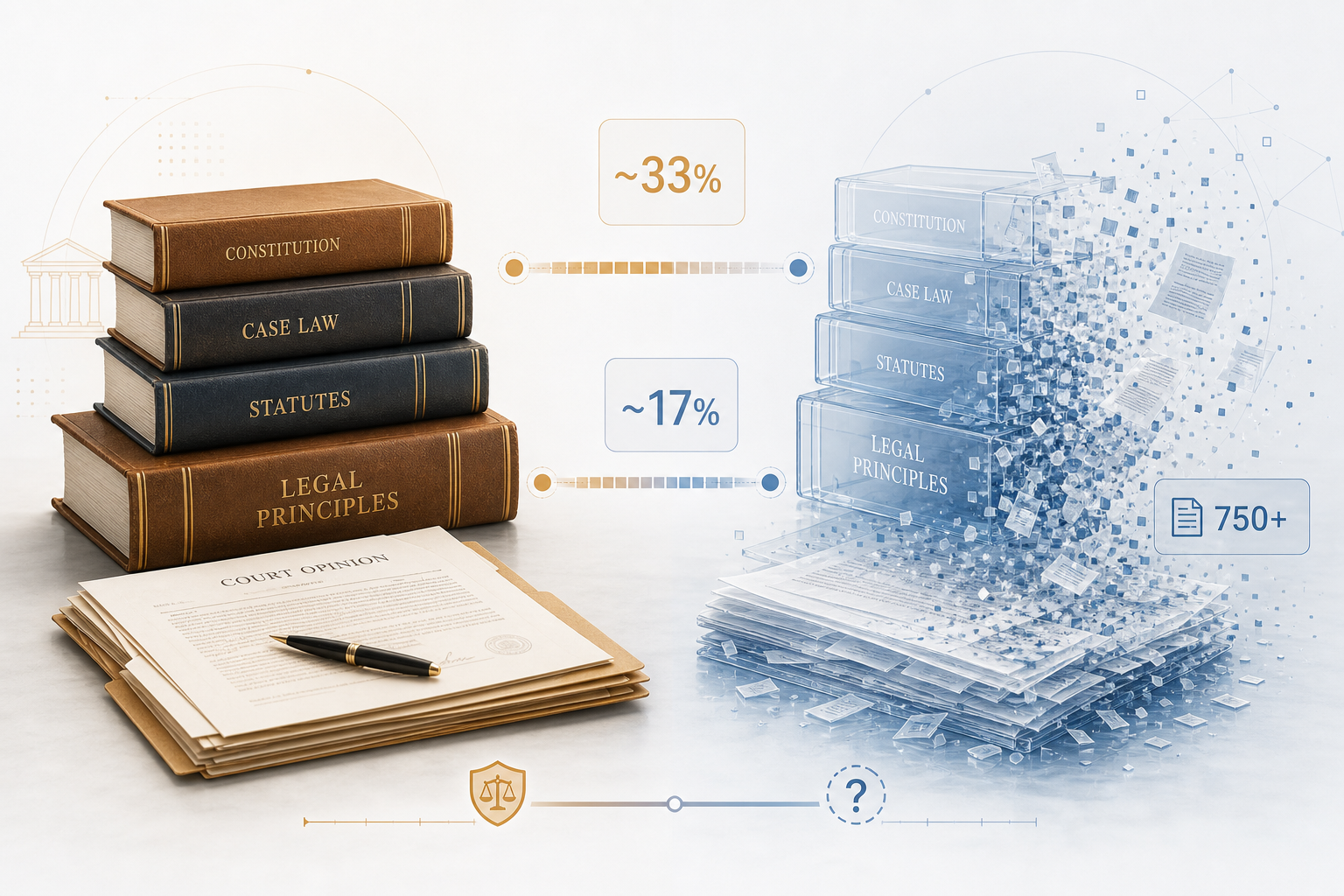
| Source | Finding | Year |
|---|---|---|
| Stanford RegLab | Westlaw Precision AI hallucinated ~33% of test queries | 2024 |
| Stanford RegLab | Lexis+ AI hallucinated ~17% of test queries | 2024 |
| Damien Charlotin tracker (via Filevine) | 750+ documented instances of lawyers reprimanded for AI hallucinated citations | 2025–2026 |
| Mata v. Avianca (SDNY) | Attorneys sanctioned for submitting ChatGPT-generated fabricated citations | 2023 |
Confidentiality Risks: What Happens to Your Data
Hallucination is not the only risk. Confidentiality — the cornerstone of the attorney-client relationship under ABA Model Rule 1.6 — is directly implicated by how different AI categories handle user data.
Consumer-grade general-purpose LLMs typically use user inputs for model training and improvement by default. As Rev's 2026 guide to legal AI tools explicitly warns, free tools like ChatGPT may use inputs for model training, posing a direct confidentiality risk. If a lawyer pastes a draft settlement agreement or a client's medical records into a consumer-grade ChatGPT session, that information may become part of the model's training data — potentially discoverable by other users or retained by the vendor.
Enterprise-grade agreements can mitigate this. OpenAI, Anthropic, and Google all offer enterprise plans with contractual guarantees that customer data will not be used for training. But these agreements must be explicitly signed — the default consumer terms do not provide this protection. The Xantrion 2026 comparison of legal AI tools underscores this point, warning that general AI tools may use inputs for model training and advising firms to verify data-handling policies before any client-facing use.
Legal-native platforms, by contrast, are built from the ground up with confidentiality as a design requirement. Westlaw CoCounsel, Lexis+ with Protégé, Harvey, and Spellbook all publish data-handling policies that explicitly state client data will not be used for model training. Many offer zero-retention options, meaning the platform does not store user queries or uploaded documents after the session ends. These policies are not marketing features — they are structural responses to the professional responsibility obligations that legal-native platforms are designed to serve.
Cost Comparison: Published and Unpublished Pricing
Pricing is one of the most opaque dimensions of the legal AI market. According to GC AI's 2026 ranking, only 2 of the 10 top legal research platforms publish individual pricing. The rest require sales conversations, making apples-to-apples cost comparison difficult for practitioners.
| Tool | Category | Published Price | Notes |
|---|---|---|---|
| GC AI | Legal-native | $500/user/month | Published pricing; includes legal research and drafting |
| Paxton AI | Legal-native | $499/user/month | Published pricing; includes legal research and document analysis |
| Harvey AI | Legal-native | Unpublished (enterprise) | Raised $200M at $11B valuation (March 2026); custom pricing for firms and in-house teams |
| Westlaw CoCounsel | Legal-native | Unpublished | Requires sales conversation; integrated with Thomson Reuters ecosystem |
| Lexis+ with Protégé | Legal-native | Unpublished | Rebranded from Lexis+ AI on February 24, 2026; custom pricing |
| Spellbook | Legal-native | Subscription (unpublished) | Built on GPT-4; integrates with Microsoft Word; pricing varies by firm size |
| ChatGPT (Consumer) | General-purpose | $20/month (Plus) | No confidentiality guarantees; inputs may be used for training |
| ChatGPT (Enterprise) | General-purpose | Custom | Zero-retention agreement available; requires enterprise contract |
| Claude (Enterprise) | General-purpose | Custom | Zero-retention agreement available; requires enterprise contract |
The cost differential between general-purpose and legal-native AI is significant, but it must be evaluated in context. A $500/user/month legal-native platform may appear expensive compared to a $20/month consumer ChatGPT subscription. However, the cost of a single sanctions order, a malpractice claim, or a bar disciplinary proceeding far exceeds any subscription savings. The Thomson Reuters 2026 State of the US Legal Market report found that firms with a clear AI strategy are almost four times more likely to see tangible ROI — suggesting that the cost of not having a strategy is higher than the cost of investing in appropriate tools.
A Decision Framework for Practicing Attorneys
The following framework is designed to help practicing attorneys make category-level decisions about AI use, grounded in the risk profile of each task and the professional responsibility obligations that apply.
Step 1: Classify the Task
- Does the task involve client-specific facts, confidential information, or work product that will be filed with a court? If yes, use a legal-native platform with verified data-handling policies.
- Is the task purely internal — brainstorming, summarizing public information, drafting internal notes that contain no client data? General-purpose AI may be acceptable, but verify the vendor's data policy first.
- Does the task require citation verification? If the output will cite cases, statutes, or regulations, use a legal-native platform that provides source links and allows independent verification.
Step 2: Verify the Data Pipeline
- Obtain and review the vendor's data-processing agreement. Confirm in writing that your inputs will not be used for model training.
- If using a general-purpose LLM, ensure an enterprise zero-retention agreement is in place before inputting any client information.
- For legal-native platforms, verify the jurisdiction coverage and ensure the tool's training data includes the relevant courts and regulatory bodies.
Step 3: Implement Human Verification
- Never file AI-generated citations without independent verification against primary sources. The 750+ documented reprimand incidents tracked by Damien Charlotin demonstrate that this step is non-negotiable.
- Establish a firm-wide policy for AI use. The Clio Legal Trends Report found that 44% of firms still have no formal AI governance policy — a gap that creates liability exposure for every attorney in the firm.
- Document your AI use. If a court or client asks which tools were used and how outputs were verified, you should be able to provide a clear answer.
State Bar Guidance and Professional Responsibility Landscape
The professional responsibility framework for AI use is evolving rapidly. The ABA has issued formal opinions addressing attorney competence in AI (Model Rule 1.1), confidentiality obligations when using AI tools (Model Rule 1.6), and the duty to supervise non-human tools (Model Rule 5.3). Several state bars — including California, Florida, New York, and Texas — have issued their own guidance, with some requiring affirmative disclosure of AI use to courts and clients.
Federal courts have also begun to act. Multiple district courts now have standing orders requiring attorneys to certify that any AI-generated content has been verified by a human. The Legal Talk Network advises litigators to distinguish between general and legal-specific AI, referencing the Mata v. Avianca case, and urges firms to establish clear AI policies addressing data security, transparency, and approved platforms.
The key takeaway for practicing attorneys: the regulatory landscape is not waiting for consensus. Courts are issuing orders, bars are publishing opinions, and clients are forming expectations. The Clio Legal Trends Report found that 70% of law firm clients either prefer or are neutral toward firms that use AI — but that preference assumes the AI is used competently and ethically. A sanctions order or a confidentiality breach will quickly erode that goodwill.
The distinction between general-purpose and legal-native AI is not a marketing distinction — it is a professional responsibility distinction. The tools in each category are designed for fundamentally different risk environments. Lawyers who understand this distinction and apply it task by task will be better positioned to serve their clients competently, ethically, and efficiently.
Chronological incident history
No sanction cases have named this tool in the tracked record set to date. This does not imply the tool is safe — see Risk Digest for ongoing monitoring.
← Compare peer toolsReport a correction or tip
Spotted an outdated figure, a misstated fact, or a ruling this tool profile should reflect? Public comments are disabled for this content given the professional cost of a misreported case outcome, penalty amount, or rule text — use the structured correction channel instead.
Report a correction or tip for this record →