
Full profile
Germany’s media regulators have made the cleaner and more consequential move: they are no longer treating AI search answers as merely a new presentation layer for indexed material. On July 14, 2026, the Conference of Directors of State Media Authorities, or ZAK, classified AI-powered search engines and chatbots, including Google AI Overviews and Perplexity-style answer services, as providers of their own media content under German media law.[1][2]
That reclassification matters because the legal object changes. A list of links can still look like an intermediary function. A generated answer, selected, compressed, phrased, and displayed as the platform’s response, starts to look like a statement for which someone has to take responsibility.
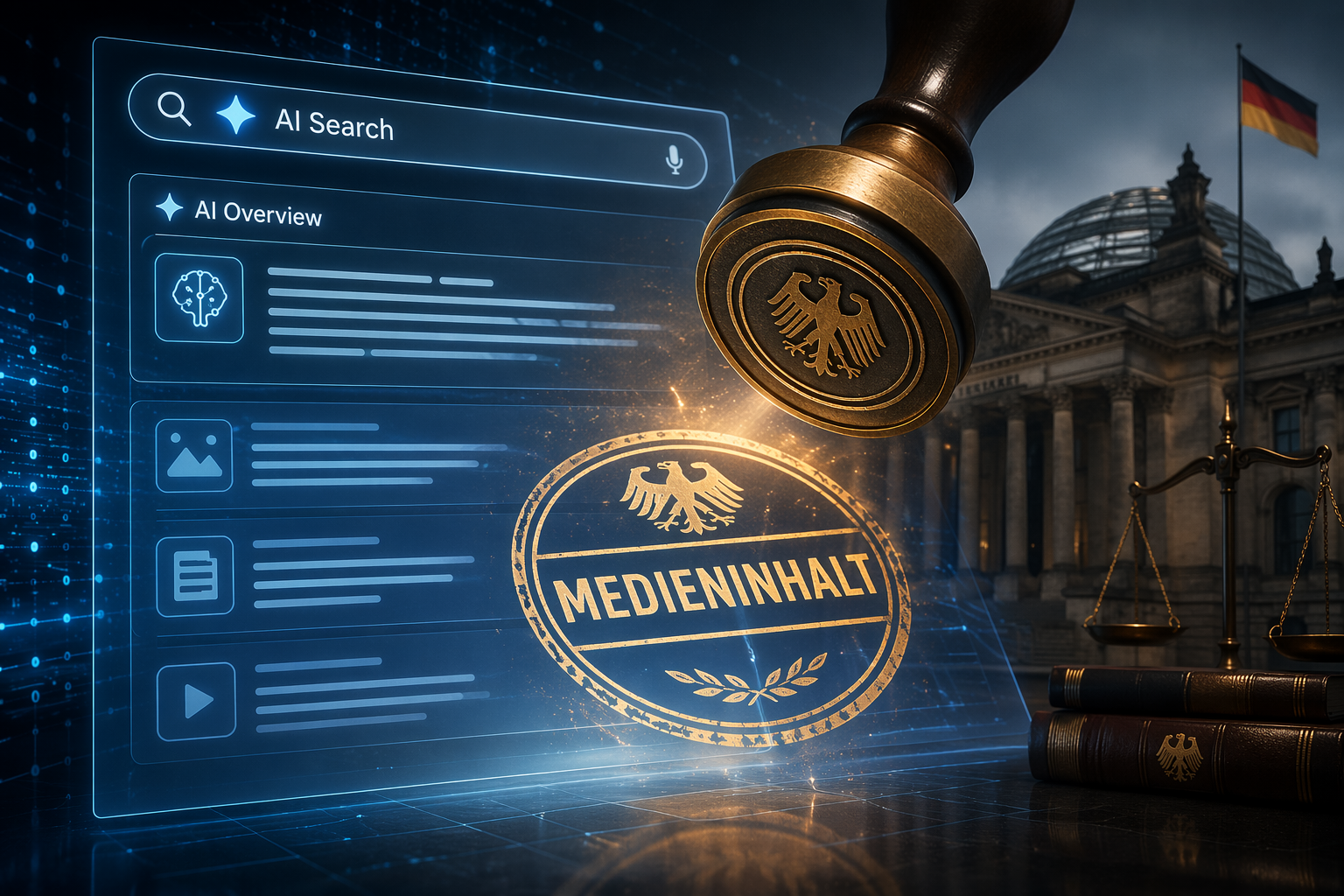
ZAK Chairman Dr. Thorsten Schmiege said the state media authorities will “consistently apply German media law” to AI search engines and chatbots from now on.[1] For providers operating in Germany, that is not a mere labeling exercise. It points toward direct responsibility for generated summaries, reduced room to rely on intermediary liability shields, and a media-law compliance layer that attaches to what users see, not only to what model teams tune.
The Munich court had already shown the liability consequence
The ZAK decision did not arrive in a vacuum. On May 28, 2026, the Munich Regional Court, in case 26 O 869/26, held Google directly liable for false statements in an AI Overview and treated the output as Google’s own words.[3] The court also rejected Google’s defense that users could simply verify the answer themselves.[3]
That rejection is the part compliance teams should read twice. The commercial promise of AI search is that it saves the user from opening several pages, comparing sources, and reconstructing an answer manually. A defense that pushes the verification burden back onto the user asks the law to ignore the product’s selling point.
The Munich ruling supplies the immediate private-law edge to the regulatory classification. ZAK says the output is media content attributable to the provider. The court has already applied a similar logic to liability for a false generated statement. Together, they move the discussion away from a familiar complaint that AI answers may be unreliable and toward a harder operational question: which provider is responsible when the generated answer is wrong, misleading, opaque, or distorts the visibility of media sources?
Why the DSA shield becomes harder to invoke
The Digital Services Act’s intermediary liability logic depends on the service being treated, in the relevant respect, as an intermediary for information supplied by others. ZAK’s classification cuts into that premise. If the generated summary is the provider’s own media content, the provider is no longer merely transmitting, caching, hosting, ranking, or linking to third-party information at the point that matters to the user.
That does not mean every technical component of AI search becomes publisher speech. Crawling, indexing, retrieval, and link display can still raise separate legal questions. The more exposed layer is the generated answer itself: the synthesized sentence, the chosen emphasis, the omission of qualifying context, and the citation box that gives the answer the appearance of traceability.
The legal opinion by Professors Jan Oster and Christoph Busch, cited in the public reporting around the dispute, makes that distinction explicit. They concluded that AI-generated search responses are generally the provider’s own content rather than information supplied by users.[3] That reasoning gives ZAK a doctrinal route around the platform’s preferred posture: “we only organize what others have published.”
For counsel, the practical consequence is not that DSA analysis disappears. It is that the most valuable exemption arguments become less dependable for the visible answer layer. A provider may still argue about scope, technical function, or particular output types on appeal. But after ZAK and the Munich court, treating AI summaries as safely covered by intermediary status is a risky baseline for Germany.
MStV duties move to the answer surface
Once AI search output is media content, the Medienstaatsvertrag becomes more than a background statute for broadcasters and media intermediaries. The relevant duties include transparency of ranking or selection criteria, non-discrimination, and protection of media pluralism.[1][2]
Those obligations do not sit neatly inside a model-governance spreadsheet. They touch the design of the answer experience. A regulator looking at an AI Overview or conversational answer will not only ask whether a model card exists or whether training data was documented. It can ask how sources are selected, why one publisher is surfaced and another disappears, whether the interface makes the basis of selection intelligible, and whether the system’s presentation privileges certain media offers without transparent criteria.
| Compliance issue | What changes after ZAK |
|---|---|
| Generated answer text | More likely to be treated as the provider’s own media content rather than neutral third-party material. |
| Source selection and citation | Selection criteria become part of the media-law transparency problem, not just a product-quality issue. |
| Ranking and prominence | Preferential or opaque treatment can implicate non-discrimination and media pluralism duties. |
| Publisher complaints | Challenges can target both false summaries and the way AI answers divert or obscure attribution. |
The hardest internal adjustment may be organizational. Search, product, trust and safety, legal, public policy, and publisher relations teams often treat answer quality, attribution, ranking, and liability as separate workstreams. The ZAK position pulls them together. If the answer is media content, then display choices become legally relevant editorial choices, even when the underlying system is probabilistic and automated.
A thin disclaimer is unlikely to carry the whole burden. Labeling an answer as AI-generated may help with transparency, especially as EU AI Act Article 50 transparency obligations begin to apply on August 2, 2026.[1] But German media-law scrutiny is concerned with more than whether the user is told that a machine generated text. It is concerned with how a media-relevant answer is selected, weighted, attributed, and displayed.
Why publishers now have a stronger route into the dispute
Publishers have been arguing for years that search and social platforms extract value from journalistic work while controlling the path to the audience. AI search sharpens that conflict because it can answer the user’s question before the user reaches the publisher’s page. The legal relevance of that shift is now clearer in Germany: if the platform’s answer is its own media content, a publisher’s objection is not limited to copyright rhetoric or complaints about bad summaries.
ZAK cited research by Professor Dirk Lewandowski finding that AI-generated answers reduce traffic to original publishers by 18% to more than 50% across different studies.[1] That range does not prove the same loss for every publisher, query, or topic. It does show why media regulators view AI answer boxes as a structural intervention in distribution rather than a harmless interface improvement.
The traffic issue also explains why attribution alone may not satisfy media-law concerns. A visible source link can coexist with a design that makes clicking unnecessary. Where the answer absorbs the economic value of the publisher’s reporting while leaving the publisher with a smaller audience path, media pluralism becomes more than an abstract constitutional value. It becomes a question of whether the information ecosystem can finance the sources that the AI interface summarizes.
Correct answers can still fail the source-transparency test
Accuracy is only one part of the regulatory concern. Oumi’s analysis found that even when Google’s Gemini 3 answers were factually correct, 56% of those correct answers could not be substantiated by the sources Google cited.[3] That finding is uncomfortable for a system that presents citations as if they explain where the answer came from.
The point is not that every cited source must contain every word of a generated answer in identical form. Search answers synthesize. But if the cited materials do not substantiate the answer, the interface creates a false sense of auditability. A user sees sources and assumes traceability; a publisher sees its work used or displaced; a regulator sees a selection and attribution mechanism that may be opaque in precisely the place where media law expects transparency.
That is why the Oster and Busch reasoning matters beyond liability doctrine. If the generated response is the provider’s content, then the provider cannot fully outsource responsibility to the cited pages. The provider chose the sources, generated the synthesis, and decided how the output would be presented.
The state-media-authority route is separate from the next AI statutes
The ZAK decision operates through Germany’s state media authority system. ZAK coordinates the directors of the 14 Landesmedienanstalten, so this is not a federal ministry decision, even though coordinated state-media enforcement can have nationwide practical consequences for providers operating in Germany.[1][2]
That distinction matters because several nearby regimes are easy to collapse into one another. The German AI Market Surveillance and Innovation Promotion Act, known as KI-MIG, was approved by the Cabinet on February 11, 2026, but has not yet been passed by the Bundestag. It would create a separate carve-out placing media-sector AI under Landesmedienanstalten supervision. That prospective framework may complement ZAK’s current approach, but it is not the legal basis that produced the July 14 ruling.
The planned State Treaty on Digital Media is also near-horizon context rather than operative law for this decision. No draft has yet been published. It may eventually clarify or expand the regulatory architecture for AI-mediated media distribution, but it should not be treated as if it already defines the scope of ZAK enforcement.
The EU AI Act sits beside these developments. Its Article 50 transparency obligations matter because they arrive at almost the same moment and will affect AI providers’ disclosure practices. But the distinctive move here is German media-law classification. An AI Act transparency notice and an MStV-facing explanation of selection, ranking, attribution, and pluralism are related compliance tasks, not substitutes.
What providers should assume while the appeal path opens
The ruling is fresh. It was issued one day before this dated briefing, and appeal filings, supervisory guidance, and more detailed legal commentary may narrow or complicate its reach. Companies have the right to appeal ZAK decisions, and Google has already indicated that it will appeal.[1]
That uncertainty should temper overbroad claims. The decision does not yet answer every question about every AI search format, every chatbot deployment, or every downstream use of indexed media content. It also does not mean that every mistaken AI output will automatically produce liability in the same way. Facts, interface design, user context, source presentation, and the procedural posture of any challenge will matter.
Still, the safe operating assumption has shifted. AI search providers active in Germany should now treat generated summaries as potentially their own media content for German media-law purposes. That assumption should affect product review, source-selection documentation, complaint handling, publisher escalation, substantiation testing, and public explanations of ranking or selection criteria.
For publishers, the ruling supplies a clearer route to contest both false summaries and opaque or uncompensated uses of their material. The strongest claims will likely be those that connect the generated statement, the source presentation, and the distribution effect, rather than treating AI search as a single undifferentiated grievance.
As of Q3 2026, the practical posture for AI search under German media law is therefore cautious but concrete: generated AI search answers may be treated as the provider’s own media content, with direct liability exposure and MStV duties following from that classification. This is a dated regulatory briefing, not compliance advice. The perimeter may change once appeal materials, state-media-authority guidance, or new legislative texts become available.
References
- German media regulator says Google's AI Overviews subject to German media law, Reuters, July 14, 2026.
- German media regulator applies media law to AI search services in landmark ruling, Broadband TV News, July 14, 2026.
- Landmark German ruling declares Google's AI Overviews are Google's own words and makes it liable for false answers, The Decoder.
Comments
Join the discussion with an anonymous comment.