
Full profile
As of July 15, 2026, the Google Gemini copyright lawsuit is not one case moving on one track. It is a split map: an earlier consolidated author-and-illustrator action in the Northern District of California, before Judge Eumi K. Lee, and a new publisher-led class action filed July 10, 2026, in the Southern District of New York. The distinction matters because the SDNY complaint is not merely another version of the familiar allegation that copyrighted books were used to train a large language model. Its sharper move is to ask whether Google’s earlier, purpose-specific access to books through Google Books, Google Play Books, and Google Scholar can be treated as authorization for Gemini training at all.
| Track | Forum and posture | Why it matters |
|---|---|---|
| In re Google Generative AI Copyright Litigation | N.D. Cal., No. 5:23-cv-03440-EKL; consolidated action filed in 2023, with docket activity reflected through mid-July 2026 in public trackers | Centers on individual authors and illustrators and proceeds in the district that has already shaped much of the AI training litigation discussion |
| Hachette v. Google | S.D.N.Y.; publisher class action filed July 10, 2026 after publishers withdrew a motion to intervene in the California action | Tests a narrower authorization theory tied to Google’s prior book-related platforms and Second Circuit precedent |
The California proceeding remains active. Public case trackers identify the consolidated Google generative AI copyright action as No. 5:23-cv-03440-EKL and place it before Judge Lee; they also show that the publishers had sought to intervene before withdrawing and filing separately, citing statute-of-limitations concerns.[1] The SDNY filing, announced by publishers and author groups on July 10, 2026, adds a different plaintiff configuration and a different doctrinal center of gravity.[2]
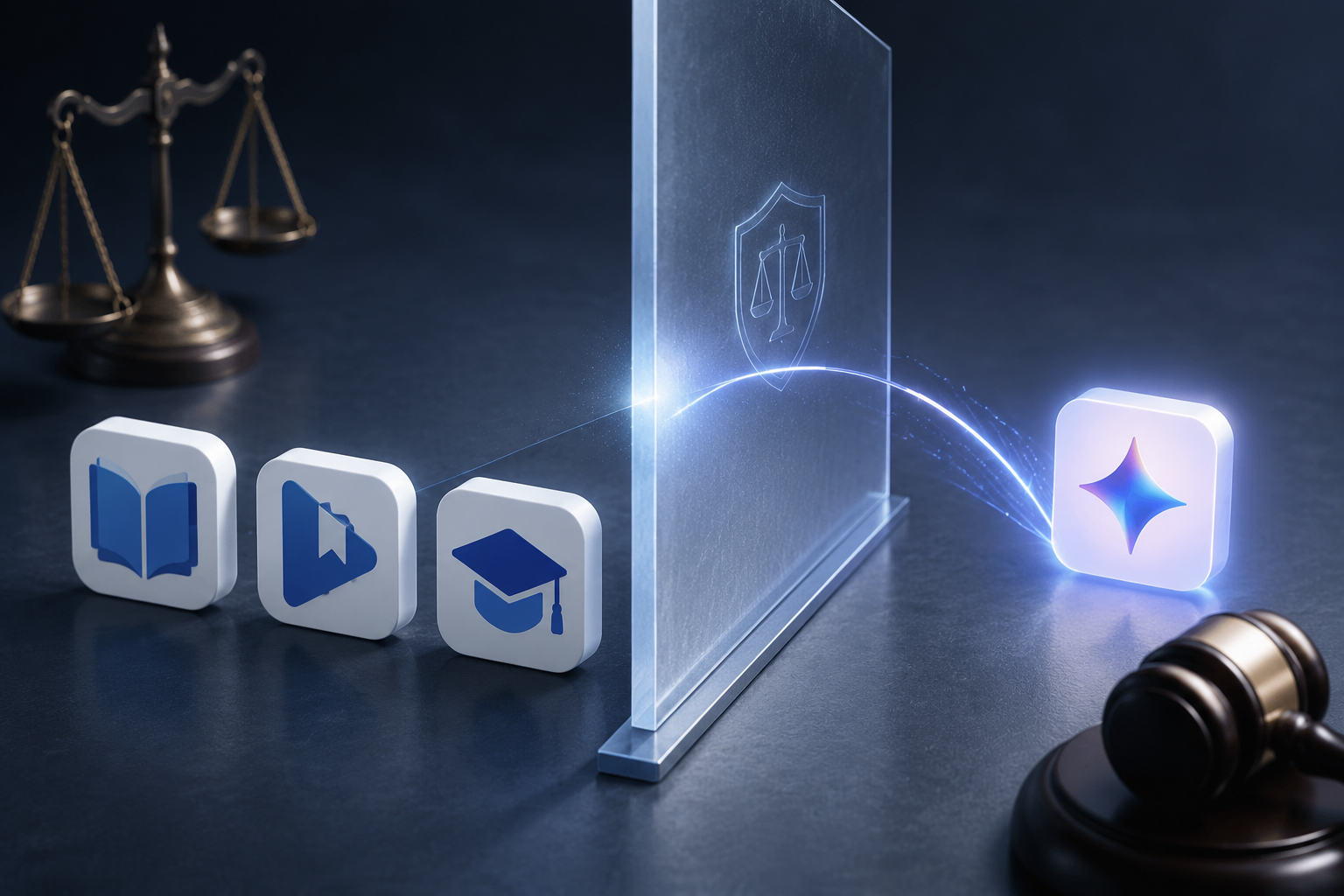
The SDNY Complaint Is About the Scope of Permission
Most AI copyright complaints eventually arrive at the same contested place: whether copying works for model training is fair use, and whether outputs are infringing, derivative, or too remote from the training corpus to support liability. The publisher theory against Google tries to reach an earlier question. If a publisher supplied a book for one Google service, what exactly did that permission cover?
The pleaded theory, as described by publisher and trade press accounts, separates three channels that can be too easily collapsed into the phrase “Google had the books.” Google Books is alleged to have involved copies for search indexing and snippets. Google Play Books involved retail distribution. Google Scholar involved academic search and citation discovery. The publishers’ point is that none of those permissions, even if valid for their stated purpose, amounted to permission to ingest books into Gemini training datasets.[2][3]
That is a materially different dispute from one in which the defendant allegedly scraped books from shadow libraries or copied web text without a preexisting platform relationship. The alleged wrong is not simply copying at scale. It is a change in use after access was obtained under a narrower bargain. For in-house counsel, that framing is the part to notice: legacy content deals, platform ingestion rights, indexing permissions, distribution licenses, and research-tool authorizations may not answer the same question if the later use is model training.
Why Authors Guild v. Google Cuts Both Ways
The Second Circuit is not a blank slate for Google and books. In Authors Guild v. Google, the court approved Google’s book-search project as fair use in 2015, but the holding was tied to the search-indexing and snippet-view function of that project.[4] That is why the SDNY forum matters. The publishers can argue that the prior Google Books precedent confirms the limited nature of the earlier use rather than blessing every later machine-learning use of the same corpus.
Google, for its part, can be expected to resist that narrowing. A defendant with an earlier fair-use win over book indexing will not lightly accept the premise that the precedent now works mainly as a boundary marker. But the boundary question is real. A fair-use holding for a searchable index does not automatically decide whether full-text ingestion for generative model training has the same purpose, market effect, or legal significance.
Romanova v. Amilus, identified in current commentary as another 2025 Second Circuit reference point for generative-AI copyright disputes, adds to the venue significance.[5] The important point is not that Romanova dictates the answer to the Google dispute. It is that the SDNY action places the authorization theory in a circuit whose book-search precedent is unusually relevant to Google’s own history.
The Ninth Circuit-Shaped AI Training Cases Do Not Answer This Version Cleanly
The recent AI training cases most lawyers now reach for do not map perfectly onto the publisher theory. In Bartz v. Anthropic, the court distinguished model training, which it treated as fair use, from the retention of pirated copies, which it did not treat the same way.[5] In Kadrey v. Meta, the Northern District of California also addressed fair use in the AI training setting.[5] Those rulings matter, but they come from a different posture and a different theory.
Anthropic and Meta sharpened the training-use debate: whether copying works into a model-development process is transformative, how market harm should be measured, and what role allegedly infringing inputs play when outputs are not shown to be substantially similar. The Google publisher action asks whether the court needs to start there at all. If the works entered Google systems under defined platform authorizations, the first fight may be over whether Gemini training fell inside or outside those permissions.
Thomson Reuters v. Ross, a Third Circuit fair-use decision from 2025, is also part of the current comparator set even though it is not a generative-AI training case.[5] Its relevance is more doctrinal than factual: courts are still working through how to evaluate copying that supports competing information products, and the fair-use analysis may not move in lockstep across circuits or technologies.
The OpenAI multidistrict litigation in the Northern District of California remains another pending reference point, but it has not yet supplied circuit-level law on the core training-data question.[5] That absence matters. Despite the volume of suits, there is still no definitive federal appellate rule deciding whether training generative AI on copyrighted works is fair use.
Crowded Litigation Context, Limited Precedential Answers
The number of AI copyright cases is now large enough to obscure rather than clarify the law. Publishing Perspectives, citing Edward Lee’s running tracker, reported more than 128 AI copyright lawsuits pending in U.S. federal courts as of July 2026.[3] That number is useful mostly as a warning against overreading any single district-court ruling.
For Google, the practical issue is not just that it faces another AI case. It is that the publisher action tries to convert Google’s long book-platform history from an asset into an evidentiary map. The more clearly the plaintiffs can identify which works were delivered for which Google service, and what the surrounding agreements or program terms allowed, the more the case may turn on permission architecture rather than general AI policy.
That does not make the publishers’ claim easy. Authorization scope can be messy. Platform terms change. Works arrive through different channels. Some copies may have been provided by publishers, some by authors or intermediaries, and some may have entered through other sources. A class action theory will have to manage those variations without dissolving into work-by-work licensing disputes.
Internal Risk Documents Matter, But Not as a Damages Forecast
The most eye-catching allegations concern internal Google documents. Multiple reports say the Hachette complaint cites internal materials describing the practice as “highly problematic for Google,” referring to “$10Bs–$100Bs in potential fines,” and identifying “heightened risk around fair use defenses.”[2][3][6] Those phrases will attract attention because they may bear on knowledge, state of mind, and willfulness. They should not be treated as an audited exposure calculation.
The legal relevance depends on predicate findings that remain contested. If the copying was authorized, or if the later use is found fair, the internal risk language loses much of its force. If the copying was unauthorized and the documents show that Google recognized a substantial infringement risk before proceeding, the willfulness inquiry becomes more serious.
That is where statutory damages enter the analysis. Norton Rose Fulbright’s 2026 update notes that willfulness allegations in AI copyright cases can implicate enhanced statutory damages, with statutory damages reaching up to $150,000 per work for willful infringement.[7] The per-work figure is real; the eventual exposure depends on liability, class scope, registration issues, the number of works, and how a court treats the alleged internal evidence.
The Publisher Theory Has Human Stakes, But the Pleading Still Has to Do Legal Work
The publishers and authors describe the Gemini training allegations as willful infringement of books whose value depends on controlled reproduction and licensing.[2] That framing is not incidental. It reflects a familiar authorship concern: a writer or publisher who agreed to discoverability, retail availability, or academic indexing did not necessarily agree to have the work used as raw material for a model that may compete in adjacent markets.
Still, the case will not be decided by the emotional force of that claim. The plaintiffs will need to show what was copied, how it was accessed, what permissions governed that access, and why the later use exceeded those permissions. Google will likely press fair use, challenge causation and classwide proof, and argue that the uses are legally protected or insufficiently tied to cognizable market harm. The fact that books are culturally important does not relieve either side of the ordinary burdens of copyright litigation.
Do Not Confuse This With the Gemini Data Trademark Case
Search results for a Google Gemini lawsuit may also surface Gemini Data, Inc. v. Google LLC, a trademark infringement case filed in September 2024.[5] That dispute is separate from the copyright training allegations. It may involve the Gemini name, but it does not decide whether books or other copyrighted works were lawfully used to train Google’s AI models.
What to Watch Next
The near-term watchlist is procedural, not predictive. First, verify the Hachette complaint directly against the filed PDF before relying on quoted internal-document language or specific pleading paragraphs. The current public discussion is strong enough to identify the authorization theory, but secondary descriptions are not a substitute for the complaint.
Second, track SDNY motion practice for how Google frames the relationship between Authors Guild and Gemini training. If the court treats Google Books as a narrow search-indexing precedent, the publishers’ authorization theory gains room. If the court treats the earlier fair-use reasoning as broadly favorable to computational uses, the case may begin to look more like the other AI training disputes.
Third, monitor the Northern District of California consolidated docket for pleading, class, and standing developments. The California track still matters, especially if it produces rulings on class certification or on how authors and illustrators can prove copying and injury across large model-training datasets.
Finally, watch for appellate guidance. District courts are now producing important AI copyright rulings, but the central training-data question has not yet been settled at the circuit level. The Google publisher action matters because it may force a court to answer a narrower but commercially significant question: when a platform obtained books for one licensed or permitted function, what happens when the later use changes?
References
- Case Tracker: Artificial Intelligence, Copyrights and Class Actions, BakerHostetler.
- Publishers and Authors File Class Action Lawsuit Against Google for Willful Copyright Infringement to Develop Gemini AI Models, Association of American Publishers.
- U.S. Publishers Sue Google, Alleging Massive Copyright Infringement Behind Its Gemini AI Service, Publishing Perspectives, July 2026.
- The Open Questions In U.S. Generative AI Copyright Litigation, Cleary Gottlieb.
- AI Copyright Training Data 2026 Landscape, AI Vortex.
- Google faces another AI training lawsuit from major publishers, TechCrunch, July 14, 2026.
- AI in Litigation Series: An Update on AI Copyright Cases in 2026, Norton Rose Fulbright, 2026.
Comments
Join the discussion with an anonymous comment.