
Full profile
The first legal warning sign in a grandparent scam is usually not the word "grandchild." It is the combination of a late-night emergency, a demand for secrecy, an authority figure on the line, and a payment method chosen because it is hard to reverse. A client may say the caller sounded like a grandson after an accident, a granddaughter in jail, or a young relative being held after a traffic stop. Then the call moves quickly: do not tell the parents, speak to this lawyer, follow this officer's instructions, withdraw cash, use a wire transfer, send cryptocurrency, or meet a courier.
That pattern matters because recourse starts with classification. A bank fraud unit, elder law attorney, legal aid office, or compliance team cannot treat the matter as a vague family embarrassment. It has to be handled as suspected elder financial exploitation, possible impersonation fraud, and, depending on the facts, a reportable criminal or administrative matter.
The scale is no longer small enough to dismiss as a rare confidence trick. In 2025, victims over 60 filed more than 201,000 complaints with reported losses of $7.7 billion, a 59% increase from 2024; the average reported loss exceeded $38,000, and at least 12,400 older victims reported losses of $100,000 or more.[1] Those figures cover elder fraud broadly, not only grandparent scams, but they explain why the intake question has changed from "Could this really happen?" to "Where does this victim go next?"

The Identifiable Pattern
The Federal Bureau of Investigation was describing the grandparent scam pattern years before AI voice tools became the headline. Its earlier public account emphasized the same core features still seen in current matters: a caller impersonates a grandchild, claims to be in trouble, asks for money, and tells the grandparent not to alert the parents.[2] The script has varied, but the control points have remained stable.
- Timing: calls often arrive when verification is harder, including late at night or during emotionally disruptive moments.
- Urgency: the caller frames delay as dangerous, legally costly, or humiliating for the supposed grandchild.
- Isolation: the victim is told not to contact parents, other relatives, bank staff, or law enforcement.
- Authority handoff: a second person may pose as a lawyer, police officer, court employee, bail bondsman, doctor, or jail official.
- Irreversible payment: the requested route may include wire transfer, cash, gift cards, cryptocurrency, or another channel that frustrates recovery.
AI voice cloning and caller ID spoofing make the facts more difficult, but not legally mysterious. The FCC's April 2026 warning describes scammers using AI voice cloning, spoofed caller ID, and online audio to make a supposed family emergency more believable; it also warns that a voice sample can be taken from social media and that scam payment demands may include cryptocurrency kiosks.[3] For intake purposes, that means a victim's statement that "it sounded exactly like him" should not end the inquiry. It is a fact to document, not a reason to accept the call as genuine.
The AI point should be kept in proportion. The FBI reported that its 2025 Internet Crime Complaint Center data tracked AI-related fraud as a distinct category for the first time, with more than 22,000 complaints and $893 million in reported losses; the agency also noted that the figure is likely an undercount because victims often cannot recognize AI-manipulated voices.[1] That is an adoption and detection problem, not proof that every grandparent scam now uses cloned audio.
Broader fraud reporting points in the same direction. Imposter scams led fraud reports to the Federal Trade Commission in 2025 and contributed to $3.5 billion in FTC-tracked losses, while total reported fraud losses across FTC categories reached $15.9 billion.[4] Grandparent scams sit inside that larger imposter-fraud environment, but their legal handling often turns on elder-specific statutes, bank response timing, and the victim's local reporting options.
Triage Before Theory
A practitioner does not need a complete criminal theory before taking the first useful steps. The first pass should preserve facts and reduce further loss. Who called? Which number appeared? Was there a second caller? What name, badge number, law firm, jail, hospital, court, or bond company was used? How was payment made? Has a second payment been requested? Has the victim already been warned not to speak with anyone?
| Triage fact | Why it matters |
|---|---|
| Payment has not yet left the account | Bank hold, fraud review, transaction cancellation, or branch escalation may still be possible. |
| Wire, cash, crypto, or gift cards have already been sent | Recovery becomes harder; reporting still matters for documentation, account protection, and possible investigation. |
| Victim was told to stay on the phone | The caller may be preventing verification with family, bank staff, or police. |
| A lawyer, officer, or court employee was named | The impersonated office may need notice, and local law enforcement may classify the matter differently. |
| The victim expects another call | There may be an immediate prevention opportunity before additional funds leave. |
This is also the point to separate legal recourse from money recovery. A report may be necessary even when restitution is unlikely. A civil freeze may be worth exploring even when a criminal case is not realistic. A state agency complaint may create a record and trigger protective pathways even when federal law sounds more impressive on paper.
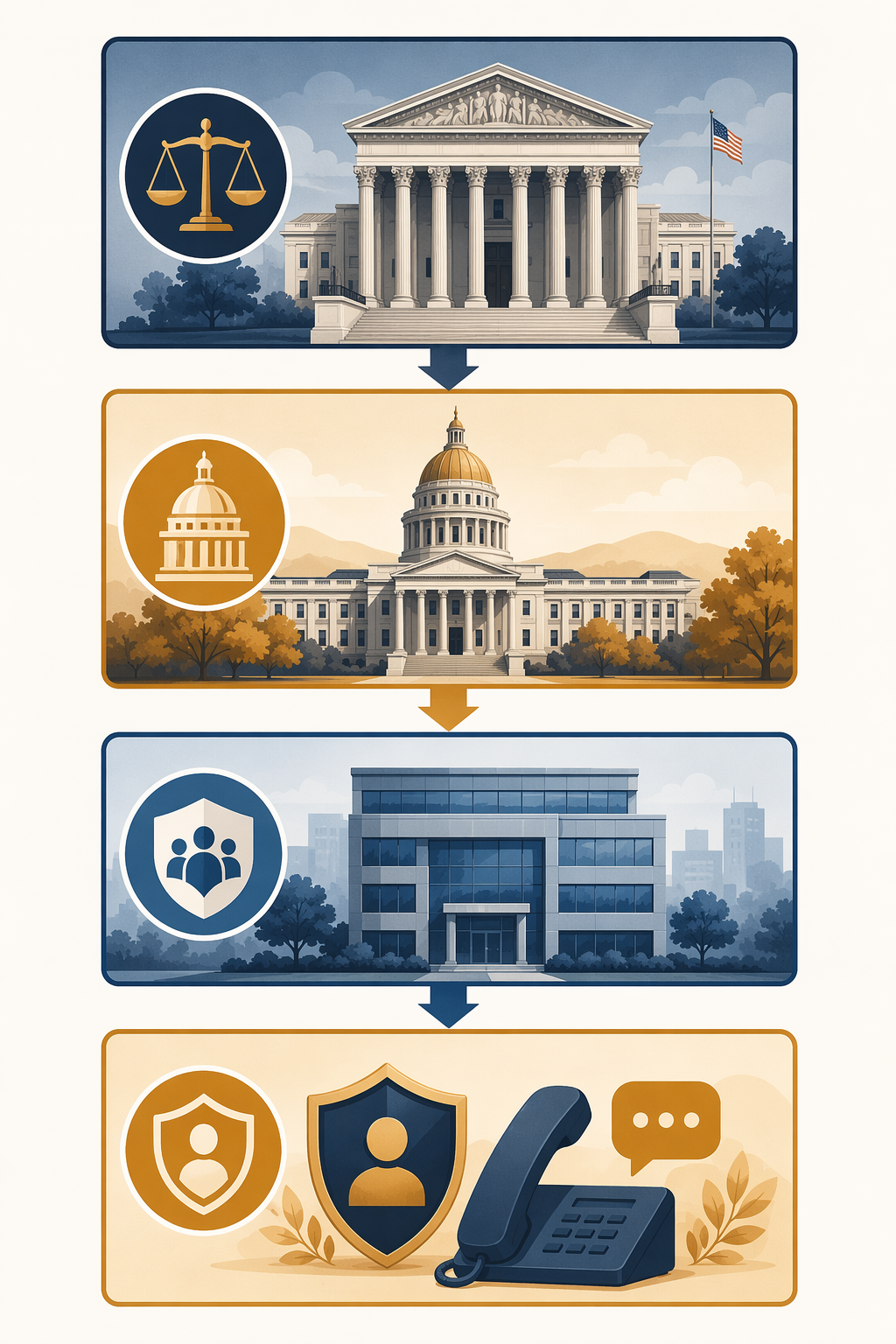
Federal Remedies Exist, but They Are Not the Usual Front Door
Federal theories can fit some grandparent scam conduct. Wire fraud, money laundering, and organized-crime theories may become relevant where the facts involve interstate communications, financial transfers, coordinated networks, money movement, or repeated conduct. There are real federal prosecution markers, and they should not be ignored.
In a 2025 Kentucky matter, a Canadian man was extradited, sentenced to five years, and ordered to pay $963,000 in restitution in connection with a grandparent scam prosecuted as a wire fraud conspiracy. The same U.S. Secret Service release also described Dominican nationals pleading guilty in a $5 million scheme and referenced a 2022 RICO sentencing, showing that federal organized-crime tools can be viable in larger or networked cases.[5]
Those examples should be treated as precedent markers, not as the ordinary client pathway. The FBI's elder fraud guidance states directly that most grandparent scam losses do not meet federal investigation thresholds and that local authorities and state consumer protection agencies are usually the primary recourse. It also describes recovery in transnational matters as challenging and unlikely.[6] That is the practical sentence a lawyer has to be willing to say before discussing federal statutes.
The distinction is not academic. If a family is told only that wire fraud is a federal crime, they may expect an FBI case number to function like a recovery mechanism. It usually will not. Federal reporting can still support pattern detection, later aggregation, or prosecution where thresholds are met, but the victim's immediate protection normally depends on bank escalation, local police documentation, Adult Protective Services, state consumer protection channels, and any viable civil action.
The State-Law Backbone
The state-law layer is not a footnote. The Department of Justice Elder Justice Initiative maintains a database of 382 elder abuse and elder financial exploitation statutes across U.S. states and territories.[7] That number is useful mainly because it prevents a false national shortcut. The legal architecture is real, but the elements, definitions, reporting duties, remedies, and agency contacts vary by jurisdiction.
For a grandparent scam matter, state analysis may affect whether the victim fits an elder or vulnerable-adult definition, whether financial exploitation includes third-party scams, whether a financial institution has mandatory or permissive reporting authority, whether a transaction hold is available, and which prosecutor or protective agency receives the matter. A national reference can identify that lane. It cannot substitute for checking the controlling state statute.
This is where intake discipline pays off. A caller who says "I sent money because my grandson was in jail" may actually be describing several state-relevant facts: exploitation of an older adult, impersonation of a public official, theft by deception, attempted follow-up exploitation, or a reportable suspicious transaction. The correct local route may depend on facts that sounded incidental during the first panicked conversation.
Administrative and Civil Recourse
The Consumer Financial Protection Bureau's reporting guide is useful because it does not pretend that one report does everything. It identifies multiple pathways for elder financial abuse matters, including Adult Protective Services reports, referrals to local law enforcement, referrals for district attorney prosecution, and civil court remedies such as temporary restraining orders and account freezes.[8] Those routes can overlap, but they do different work.
| Pathway | Practical role in a grandparent scam matter |
|---|---|
| Adult Protective Services | Protective intake when the victim may remain at risk, is being pressured again, or needs support beyond a criminal report. |
| Local law enforcement | Incident report, immediate safety response, local investigation, and documentation for banks, insurers, or later proceedings. |
| District attorney or prosecutor referral | Criminal review where facts and local thresholds support prosecution. |
| Civil court remedies | Potential restraining orders, account freezes, or other urgent remedies when identifiable parties, accounts, or assets are within reach. |
| National Elder Fraud Hotline | Centralized support at 833-FRAUD-11 for victims and professionals seeking help identifying reporting options. |
The CFPB's model is especially important for legal and compliance professionals because it resists the one-door mistake. APS is not a substitute for a bank fraud report. A police report is not a civil freeze. A civil remedy does not guarantee prosecution. A federal complaint does not usually stop tomorrow's withdrawal. Each route should be explained by function, timing, and limit.
Where money has just moved, the most time-sensitive contact is often the financial institution or payment platform. The legal theory can be refined later; the immediate question is whether a hold, recall, fraud claim, suspicious activity review, account closure, or protective measure is still possible. If cryptocurrency was purchased at a kiosk or cash was handed to a courier, the documentation burden becomes even more important because reversal may be limited or impossible.
Civil remedies require careful screening. A temporary restraining order or account freeze is meaningful only if there is a reachable person, account, property interest, or institution subject to the court's authority. In many grandparent scams, the caller is anonymous, offshore, using mules, or moving funds too quickly for a civil order to catch them. In other matters, especially those involving known intermediaries or recent transfers, civil relief may be worth immediate evaluation.
How to Counsel Before the Next Call
Prevention advice is often written as if older adults simply need to be less trusting. That framing is both unfair and operationally weak. The useful question is how to interrupt urgency, isolation, impersonation, and irreversible payment before the scammer controls the next decision.
The FCC's April 2026 guidance recommends a family safe word or phrase to verify emergency calls involving relatives, along with caution about caller ID spoofing and AI-cloned voices.[3] For client counseling, the safe word works best when it is treated like a procedure rather than a sentimental family exercise. The client should know that any caller claiming to be a relative in an emergency must tolerate verification. A caller who refuses verification has supplied a warning sign.
- Create a family verification phrase that is not posted online and is not obvious from public information.
- Write down two callback numbers for relatives or trusted contacts and keep them near the phone.
- Agree that no emergency payment will be made while the caller keeps the client on the line.
- Tell clients that spoofed caller ID and familiar voices are not enough to verify identity.
- Name the payment methods that require a pause: wire transfer, cash pickup, gift cards, cryptocurrency, courier pickup, and kiosk deposits.
Financial institutions can translate the same prevention model into account-level controls. That may include trusted contact information, branch scripts for emergency-family-payment scenarios, escalation when an older customer withdraws unusual cash after a phone call, and clear instructions for staff when a customer says a lawyer or officer told them not to disclose the reason for the withdrawal. The legal and compliance value is not only loss prevention; it is creating a documented response when the red flags are present.
A Practical Recourse Ladder
For most grandparent scam matters, the cleanest client explanation is a ladder, not a promise. Start where action can still affect the loss or the victim's safety. Move upward when the facts support it. Keep federal prosecution in view, but do not let it crowd out the local and administrative routes that are more likely to matter first.
- Stop further contact and verify independently. Call the relative or another trusted person using a known number, not a number supplied by the caller.
- Contact the bank, payment provider, wire service, card issuer, or cryptocurrency platform immediately. Ask about holds, recalls, fraud claims, account protection, and documentation.
- Document the incident for local law enforcement. Preserve phone numbers, voicemails, texts, receipts, wallet addresses, kiosk records, courier descriptions, and names used by fake officials.
- Evaluate APS or state elder financial exploitation reporting. Use the controlling state statute and agency pathway, not a generalized national assumption.
- Consider civil relief only where there is a reachable defendant, account, asset, institution, or transaction still capable of being restrained.
- Report through federal channels where appropriate, understanding that the report may support aggregation or investigation but will not usually function as direct recovery.
- Use the National Elder Fraud Hotline at 833-FRAUD-11 when the victim or practitioner needs help identifying reporting options and support resources.
This article is informational reference material for U.S. legal and compliance professionals, not legal advice for a specific matter. The decisive legal questions still belong to the jurisdiction, the payment route, the timing, the victim's status under state law, and whether any person or asset is reachable before the money disappears.
Grandparent scams sit inside a broad legal architecture. Federal prosecution is possible in the right case. State elder financial exploitation law supplies much of the working framework. Administrative reports and civil tools may determine whether anyone acts quickly enough. For most victims, the realistic first forum is local, state, administrative, and preventative rather than federal prosecution.
References
- Scammers Target Older Adult Victims, FBI, May 15, 2026.
- The Grandparent Scam, FBI, April 2, 2012.
- Grandparent Scams Get More Sophisticated, FCC, updated April 24, 2026.
- Imposter Scams Led Fraud Reports to FTC in 2025, $3.5 Billion Losses, CNBC, June 26, 2026.
- Canadian Man Sentenced in Grandparent Scam, U.S. Secret Service, June 13, 2025.
- Elder Fraud, FBI Internet Crime Complaint Center.
- Elder Abuse and Elder Financial Exploitation Statutes, DOJ Elder Justice Initiative.
- Reporting Elder Financial Abuse Guide, CFPB.
Comments
Join the discussion with an anonymous comment.