
Full profile
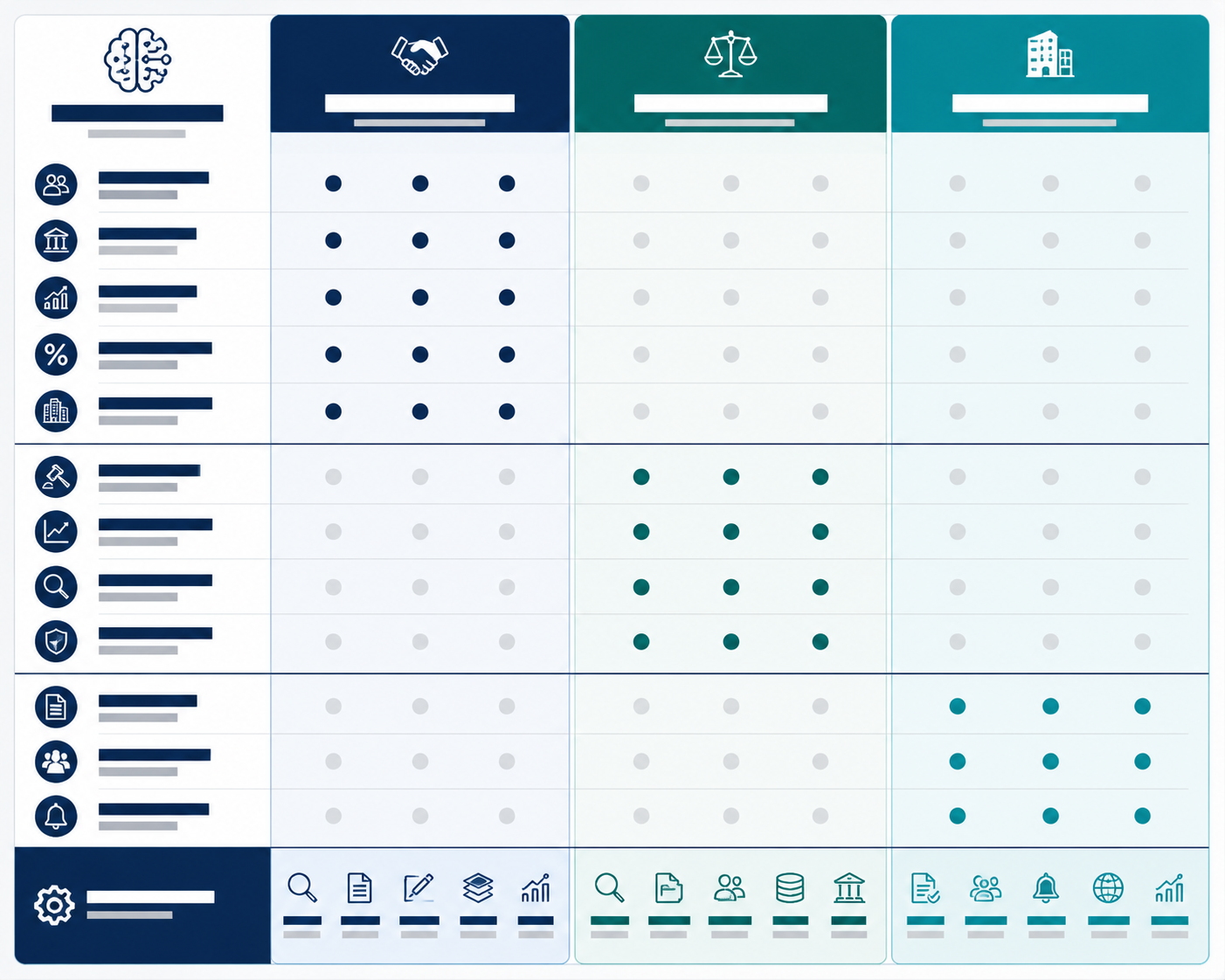
For deployment planning, Harvey AI is more useful as a practice-group map than as a feature list. Harvey’s published materials point to three broad workflow categories: transactional work, litigation work, and in-house legal work. Those categories are vendor-derived, but they are still operationally useful because the tasks inside them cluster differently by practice group.
| Workflow category | Practice groups or teams most clearly associated | Typical Harvey tasks | Evidence base to treat as strongest |
|---|---|---|---|
| Transactional | M&A, Banking, Private Equity, Tax, Real Estate | Drafting, due diligence, contract analysis, deal-document comparison, matter-specific research, workflow agents for recurring deal tasks | Harvey-published activity and use-case data from anonymized lawyer activity logs |
| Litigation | Antitrust, Securities Litigation, White Collar, IP Litigation | Brief and memo drafting, case law research, document review, timeline building, deposition and trial-preparation support | Harvey-published practice-group use-case data; no independent practice-area accuracy study identified |
| In-house | Corporate legal departments, procurement-facing legal teams, regulatory and compliance teams | Contract review, supplier management, regulatory tracking, legal intake, reusable workflow agents | Named in-house examples, including Repsol departmental adoption and Syngenta savings data |
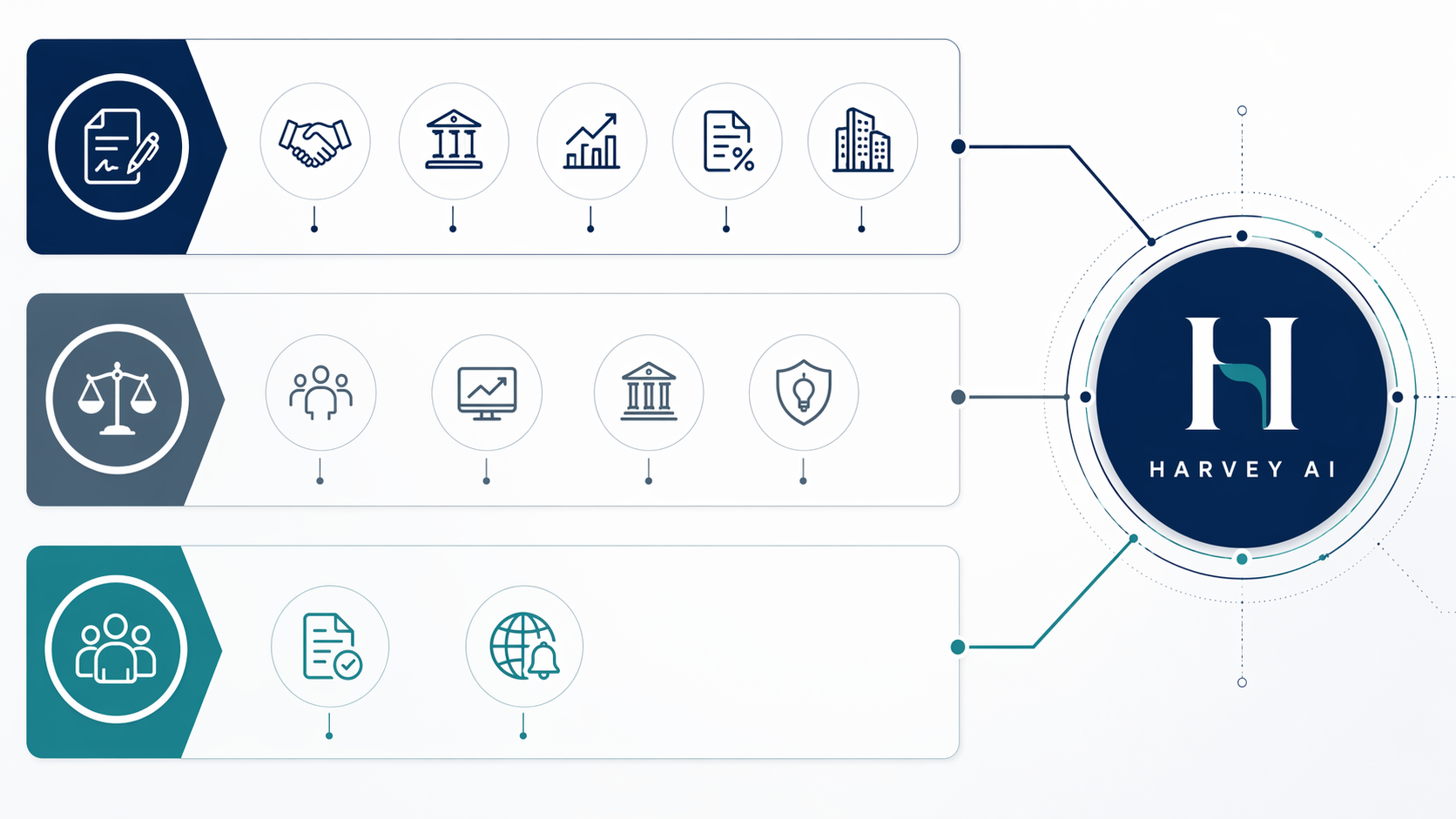
The scale behind the taxonomy is meaningful, with caveats. Harvey says its use-case analysis draws on anonymized activity from more than 142,000 lawyers and shows a 92% monthly adoption rate among active users, with more than 25,000 custom Workflow Agents created across more than 500 practice groups and business areas.[1] A separate Harvard Business School case places Harvey at $50 million in annual recurring revenue and 235 enterprise customers by early 2025, which supports the point that the company has moved beyond a small pilot footprint.[2] The Maryland State Bar Association’s overview adds a non-vendor legal audience explanation of Harvey’s lawyer-facing features, but it should not be read as an independent validation of practice-area accuracy.[3]
Those distinctions matter because “drafting,” “research,” and “review” are too blunt to guide rollout sequencing. A Banking group and a White Collar group may both ask Harvey to summarize documents, but the business consequence, review standard, and partner tolerance for error are not the same. The relevant question is which practice group can turn the tool into a Monday-morning workflow without asking everyone else in the firm to change at once.
Transactional use cases: same verbs, different deal pressure
Transactional work is where Harvey’s use-case taxonomy is easiest to imagine operationally and easiest to oversimplify. M&A, Banking, Private Equity, Tax, and Real Estate teams all work with documents, deadlines, diligence questions, and negotiated language. That does not make them one workflow.
In M&A, Harvey’s likely value sits around first-pass diligence synthesis, issue spotting across uploaded materials, comparison of transaction documents, and draft language that helps a team move from messy facts to a negotiable position. Harvey’s own use-case materials describe transactional applications such as drafting, due diligence, and deal management, and its practice-group activity framing places M&A among the groups where those tasks appear.[1] The point is not that Harvey replaces diligence judgment. It is that the associate or knowledge lawyer can ask a more structured first question: what has changed, what is missing, and what needs partner review?
Banking work shifts the emphasis. The document set may be repetitive, but the tolerance for a misplaced covenant, definition, or condition precedent remains low. A Banking deployment should therefore privilege controlled workflows: clause comparison, issue lists against firm playbooks, draft summaries for lender or borrower teams, and Workflow Agents that repeat a narrow task on similar financing matters. Harvey’s count of more than 25,000 custom Workflow Agents is relevant here because Banking teams often need repeatability more than open-ended experimentation.[1]
Private Equity sits between speed and pattern recognition. A PE team may care less about a beautiful memo and more about whether the team can quickly compare a new purchase agreement, management equity document, or financing term against what the sponsor has accepted before. Harvey’s activity data does not prove better PE outcomes, but it does suggest that repeat deal teams are plausible early adopters because the same types of review questions recur across matters.[1]
Tax is different again. A Tax group may use drafting and research functions, but the deployment risk is higher if the firm treats tax analysis as ordinary summarization. Harvey can assist with organizing authorities, producing first-draft explanations, and turning transaction facts into questions for specialist review. It should not be positioned internally as a shortcut around tax partner judgment unless the firm has separately validated the workflow against its own standards.
Real Estate use cases tend to be document-heavy and process-heavy: leases, purchase agreements, title materials, diligence trackers, consents, and closing checklists. Here, the practical opportunity is often not a dramatic single answer from AI, but the removal of small frictions across a closing. If the Real Estate group already has repeat forms and checklists, Harvey can be tested against defined review tasks rather than introduced as a general assistant.
| Transactional group | Where Harvey is most naturally tested | Deployment caution |
|---|---|---|
| M&A | Diligence summaries, agreement comparison, issue lists, first-draft transaction language | Do not treat broad summarization as completed legal review |
| Banking | Covenant and definition comparison, conditions checklists, financing-document review agents | Keep workflows narrow and repeatable |
| Private Equity | Sponsor precedent comparison, fast review of recurring deal documents, management equity document support | Separate speed gains from negotiated-risk judgment |
| Tax | Authority organization, first-draft explanations, transaction-fact issue spotting | Require specialist review before relying on analysis |
| Real Estate | Lease and title material review, diligence trackers, closing support | Anchor the rollout in existing forms and checklists |
Litigation use cases: research, review, and trial prep should not be merged
Litigation is where use-case language becomes especially slippery. “Draft a motion,” “summarize a deposition,” “research case law,” and “prepare for trial” sound adjacent, but they carry different verification burdens. Harvey’s materials identify litigation-oriented work such as drafting, case law research, document review, and trial preparation, with activity patterns across groups including Antitrust, Securities Litigation, White Collar, and IP Litigation.[1]
Antitrust litigation and investigations are likely to test Harvey against dense factual records, economic concepts, agency materials, and long timelines. A sensible first deployment is not “write the brief.” It is chronology construction, deposition-summary preparation, issue extraction from document sets, and research support that a senior associate can verify. The tool can reduce the surface area of review, but the practice group still needs explicit rules for source checking and privilege-sensitive inputs.
Securities Litigation has a different document rhythm: complaints, disclosures, analyst materials, board materials, expert reports, and motion practice that often turns on what was said, when, and by whom. Harvey may be useful for organizing timelines, comparing allegations to underlying documents, and producing first-pass research memos. The risk is that a plausible narrative summary can hide an unsupported inference. That makes citation discipline and attorney verification central to any Securities Litigation rollout.
White Collar work raises the governance bar again. Interview notes, subpoenas, regulator correspondence, and internal investigation materials require careful access controls and privilege handling. Harvey’s general litigation use cases may apply, but this is a poor place for an informal pilot. If a White Collar group receives early access, the better starting point is usually a constrained workflow: summarize a defined, approved document set; extract issues for attorney review; or generate a draft interview outline from already-cleared materials.
IP Litigation brings its own split between legal argument, technical material, and claim-construction work. A generic litigation assistant may help summarize prior art, organize expert materials, or draft research notes, but technical accuracy and claim-language sensitivity make this a practice area where local validation matters. Harvey’s published practice-group activity data can justify an IP Litigation pilot; it does not, by itself, establish that the model performs equally well on patent-specific or trade-secret-specific tasks.
The missing evidence should be stated plainly. The available research materials did not identify an independent, peer-reviewed accuracy study that evaluates Harvey separately by Antitrust, Securities Litigation, White Collar, and IP Litigation tasks. Harvey’s own activity data can show where users are applying the product; it cannot, without more, prove that the outputs are accurate enough for every litigation use case.
In-house use cases have the clearest adoption and savings evidence
The in-house category is narrower for law firms, but it provides some of the more concrete evidence in the available materials. Harvey describes in-house uses around contract review, supplier management, regulatory tracking, and recurring legal workflows, with reported time savings of more than 25 hours per month per user.[4] Those tasks are easier to tie to legal operations metrics than a litigation research memo or a deal negotiation judgment.
Repsol is the stronger adoption example because the metric is departmental rather than anecdotal: Harvey reports 96% departmental adoption.[4] That does not mean 96% of all legal departments will adopt Harvey at the same level. It means the Repsol example is useful for understanding what a successful department-wide rollout can look like when the work is repeatable enough for broad participation.
Syngenta is the stronger savings example. Harvey reports $320,000 saved over six months on 40 seats.[4] The useful lesson for law firms is not that the same savings will appear in a partnership environment. It is that in-house workflows often attach AI use to measurable queues: contracts reviewed, supplier questions processed, regulatory changes tracked, and business users served.
For a law firm, that evidence can be relevant in two ways. First, firms with captive legal operations, alternative delivery, or managed services groups may have in-house-like workstreams where Harvey can be measured against volume and turnaround time. Second, outside counsel advising legal departments will increasingly encounter clients that expect AI-supported contract and regulatory processes to be normal, not experimental.
Named scale helps; it does not replace local validation
Harvey’s named-market credibility matters because law firms are rightly skeptical of tools that look impressive only in a controlled demo. The HBS case-study context—$50 million in annual recurring revenue and 235 enterprise customers by early 2025—indicates a substantial enterprise customer base.[2] The MSBA overview also reflects that Harvey is being explained to mainstream legal audiences, not only to venture-backed technology circles.[3]
Still, scale evidence and workflow evidence answer different questions. Scale says the product has buyers. Activity logs say what active users appear to do. Neither tells a firm whether its own Tax partners will trust generated authority summaries, whether its Banking associates will use a covenant agent under deadline pressure, or whether its litigators will accept AI-assisted draft research without recreating the work from scratch.
That is why the 92% monthly adoption figure should be read carefully.[1] It is an adoption metric among the population Harvey is measuring, not a neutral prediction of what will happen after a new firmwide license is announced. Product activity logs can overrepresent committed users, successful deployments, and customers already motivated enough to configure workflows. They are useful directional evidence, not a benchmark to paste into an internal business case without qualification.
How to prioritize a Harvey rollout by practice group
The strongest initial candidates are not necessarily the largest departments. They are the groups where work is frequent, document-heavy, supervised, and repeatable enough to become a workflow rather than a collection of one-off questions. On that standard, a firm might start with M&A diligence, Banking document comparison, Real Estate closing support, or a litigation team with a defined document-review and timeline-building need.
- Start where the work has a visible queue: diligence requests, financing checklists, lease reviews, subpoena responses, deposition summaries, or contract intake.
- Choose a practice sponsor who can define acceptable output, not just an innovation sponsor who can arrange access.
- Prefer workflows where a senior lawyer already reviews junior work, because AI output can enter an existing supervision pattern.
- Measure a specific reduction: fewer first-pass review hours, faster issue-list preparation, shorter intake queues, or more consistent draft summaries.
- Delay high-risk open-ended analysis until the firm has tested retrieval, citation, confidentiality, and review controls in lower-variance workflows.
Cost belongs in that decision, but it is not the focus of a use-case taxonomy. Firms comparing deployment scope against budget can pair this workflow map with a dedicated Harvey AI pricing and TCO analysis. Firms still deciding whether they are institutionally ready for practice-group AI deployment should also separate product fit from governance readiness; those are related decisions, not the same decision.
What the evidence supports
Harvey’s available evidence supports using transactional, litigation, and in-house workflows as a practical prioritization map for law firm deployment. Transactional groups appear best suited to early structured pilots around drafting support, due diligence, and deal-document management. Litigation groups require more careful separation among drafting, case law research, document review, and trial preparation, especially because independent practice-area accuracy evidence is not available in the materials reviewed. In-house examples provide the clearest adoption and savings signals, but those economics should not be generalized automatically to law firm practice groups.
The taxonomy is useful precisely because it is concrete enough to guide Monday-morning access decisions. It should not be treated as proof that every group will use Harvey equally well, or that Harvey-published activity data represents typical-user performance. For a firm leader deciding where to begin, the safer reading is directional: follow the workflow clusters, test them locally, and give political capital first to the practice groups that can turn AI use into a repeatable supervised process.
References
- Top Harvey Use Cases, Harvey.
- Harvey, Harvard Business School.
- An Overview of Harvey AI's Features for Lawyers, Maryland State Bar Association.
- AI Use Cases Powering Daily Legal Work, Harvey.
Comments
Join the discussion with an anonymous comment.