
Full profile
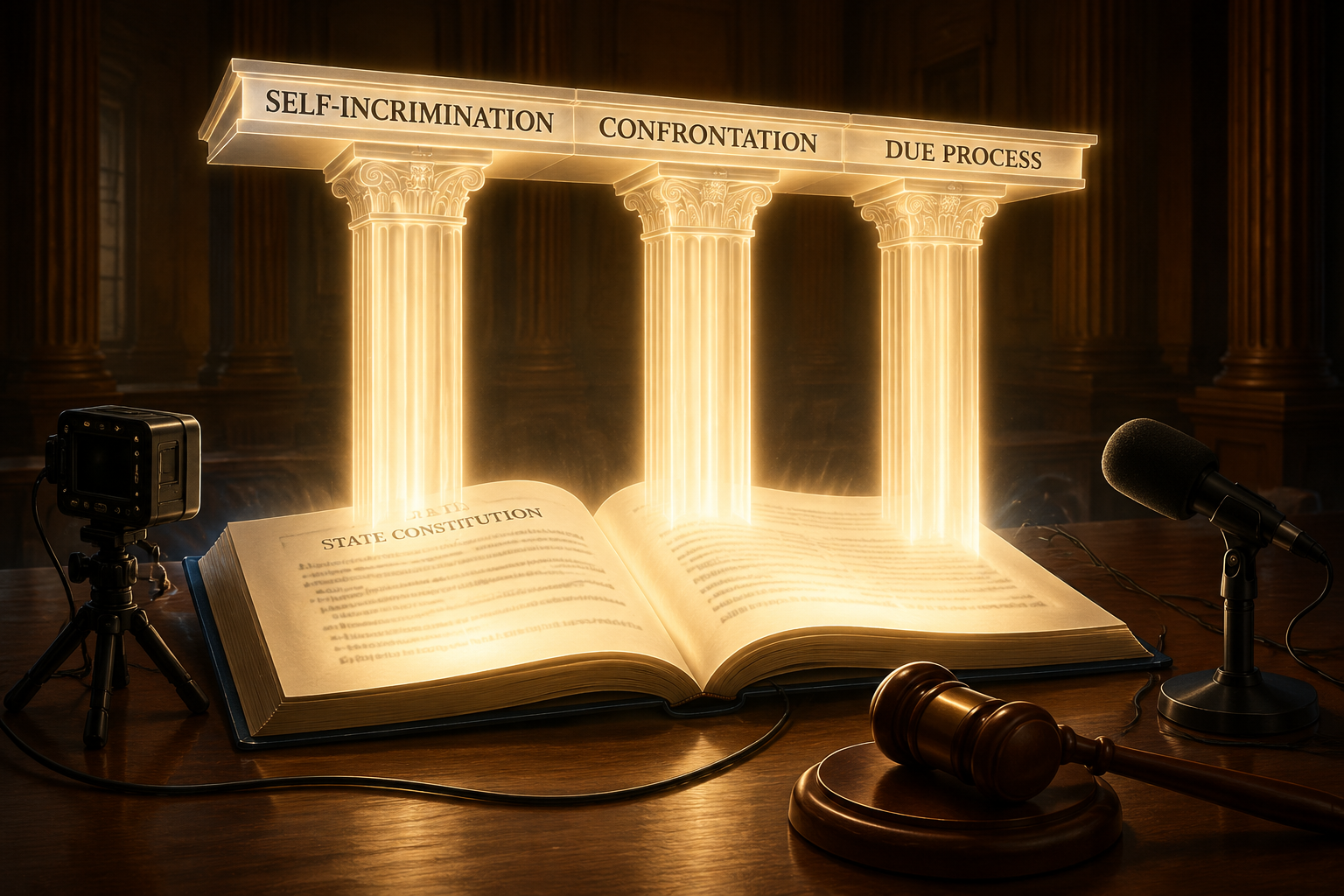
State v. Zuffante is the Hawaii Supreme Court ruling on police interrogation recording that matters less as a housekeeping directive to police departments than as a piece of state constitutional construction. In September 2025, the court held that Hawaii’s constitution requires law enforcement to record custodial interrogations, grounding that rule in Article I, Section 5’s due process guarantee while identifying two other constitutional interests the absence of recording can damage: the privilege against self-incrimination under Article I, Section 10, and the right of confrontation under Article I, Section 14.[1]
That framing is the first important move. Zuffante did not say recording is merely a sensible administrative practice, or that the court preferred one evidence-management protocol over another. It treated recording as a procedural protection made necessary by the structure of a criminal trial: when the state offers an officer’s account of an unrecorded custodial interrogation, the defendant may be forced into a choice between remaining silent and leaving that account unrebutted, or testifying and surrendering the protection silence was supposed to preserve.[1]
The rule the court actually built
The operative rule is mandatory but not identical in every setting. For in-station custodial interrogations, law enforcement must make an audiovisual recording. For custodial interrogations outside the station house, the standard turns on feasibility. The court attached an exclusion remedy: unrecorded statements covered by the rule are excluded, and the decision applies to cases on direct review or not yet final as of September 17, 2025.[1]
The in-station rule matters because it eliminates the least defensible category of nonrecording. A station-house interrogation is ordinarily the setting where officers control the room, the equipment, the timing, and the preservation process. By contrast, the feasibility standard for out-of-station questioning leaves room for the practical messiness of arrests, searches, and rapidly changing field conditions without turning the constitutional rule into a nullity.
The holding also changes the evidentiary posture of suppression litigation. Before Zuffante, the fight over what happened in an interrogation room could turn on after-the-fact testimony, reports, and credibility judgments. After Zuffante, the absence of a required recording is not just an impeachment point; it can remove the defendant’s statement from the state’s case.
Three constitutional interests, one procedural protection
The self-incrimination problem is the opinion’s most concrete constitutional injury. A defendant confronted with an officer’s testimony about an unrecorded statement has no clean way to contest the account. Cross-examination may expose uncertainty, but it cannot recreate tone, sequence, pauses, pressure, or the defendant’s exact words. The defendant can testify, but that answer carries its own constitutional cost.
That is why the confrontation interest is not ornamental. The right to confront witnesses presumes there is something meaningful to test. When the state’s proof of a custodial interrogation is filtered through an officer’s memory and report-writing choices, the defense cross-examines a reconstruction rather than the event itself. A recording does not resolve every dispute, but it gives the adversarial process a shared object.
Due process supplies the rule’s main doctrinal home because the court framed the recording requirement as a truth-seeking safeguard. The point is not that every unrecorded statement is false or coerced. The narrower and stronger claim is that required recording reduces avoidable uncertainty in a setting where the state controls the evidence-generating event and later asks a court to credit its account of that event.[1]
| Constitutional interest | Problem created by nonrecording | Role in Zuffante |
|---|---|---|
| Self-incrimination | The defendant may have to testify to rebut the officer’s account | Shows the coercive trial bind created by missing interrogation evidence |
| Confrontation | Cross-examination tests a reconstruction rather than the interrogation itself | Explains why adversarial testing is weakened |
| Due process | The factfinder receives a less reliable account of a state-controlled event | Provides the primary source for the mandatory rule |
How changed facts became permission to overrule Kekona
The court could not simply announce a new preference. It had to move State v. Kekona, the 1994 precedent that had declined to impose a state constitutional recording requirement, out of the way. Zuffante did that through changed-circumstances reasoning: what may have looked unnecessary, impractical, or doctrinally unsupported three decades earlier no longer looked the same in 2025.[1]

The first changed circumstance was the modern record on false confessions. The Zuffante court cited data that about one-third of 375 DNA exonerations involved false confessions.[1] That figure should be read carefully: it is the court’s cited exoneration universe, not a free-floating claim about all confessions or all wrongful convictions. The Innocence Project separately describes false confessions as a factor in about 25% of DNA exoneration cases, a nearby but not identical measure.[2]
The second changed circumstance was technological. By 2025, the premise that recording custodial interrogations is an exotic or unusually burdensome demand had become harder to maintain. The doctrinal significance of that point is not convenience for its own sake. Once recording is ordinary and available, the state’s decision not to preserve the interrogation becomes more constitutionally salient because the lost evidence is no longer the unavoidable byproduct of older investigative conditions.
The third changed circumstance was the national legal landscape. A Duke Law Wilson Center survey counted 31 states plus the District of Columbia with custodial-interrogation recording requirements as of August 2024.[3] Because Hawaii was not yet part of that count, Zuffante brings the total to 32 states. The same survey context also matters in the other direction: only a smaller subset of states requires recording for all crimes regardless of severity, and Hawaii is now among that group.[3]
Those facts do not prove that every state constitution must yield the same rule. They do something more useful for courts deciding whether to overrule old precedent: they identify why the old precedent’s factual assumptions no longer carry the same weight. Kekona could remain historically intelligible and still become doctrinally obsolete.
State constitutional independence was not a footnote
Zuffante’s most transferable feature may be its refusal to wait for federal constitutional permission. Reporting on the opinion emphasized the court’s statement that it would reach the same result under Hawaii’s constitution even if the U.S. Supreme Court had already addressed the federal question differently or more narrowly.[4] That is a stronger move than distinguishing federal precedent. It says the state constitution is an independent source of criminal procedure, not a mirror held up to federal minimums.
Justice Todd Eddins’ majority opinion fits a broader pattern in which state constitutional analysis is not treated as a decorative supplement to federal law. The opinion’s due process reasoning does not ask whether the Roberts Court would likely recognize a federal recording right. It asks what Hawaii’s own guarantees require when police control a custodial interrogation, the defendant faces a trial-stage bind, and accurate factfinding depends on evidence the state could have preserved.
That matters for lawyers outside Hawaii because the opinion’s architecture is replicable even where its exact holding is not. A state court considering an analogous claim can separate the federal floor from the state constitutional ceiling, identify the particular trial rights affected by the police practice, and then ask whether changed circumstances have undermined an older refusal to constitutionalize a procedural safeguard.
The remedy has force, but not full remedial symmetry
The exclusion remedy gives the rule teeth. Without exclusion, the recording requirement would risk becoming an instruction manual rather than a constitutional command. If the state can use the unrecorded statement anyway, the defendant’s bind remains in place and the trial court is left to manage the same evidentiary uncertainty Zuffante identifies.
The weak seam is derivative evidence. Zuffante excludes covered unrecorded statements, but it does not exclude evidence derived from those statements. Hawaii Opinions Blog noted that the court drew that distinction without citing authority for the remedial carveout.[5] That is not a small remedial detail. If an unrecorded interrogation produces a lead, physical evidence, or another witness, the constitutional violation may be acknowledged while much of its investigative yield remains available.
There are plausible institutional reasons a court might hesitate before attaching a full fruits doctrine to a newly announced recording rule. But the opinion’s own logic creates pressure on that limitation. If the constitutional injury is the state’s failure to preserve a reliable account of a custodial interrogation, then the derivative-evidence question asks how much benefit the state may retain from an interrogation whose central statement cannot be used.
The dissents objected to the institution doing the building
The dissenting positions are best understood as objections to judicial rule creation, not as denials that recording has evidentiary value. Chief Justice Mark Recktenwald, concurring in part and dissenting in part, favored a stakeholder-driven process. Judge Lisa Ginoza, sitting by designation, dissented and argued that the rule should come through the legislature or law-enforcement policymaking rather than constitutional adjudication.[4][5]
That institutional objection has real bite in separation-of-powers terms. Recording rules involve equipment, training, exceptions, preservation, access, and remedies. A stakeholder process can surface implementation problems a court may not see from an appellate record. A legislature can write detailed exceptions and budget for compliance.
But the majority’s answer is embedded in the constitutional injury it identifies. If the problem is that unrecorded custodial interrogation evidence forces a defendant into a constitutionally distorted trial choice, then waiting for a policy process leaves the right contingent on institutional will. Zuffante treats that as the wrong sequence: constitutional violation first, administrative implementation second.
What travels beyond Hawaii
The decision’s national significance is not that it guarantees a wave of identical rulings. State constitutions differ, state precedents differ, and some states already have statutory or court-rule recording requirements. Zuffante’s value lies in the method: it shows how a state high court can translate overlapping trial rights into a procedural rule when old assumptions about reliability, feasibility, and national practice have changed.
For appellate counsel, the opinion is a template for building a record around changed circumstances rather than arguing only from first principles. For clerks and judges, it models how to overrule precedent without pretending the prior court was irrational. For scholars, it is a useful example of state constitutional due process doing affirmative work in criminal procedure rather than merely shadowing federal doctrine.
Zuffante matters because the court did all of that openly. It named the state constitutional provisions, identified the trial-level bind, explained why 1994 precedent no longer controlled, attached a remedy, limited that remedy in a way future litigation will likely test, and refused to make federal minimalism the measure of Hawaii’s own constitution. That is why the opinion is more than a police-recording case. It is a working model of independent state constitutional criminal procedure.
References
- State v. Zuffante, 576 P.3d 243 (Haw. 2025) — Opinion of the Court, Supreme Court of Hawaii, 2025.
- False Confessions, Innocence Project.
- Jurisdictions That Record Police Interrogations, Duke Law Wilson Center, August 2024.
- Hawaii Supreme Court Says Police Must Record Interrogations, Bolts Magazine.
- An Unrecorded Police Interrogation, Hawaii Opinions Blog, October 2025.
Comments
Join the discussion with an anonymous comment.