
Full profile
The first practical change under Virginia HB 1479 is not in the damages paragraph of a complaint. It is in the first hour after intake, when the file is labeled. A hit-and-run crash occurring on or after July 1, 2026 can no longer be treated as an ordinary collision file while everyone waits to see whether a prosecutor secures a conviction. If the facts may satisfy felony hit-and-run under § 46.2-894, the civil team has to start building that proof itself.
The new statute, codified at Va. Code § 8.01-44.5:1, allows punitive damages in an action arising from personal injury, death, or property damage caused by operation of a motor vehicle when the defendant’s conduct “constitutes a felony violation of § 46.2-894,” Virginia’s hit-and-run statute.[1] That phrase is the hinge. The statute does not make the civil claim depend on a completed criminal case. It asks whether the conduct meets the felony threshold.

That is why HB 1479 should not be reduced to a casual answer that punitive damages are now available in every leaving-the-scene case. The statute is narrower and more useful than that. It creates a punitive-damages route for qualifying felony-level hit-and-run conduct, and it leaves the plaintiff with the burden of proving the facts that make the conduct felony-level.
What changed after Doe v. Isaacs
Before HB 1479, the civil punitive-damages path in a Virginia hit-and-run case ran into a hard common-law problem. In Doe v. Isaacs, the Supreme Court of Virginia held that fleeing the scene, by itself, did not satisfy the willful-and-wanton misconduct standard required for common-law punitive damages.[2] For plaintiffs’ lawyers, that meant the most morally aggravating fact in the file—the driver left—often did not carry the punitive claim by itself.
HB 1479 does not simply rename that common-law theory. It creates a statutory claim tied to felony hit-and-run conduct. Marks & Harrison describes the statute as a new tool because it removes the Doe v. Isaacs barrier where the plaintiff can prove conduct that constitutes a felony violation of § 46.2-894, rather than merely prove that the driver departed after impact.[2] Curcio Law likewise frames the change against Doe v. Isaacs and the prior difficulty of obtaining punitive damages in hit-and-run cases.[3]
The difference matters at pleading and discovery. A complaint that says only that the defendant left the scene is still thin. A complaint that alleges facts supporting injury, death, or qualifying property damage; the driver’s knowledge of the crash; and knowing flight from the scene is aimed at the statute’s actual trigger.
Do not wait for the criminal docket
The civil file should not be parked until a charging decision, plea, or conviction. Law firm analyses of HB 1479 have emphasized that the statute looks to conduct constituting a felony violation, so a civil court can evaluate the facts independently of the criminal case.[2][4] That does not make charging documents irrelevant. It means they are one evidence source, not the gate.
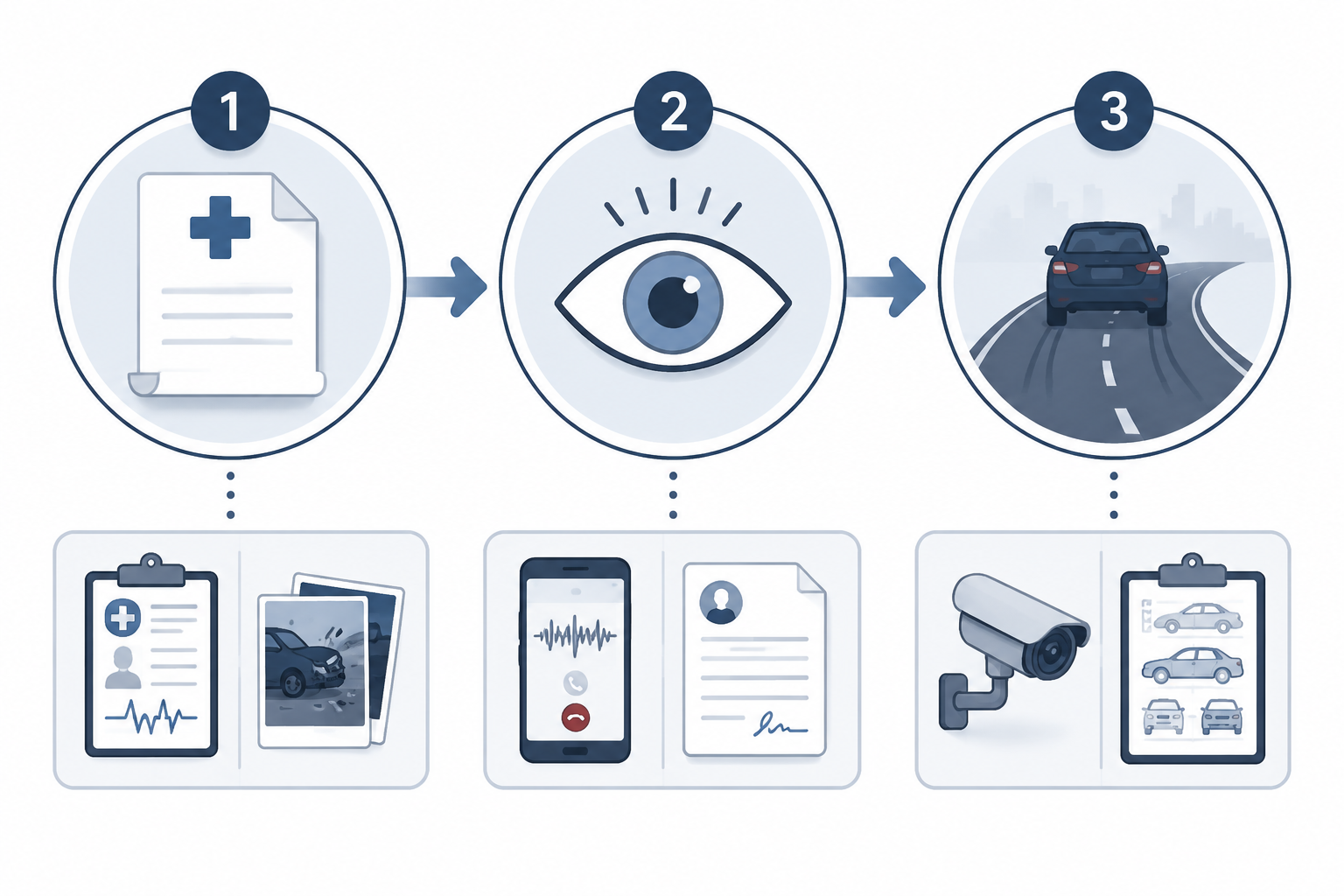
This changes intake instructions. The paralegal does not ask only whether the driver was charged. The better first-pass questions are: Was anyone injured? Did anyone die? Was property damage over $1,000? What shows the driver knew there had been an accident? What shows the driver left knowingly? Who has footage, audio, dispatch records, photographs, or repair documentation that will disappear if no one asks today?
| Civil proof target | Why it matters under HB 1479 | Evidence to preserve early |
|---|---|---|
| Injury, death, or more than $1,000 property damage | Separates felony-level § 46.2-894 conduct from lesser leaving-the-scene facts | Medical records, EMS records, photos, repair estimates, total-loss documents, property-damage appraisals |
| Driver’s knowledge of the accident | Shows the driver knew there had been a crash before leaving | 911 calls, witness statements, impact severity, vehicle damage, post-impact movements, statements by the driver |
| Knowing flight from the scene | Connects departure to conscious leaving rather than confusion, medical emergency, or disputed identity | Surveillance video, traffic-camera footage, doorbell footage, timeline evidence, police contact timing, route information |
The three proof targets that should organize the file
A clean HB 1479 workflow starts with the felony threshold. Virginia’s hit-and-run statute treats conduct as felony-level when the accident involves injury, death, or property damage above the statutory threshold, and the new punitive-damages provision is tied to conduct constituting a felony violation of that statute.[1] For civil case-building, that means the file needs more than liability and damages in the usual negligence sense. It needs facts that map onto the hit-and-run elements.
1. Qualifying injury, death, or property damage
In an injury case, the medical file may seem obvious, but the punitive-damages theory should not rely on obviousness. Preserve the EMS record, emergency department record, follow-up treatment, diagnostic imaging, photographs, and any contemporaneous pain or mobility documentation. If the injury is contested later, the punitive-damages claim may be contested with it.
Property damage deserves the same discipline. The felony threshold includes more than $1,000 in property damage.[1] That is often a modest number in modern vehicle repairs, but “often” is not evidence. The file should contain photographs before repair, tow records, repair estimates, supplement estimates, total-loss valuation documents, storage invoices, and any insurer inspection materials that establish the amount and nature of the damage.
2. Knowledge of the accident
Knowledge is where many files will become stronger or weaker very quickly. A driver who later says, “I did not know I hit anyone,” has created the factual dispute the civil team should have anticipated. The answer may be in the sound of the impact captured on a 911 call, a witness who saw the driver stop and look back, the extent of front-end damage, airbag deployment, a disabled vehicle, or statements made at the scene before the driver left.
Huffman & Huffman’s practical discussion of HB 1479 emphasizes early evidence collection, including 911 calls, surveillance footage, witness observations, and vehicle damage evidence, because those materials can show both what happened and what the fleeing driver knew.[5] That guidance is not just useful for settlement posture. It is tied to the statutory theory.
3. Knowing flight from the scene
Departure alone is the beginning of the question, not the end. The file should show the sequence: impact, opportunity to remain or provide identifying information, departure, and later contact or identification. Time stamps matter. So do camera angles, dispatch logs, witness descriptions, and vehicle-location evidence.
The defense may not need a complicated alternative explanation to create friction. It may argue confusion, fear, lack of awareness, medical distress, mistaken identity, or a brief movement away from danger rather than flight. A plaintiff’s punitive theory is stronger when the preserved evidence shows the driver had reason to know what happened and nevertheless continued away from the scene.
A Monday-morning collection sequence
The practical danger is delay. Store footage is overwritten. Doorbell clips are deleted. A witness who was precise on the day of the crash becomes less useful after two weeks of ordinary life. If HB 1479 is in play, the file needs a preservation sequence before the pleading debate becomes too refined.
- Lock down the date first. Confirm that the crash occurred on or after July 1, 2026, because the statute took effect that day and pre-effective-date crashes should not be treated as eligible under HB 1479.[4]
- Request 911 audio and CAD or dispatch records. These can capture the timing of the crash report, descriptions of the fleeing vehicle, statements about the driver’s movements, and the gap between impact and police contact.
- Send preservation letters for nearby video. Businesses, apartment complexes, gas stations, traffic-adjacent properties, and homeowners with doorbell cameras may have the only visual record of impact, pause, route, or flight.
- Interview witnesses around knowledge and sequence, not just liability. Ask what the driver did immediately after impact, whether the driver stopped, looked back, spoke, exchanged words, inspected damage, reversed, changed direction, or accelerated away.
- Photograph and document vehicle damage before repair. Capture impact location, severity, paint transfer, broken lighting, deployed airbags, disabled components, and any repair estimate or appraisal showing the amount of property damage.
- Pull criminal records without making them the file’s foundation. Summonses, warrants, crash reports, and charging documents can be useful, but HB 1479 should be built so the civil proof does not collapse if the charge is reduced, delayed, or unresolved.
That last point is the one most likely to require a habit change. A criminal charge may supply helpful admissions, officer observations, or investigative leads. It may also be narrower than the civil theory, delayed by docket timing, or resolved for reasons that do not answer the punitive-damages question. HB 1479 makes the civil evidence file the working file.
Pleading the claim without overstating the statute
The complaint should do more than cite § 8.01-44.5:1. It should plead the facts that make the hit-and-run felony-level: the injury, death, or property damage; the defendant’s knowledge of the accident; and the knowing failure to stop and comply with the duties imposed by § 46.2-894. If those facts are not yet all known, the investigation plan should be aimed at them, not at a generic punitive-damages paragraph.
There is also a statutory-language trap. HB 1479 says punitive damages “may be awarded.”[1] TTH Law has flagged that discretionary wording as different from Virginia’s drunk-driving punitive-damages statute, § 8.01-44.5, which uses a different statutory structure.[4] The difference should temper both drafting and client counseling. The statute opens the door; it does not promise that every qualifying file will receive a punitive award.
The comparison to drunk-driving punitive damages is useful only if it is kept precise. HB 1479 is not a blood-alcohol statute. It does not rest on a chemical test threshold or a statutory intoxication presumption. It turns on felony hit-and-run conduct. The evidence, therefore, is less about a lab result and more about what the driver knew, what the driver did after impact, and what level of injury or damage the crash caused.
Caps, effective date, and unsettled edges
Virginia’s punitive-damages cap still matters. Punitive damages under HB 1479 remain subject to the $350,000 cap in Va. Code § 8.01-38.1, and the jury is not told about that cap.[3][4] That should be handled plainly in valuation and client conversations. A viable statutory punitive claim may materially change leverage and proof strategy, but it does not remove the statewide cap.
The effective date is just as important. Governor Spanberger signed HB 1479 on April 8, 2026, and the statute became effective July 1, 2026.[4] A crash before that date should not be casually folded into the new statutory theory. For older crashes, the preexisting common-law problem remains the starting point.
There is no developed case law yet. As of July 19, 2026, the statute has been effective for only 18 days. Trial courts and appellate courts have not had time to answer the harder questions about pleading standards, John Doe defendants, evidentiary sufficiency, or how juries will be instructed. The current confidence should come from the statutory text and disciplined workflow, not from pretending interpretive disputes have already been resolved.
John Doe cases deserve particular caution. TTH Law notes unresolved questions about whether the statute reaches unnamed or unidentified drivers, given the way the statutory wording interacts with actions against a person and the practical reality that a hit-and-run driver may never be identified.[4] There may be arguments for applying the statute in that setting, but for now it should be treated as an open issue, not a settled entitlement.
The file has to prove felony-level conduct on its own
HB 1479 gives Virginia plaintiffs’ attorneys a new route to punitive damages in qualifying hit-and-run cases. The route is real because it moves the punitive theory away from the old common-law blockage and toward a statutory question: did the defendant’s conduct constitute a felony violation of § 46.2-894?
But the statute rewards early proof, not late optimism. The civil team should be collecting injury and property-damage evidence, knowledge evidence, and flight evidence from day one. Waiting for a conviction may mean waiting until the best civil evidence has disappeared.
References
- § 8.01-44.5:1. Punitive damages for persons injured by hit and run driver, Virginia Law Portal
- Statutory Punitive Damages for Hit-and-Runs: A New Tool for Victims, Marks & Harrison
- Punitive Damages in Virginia: A New Change for Hit and Run Cases, Curcio Law, June 8, 2026
- VIRGINIA CLIENT ADVISORY: HB1479, Punitive Damages; Hit and Run Drivers, TTH Law
- What Virginia's New HB 1479 Means for Hit-and-Run Victims, Huffman & Huffman
Comments
Join the discussion with an anonymous comment.