
Full profile
The legal answer to the question of the West Bank barrier's legality under international law is no longer contained in a single advisory opinion. In 2004, the International Court of Justice concluded, by 14 votes to 1, that Israel’s construction of the wall in the Occupied Palestinian Territory, including in and around East Jerusalem, and its associated regime were contrary to international law.[1] In 2024, the Court moved beyond the barrier as a discrete object and concluded, by 11 votes to 4, that Israel’s continued presence in the Occupied Palestinian Territory was itself unlawful.[2]
That difference matters. The 2004 opinion is still the most direct international judicial treatment of the barrier. It asks what the route, construction, and permit regime did to land, movement, family life, work, health, education, and self-determination. The 2024 opinion asks a larger question: whether the occupation, settlement policy, annexation-related measures, and separation system had crossed a legal threshold that made Israel’s continuing presence unlawful as a whole. The second opinion does not replace the first. It makes the first harder to isolate.

What the ICJ Actually Held in 2004
The 2004 Wall advisory opinion began from a narrow request but produced a wide legal analysis. The Court did not merely say that some inconvenience had been imposed on Palestinians. It held that the construction of the wall and its associated regime impeded the Palestinian people’s right to self-determination, violated applicable international humanitarian law and human rights law, and triggered duties for Israel and other states.[1]
The route was central. The Court treated the barrier not as an abstract security device but as a structure built largely inside occupied territory, with practical effects on land, communities, and movement. On that basis, it connected the barrier to the settlement enterprise. The opinion recalled Article 49(6) of the Fourth Geneva Convention, which prohibits an occupying power from transferring parts of its own civilian population into the territory it occupies, and concluded that the Israeli settlements in the Occupied Palestinian Territory, including East Jerusalem, had been established in breach of international law.[1]
Article 53 of the Fourth Geneva Convention also did important work. It prohibits destruction by the occupying power of real or personal property belonging individually or collectively to private persons, the state, public authorities, or social or cooperative organizations, except where such destruction is rendered absolutely necessary by military operations. The Court found that the requisition and destruction connected with the wall’s construction were not shown to meet that standard.[1]
The Hague Regulations supplied a parallel foundation. Article 46 protects private property, and Article 52 regulates requisitions in occupied territory. The Court read those rules alongside the Fourth Geneva Convention rather than treating them as historical ornaments. Its reasoning left little room for a view that land seizure, demolition, and route planning could be assessed only by domestic administrative law or military discretion.[1]
Human rights law was not pushed aside by the existence of occupation. The Court held that the International Covenant on Civil and Political Rights applied, including Article 12 on liberty of movement. It also considered obligations under the International Covenant on Economic, Social and Cultural Rights and the Convention on the Rights of the Child. The point was not that every interference with movement is automatically unlawful. The point was that the wall’s route and its associated permit and access regime produced restrictions that the Court did not accept as justified under the applicable legal standards.[1]
The opinion’s treatment of self-determination was broader than a mobility analysis. The Court found that the wall’s construction, together with measures previously taken, severely impeded the Palestinian people’s exercise of the right to self-determination. That conclusion tied the physical geography of the barrier to a collective legal right, not only to individual hardship.[1]
The Defenses the Court Rejected
Israel had invoked security concerns, and any serious account of the opinion has to acknowledge that the Court was not reviewing the barrier in a vacuum. But the ICJ rejected the reliance on Article 51 of the UN Charter. In the Court’s view, Article 51 recognizes an inherent right of self-defense in the case of armed attack by one state against another state, while the threats invoked by Israel were not treated by the Court as fitting that framework for purposes of justifying the wall in occupied territory.[1]
The Court also rejected necessity as a justification. It was not persuaded that the construction of the wall along the chosen route was the only means to safeguard Israel’s interests against the peril invoked. That distinction is easy to blur. The ICJ did not deny that Israel faced security threats. It refused to treat those threats as legally sufficient to validate the particular structure, route, and regime before it.[1]
The resulting remedial language was direct. Israel was obliged to cease the works of construction, dismantle the structure situated in the Occupied Palestinian Territory, repeal or render ineffective related legislative and regulatory acts, and make reparation for damage caused by the wall’s construction.[1] Other states were not to recognize the illegal situation resulting from the wall and were not to render aid or assistance in maintaining it.[1]
Why 2024 Was Not Just a Repetition
The 2024 advisory opinion asked a different question and received a different kind of answer. The Court considered the legal consequences arising from Israel’s policies and practices in the Occupied Palestinian Territory, including East Jerusalem. Its conclusion that Israel’s continued presence was unlawful rested on a cumulative assessment of prolonged occupation, settlement policy, annexation-related measures, and the separation of communities.[2]
The barrier appears in that opinion as part of a wider system. The legal object is no longer only a wall, fence, route, permit regime, or set of gates. It is a structure embedded in a territorial policy that the Court found frustrated the Palestinian people’s right to self-determination and entrenched unlawful control. That is a broader condemnation than the 2004 opinion, even though the 2004 reasoning remains indispensable to it.[2]
The remedial consequences also widened. The Court stated that Israel was under an obligation to bring its unlawful presence in the Occupied Palestinian Territory to an end as rapidly as possible, to cease settlement activities, to evacuate settlers, and to make reparation for damage caused to all natural or legal persons concerned.[2] It also identified consequences for other states and international organizations, including duties not to recognize as legal the situation arising from Israel’s unlawful presence and not to render aid or assistance in maintaining it.[2]
That remedial shift changes the legal setting in which the barrier is now assessed. In 2004, the Court ordered cessation and dismantling of the wall sections in occupied territory because the wall and its associated regime were unlawful. In 2024, the same barrier can be understood as one component of an unlawful continued presence. It changes the scope of cessation, restitution, reparation, and non-recognition.
The CERD Article 3 Finding
One of the sharpest legal developments in 2024 was the Court’s conclusion under Article 3 of the International Convention on the Elimination of All Forms of Racial Discrimination. Article 3 requires states parties to condemn racial segregation and apartheid and to prevent, prohibit, and eradicate practices of that nature in territories under their jurisdiction. The Court found that Israel’s legislation and measures imposed and maintained a near-complete separation in the West Bank and East Jerusalem between settler and Palestinian communities, breaching Article 3.[2]
That finding should not be reduced to rhetoric. It added a distinct legal register to the occupation-law and human-rights analysis. The 2004 opinion had already treated the barrier as unlawful because of its effects on land, movement, property, self-determination, and protected-person status. The 2024 opinion added that the separation system itself breached a treaty prohibition on racial segregation. For the barrier, that means its legal significance is no longer confined to whether a particular route is proportionate or whether particular permits are too restrictive.
The Israeli Supreme Court’s Different Method
The Israeli Supreme Court’s barrier cases are essential because they show a competing legal method rather than a simple refusal to apply law. In Beit Sourik, the Court accepted in principle that the military commander could construct a separation fence for security purposes in the area under belligerent occupation. It then applied proportionality review to specific route segments and ordered changes where the injury to Palestinian residents was disproportionate to the security benefit.[3]
That approach differs from the ICJ’s. The Israeli court asked whether the military commander’s chosen route could be justified by security necessity and proportionality. The ICJ asked whether the wall’s construction and associated regime, viewed against the settlements and the applicable international-law framework, violated obligations owed under humanitarian law, human rights law, and the right of self-determination. Both courts used legal vocabulary familiar to public lawyers. They did not use the same architecture.
Mara’abe made the divergence more explicit. The Israeli Supreme Court held that the military commander was authorized to construct a barrier to protect Israeli settlers in the area, even while recognizing that the ICJ had treated the settlements as contrary to international law. The judgment therefore accepted protection of settlers as a permissible military purpose in a setting where the ICJ’s analysis treated the settlement enterprise itself as legally unlawful.[3]
That is not a minor doctrinal disagreement. If settler protection is treated as a legitimate security objective, proportionality analysis can reroute sections of the barrier without condemning the basic project. If the settlements are an unlawful population transfer and the barrier helps incorporate or protect them, the legal inquiry changes. The ICJ’s 2024 opinion widened that gap by treating the settlement regime and separation system as part of the reason Israel’s continued presence is unlawful.[2]
Advisory Opinions Are Not Empty Because They Are Non-Binding
Both ICJ opinions are advisory opinions. They are not binding judgments between contentious parties in the ordinary sense. That limitation should be stated plainly because it marks the boundary of what the Court formally did. The opinions did not, by themselves, dismantle a section of concrete, reopen a road, cancel a permit regime, or evacuate a settlement.
But non-binding is not the same as legally weightless. Advisory opinions are statements of law by the principal judicial organ of the United Nations. They shape the legal premises available to the General Assembly, Security Council, states, international organizations, domestic courts, and litigants. The 2004 opinion was endorsed by the General Assembly by 150 votes to 6, and the 2024 opinion was endorsed by the General Assembly by 124 votes to 14 on 18 September 2024.[4]
The more important point is cumulative. The 2004 opinion gave states a legal basis to treat the barrier and associated regime as unlawful. The 2024 opinion gave them a broader basis to treat the occupation’s continuation, settlement policy, and separation system as unlawful. The practical consequences depend on political will and institutional action, but the legal vocabulary available after 2024 is materially different from the vocabulary available after 2004.
The Ground Has Not Moved Toward the Law
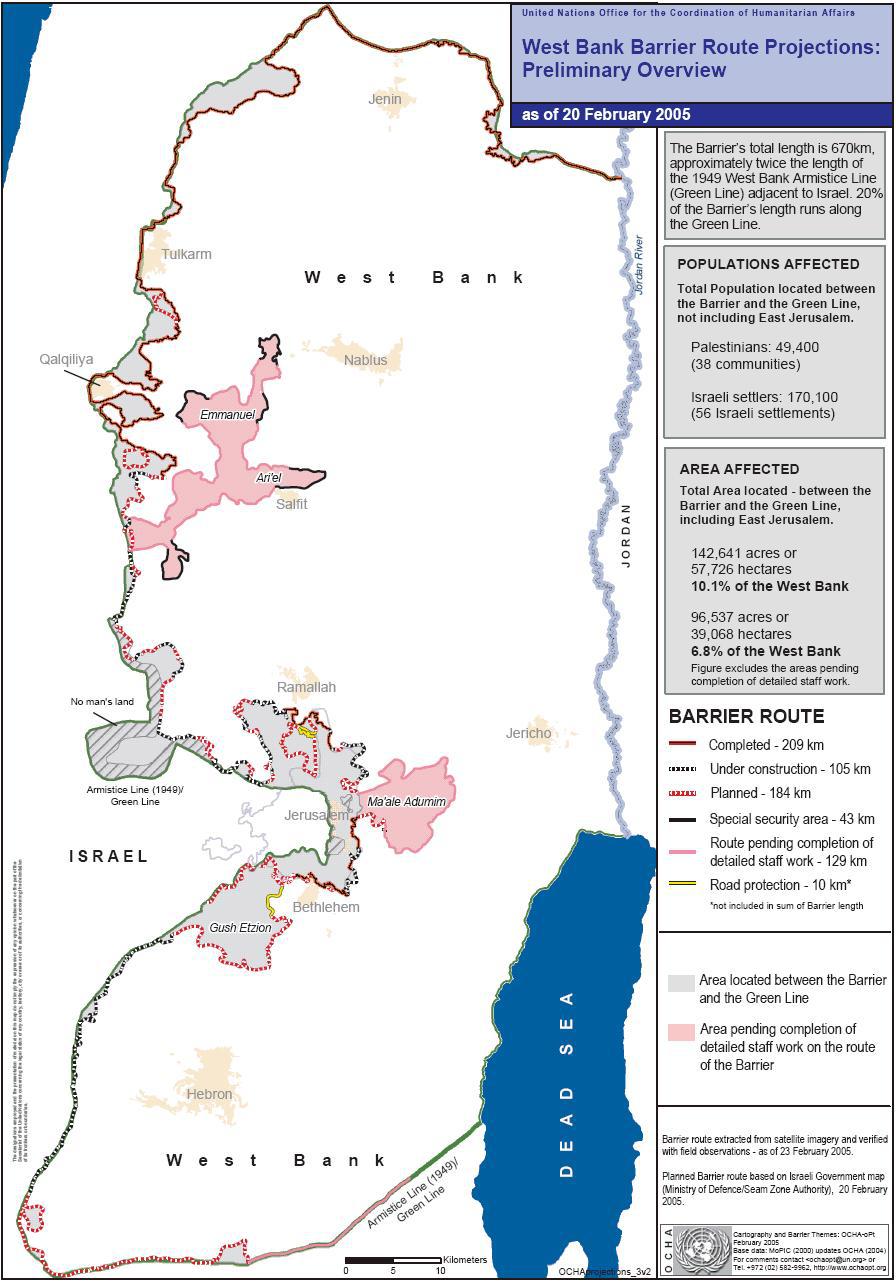
The distance between advisory jurisprudence and physical reality is stark. OCHA’s twenty-year reporting records that around 190 kilometers of the barrier had been completed in 2004, while the planned route extends to 712 kilometers.[5] OCHA’s April 2026 movement and access data states that 64% of the barrier is built and that 85% of the route runs inside the West Bank rather than along the Green Line.[6]
The same OCHA data reports more than 14,000 Palestinians living in the area between the barrier and the Green Line.[6] That area is often discussed through the language of maps and routes, but the legal consequence is lived through permits, gates, family separation, access to land, and the narrowing of ordinary movement. Those facts do not prove the legal violation by themselves; the ICJ’s reasoning does that work. They show how little the physical situation has conformed to the legal conclusions.
Movement restrictions also extend beyond the barrier. OCHA documented 925 movement obstacles in the West Bank as of December 2025, a 43% increase over the 20-year annual average.[6] That figure should not be made to carry more than it can bear. It is not a measure of the barrier alone, nor is it a judicial finding. It is evidence of the wider access environment in which the barrier operates.
Where the Law Now Stands
After 2004, the barrier’s legality under international law could already be answered with unusual clarity: the ICJ found that its construction in the Occupied Palestinian Territory and the associated regime violated international law, and it specified the humanitarian-law, human-rights, and self-determination grounds for that conclusion.[1] The principal disputes after that point concerned effect, implementation, competing domestic judicial approaches, and the legal consequences other actors were willing to draw.
After 2024, the answer is broader. The barrier is not only a structure whose route and permit regime were condemned in 2004. It is also part of a legal setting in which the ICJ has found Israel’s continued presence in the Occupied Palestinian Territory unlawful, identified expanded duties of cessation and reparation, required evacuation of settlers, and found a breach of CERD Article 3 through separation between settler and Palestinian communities.[2]
The Court’s view has therefore not simply remained constant for two decades. It has accumulated, widened, and hardened. The West Bank barrier remains legally condemnable on the 2004 grounds that attached directly to its construction and associated regime. It is now also legally condemnable as part of the broader unlawful occupation framework articulated in 2024.
References
- Legal Consequences of the Construction of a Wall in the Occupied Palestinian Territory, International Court of Justice, 9 July 2004.
- Legal Consequences arising from the Policies and Practices of Israel in the Occupied Palestinian Territory, including East Jerusalem, International Court of Justice, 19 July 2024.
- Israel, The Separation Barrier in the Occupied Palestinian Territory, ICRC Casebook.
- The International Court of Justice Advisory Opinion on Israel’s Security Barrier and the International Law of Self-Defense, ASIL Insights.
- Back to the Wall, OCHA.
- Movement and Access in the West Bank, OCHA, April 2026.
Comments
Join the discussion with an anonymous comment.