
Full profile
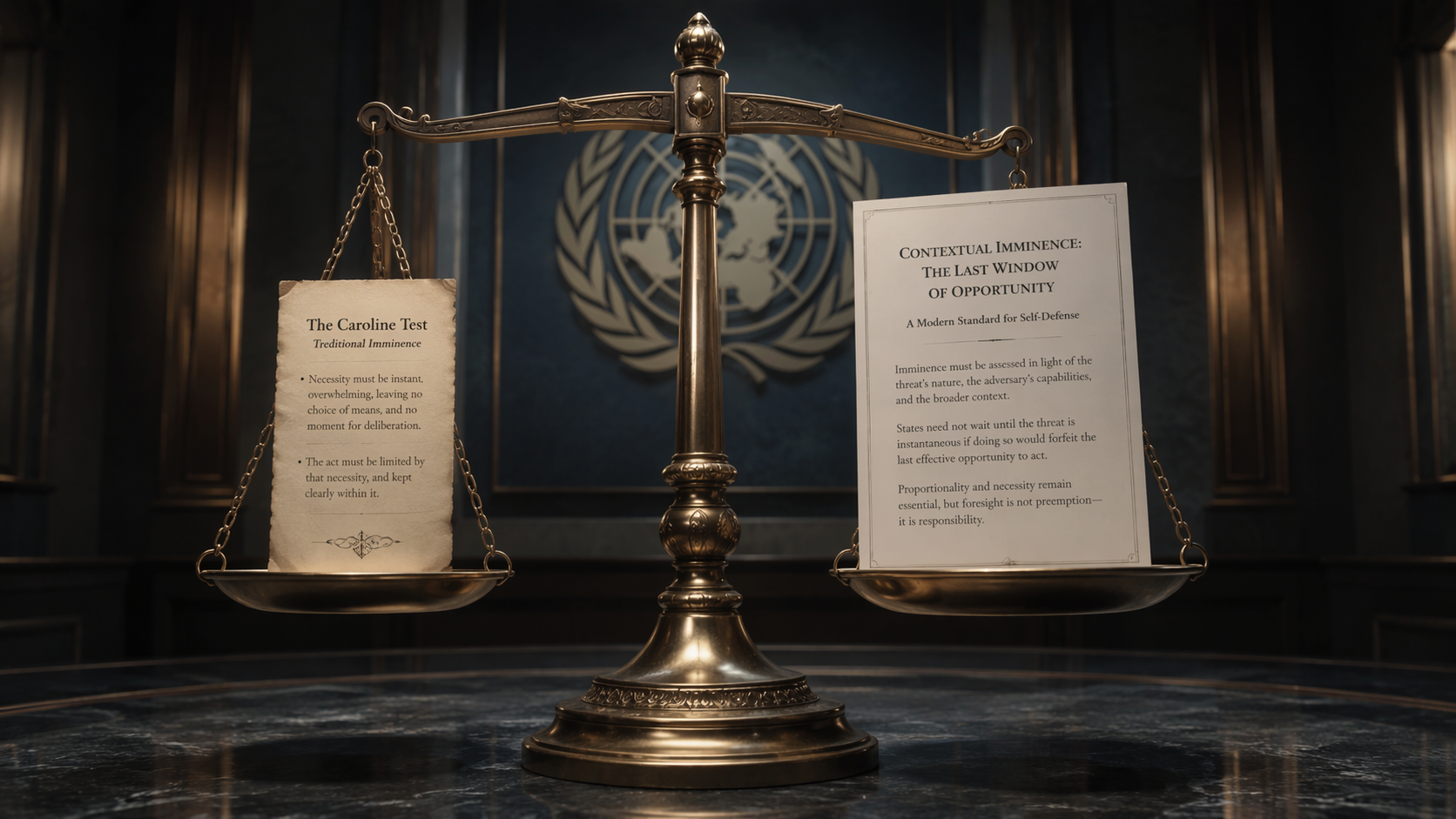
The legal fork is clear, and it matters. If the Iran strikes are tested under the traditional Article 51 framework — an actual armed attack, or a threat so immediate that the old Caroline formula still has work to do — the case for legality is exceptionally weak. If they are tested under a broader contextual theory of imminence, sometimes described as a “last window of opportunity” approach, the US-Israeli position becomes intelligible but not settled. That difference is the center of the debate over the legal implications of the Iran attack under international law, not a decorative doctrinal quarrel.
This is an out-of-lane analysis piece for Lex Machina Review, which normally covers legal AI rather than use-of-force law. The reason to take the detour is simple: when states stretch legal terms such as “imminent,” lawyers need to ask whether the resulting rule could govern the next case when the state invoking it is less trusted, less transparent, or less aligned with the reader’s sympathies.
The Two Operations and the Public Record
The public record discussed here concerns two distinct operations: Israel’s Operation Rising Lion on June 13, 2025, and the joint US-Israeli Operation Epic Fury / Shield of Judah on February 28, 2026. The distinction matters because some commentary addresses only one strike sequence, while later legal criticism folds both into a broader assessment of preventive force against Iran.
The public legal record is thinner than it should be. The US and Israeli governments have not, on the materials available here, published detailed legal memoranda laying out their Article 51 theory, the intelligence basis for imminence, the necessity analysis, or the proportionality assessment. That absence does not prove unlawfulness by itself. It does mean that outside lawyers are working from official statements, public facts, IAEA material, and competing expert analysis rather than from a full pleaded case.
That evidentiary gap is especially important because nuclear facilities, proxy forces, and compressed intelligence timelines are precisely the circumstances in which governments are tempted to use legal language at a higher level of abstraction. The harder the security case, the more carefully the legal threshold has to be stated.
Article 2(4), Article 51, and the Traditional Route to Illegality
The UN Charter starts with prohibition, not permission. Article 2(4) bars the threat or use of force against the territorial integrity or political independence of any state. Article 51 preserves the inherent right of individual or collective self-defense “if an armed attack occurs,” until the Security Council has taken necessary measures.[1] For present purposes, the hard question is whether Article 51 can cover force used before an attack has occurred, and if so, how close the attack must be.
The traditional answer begins with the Caroline formulation: anticipatory self-defense is confined to a necessity of self-defense that is “instant, overwhelming, leaving no choice of means, and no moment for deliberation.”[2] Lawyers have argued for generations about how directly that nineteenth-century correspondence maps onto the Charter. Still, its discipline is obvious. It does not ask whether a target state is dangerous in general, whether its leadership is hostile, or whether future military action may become costlier. It asks whether the choice has genuinely collapsed.
The International Court of Justice has generally kept the self-defense trigger narrow. In Nicaragua v. United States, the Court treated an “armed attack” as the gravest form of force and identified, in the context of indirect force, the sending by or on behalf of a state of armed bands, groups, irregulars, or mercenaries as the kind of conduct that may cross the threshold.[3] In Armed Activities on the Territory of the Congo, the Court again resisted an expansive self-defense theory detached from a sufficiently established armed attack attributable in the necessary way.[4]
Applied to the Iran strikes, that framework creates a serious problem for the US-Israeli position. The public materials identified for this analysis do not establish that Iran had already launched an armed attack triggering Article 51 for these operations. Nor do they publicly establish a manifestly imminent Iranian nuclear attack in the Caroline sense. The point is not that Iran’s regional conduct, proxy relationships, or nuclear program are irrelevant to security policy. The point is that Article 51 is not a general warrant to eliminate future strategic danger.
The nuclear rationale runs into a particularly concrete fact. On June 17, 2025, IAEA Director General Rafael Grossi stated that the agency had “no proof of a systematic effort by Iran to move into a nuclear weapon.”[5] That statement does not certify benign intent, and it does not erase all intelligence that states may claim to possess outside public channels. But it sharply limits what can be said on the public record about nuclear imminence. A state may be closer to capability than outsiders would like; that is not the same as an armed attack being underway or manifestly about to occur.
| Legal Element | Traditional Inquiry | Problem on the Public Record |
|---|---|---|
| Armed attack | Has Iran already used force at the Article 51 threshold against the acting state? | The available materials do not establish such an armed attack for these operations. |
| Imminence | Was an attack instant, overwhelming, and leaving no choice of means or moment for deliberation? | The public record does not show a manifestly imminent nuclear attack. |
| Necessity | Was force the only available means? | Without detailed legal and intelligence memoranda, necessity is asserted more than demonstrated. |
| Proportionality | Was the defensive force limited to stopping the qualifying attack? | Assessment remains constrained by the absence of full operational and legal disclosures. |
This is why the traditional path leads so quickly to illegality. It is not because anticipatory self-defense is impossible in every conceivable case. It is because the traditional standard is deliberately hostile to preventive war dressed in defensive vocabulary.
The Broader “Last Window” Argument
The best available defense of the strikes does not pretend that a missile had to be visibly in the air. It relies instead on a contextual understanding of imminence. The Chatham House Principles and the Bethlehem Principles both reflect efforts to adapt self-defense doctrine to threats that may not present themselves as a neat countdown.[6][7] The Bethlehem Principles, in particular, direct attention to factors such as the probability of an attack, the nature of the threat, and the consequences of delay.[7]
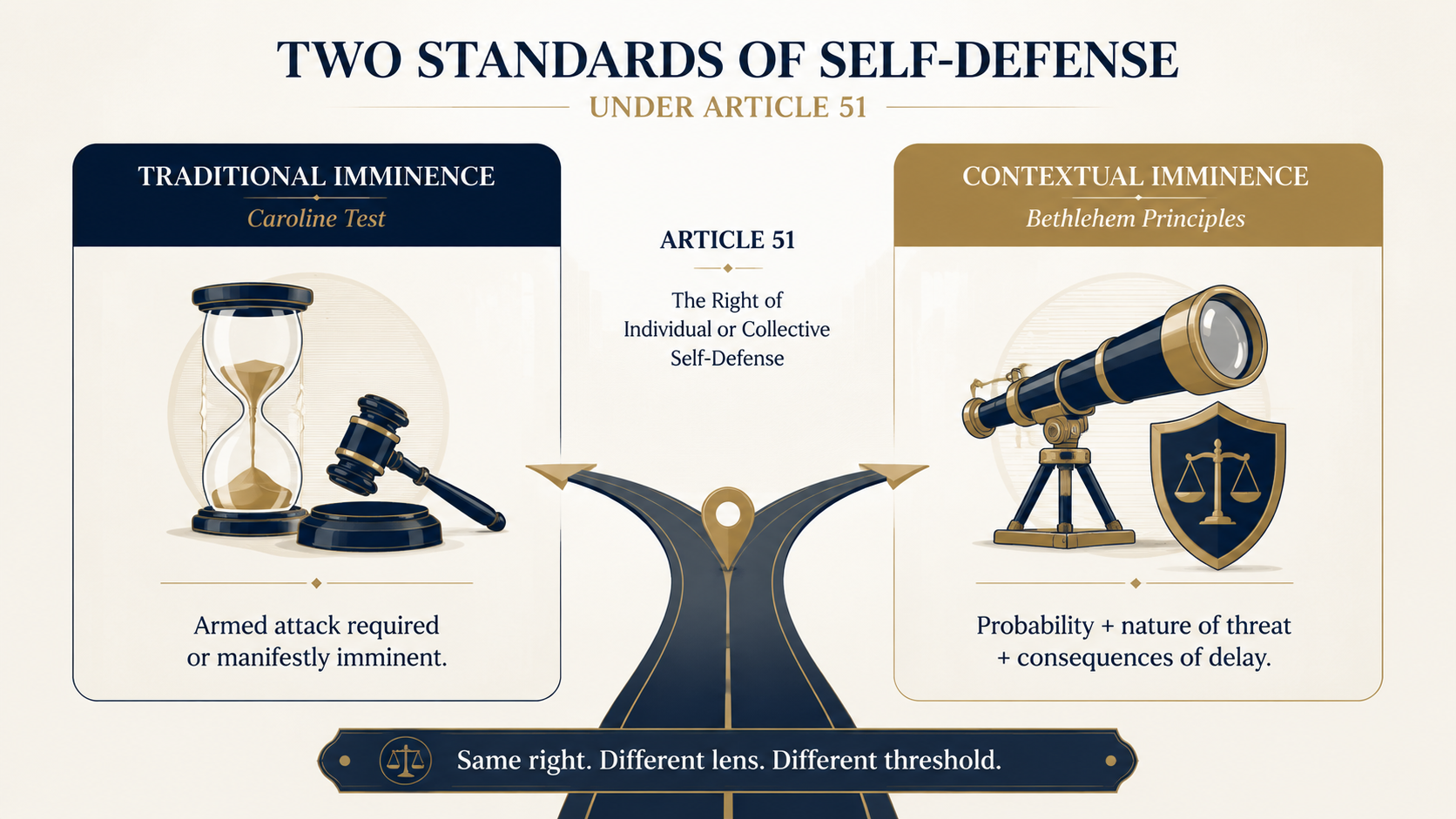
Nicholas Tsagourias’s analysis at the Lieber Institute gives that argument its most serious form in the materials reviewed here. On this view, imminence is not purely temporal. A state facing a grave threat may have to act at the last realistic moment when defensive force can still be effective, especially where delay could allow a threat to mature beyond meaningful interruption.[5] Nuclear facilities are an obvious candidate for that argument because the consequences of waiting may be catastrophic and the operational window may close before the final political decision to attack is externally visible.
There is a hard case buried inside that formulation. If the law requires a state to wait until the final observable step before a nuclear strike, the law may become strategically unserious. If the law permits a state to attack whenever it believes a hostile state may later acquire or use a catastrophic capability, the law becomes an invitation to preventive war. The phrase “last window of opportunity” does real work only if it is tied to evidence that the window is actually closing, that no non-forcible alternative remains capable of addressing the threat, and that the anticipated attack is probable rather than merely possible.
That is the point at which the contextual theory becomes vulnerable on this public record. It can explain why temporal immediacy is not always the right test. It does not relieve the acting states of showing probability, necessity, and constraint. Without public legal memoranda, and against the IAEA Director General’s June 17, 2025 statement, the broader theory remains a contested rationale rather than a settled justification.[5]
Expert Criticism and the Precedent Problem
The strongest criticism in the public materials is not merely that the strikes were unwise. It is that they violated the Charter system. In March 2026, more than 100 US-based international law experts, including the American Society of International Law President and President-elect, signed a letter concluding that the strikes violated the UN Charter and may constitute war crimes.[8] That is not a court judgment, and it does not bind states. It is, however, a substantial signal of where much of the professional international law community has landed on the public facts.
The letter matters because it frames the issue as a rule-system problem. If the strikes are lawful because Iran posed a grave future danger, then the limiting principle has to be stated with enough precision to deny the same logic to other states making their own claims about hostile neighbors, covert programs, proxy networks, or closing windows. A legal rule that depends on trusting the particular governments invoking it is not much of a legal rule.
Allen Weiner of Stanford Law School put the concern in institutional terms, describing the strikes as “a dangerous reversion to the Clausewitzian vision” of war as politics by other means.[9] Völkerrechtsblog’s March 2026 symposium likewise emphasized the precedential cost of weakening the prohibition on force.[10] AP’s framing — that the international legal order was being tested by war in Iran — is broad, but in this setting the breadth is earned: the test is whether Article 2(4) remains a prohibition with exceptions, or becomes a presumption that powerful states can overcome by invoking threat complexity.[11]
The Conversation’s analysis by Kai Ambos and co-authors took an even sharper view, arguing that the strikes were “neither preemptive nor legal.”[12] That conclusion aligns with the traditional Caroline and ICJ path. It is less hospitable to the Bethlehem-style contextual approach, but the disagreement is not over whether words such as necessity and imminence matter. It is over whether those words still constrain.
Necessity, Proportionality, and Attribution Cannot Be Assumed
Even if one accepts a broader imminence theory, Article 51 does not end at imminence. Necessity and proportionality remain separate requirements. Necessity asks whether force was required to address the qualifying threat, not whether force was useful, expedient, or strategically attractive. Proportionality asks whether the force used was limited by the defensive purpose, not whether it was proportionate to the target state’s general misconduct.
Attribution also matters where proxy forces enter the narrative. Nicaragua’s treatment of armed bands, groups, irregulars, and mercenaries is demanding because the Court did not want every hostile relationship or material support allegation to become an armed attack by the state itself.[3] A state may face real violence from non-state actors supported by another state; that still leaves the legal work of attribution, gravity, necessity, and target selection to be done.
The available public materials do not provide enough detail to complete those inquiries with confidence. That uncertainty cuts against categorical claims of legality more than it cuts against criticism. The acting states are the ones invoking the exception to Article 2(4). They bear the burden, at least in public legal argument, of showing why the exception applies.
Where the Legal Assessment Stops
On the public record, the traditional Caroline and ICJ framework points strongly toward unlawfulness. There is no publicly established prior armed attack by Iran sufficient to trigger Article 51 for these operations, and the publicly available nuclear evidence is difficult to reconcile with a manifestly imminent nuclear attack, especially after Grossi’s statement that the IAEA had “no proof of a systematic effort by Iran to move into a nuclear weapon.”[5]
The broader contextual imminence theory supplies the principal contested defense. It deserves to be taken seriously because modern threats do not always arrive with Caroline’s tidy temporal markers. But a last-window theory has to identify the window, show why it was closing, and explain why force was necessary at that point. Otherwise “imminent” becomes a fog machine for prevention.
The stronger weight of expert opinion in the materials reviewed here concludes that the strikes violated the UN Charter and may constitute war crimes.[8] That conclusion is not a prediction of what a court would do on a fuller evidentiary record. It is the most defensible assessment from the public materials now available: almost certainly unlawful under the traditional Caroline and ICJ approach, only contestably defensible under the broader last-window theory, and dangerous as precedent if accepted without a much more constraining account of imminence.
References
- Charter of the United Nations, United Nations.
- The Caroline Case, Yale Law School Avalon Project, 1842.
- Military and Paramilitary Activities in and against Nicaragua (Nicaragua v. United States of America), International Court of Justice, 1986.
- Armed Activities on the Territory of the Congo (Democratic Republic of the Congo v. Uganda), International Court of Justice, 2005.
- Israel’s Attack on Iran and the International Law of Self-Defense, Lieber Institute West Point.
- Principles of International Law on the Use of Force by States in Self-Defence, Chatham House, 2005.
- Principles Relevant to the Scope of a State’s Right of Self-Defense Against an Imminent or Actual Armed Attack by Nonstate Actors, American Journal of International Law, 2012.
- International Law Experts Condemn U.S.-Israeli Strikes on Iran as Violations of the UN Charter and Potential War Crimes, Just Security, March 2026.
- Stanford Law School analysis on the Iran strikes, Stanford Law School.
- Symposium on the Iran strikes and international law, Völkerrechtsblog, March 2026.
- International legal order tested by war in Iran, AP News.
- The strikes on Iran were neither preemptive nor legal, The Conversation.
Comments
Join the discussion with an anonymous comment.