
Full profile
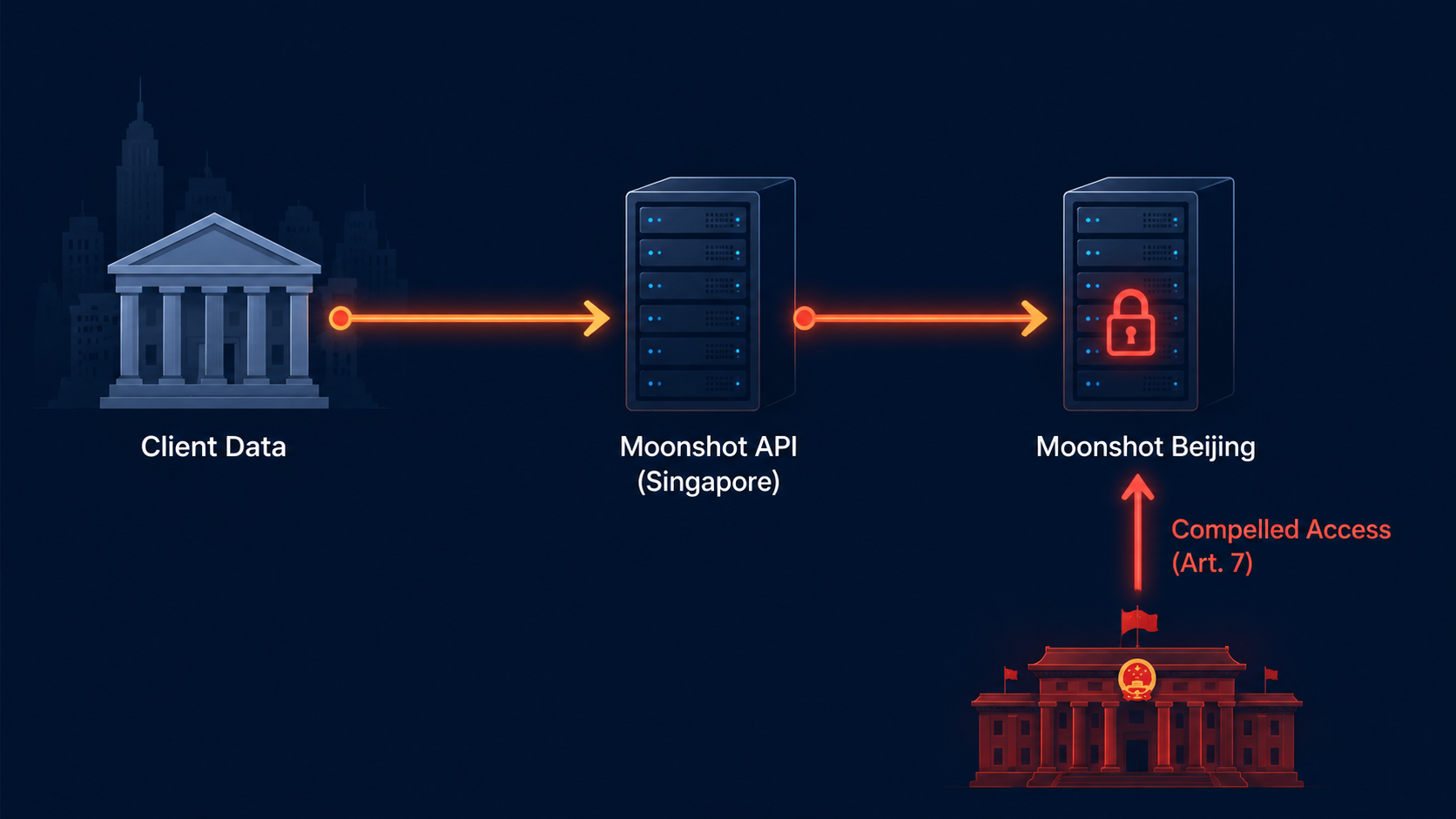
The answer for a US law firm is no: Kimi K3's hosted API is not a defensible place to send client material, even if the model is capable and inexpensive. The procurement question here is not benchmark pride; it is whether the firm can preserve confidentiality when Moonshot's public consumer policy says user content, including prompts and files, is processed to train and optimize the models, with no obvious opt-out for consumer users, while the reviewed public business materials do not supply SOC 2 or a HIPAA BAA for the hosted service. [1] Add the jurisdictional haze around Moonshot AI PTE. LTD., its Beijing roots, and China's compelled-access framework, and the firm is left with no clean answer to where client data sits or who can compel it. [2]

The hosted API is the problem
That combination matters because a law firm cannot treat an ordinary SaaS intake decision as a casual tool choice. If client material is disclosed to a third-party model host, the firm must know what that host does with the data, whether it is reused for training, where it is processed, and what contractual protections limit access. Moonshot's public materials do not resolve those questions in a way that a risk counsel can comfortably sign off on. [1][2]
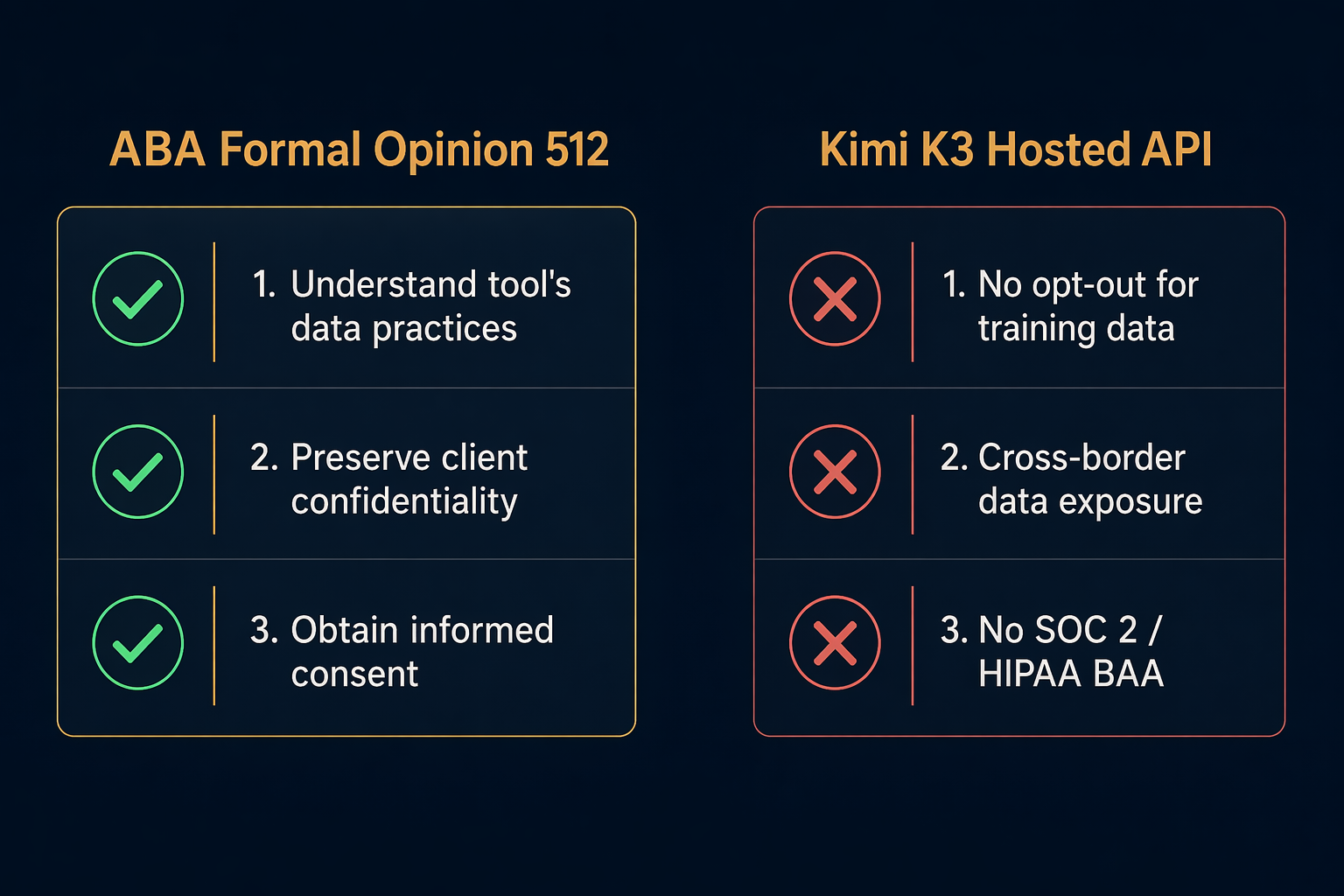
For Model Rules 1.1 and 1.6, ABA Formal Opinion 512 turns that from a vendor concern into a professional responsibility problem. The opinion requires lawyers to reasonably understand an AI tool's capabilities and data practices, ensure confidentiality protections apply, and obtain informed consent if disclosure to third parties may occur. In practice, that means 'we did not know what the tool did with the data' is not a usable defense for client work, and a vague 'use responsibly' policy is not a substitute for actual controls. [3]
Benchmark hype does not cure the risk
K3 is still so new that Moonshot's own performance claims are doing most of the talking for now, and that is exactly why a law firm should resist letting capability headlines outrun confidentiality analysis. A model can be fast, cheap, and impressive without being acceptable for client work. The more relevant warning is strategic: once a vendor's product is surrounded by enough regulatory uncertainty, regulated enterprises start backing away before any single rule change forces them to, and that dynamic has already shown up in the way Chinese AI has been treated in sensitive government settings. [2]
Self-hosting is the only workable path
If K3's open-weight version appears, self-hosting is the only plausible mitigation for firms that want the model at all. That removes the hosted cross-border data problem, but it does not make the model casual to deploy. The Constellation evaluation of predecessor K2.5 found that open-weight safeguards could be stripped with under $500 of compute, which is a reminder that model controls cannot be assumed to stay in place just because weights are public. The evaluation is about K2.5, not K3, so it should be read as caution, not as proof about the new model. [4]
A self-hosted deployment would still need serious GPU capacity, restricted access, logging, prompt and output review, retention limits, and a policy that keeps client matter data out of ad hoc experimentation. That is a controlled infrastructure project, not a loophole around the hosted API problem.
For a US firm, the defensible policy posture is straightforward: block hosted Kimi K3 for client work, revisit only if Moonshot offers enterprise terms that actually answer the data-handling questions, and treat any self-hosted deployment as a separate risk program that lives under the firm's normal confidentiality, security, and supervision controls.
References
- Is Kimi K3 Safe for Business? A Compliance Review. Layer3Labs.
- Kimi Claw: Risks from Chinese-Hosted 'Always On' AI Agents. IAPS.
- ABA issues first ethics guidance on a lawyer's use of AI tools. American Bar Association. July 2024.
- arXiv:2604.03121. arXiv. April 2026.
Comments
Join the discussion with an anonymous comment.