
Full profile
The client email usually arrives with the wrong question attached: “Is this Olympic ticket tax refund law thing real?” In July 2026, the narrow answer is yes, at least for the LA28 email LAist verified: LA28 confirmed that some purchasers received an email with the subject “Official LA28 Ticket Tax Refund” because local taxes were erroneously charged on ticket purchases at two venues, Intuit Dome and the Columbus Crew stadium venue.[1]
That does not make it a new tax law, a government rebate, or a deduction opportunity. It is a correction of a charge on a ticket transaction. The phrase “how to get olympic ticket tax refund law” is therefore a poor label for the actual task: verify the email, identify the original purchase, accept the refund through the offered channel if appropriate, and keep the records.
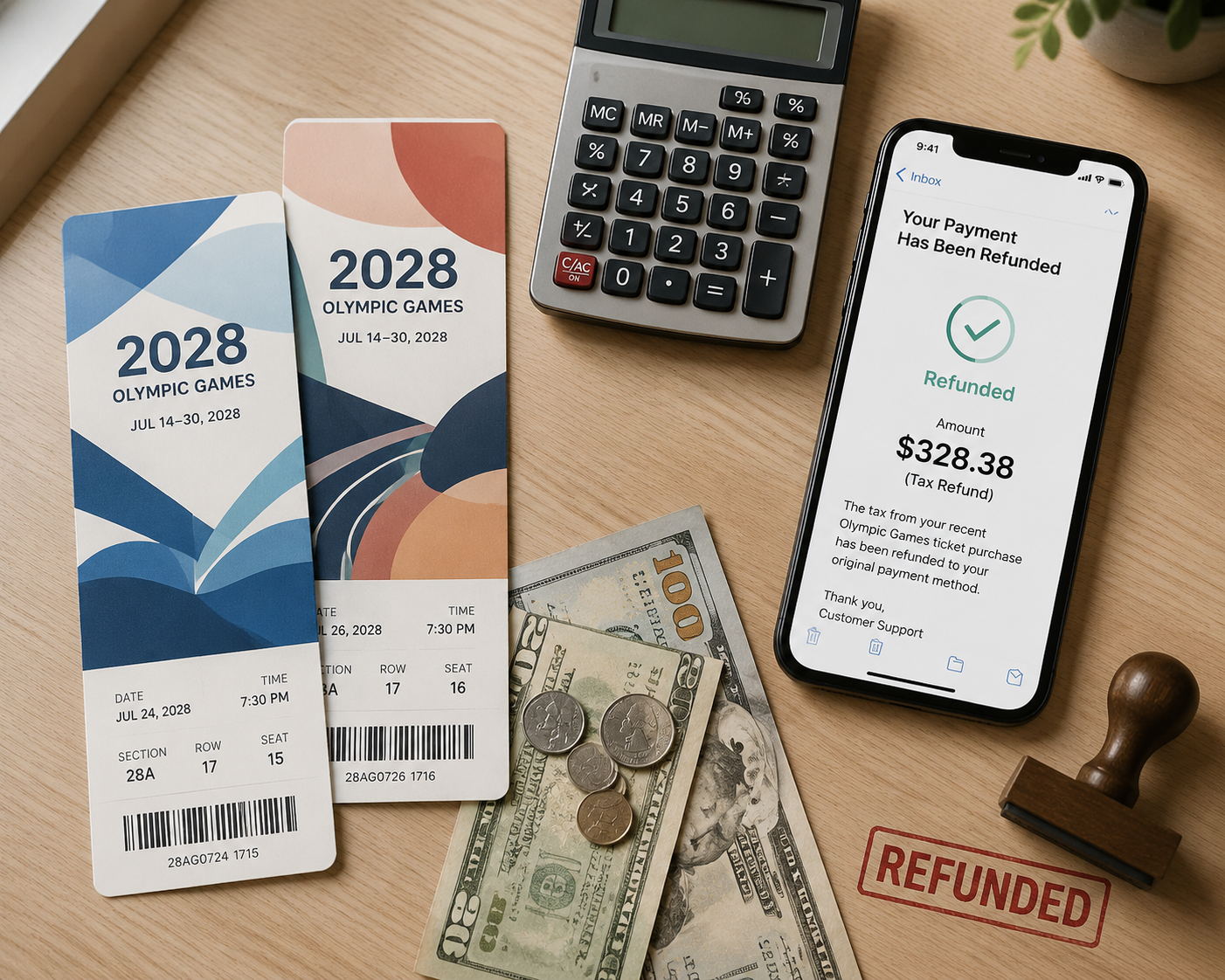
What LA28 Confirmed
LA28 spokesperson Jacie Prieto Lopez told LAist that the organization was proactively refunding taxes that should not have been collected on purchases for two venues. The reported refunds were described as under $11 for Intuit Dome purchases and under $40 for Columbus Crew stadium purchases.[1]
Those amounts matter less for their size than for their function. They point to a local-tax correction tied to a specific purchase route and venue, not to a generalized Olympic tax benefit. They also appear to be per-purchase refund amounts as reported by LA28, not a promise that every ticket buyer receives the same amount per ticket.[1]
The process LAist described is equally important for verification. Eligible buyers may accept the refund online, use Zelle, or wait for a mailed check.[1] A practitioner reviewing a forwarded email should start there: subject line, sender, purchase history, venue, payment route, and whether the refund amount is consistent with the LA28 explanation.
| Question | Practical answer |
|---|---|
| Who is the refund for? | Purchasers affected by erroneous local tax charges on LA28 ticket purchases at the identified venues. |
| What venues are involved? | Intuit Dome and the Columbus Crew stadium venue, as reported by LAist based on LA28 confirmation. |
| How much is involved? | Under $11 for Intuit Dome purchases and under $40 for Columbus purchases, with individual amounts depending on the transaction. |
| How can the recipient get it? | Accept online, use Zelle, or wait for a mailed check, according to the LAist description. |
| What is it not? | It is not a new Olympic ticket tax law, a government rebate, or a federal deduction rule. |
The Tax Characterization Comes Before the Tax Consequence
There is no research-source basis for saying the IRS has issued LA28-specific guidance on this refund. The analysis should therefore stay at the level the facts support: if a buyer paid a local tax that should not have been charged, and the merchant returns that amount, the payment is best characterized as a return of an overpayment. It restores the purchaser to the position they should have occupied at the time of sale.
On that characterization, the ordinary income-tax concern is limited. The buyer has not received a new accession to wealth merely because the transaction label includes the word “tax.” The buyer has received back money that should not have been collected in the first place. That is different from resale proceeds, a prize, a compensatory payment, or a separate promotional credit.
It is also different from a ticket-price adjustment. If a seller later reduced the actual ticket price, the better practical framing would be a reduction of the buyer’s cost in the ticket. Here, the LA28 explanation is narrower: a refund of erroneously collected local tax on specified venue purchases.[1]
For most individual purchasers, that means the file answer can be short: absent contrary facts, do not treat the LA28 tax refund itself as taxable income. But “absent contrary facts” is doing work. If the client bought tickets through a business account, resold tickets, reimbursed employees, allocated costs to clients, or booked the original purchase in an accounting system, the refund belongs in that transaction history rather than in a casual inbox folder.
- Keep the original ticket purchase confirmation and receipt.
- Save the “Official LA28 Ticket Tax Refund” email with full headers if authenticity is later questioned.
- Record the amount received and whether it arrived online, through Zelle, or by mailed check.
- Match the refund to the original venue and purchase account.
- Preserve any internal accounting entry that reduces the original tax or ticket cost.
Verification Still Matters Because Olympic Ticket Scams Are Not Hypothetical
The refund confirmation does not make every LA28-related email safe. California Attorney General Rob Bonta warned consumers in April 2026 about possible LA28 ticket scams, including risks around fraudulent ticket listings and payment requests.[2] That warning does not contradict LA28’s refund process; it explains why the process should be checked rather than trusted on branding alone.
A reasonable verification path is not elaborate. Confirm that the client actually made an LA28 purchase connected to one of the affected venues. Compare the refund amount to the LA28-reported range. Avoid entering credentials through a suspicious link. If the recipient is uncomfortable with the online or Zelle option, the reported process allows the recipient to wait for a mailed check.[1]
Why Utah’s 2034 Exemption Is a Different File
Utah’s HB537 is a sales-tax exemption for tickets to the 2034 Winter Games, not the legal source of the LA28 refund. The Utah materials concern future 2034 Olympic and Paralympic ticket sales, with the legislation enacted in March 2026 and an effective date of January 1, 2028.[3][4]
That distinction is not academic. A statutory exemption prevents or removes a tax obligation under defined conditions. The LA28 refund, as reported, corrects tax that was already charged in error on particular 2028 ticket purchases. One is prospective legislation for Utah’s 2034 event structure; the other is a merchant correction tied to LA28 purchase records.
Utah’s implementation details also remain their own problem. Deseret News reported in March 2026 that the amount of a “government Olympic services recovery fee” had not yet been determined.[4] That unresolved fee question should not be imported into an LA28 refund analysis.
The Los Angeles 10% Ticket Tax Proposal Is Not a Refund Mechanism
The Los Angeles City Council proposal belongs in the comparison only long enough to keep it out of the client answer. In May 2026, Deseret News reported that Los Angeles officials were considering a 10% tax on 2028 Olympic tickets, with the proposal referred to multiple committees and requiring further action, including voter approval.[5]
As of that reported status, the proposal was not the reason LA28 was sending refund emails. It was a possible local tax measure moving through a political process. A refund of erroneously collected local tax and a proposed future ticket tax do not answer the same legal question.
Federal Entertainment Deduction Rules Do Not Change the Refund
Some client questions will drift from “is the refund taxable?” to “can we deduct the tickets?” That is a separate federal income-tax issue. IRC §274 limits deductions for entertainment, amusement, or recreation expenses, and practitioner summaries commonly describe post-TCJA entertainment tickets as nondeductible while separately stated food and beverage may be subject to different treatment.[6][7]
That rule can matter for a company that bought Olympic tickets for client entertainment. It does not convert an LA28 local-tax refund into a business deduction, and it does not make the refund a new “Olympic ticket tax refund law.” If the business deducted or capitalized any part of the original transaction, the refund should be matched back to that accounting treatment. If it did not, the refund remains what the LA28 facts say it is: a return of tax that should not have been collected.
The Clean Client Answer
The safest short answer is also the most precise: LA28 has confirmed a legitimate ticket tax refund process for erroneous local taxes charged on purchases at Intuit Dome and the Columbus Crew stadium venue. Eligible buyers may accept the refund online, use Zelle, or wait for a mailed check. The reported amounts are small, but the classification matters.[1]
For tax purposes, characterize the payment before reaching for a reporting conclusion. A return of overcollected tax generally is not income to the purchaser; it is a correction of the original transaction. Keep the purchase record, refund email, amount, payment method, and any accounting entry that shows how the correction was handled.
Do not use “Olympic ticket tax refund law” as shorthand for Utah’s 2034 sales-tax exemption, Los Angeles’s proposed 10% ticket tax, federal entertainment deduction limits, resale reporting, or charitable ticket donations. Those may be real issues in the right file. They are not this refund.
References
- Olympics refund (LA28 Ticket Tax Refund), LAist, July 17, 2026.
- Fans warned about possible LA28 ticket scams, KTLA, April 2026.
- Fiscal Note — HB 537 (Substitute), Utah Legislature.
- Will there be sales tax on Olympic tickets in 2034?, Deseret News, March 11, 2026.
- A 10% tax on Olympic tickets in LA?, Deseret News, May 21, 2026.
- 26 U.S. Code § 274, Cornell LII.
- World Cup Tickets, Client Entertainment and What You Can Actually Deduct, Maddox Thomson.
Comments
Join the discussion with an anonymous comment.