
Building a Law Firm AI Policy: 8 Essential Components Based on Bar Guidance and Policy Frameworks
This article synthesizes eight essential components of a law firm AI governance policy from independently developed bar-approved frameworks and model policies. It provides a practical reference for attorneys and practice managers drafting a policy that satisfies ABA ethical duties while enabling innovation within defined guardrails.
- Hallucination rate
- Not measured / undisclosed
An AI governance policy for law firms has to answer two questions at the same time: what ethical duties apply when lawyers use AI, and where is experimentation actually allowed? A policy that only says “use AI responsibly” will not help the partner reviewing a hallucinated brief, the associate deciding whether to paste client facts into a public chatbot, or the billing lawyer deciding how to describe AI-assisted work on an invoice.
ABA Formal Opinion 512 gives the policy its professional-responsibility spine. The opinion states that lawyers using generative AI must have a reasonable understanding of the tool’s capabilities and limitations, must protect client confidentiality, must supervise AI-assisted work, and must verify AI-generated legal citations, factual assertions, and statutory references against primary sources before relying on them.[1] That is not a ban. It is a governance assignment.
Across bar materials and policy frameworks from the North Carolina Bar Association, GC AI, NexLaw, DISCO, Clio, and Texas Bar Practice, the same practical components keep recurring: scope, permitted and prohibited uses, confidentiality rules, human review, vendor controls, billing rules, training, and enforcement.[2][3][4][5][6][7] Some of those sources are vendor-published, so their commercial interest should stay visible. Still, the convergence is useful because the better frameworks are not merely encouraging adoption; they are identifying the points where legal work can fail.

The Eight Components a Law Firm AI Policy Should Cover
The table below is a drafting map, not a substitute for jurisdiction-specific review. A solo lawyer may compress it into two pages. A larger firm may turn the same map into an enterprise process with intake forms, procurement review, training logs, and audit records.
| Component | What the policy must decide | Why it matters |
|---|---|---|
| 1. Purpose and scope | Who is covered, which tools are covered, and whether the policy applies to free, paid, embedded, and client-provided AI systems. | Lawyers often encounter AI inside ordinary research, drafting, e-discovery, document-management, and office-productivity tools. |
| 2. Risk classification | Which uses are prohibited, which require approval, and which are permitted with ordinary safeguards. | A traffic-light model lets the firm distinguish low-risk internal support from client-confidential or legal-output use. |
| 3. Confidentiality and data handling | What information may be entered into which tools, under what contractual protections. | Model Rule 1.6 duties and state ethics guidance make data handling a policy core, not an IT preference. |
| 4. Human review and verification | Who must review AI output and what must be checked against primary sources. | ABA Formal Opinion 512 requires verification of citations, facts, and legal authorities before use. |
| 5. Approved tools and vendor due diligence | How tools are evaluated, approved, documented, and removed. | Procurement is where confidentiality promises, training-on-inputs restrictions, and retention terms become enforceable. |
| 6. Client disclosure, consent, and billing | When AI use must be disclosed, when consent is needed, and how AI-assisted work is billed. | Billing rules should prevent AI time compression from becoming client overcharging. |
| 7. Training, supervision, and records | Who receives training, who supervises use, and what records the firm keeps. | Competence and supervision duties require more than a one-time policy email. |
| 8. Enforcement and maintenance | What happens after a violation, who investigates, and when the policy is updated. | A policy without ownership, sanctions, and review cadence is usually just a memo. |
1. Define Scope Before Anyone Argues About a Tool
The scope clause should say who must follow the policy: lawyers, paralegals, staff, contract attorneys, summer associates, outside vendors, and any temporary personnel with access to firm or client information. It should also say what counts as an AI tool for firm purposes. That definition should be broad enough to cover standalone generative AI systems, legal research assistants, e-discovery analytics, document review tools, contract analysis products, transcription systems, and AI features embedded in software the firm already uses.
This is where many polished templates become too narrow. If the policy only names one public chatbot, it misses the more likely path of adoption: a lawyer clicks an AI feature inside a research platform, document tool, or office suite and assumes procurement has already solved the ethics questions. Clio’s and NexLaw’s policy materials both treat tool coverage and acceptable-use boundaries as threshold drafting issues, which is the right instinct even though both sources come from legal-technology vendors.[4][6]
For a smaller firm, the scope clause can be plain: no firm or client information may be entered into any AI system unless the tool is listed as approved or the responsible lawyer has documented approval. For a larger firm, the same idea usually needs a tool registry, owner, approval date, permitted uses, prohibited uses, contract status, and renewal review date.
2. Use a Traffic-Light Classification, but Do Not Treat It as Magic
The red/yellow/green classification is one of the most useful devices in current law firm AI policy drafting. The North Carolina Bar Association, GC AI, and NexLaw each discuss versions of this approach, and the frameworks trace the formulation to Casemark.[2][3][4] That gives it practical credibility, not scientific finality. It is a widely adopted drafting model, not an independently validated universal standard.
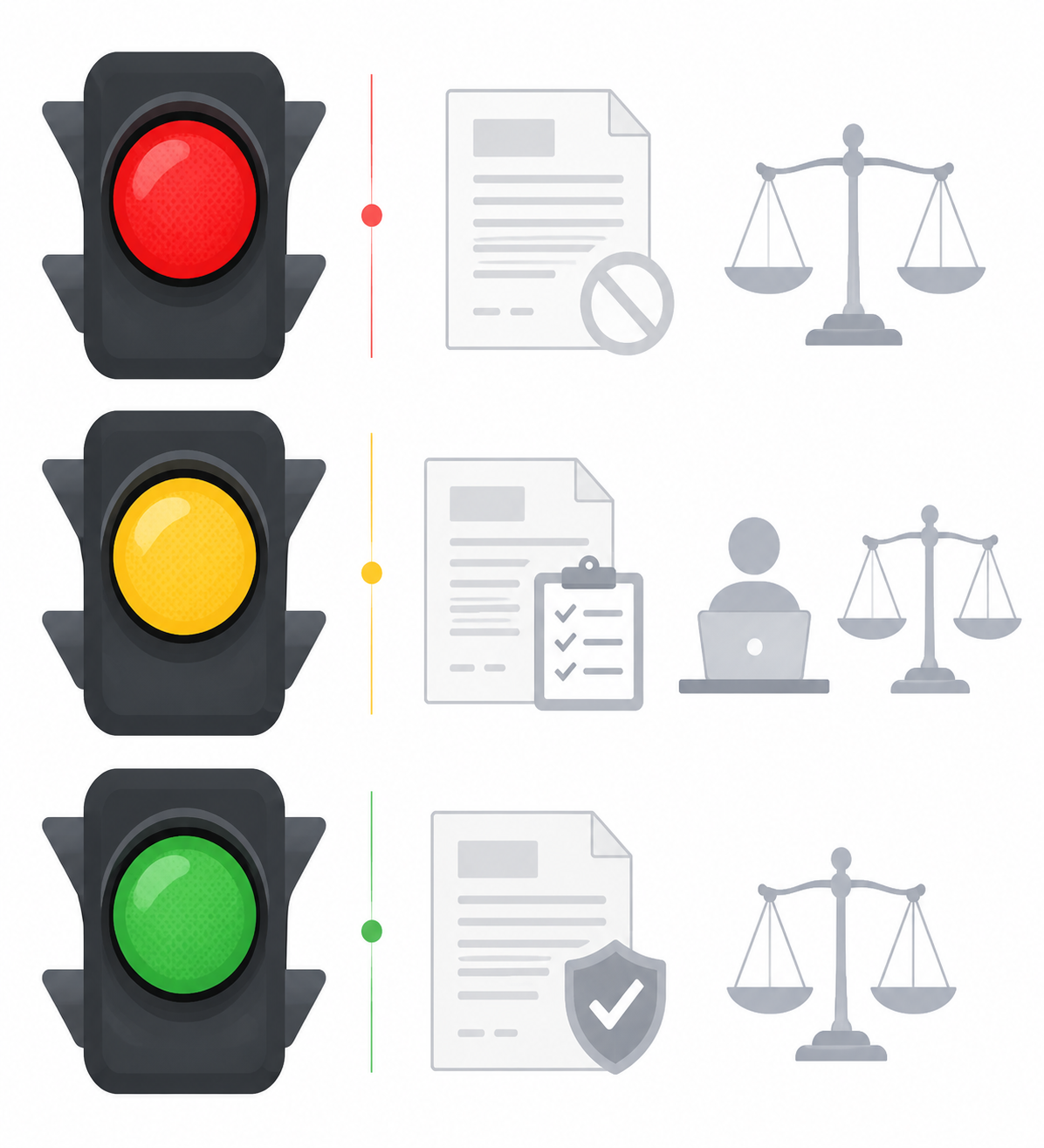
| Risk level | Typical policy treatment | Examples of use categories |
|---|---|---|
| Red | Prohibited unless the firm’s designated approver grants an exception in writing. | Entering client confidential information into consumer tools that train on inputs; filing AI-generated legal work without lawyer verification; using AI to make unsupervised legal judgments. |
| Yellow | Allowed only with approval, safeguards, and documented human review. | Drafting client-facing text from approved tools; summarizing confidential materials in enterprise systems with contractual protections; using AI for research support where primary-source verification is required. |
| Green | Allowed under standing rules and ordinary professional judgment. | Administrative brainstorming; formatting nonconfidential internal materials; generating generic training hypotheticals; improving grammar in text that contains no client or sensitive firm information. |
The classification should attach to uses, not just tools. The same AI product might be green when used to reformat a nonconfidential internal agenda, yellow when used to summarize a client document inside an approved enterprise environment, and red when used to upload privileged facts into a consumer account with unclear retention and training practices.
That distinction matters because lawyers do not experience policy as a procurement chart. They experience it at the moment of use: Can I paste this? Can I rely on this? Can I send this to the client? A traffic-light table gives them a fast answer while preserving room for careful experimentation.
3. Make Confidentiality Rules Tool-Specific
The confidentiality section should be more concrete than “do not disclose client information.” It should say that lawyers and staff may not enter client confidential information, privileged material, personal data, trade secrets, litigation strategy, nonpublic transaction details, or protected firm information into consumer AI systems that train on user inputs or lack contractual protections. GC AI’s ethics discussion and Texas Bar Practice’s governance materials both emphasize that confidentiality controls must account for whether a system retains prompts, trains on inputs, or gives the firm contractual assurances.[3][7]
For approved enterprise tools, the policy should identify the conditions that make use permissible: zero-data-retention terms where available, restrictions on training on firm or client inputs, confidentiality commitments, access controls, auditability, and a process for reporting suspected exposure. Florida Ethics Opinion 24-1, as discussed in current legal-ethics policy materials, is especially important here because it links generative AI use to confidentiality, competence, supervision, and billing duties.[3]
The reporting rule should be unambiguous. If someone enters client facts into the wrong system, the policy should tell them whom to contact, how quickly to report, what information to preserve, and who decides whether client notice, court notice, or other remedial action is required. Silence on this point encourages delay, and delay is usually the most expensive part of the incident.
4. Require Human Review Where the Work Leaves the Sandbox
The human-review section should identify which outputs require lawyer review before use. At minimum, any AI-assisted legal research, client advice, litigation filing, contract language, factual summary, discovery response, negotiation position, or regulatory analysis should be reviewed by a responsible lawyer before it is sent, filed, or relied on.
ABA Formal Opinion 512 is direct on the verification point: lawyers must verify AI-generated citations, factual assertions, and legal references against reliable sources, including primary sources where legal authority is involved.[1] A policy should convert that duty into a workflow. For litigation filings, require the drafter to check every cited case, quotation, pin cite, statute, rule, and record reference. For transactional work, require review of defined terms, cross-references, governing-law assumptions, party names, dates, and client-specific instructions. For research memos, require confirmation that the cited authority exists, remains good law, and supports the proposition for which it is used.
The policy should also prohibit delegation of professional judgment to the system. AI can assist with drafts, summaries, issue spotting, and organization. It cannot decide litigation strategy, approve final advice, determine whether a conflict exists, or replace the lawyer’s obligation to understand the work product.
5. Build Vendor Due Diligence Into the Approval Process
Vendor review is where a law firm AI policy stops being aspirational. A lawyer cannot comply with a confidentiality rule if the firm has never asked whether the vendor stores prompts, trains on inputs, shares data with subprocessors, or permits the firm to disable retention. DISCO’s governance blueprint and Axiom’s governance framework both push legal teams toward structured governance rather than ad hoc tool adoption.[5][8]
| Due diligence item | Question the firm should answer before approval |
|---|---|
| Data retention | Does the vendor retain prompts, uploads, outputs, metadata, or user activity, and for how long? |
| Training on inputs | Does the vendor use firm or client data to train, fine-tune, evaluate, or improve models? |
| Confidentiality terms | Does the contract bind the vendor to confidentiality obligations suitable for legal work? |
| Zero-data-retention or no-training option | Is a zero-retention, no-training, or enterprise-isolated configuration available and enabled? |
| Security controls | What access controls, encryption, audit logs, incident-response commitments, and subprocessors apply? |
| Jurisdiction and data location | Where is data processed and stored, and does that create client, regulatory, or contractual issues? |
| Output limitations | What does the vendor disclose about hallucinations, accuracy limits, source grounding, and appropriate use? |
| Contract remedies | What notice, indemnity, termination, audit, and cooperation rights does the firm have? |
The approval process should name the decision-maker. In a solo or small firm, that may be the owner or managing partner. In a mid-sized firm, it may be a technology partner, practice manager, general counsel, or risk committee. In a larger firm, approval may require information security, procurement, privacy, records, conflicts, and professional-responsibility review. What matters is that the policy does not leave approval to the person most excited to try the tool.
The firm should keep an approved-tool register with the tool name, approved use cases, prohibited use cases, data categories allowed, contract status, reviewer, approval date, renewal date, and responsible owner. If the vendor changes its terms or releases a materially different feature, approval should not silently carry over.
6. Address Client Disclosure, Consent, and Billing Without Guesswork
The client-disclosure section should distinguish between routine internal use and uses that materially affect the representation, confidentiality, cost, or client expectations. ABA Formal Opinion 512 discusses client communication duties in the generative AI context, and GC AI’s 2026 ethics synthesis connects disclosure questions to confidentiality, supervision, and billing risks.[1][3]
A cautious policy should require lawyers to check engagement letters, outside counsel guidelines, protective orders, court rules, client technology restrictions, and matter-specific instructions before using AI on client work. Some clients will permit AI use inside approved enterprise environments. Others will prohibit it or require advance written consent. The policy should make the responsible lawyer accountable for knowing which rule applies to the matter.
Billing needs its own language. Under Model Rule 1.5 principles as discussed in current AI ethics materials, lawyers may bill for time spent supervising, reviewing, and verifying AI-assisted work, but they may not bill for hours that were not actually worked simply because the task would previously have taken longer.[3] The policy should also address whether AI subscription fees are overhead, technology charges, or client-reimbursable expenses, and it should require disclosure where the firm intends to pass a cost through to a client.
A simple billing provision can do a great deal of work: time entries must describe the lawyer’s actual work, including review and verification where applicable; AI use does not justify charging for time not spent; and any AI-related expense charged to a client must be authorized by the engagement terms, client guidelines, or separate disclosure.
7. Train People on Decisions, Not Just Concepts
Training should not be a generic lunch presentation about what generative AI is. The policy should require training on the firm’s own classifications, approved tools, prohibited inputs, verification duties, client-disclosure triggers, billing language, and incident-reporting procedure. New hires should receive it during onboarding. Existing lawyers and staff should receive updates when the policy changes or when the firm approves a materially different tool.
DISCO’s 2026 governance discussion states that 40 states have implemented a duty of technological competence under Model Rule 1.1 Comment 8, including understanding the benefits and risks of relevant technology.[5] That figure should be verified against primary state-bar sources before a firm relies on it in a formal ethics memorandum. Even with that caveat, the direction is clear enough for policy drafting: lawyers cannot supervise what they do not understand.
For supervisors, training should include how to review AI-assisted work by junior lawyers and nonlawyer staff. For practice managers and administrators, it should include procurement routing and approved-tool records. For lawyers, it should include concrete examples: a prohibited consumer-tool prompt containing client facts, a yellow use that requires enterprise-tool approval and review, and a green use that remains nonconfidential and administrative.
8. Give the Policy Teeth and a Review Date
Many AI policy templates are thinnest where firms most need help: enforcement. A policy should say who receives reports, who investigates potential violations, what immediate containment steps are required, how client or court notification decisions are made, and what consequences may follow. Consequences do not need to be theatrical. They need to be real: retraining, loss of tool access, matter-level supervision, employment discipline, or escalation to firm management where appropriate.
Monitoring should be proportionate to the firm. A solo practice may review its approved tools and engagement-language once or twice a year. A larger firm may need usage logs, procurement checkpoints, periodic attestations, internal audits, and a standing governance committee. Axiom’s framework and DISCO’s blueprint both emphasize governance as an ongoing operating process rather than a one-time document.[5][8]
The update cadence should be written into the policy. At minimum, review the policy when a new AI tool is approved, when a vendor changes material terms, when a court or bar issues relevant guidance, when a client imposes new outside-counsel requirements, after a significant incident, and on a scheduled periodic basis. Without that cadence, the policy will age faster than the tools it is supposed to govern.
How to Scale the Same Framework by Firm Size
The eight components do not require every firm to build the same bureaucracy. They require every firm to make the same categories of decisions. The difference is how much process is needed to make those decisions reliable.
| Firm setting | Appropriate policy form | Governance machinery |
|---|---|---|
| Solo or very small firm | Short written policy with approved tools, prohibited uses, confidentiality rule, verification rule, billing language, and incident contact. | Owner approval for new tools; simple annual review; matter-by-matter client restriction check. |
| Small to mid-sized firm | Policy plus approved-tool register, training requirement, risk classification, vendor checklist, and written exception process. | Technology partner, managing partner, practice manager, or general counsel owns approvals and updates. |
| Large or multi-office firm | Enterprise AI governance policy integrated with procurement, privacy, security, records, conflicts, training, and professional-responsibility processes. | Cross-functional review, tool inventory, audit logs, periodic attestations, usage monitoring, and formal incident-response procedure. |
A smaller firm should not pretend it has an enterprise governance office. A larger firm should not rely on a two-page acceptable-use memo if dozens of lawyers are using AI features across research, discovery, drafting, marketing, and operations. The right test is whether the policy identifies the decision-maker before the question becomes urgent.
Where Current Templates Need the Most Editing
The available templates and frameworks are useful starting points, especially when they align with bar guidance. They should not be adopted untouched. Vendor-published materials from companies that sell legal technology can be practical and still adoption-friendly by design. Bar guidance should control where ethics duties and commercial convenience point in different directions.
- Add an approval owner if the template says tools must be approved but does not say by whom.
- Add a confidential-information rule that distinguishes consumer tools from enterprise tools with contractual protections.
- Add a primary-source verification requirement for citations, quotations, facts, statutes, rules, and legal propositions.
- Add billing language that prevents AI-assisted efficiency from being converted into fictional time.
- Add enforcement, incident reporting, sanctions, monitoring, and a review cadence.
- Add a vendor due diligence checklist before the firm approves any tool for client or confidential work.
This article is a research synthesis and drafting reference, not legal advice. A firm should adapt any AI governance policy to its jurisdictions, practice areas, client commitments, court rules, insurance requirements, and risk tolerance.
A defensible law firm AI policy is not mainly a statement about whether the firm likes or dislikes AI. It is a record of permitted uses, prohibited inputs, required human review, confidentiality boundaries, vendor controls, billing rules, approval authority, and enforcement before the next tool becomes part of daily work.
References
- Formal Opinion 512, ABA, July 2024.
- Beyond the Ban: Why Your Law Firm Needs a Realistic AI Policy in 2026, NC Bar Association, 2026.
- AI Legal Ethics in 2026: 6 Cases, 4 Rules, 1 Policy Template, GC AI, 2026.
- Law Firm AI Policy Template 2026: What to Include Before Your First Tool Purchase, NexLaw, 2026.
- The Legal AI Governance Blueprint: From Experimentation to Deployment, DISCO, 2026.
- Law Firm AI Policy Template, Tips & Examples, Clio.
- AI Policy and Governance, Texas Bar Practice.
- AI Governance Framework: How Legal Teams Can Get It Right, Axiom Law, 2026.
Chronological incident history
No sanction cases have named this tool in the tracked record set to date. This does not imply the tool is safe — see Risk Digest for ongoing monitoring.
← Compare peer toolsReport a correction or tip
Spotted an outdated figure, a misstated fact, or a ruling this tool profile should reflect? Public comments are disabled for this content given the professional cost of a misreported case outcome, penalty amount, or rule text — use the structured correction channel instead.
Report a correction or tip for this record →