
A Three-Stage Maturity Model for Legal Ops AI Workflow Automation
Drawing on industry benchmarks and implementation data, this article presents a three-stage maturity model for AI-powered workflow automation in legal operations, explaining why skipping foundational steps is the primary cause of failed AI projects and how to sequence adoption for measurable ROI.
- Hallucination rate
- Not measured / undisclosed
Legal ops AI workflow automation does not fail because the ambition is too high. It fails because the work underneath it is often too undefined for automation to hold. A department can buy a capable AI tool and still leave lawyers with unclear intake, missing matter fields, exception handling in email, and a quiet second shift of human cleanup.
That distinction matters now because the pressure is not theoretical. In 2026, 81% of corporate legal departments reported increasing matter volumes, while 55% reported flat or decreasing budgets.[1] At the same time, only 30% of legal teams have moved beyond the AI pilot stage, even though 54% plan to adopt AI within two years.[2] The demand curve is moving faster than the operating model.
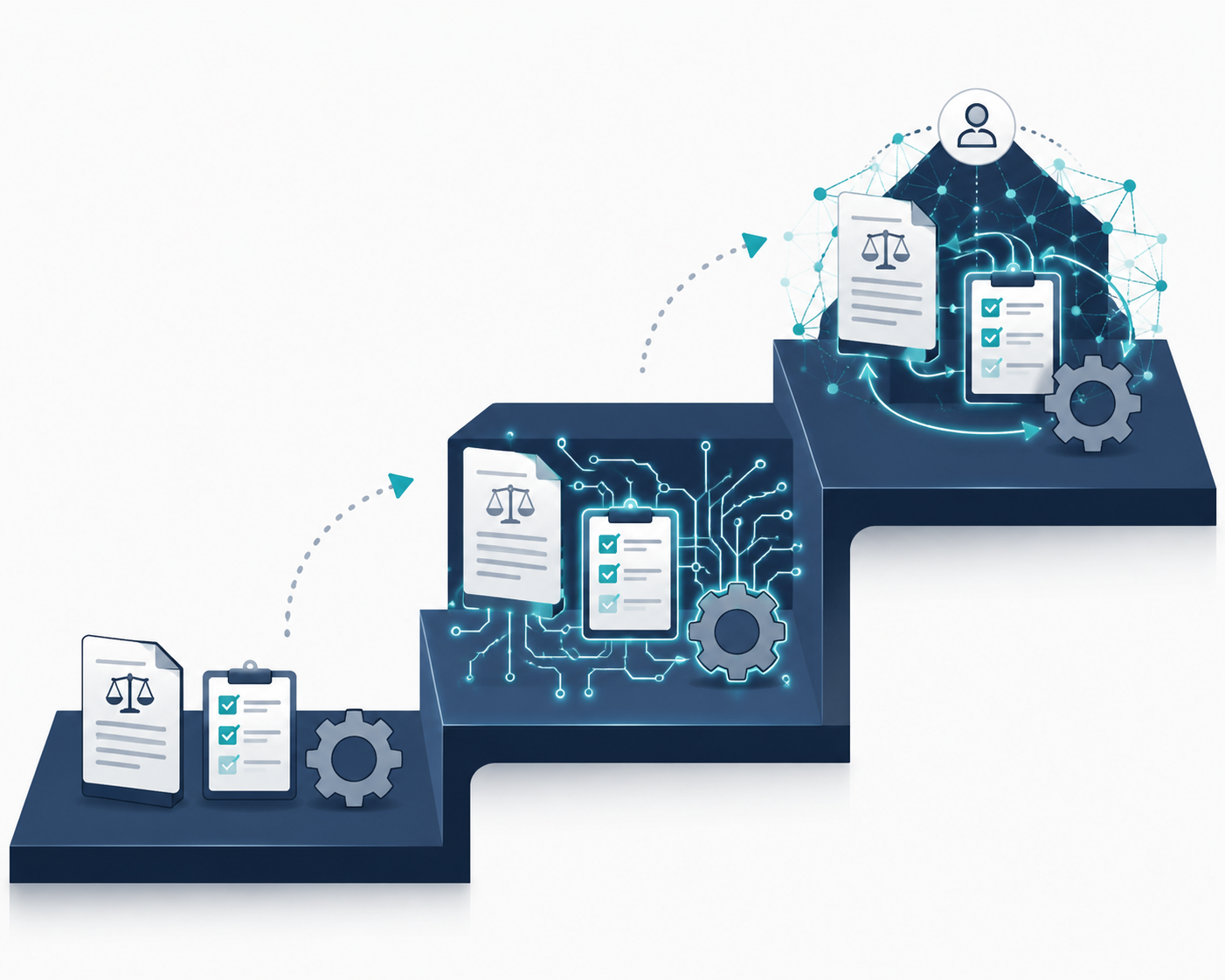
The right sequence is not to start with an autonomous agent and hope it imposes order. It is to build in three stages: first, foundational workflow automation with structured data and governance; second, AI-enhanced process layers inside those workflows; and third, agentic workflows that can execute multi-step legal tasks within clear boundaries. Most disappointing implementations are just stage three projects wearing stage one infrastructure.
The Shortcut Pattern: AI on Top of a Messy Queue
The shortcut usually starts with a real pain point: commercial teams want faster contract review, procurement wants fewer legal delays, finance wants outside counsel spend reduced, and the general counsel wants proof that AI investment is not just experimentation. Someone finds a demo where a model reads a contract, identifies risk, drafts comments, and routes next steps. The demo is elegant. The live workflow is not.
In production, the system needs to know which business unit submitted the request, whether the counterparty is strategic, which fallback positions apply, who can approve non-standard liability language, whether the agreement belongs to an existing matter, and where the final version should be stored. If that information is buried across email threads, shared drives, spreadsheets, and individual lawyer judgment, AI has not automated the workflow. It has entered an unmanaged workspace.
This is where enthusiasm and measurement often diverge. A Thomson Reuters AI report cited by DiliTrust found that only 18% of organizations collect ROI metrics around AI.[3] That does not mean the remaining organizations are getting no value. It means many cannot yet prove whether AI reduced time, errors, cycle length, rework, or outside spend. For legal ops, that is not a reporting inconvenience. It is an implementation risk.
The Three-Stage Maturity Model
Harvey, Mitratech, and Axiom all describe legal AI adoption in layered terms: establish the workflow and data foundation, pilot AI in contained use cases, measure results, and only then expand toward more autonomous execution.[4][5][6] The labels differ, but the operational logic is consistent. AI performs better when it acts inside a process that already knows its inputs, outputs, owners, escalation points, and success measures.
| Stage | What changes | Legal ops test |
|---|---|---|
| 1. Foundational workflow automation | Intake, routing, matter data, approvals, repositories, and metrics become standardized | Can the department see where work enters, who owns it, what status it is in, and how long it takes? |
| 2. AI-enhanced process layering | AI summarizes, classifies, extracts, drafts, triages, or recommends inside governed workflows | Can the team measure whether AI reduces review time, rework, errors, or outside spend without losing accountability? |
| 3. Agentic workflows | AI executes multi-step tasks across systems with human review at defined points | Is the workflow stable enough for autonomy, and are exceptions, approvals, audit trails, and ROI visible? |
The model is useful because it refuses to treat legal AI as a procurement category. It treats it as an operating sequence. A contract review workflow, an employment advice intake process, an outside counsel billing review, and a litigation hold process may all mature at different speeds. The department does not become “agentic” all at once. Individual workflows earn more autonomy as their structure improves.
Stage 1: Build the Workflow Before Asking AI to Improve It
Stage 1 is the least glamorous part of legal ops AI workflow automation and the part most likely to decide whether the later stages survive. It includes the work that makes legal service delivery legible: workflow mapping, standardized intake, matter taxonomy, approval routing, document repositories, governance rules, and baseline metrics.
Workflow mapping should not stop at a whiteboard version of the happy path. It needs to capture how requests actually arrive, which fields are missing, where lawyers ask follow-up questions, which decisions require business approval, which exceptions trigger escalation, and where final work product is stored. If the current process depends on a senior lawyer remembering that one business unit has a different risk tolerance, the workflow is not ready for autonomy. It may not even be ready for reliable AI triage.
Intake standardization is the next control point. Legal work often enters through email because email is forgiving: the requester can be vague, attach the wrong version, skip commercial context, and still expect someone in legal to interpret the need. Automated workflows are less forgiving, which is a benefit. They force the department to decide which fields are required, which choices should be dropdowns, which free-text explanations are unavoidable, and which requests should be rejected or returned before they consume lawyer time.
Matter data is where many AI plans quietly weaken. If the department cannot consistently identify matter type, business owner, jurisdiction, counterparty, risk level, value band, outside counsel involvement, and current status, it cannot reliably compare performance before and after AI. It also cannot reuse the data that later models need for classification, prioritization, and recommendation.
Approval routing is not just administrative plumbing. It is where legal risk tolerance becomes operational. A contract workflow, for example, needs to know whether a deviation from the standard indemnity position can be accepted by the responsible lawyer, requires a business owner, or must go to a senior legal approver. Without that routing logic, AI-generated recommendations may look efficient while leaving accountability vague.
Document repositories matter for the same reason. If templates, playbooks, executed agreements, negotiation histories, and policy documents live in inconsistent locations, the AI layer will either retrieve incomplete context or force humans to keep supplying it manually. A searchable, permissioned repository does not make headlines. It does, however, prevent the system from answering with confidence based on the wrong source.
Governance at this stage should be visible in the workflow itself. The requester should know what information is required. The lawyer should know what the system has done and what remains for review. The process owner should know where exceptions accumulate. Finance should know which metrics connect the system to cost avoidance or productivity. A governance memo in a folder is not enough if the actual workflow lets users bypass it.
Mitratech cites Deloitte for the claim that workflow automation alone can decrease errors by 50% and increase process efficiency by 40%.[4] Because that data point is presented second-hand in a vendor article rather than from the original Deloitte report, it should not be treated as a universal guarantee. Still, the direction is credible: even before AI, structured workflow automation can remove avoidable rekeying, missed handoffs, inconsistent approvals, and status-chasing.
For contract lifecycle management, this foundation also changes what later benchmarks mean. A department comparing AI review tools without knowing its own current turnaround time, escalation rate, fallback usage, and lawyer touch time is measuring product impressions, not operational improvement. More detailed contract-specific benchmark discussions belong in pieces such as AI for contract review adoption and governance and AI contract review accuracy benchmarks; the point here is simpler: workflow maturity determines whether those benchmarks can be used responsibly.
A Practical Stage 1 Readiness Check
- Every request type has a defined intake path, not just an email alias.
- Required matter fields are standardized enough to support reporting and routing.
- Approvals and escalation rules are embedded in the workflow rather than left to memory.
- Templates, playbooks, policies, and final documents are stored in controlled repositories.
- Baseline metrics exist for cycle time, lawyer touch time, rework, error rate, and outside spend where relevant.
Stage 2: Layer AI Into a Process That Already Has Edges
Stage 2 is where AI starts doing visible work, but not by taking over the entire matter. It summarizes, classifies, extracts, drafts, triages, compares, or recommends within a workflow that already defines where the task begins and ends.
In an intake workflow, AI might classify a request as commercial, employment, privacy, litigation, or regulatory; identify missing information; and suggest priority based on predefined criteria. In a contract workflow, it might extract governing law, liability caps, renewal terms, data processing obligations, or deviations from the playbook. In an outside counsel management workflow, it might flag billing narratives that appear inconsistent with guidelines. In a policy workflow, it might summarize changes and suggest affected internal stakeholders.
The important boundary is that AI is assisting a controlled process, not inventing one. A model can draft a fallback clause only if the playbook says which fallback is allowed for the matter type. It can recommend escalation only if escalation criteria exist. It can summarize a document only if the workflow tells the lawyer what decision the summary is supposed to support.
This stage also requires a different kind of review discipline. Human review should not mean “a lawyer rereads everything because nobody trusts the system.” It should mean the workflow identifies which outputs require legal judgment, which can be sampled for quality, which can be accepted after business confirmation, and which must be blocked until a responsible reviewer approves them. Otherwise, AI reduces drafting time but increases invisible verification time.
Axiom’s pilot framework is useful here because it treats ROI proof as part of implementation rather than a postscript: select a bounded use case, define baseline metrics, run the pilot against comparable work, and measure whether the change is worth scaling.[6] That approach is less exciting than a department-wide rollout, but it is far easier to defend to finance and risk owners.
The metrics should match the work. For a contract review workflow, useful measures may include first-pass review time, total cycle time, number of lawyer touches, percentage of matters escalated, rework after business review, deviations accepted, and outside counsel hours avoided. For intake triage, the measures may be routing accuracy, time to assignment, percentage of requests returned for missing information, and backlog age. For invoice review, they may be guideline exceptions identified, reviewer time, savings accepted, and disputes created.
Vendor ROI studies can help frame hypotheses, but they should not carry the business case alone. LexisNexis, for example, has promoted a Forrester Total Economic Impact study reporting 284% ROI for Lexis+ AI, but the study was commissioned by LexisNexis and based on interviewed customer composites rather than a blind independent sample.[7] That does not make the figure useless. It makes it a benchmark to test against the department’s own workflow, not a substitute for local measurement.
The same caution applies to adoption statistics drawn from vendor user bases. They can show what motivated early adopters are attempting, but they may overrepresent organizations that already have the budget, tolerance, and process maturity to experiment. Legal ops teams should read them as directional context, not as proof that their own department is behind.
What Stage 2 Should Prove Before Expansion
- The AI output reduces a measured step in the workflow, such as review time, routing delay, or rework.
- The department knows which outputs require lawyer approval and which can move forward with lighter review.
- Matter metadata improves rather than deteriorates as AI is introduced.
- Exceptions are captured and analyzed instead of handled privately in email.
- The ROI case is based on the department’s own baseline and post-implementation data.
Governance Is Now a Timing Constraint, Not a Later Cleanup Task
By Q3 2026, AI governance is no longer something legal teams can postpone until after experimentation. The EU AI Act’s high-risk AI obligations will apply from August 2, 2026, and the regulation includes penalties that can reach €35 million or 7% of total worldwide annual turnover, depending on the violation.[8] Not every legal ops use case will be high-risk, but the near-term compliance calendar changes the posture. Departments need to know what systems are being used, for which workflows, with what human oversight, and with what documentation.
That does not require turning every workflow automation project into a regulatory treatise. It does require an inventory of AI use cases, role-based access, documented review points, data retention rules, vendor diligence, and escalation paths for problematic outputs. Teams needing a regulation-specific plan should use an EU AI Act compliance action plan rather than treating governance as a few extra clauses in the procurement file.
Stage 3: Agentic Workflows, Once the Workflow Can Withstand Autonomy
Agentic workflows are not just AI features with a more dramatic label. In a legal ops context, they involve systems that can carry out multi-step tasks across tools: gather inputs, retrieve relevant documents, apply playbook rules, draft or revise work product, update matter status, trigger approvals, notify stakeholders, and prepare an audit trail.
That is a meaningful destination. It is also the stage most likely to expose weak foundations. If intake data is unreliable, the agent starts with the wrong facts. If playbooks are vague, it applies inconsistent judgment. If approvals are informal, it may move work forward without the right authority. If repositories are disorganized, it retrieves stale documents. If ROI is not measured, the department cannot tell whether autonomy reduced work or merely relocated it.
The cancellation risk is real enough to take seriously even though the most cited forecast comes through secondary reporting. Gartner projects that 40% of agentic AI projects will be canceled by the end of 2027 because of escalating costs or unclear business value, a forecast cited in vendor commentary from both Mitratech and Harvey.[4][5] The useful lesson is not that agentic AI is doomed. It is that unclear value and uncontrolled cost are predictable outcomes when autonomy is introduced before the workflow can measure and govern it.
The Talanx example shows what the better version can look like. Harvey reports that Talanx reduced ICT contract review from two hours to 15 minutes, cut NDA review time by 60%, and saved more than 400 external consultant hours in one year through agentic legal workflows.[5] Those numbers are compelling, but they should be read as a proof point for mature sequencing, not as a generic promise that agent deployment will produce the same result everywhere.
The value in that case is not simply that an AI system acted. It is that the work being acted on was repeatable enough to compress. ICT contract review and NDA review have recognizable documents, recurring risk issues, and measurable time baselines. External consultant hours could be counted. That is exactly the environment where agentic execution can move from demo to defensible ROI.
Measure the Work AI Removes, Not the Work It Impresses
Legal departments do not need a single universal AI ROI formula. They need workflow-level measurement that can survive scrutiny. A good ROI trail starts before implementation, captures the old process, measures the changed process, and separates adoption from effectiveness.
| Workflow | Baseline to capture | Post-AI measure |
|---|---|---|
| Contract review | First-pass review time, total cycle time, escalation rate, outside counsel hours | Time saved, rework avoided, deviations resolved, external hours reduced |
| Legal intake | Time to assignment, missing-information rate, backlog age | Routing accuracy, returned requests reduced, backlog movement |
| Invoice review | Reviewer time, guideline exceptions, savings accepted | Exceptions surfaced, review time reduced, spend avoided |
| Knowledge management | Search time, duplicate questions, policy update delay | Reusable answers, reduced repeat inquiries, faster policy distribution |
Adoption means people used the tool. Effectiveness means the workflow improved. A lawyer asking the AI assistant 200 questions in a month may indicate interest, frustration, or both. A stronger measure is whether the assistant reduced the number of manual steps, shortened the queue, improved first-pass quality, or prevented avoidable external spend.
The same distinction applies to accuracy. A model may perform well on a benchmark and still fail a department’s actual workflow if the input documents, playbooks, jurisdictions, or review standards differ. Conversely, a narrower tool may produce high value if it reliably handles one repetitive, well-governed task. Legal ops should be more interested in task fit than in broad claims of intelligence.
The Question Before “Which Agent?”
The mature question is not “Which AI agent should we deploy?” It is “Which workflow is stable, governed, measurable, and ready for AI to act inside it?”
Some workflows will only need stage 1 automation for now. That is not failure if it removes errors, clarifies ownership, and gives the department reliable data. Some will be ready for stage 2, where AI can summarize, extract, classify, draft, and recommend while lawyers retain defined review responsibility. A smaller number will be ready for stage 3, where agentic execution can take multiple steps off the table because the process is already mapped, governed, and measured.
The prize is not autonomy for its own sake. It is legal work that moves faster, creates fewer errors, gives lawyers clearer points of judgment, gives business teams more predictable service, and gives finance a defensible ROI trail. That starts with the workflow, not the demo.
References
- From Strategy to Execution, Thomson Reuters
- CLOC Releases 2025 State of the Industry Report, Corporate Legal Operations Consortium
- Legal AI ROI: How to Measure the Return on Investment of AI in Legal Departments, DiliTrust
- AI for Legal Workflow Automation, Mitratech
- The Guide to Legal Workflow Automation For Lawyers, Harvey
- How Legal Departments Can Prove ROI from AI Implementation, Axiom
- The Total Economic Impact™ Of Lexis+ AI, LexisNexis
- Regulation (EU) 2024/1689 laying down harmonised rules on artificial intelligence, EUR-Lex, July 12, 2024
Chronological incident history
No sanction cases have named this tool in the tracked record set to date. This does not imply the tool is safe — see Risk Digest for ongoing monitoring.
← Compare peer toolsReport a correction or tip
Spotted an outdated figure, a misstated fact, or a ruling this tool profile should reflect? Public comments are disabled for this content given the professional cost of a misreported case outcome, penalty amount, or rule text — use the structured correction channel instead.
Report a correction or tip for this record →