
Full profile
By the time a police-shooting use-of-force investigation reaches a civil-rights lawyer’s desk, the legal standard is usually not the mystery. Everyone knows the words from Graham: severity of the crime, immediate threat, active resistance or flight, judged from the perspective of a reasonable officer on the scene rather than with 20/20 hindsight. The harder question is what to do with this particular record, in this particular court, against this city, before this judge, with this video, this expert, this medical causation problem, and this settlement history.
That is where traditional research starts to thin out. Published opinions tell counsel how courts explain outcomes after the fact. Courthouse memory tells counsel which judges are thought to be plaintiff-friendly, defense-friendly, impatient with qualified immunity, skeptical of body-camera gaps, or reluctant to send shooting cases to juries. Neither source reliably answers the operational questions that drive a §1983 excessive-force case: how often a judge grants summary judgment in fact-heavy shooting cases, how long comparable motions sit pending, whether local settlements cluster anywhere near the current demand, and whether the other side’s lawyer has actually tried these cases or mostly settled them.
Litigation analytics does not make the Graham reasonableness inquiry mechanical. It should not be sold that way. What it can do, when the underlying coverage is verified, is force the case team to replace memory-based benchmarks with questions that can be tested against dockets, motion outcomes, settlement data, timing patterns, and counsel histories.

The Scale Problem Is Already a Data Problem
Excessive-force litigation is often discussed through individual cases: the video that goes viral, the settlement that makes the front page, the dismissal that frustrates a family, the verdict that alarms a city attorney. Those cases matter, but they are a poor denominator.
The TMI Police Funding Database records 441 publicly reported police settlements with policy-change provisions and more than $4.1 billion in compensation as of April 2026.[1] The Public Policy Institute of California reports an average of 195 fatal police shootings per year in California and cites a national estimate of about 250,000 civilian injuries annually from police use of force.[2] The University of Illinois Chicago Law Enforcement Epidemiology Project estimates roughly 800 fatal police shootings annually nationwide.[3]
Those figures do not describe the same thing. One is a public settlement database with policy-change provisions. One is a California-focused policy analysis that includes a national injury estimate. One is a national fatal-shooting estimate. Put together carefully, they show why anecdote is too small for this practice area. They do not show that every shooting case has high settlement value, that policy reform follows most cases, or that a particular jurisdiction will behave like the national picture.
The data is also incomplete in predictable ways. Public settlement databases miss confidential agreements, side payments, defense costs, insurance arrangements, and internal administrative consequences that never appear in the docket. Police misconduct data projects have expanded substantially, but even recent roundups emphasize fragmentation across sources rather than a single complete national dataset.[4] For lawyers, that incompleteness is not a reason to ignore data. It is a reason to label the dataset before treating it as a benchmark.
Where Analytics Enters the Case File
The useful starting point is not a platform demo. It is the case-evaluation memo. A shooting case already forces counsel to organize officer perception, civilian conduct, timing, distance, warnings, weapon evidence, medical causation, video, dispatch information, prior incidents, training records, and municipal policy evidence. Analytics adds a second layer: what has happened when similar procedural and evidentiary features reached similar decision points.
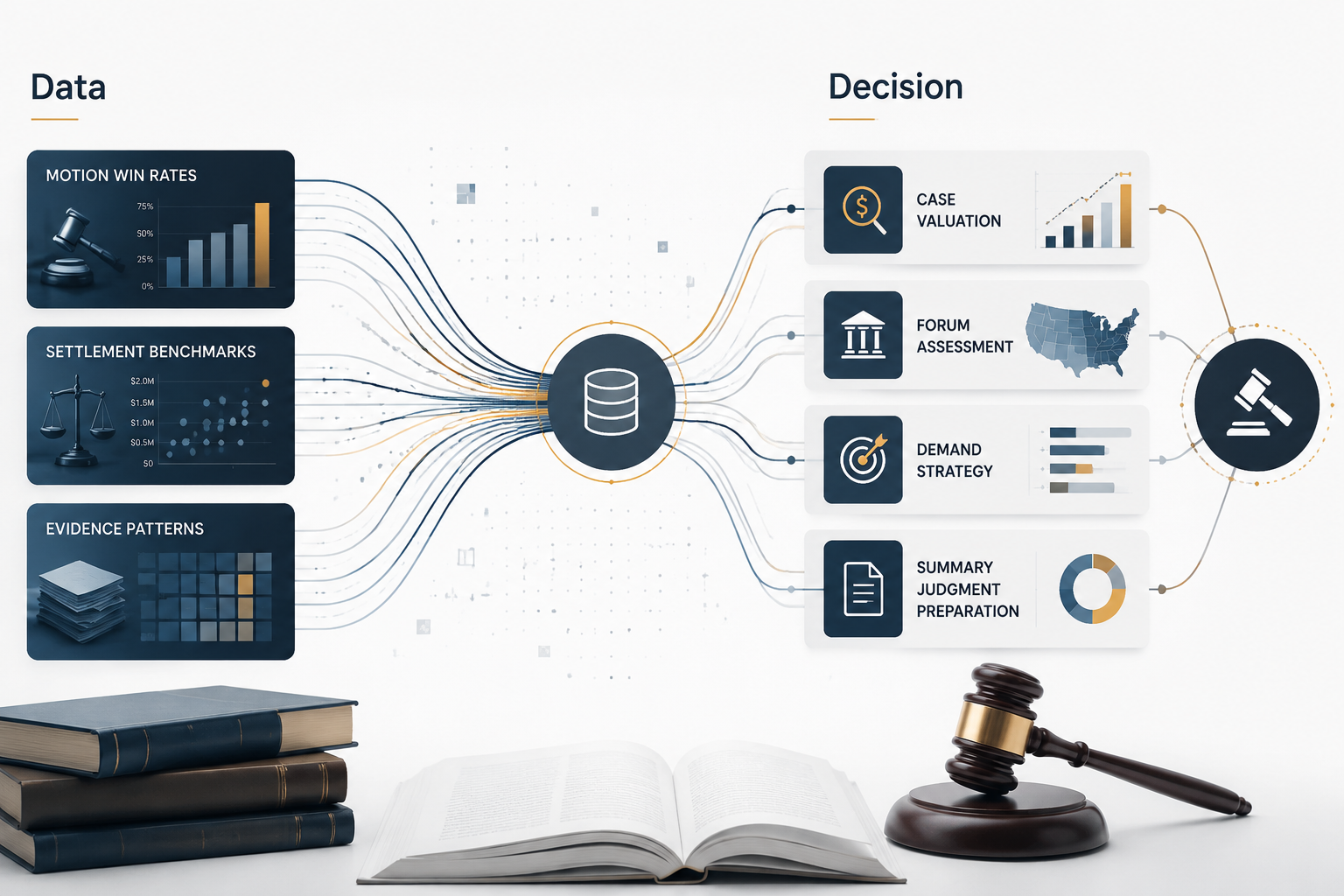
| Case decision | Analytics field worth checking | How it changes the work |
|---|---|---|
| Initial valuation | Comparable settlements, verdicts, dismissal rates, time to resolution | Tests whether the opening demand or reserve is anchored to local outcomes rather than one memorable case |
| Forum and venue assessment | Court-level and judge-level motion outcomes, removal patterns, case duration | Identifies whether a forum assumption is supported by actual procedural history |
| Demand strategy | Public settlement clusters, policy-change provisions, defense counsel history | Separates damages valuation from institutional pressure and nonmonetary relief |
| Summary judgment planning | Judge-level qualified-immunity and excessive-force motion tendencies | Helps counsel build the factual record around the decision point most likely to matter |
| Evidence strategy | Outcomes associated with body-camera video, partial recordings, expert disputes, forensic evidence | Shows whether a piece of evidence has historically clarified the case or created new factual disputes |
Large platforms now advertise broad litigation coverage. Lex Machina, for example, describes coverage of more than 27 million federal cases and more than 1,300 state courts, with fields such as judge analytics, motion outcomes, counsel analytics, timing, and damages. That scale is valuable only after one practical check: the team must confirm the platform’s actual coverage for the relevant §1983 docket, court, time period, and outcome coding before relying on it in a police shooting matter. A database that is excellent for patent, employment, or commercial disputes may still have uneven tagging for civil-rights subcategories unless the vendor confirms otherwise.
Initial Valuation: Stop Starting With the Loudest Settlement
Early valuation in a shooting case is vulnerable to two bad anchors. Plaintiffs’ counsel can over-weight the rare public settlement that combines catastrophic facts, political pressure, and a city ready to buy peace. Defense counsel can over-weight the dismissal order that treats a fast-moving threat encounter as legally obvious. Both anchors may be real. Neither is a benchmark until the case team knows how often comparable cases in the jurisdiction resolved above, below, or nowhere near that number.
A disciplined valuation pull separates at least four categories: fatal shooting cases, nonfatal firearm cases, other force cases involving serious injury, and policy-change settlements. The TMI database is especially useful for the last category because it captures publicly reported settlements with policy-change provisions, not merely compensation.[1] That distinction matters. A settlement with training, supervision, reporting, or use-of-force policy terms may not be comparable to a damages-only agreement, even if the dollar amount looks tempting in a demand letter.
The case team should then mark what the dataset cannot see. Confidential settlements may be missing. Defense costs may be outside the figure. Municipal insurance or indemnification may distort the apparent pain of the payment. A case that settled after a damaging deposition is not the same as a case that settled on the pleadings. Analytics can narrow the argument, but the lawyer still has to read the docket path.
For plaintiffs, the practical output is a demand range that can be defended without pretending the best public comparator is typical. For municipalities, the output is a reserve and settlement posture that does not depend on a deputy city attorney’s memory of what happened before a different judge five years ago. The number is not the strategy. The defensible range is.
Judge-Level Motion Data Belongs in the Summary Judgment Plan
In excessive-force cases, judge analytics is most useful when it is tied to a specific procedural risk. The question is not whether a judge is “good” or “bad” for civil-rights plaintiffs. The question is narrower: how has this judge handled qualified-immunity motions, excessive-force summary judgment motions, disputed-video records, expert-supported causation disputes, and municipal-liability claims at the stage this case is approaching?
A motion win rate without context can mislead. If a judge grants many defense motions because most cases involve weak factual records, that does not predict what happens when body-camera footage conflicts with officer testimony. If a judge denies many motions because the docket contains prisoner abuse cases, that may not transfer cleanly to street-level shootings. The useful work is classification: identify the motion type, claim type, record type, time period, and posture before treating the rate as meaningful.
Time-to-resolution data belongs in the same memo. A judge who takes months to decide summary judgment changes settlement timing, expert-cost exposure, mediation leverage, and client expectations. A city may be willing to hold a firm line if the motion will be heard quickly. A plaintiff may decide to invest more heavily in expert declarations if the case will live or die on a record the judge tends to examine closely. Timing is not glamorous analytics, but it is often the first place a case budget becomes honest.
Barnes Makes the Tracking Problem More Concrete
The Supreme Court’s 2025 decision in Barnes v. Felix gives analytics a useful test case. The Court unanimously rejected the “moment of threat” approach that had been used in several circuits and held that courts evaluating police use of force must consider the totality of the circumstances, not artificially narrow the inquiry to the instant when the officer perceived a threat.[5] FBI legal analysis described the decision as rejecting moment-of-threat doctrines in the Second, Fourth, Fifth, and Eighth Circuits, and later commentary likewise treated Barnes as a clarification of how courts should frame the reasonableness inquiry.[6][7]
Barnes does not tell a lawyer whether a particular shooting was reasonable. It changes what counsel should watch in post-2025 motion practice. In courts that previously leaned on moment-of-threat reasoning, are judges denying more motions where pre-shooting officer conduct, tactical choices, warnings, cover, distance, or escalation evidence are disputed? Are defense briefs still compressing the timeline, or are they adapting to totality language? Are plaintiffs surviving summary judgment more often when they build the record around pre-threat facts rather than only the final seconds?
Those are empirical questions before they become confident talking points. A litigation analytics workflow should tag post-Barnes cases by circuit, court, judge, motion type, disposition, and factual features. The goal is not to announce a national shift before enough decisions exist. The goal is to stop briefing as if the old circuit habit still answers the question.
Video Evidence Needs More Than a Gut Reaction
Body-camera evidence is another place where lawyers often talk from vivid experience. One lawyer remembers the video that destroyed a defense. Another remembers the recording that ended a plaintiff’s case. Both memories can be true because video evidence does not operate as a single category.
Zachary S. Zamoff’s Georgia Law Review study of excessive-force cases from 2019 and 2020 found that body-camera evidence affected litigation outcomes, and that partial videos harmed defense outcomes.[8] The date range matters. Body-camera use, public expectations, agency policies, and judicial familiarity have continued to evolve since then, so the study should not be treated as a permanent rule for every current docket. But it gives lawyers a better question than “Is there video?”
The better questions are more granular. Does the recording capture the full encounter or only the final seconds? Is there a gap at the moment commands were given? Does audio begin late? Are multiple officers’ cameras synchronized? Does the video confirm the officer’s stated perception, contradict it, or leave enough ambiguity that the judge must credit the nonmovant? Has this judge treated partial video as clarifying evidence or as a source of factual dispute?
Analytics can help by tracking outcomes associated with video type, not merely video presence. A database field that says “body camera: yes” is too blunt for serious use. A case team needs coding for complete video, partial video, disputed interpretation, missing footage, late activation, audio-only gaps, third-party video, and expert video analysis. If the platform cannot provide that level of detail, the team can build it manually for its own matter set. Messy internal coding is still better than arguing from whichever clip the lawyer remembers most clearly.
Demand Strategy Should Combine Money, Policy Terms, and Timing
Settlement analytics in police shooting cases cannot stop at dollar amounts. A high-value case may settle because liability is severe, damages are catastrophic, the defendant wants to avoid discovery into prior incidents, the city is under public pressure, or policy reforms are part of the exchange. A lower-value case may reflect litigation risk, damages problems, immunity risk, a difficult decedent profile, or a jurisdiction where public entities rarely pay early.
The TMI data is valuable precisely because it keeps policy-change settlements visible.[1] For plaintiffs, that supports a negotiation structure that distinguishes compensation from injunctive or administrative terms. For municipal defendants, it forces an early conversation about which nonmonetary terms are legally available, operationally realistic, politically acceptable, and worth trading for monetary certainty.
A good demand memo should therefore show at least three bands: damages-only comparators, settlements with policy-change provisions, and cases that resolved only after major dispositive-motion events. If those bands are unavailable in a commercial platform, public databases and manual docket review can still establish a floor. The point is not to make settlement scientific. It is to make the negotiation less hostage to selective memory.
Opposing Counsel Data Is Useful, but Easy to Overread
Counsel analytics can answer mundane questions that matter. Has this plaintiff’s lawyer taken police shooting cases through expert discovery? Has the municipal defense team tried excessive-force cases or settled before pretrial conference? Does outside counsel file early qualified-immunity motions as a default move, or only after building a factual record? Does the lawyer stipulate to protective orders quickly, fight Monell discovery aggressively, or use mediation before summary judgment?
Those patterns can affect calendar, staffing, discovery sequencing, and settlement posture. They should not become amateur psychology. A lawyer’s past settlement rate may reflect client instructions, insurance structures, city council approval rules, judge assignment, or case mix. Opposing counsel data is strongest when used to prepare for behavior, not to assign motive.
A Practical Workflow for a New Shooting Case
The cleanest use of analytics is early and iterative. Waiting until the summary judgment brief is half-written wastes the tool. By then, the discovery record may already be missing the facts that judge-level patterns made predictable.
- Define the case subtype before searching: fatal shooting, nonfatal shooting, vehicle-related shooting, mental-health call, warrant service, traffic stop, domestic call, foot pursuit, or other encounter category.
- Verify data coverage: confirm the platform’s §1983, civil-rights, court, judge, time-period, motion, and outcome coverage before treating the output as representative.
- Build the procedural map: complaint date, removal date if any, assigned judge, motion history, likely dispositive-motion window, discovery cutoff, expert deadlines, and median time to resolution for similar cases.
- Pull judge-specific motion history: excessive force, qualified immunity, municipal liability, evidentiary disputes involving video, and summary judgment rulings with disputed facts.
- Separate settlement comparators: damages-only cases, policy-change settlements, post-motion settlements, verdicts, and dismissals.
- Code the evidence: complete body-camera footage, partial footage, missing footage, third-party video, forensic evidence, radio traffic, dispatch notes, medical evidence, and expert reconstruction.
- Revisit after each record event: key deposition, video ruling, expert disclosure, Monell discovery order, mediation, and dispositive-motion filing.
This workflow is not limited to plaintiffs. Municipal defense teams should be doing the same work, especially where elected officials, insurers, risk managers, and police leadership all need different parts of the answer. A city attorney may care about immunity odds. A risk manager may care about reserve range. Police leadership may care about policy terms. Outside counsel may care about motion timing. The same analytics pull can inform all four, if the memo is written in decision language rather than platform language.
What Not to Let the Dashboard Decide
The biggest mistake is treating analytics as a prediction engine for constitutional reasonableness. Graham still depends on what the officer knew, what the civilian did, what the record shows, what a reasonable jury could infer, and how the court frames disputed facts. A dashboard cannot watch a witness hesitate at deposition. It cannot decide whether an expert’s reconstruction will survive Daubert. It cannot know whether a family’s damages evidence will move a jury or whether a city council will approve a settlement with policy terms.
The second mistake is treating incomplete data as neutral. Public settlement data undercounts confidential outcomes. Platform coverage may be uneven by jurisdiction and claim type. Outcome coding may collapse important distinctions, such as a partial grant of summary judgment that dismisses Monell but leaves the individual officer claim alive. State-law claims, indemnification rules, damages caps, notice requirements, and local approval processes may sit outside the neat federal docket fields.
The third mistake is using analytics only to confirm the story the team already likes. If the plaintiff’s case valuation depends on one famous settlement, the comparator set should test it. If the defense assumes qualified immunity will end the case, the judge’s recent record should test that too. The value is not in replacing judgment. It is in making bad assumptions easier to catch while there is still time to change discovery, motion strategy, or settlement posture.
The Narrow Promise
Litigation analytics can make police excessive-force strategy more evidence-aware. It can surface judge-level tendencies that case-law research misses. It can show whether settlement demands are floating far above local public comparators or whether municipal confidence is built on stale lore. It can help counsel track how courts apply Barnes, how they handle partial body-camera records, and how long dispositive motions actually take.
It cannot make a police shooting case clean. The data remains partial, coverage has to be verified, and the constitutional inquiry still turns on fact development and legal judgment. This article is about litigation analytics and public legal data, not legal advice for any specific case.
The useful question is not whether analytics wins excessive-force cases. The better question is whether it helps counsel ask sharper questions earlier, set more defensible demands, prepare for the judge actually assigned, and build the record the motion will require.
References
- Settlements, TMI Police Funding Database, https://policefundingdatabase.org/explore-the-database/settlements/
- Police Use of Force and Misconduct in California, Public Policy Institute of California, https://www.ppic.org/publication/police-use-of-force-and-misconduct-in-california/
- U.S. Data on Police Shootings and Violence, Law Enforcement Epidemiology Project, University of Illinois Chicago, https://policeepi.uic.edu/u-s-data-on-police-shootings-and-violence/
- Where to find data on police use of force and misconduct, Prison Policy Initiative, Jan. 26, 2026, https://www.prisonpolicy.org/blog/2026/01/26/police_misconduct/
- Barnes v. Felix, Supreme Court of the United States, 2025, https://www.supremecourt.gov/opinions/24pdf/23-1239_onjq.pdf
- Legal Spotlight: Barnes v. Felix and Use-of-Force Cases, FBI Law Enforcement Bulletin, https://leb.fbi.gov/spotlights/legal-spotlight-barnes-v-felix-and-use-of-force-cases
- Barnes v. Felix, Harvard Law Review, Vol. 139, Nov. 2025, https://harvardlawreview.org/print/vol-139/barnes-v-felix/
- Assessing the Impact of Police Body Camera Evidence on the Litigation of Excessive Force Cases, Georgia Law Review, https://www.georgialawreview.org/article/11737-assessing-the-impact-of-police-body-camera-evidence-on-the-litigation-of-excessive-force-cases
Comments
Join the discussion with an anonymous comment.