
Full profile
The Madewell sweater recall begins with a concrete consumer problem, not an abstract refund doctrine: about 5,900 women’s sweaters were recalled because they violate the mandatory federal flammability standard for clothing textiles and pose a burn hazard. The July 16, 2026 CPSC notice covers two styles, the Double V-Neck Pullover, style NT611, and the V-Neck Cardigan, style NT612, sold from December 2024 through October 2025 through Madewell, TJ Maxx, and online channels. The pullovers sold for about $138 and the cardigans for about $148. One sweater reportedly caught fire.[1]
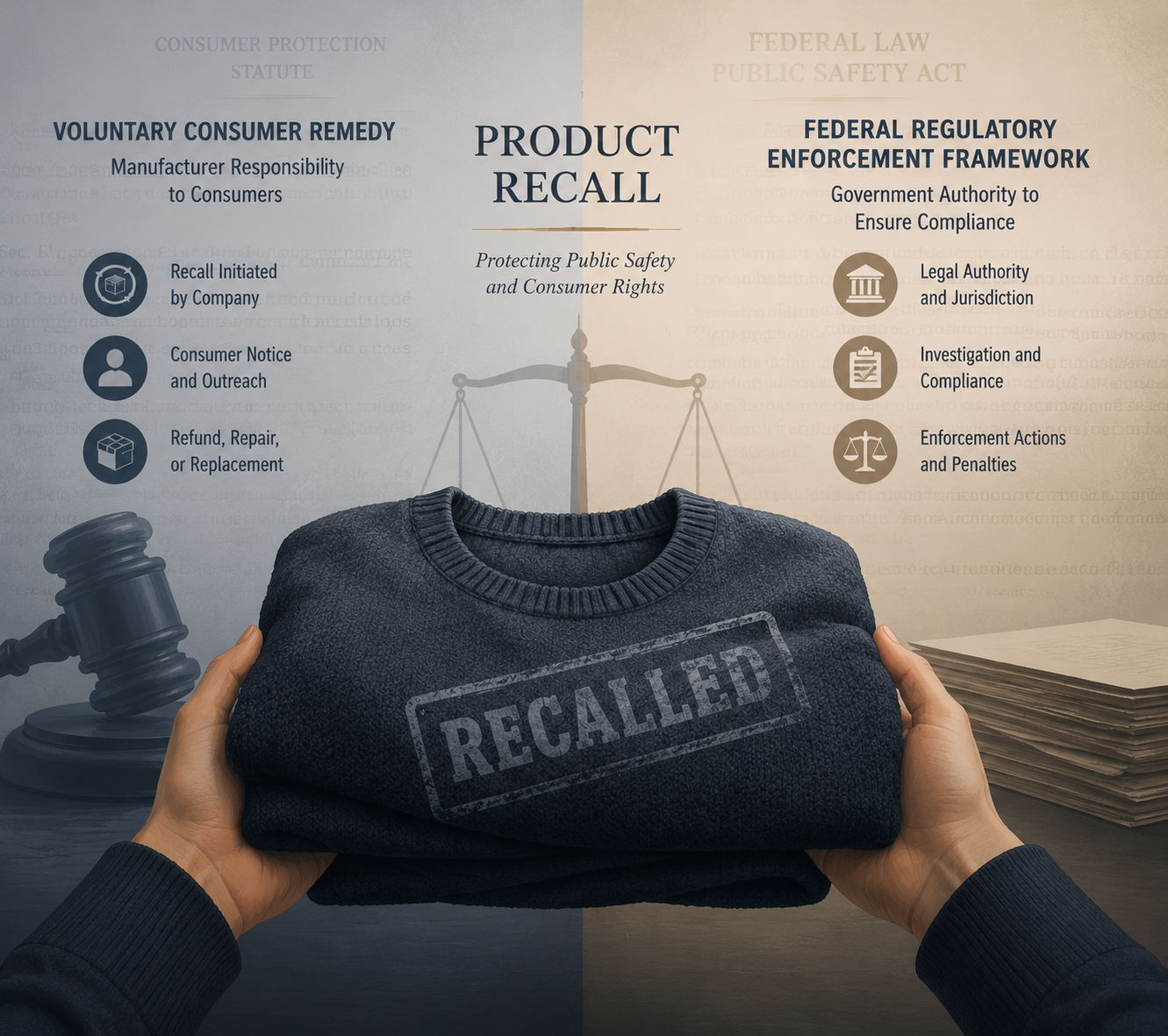
That is enough to make the recall legally serious. It is not, by itself, enough to answer the narrower consumer law question many owners will ask first: does a recalled clothing product create a statutory right to a refund?
For this recall, Madewell is offering a refund. The important distinction is where that refund comes from. It appears in the recall remedy announced for this product, not as a fixed refund formula supplied by the Flammable Fabrics Act or the Consumer Product Safety Act. Consumers can point to Madewell’s recall terms; they should be more careful about saying federal law itself guarantees this particular refund format.
What the recall notice actually promises
The CPSC notice identifies J. Crew Group LLC as the importer, Madewell Inc. as the distributor, and China as the country of manufacture. Those details matter because recalls attach responsibilities to the firms that made, imported, distributed, or sold the product; they do not need to become a story about fashion retail strategy.[1]
| Recall detail | What the notice says |
|---|---|
| CPSC recall number | 26-625 |
| Recall date | July 16, 2026 |
| Products | Madewell Double V-Neck Pullover, style NT611; Madewell V-Neck Cardigan, style NT612 |
| Units | About 5,900 |
| Sale window | December 2024 through October 2025 |
| Hazard | Violation of the mandatory clothing textile flammability standard, creating a burn hazard |
| Known incident | One confirmed incident of a sweater catching fire |
Madewell’s own recall page gives the consumer-facing mechanics. To receive the refund, consumers are instructed to cut the sweater in half and email photographic proof to [email protected]. Madewell says consumers will receive a full refund in the original form of payment or store credit.[2]
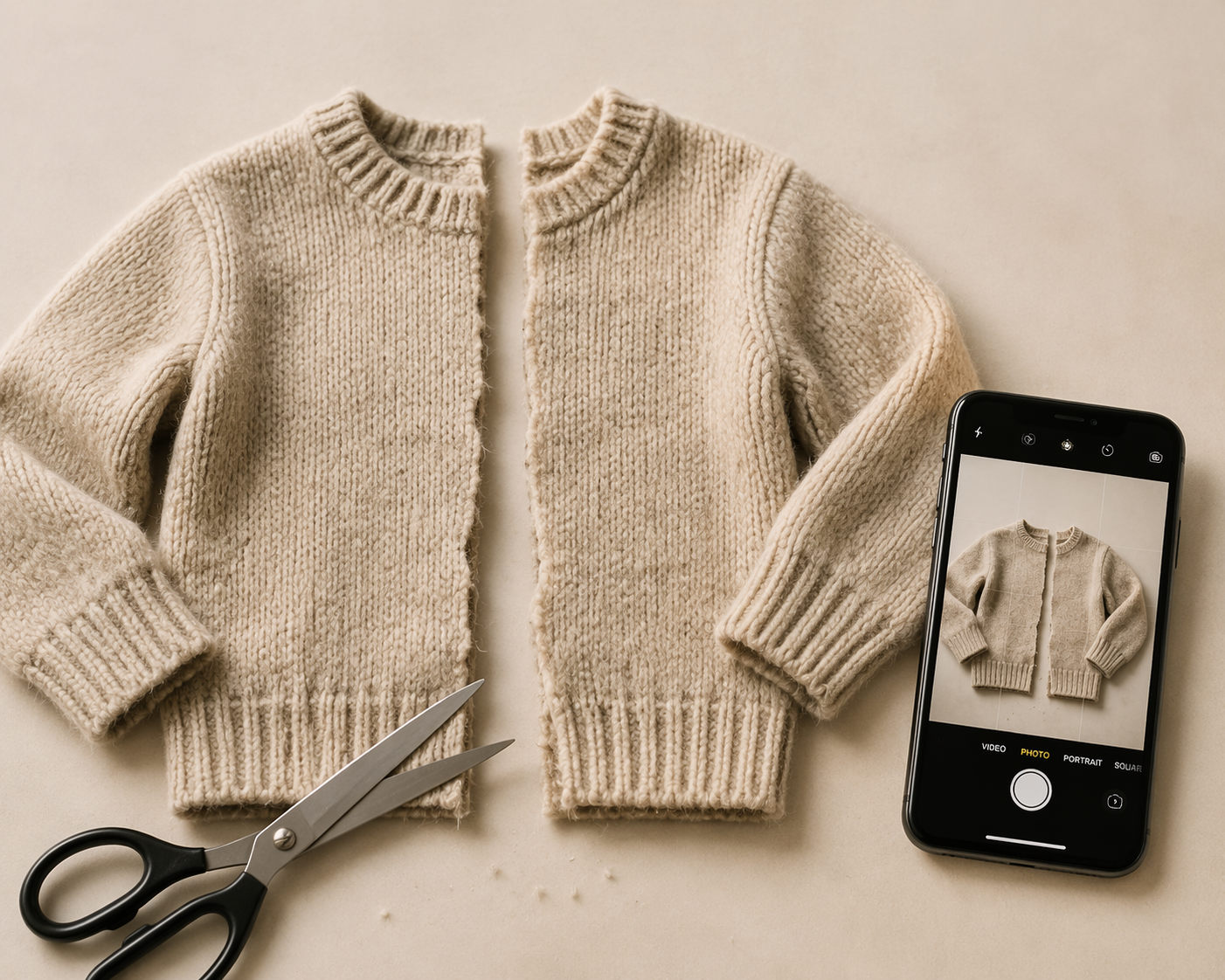
The cut-and-photo requirement is the kind of operational detail that deserves more attention than it usually gets. It is not just a quirky instruction. It is the gate between the promised remedy and the person holding the garment. A refund term is only as useful as the process a consumer can complete without losing the proof, misunderstanding the destruction step, or being routed into an unresolved customer-service exchange.
That does not make the process unlawful on the information available here. It does mean the remedy should be read as a recall procedure with conditions, not as a cash entitlement detached from the recall instructions.
The flammability violation is the legal engine
The underlying defect matters because clothing textiles are not governed only by ordinary warranty expectations. The recalled sweaters failed to comply with 16 CFR Part 1610, the federal standard for the flammability of clothing textiles. That regulation implements the Flammable Fabrics Act framework for measuring how quickly certain fabrics ignite and spread flame.[1][3]
The standard uses a class system. Class 1 textiles are considered normal flammability and generally acceptable for clothing. For plain-surface textile fabrics, Class 1 includes fabrics with a flame-spread time of 3.5 seconds or more. Class 2 applies only to raised-fiber surface textiles and reflects intermediate flammability. Class 3 textiles are dangerously flammable; for plain-surface textile fabrics, that includes fabrics with a flame-spread time of less than 3.5 seconds, and Class 3 fabrics are not suitable for clothing under the standard.[3]

That framework explains why the recall notice is not merely warning consumers that wool or knitwear can burn. The legal issue is that the sweaters failed a mandatory clothing textile standard. The confirmed fire incident gives the notice practical urgency, but the recall does not depend on proving a pattern of fires in consumers’ homes. A product can be recalled because it violates the standard and presents the regulated hazard.
There is one timing point worth keeping narrow. The current 16 CFR Part 1610 text reflects an April 22, 2024 update, and the Madewell sweaters were sold from December 2024 through October 2025.[1][3] The materials here do not establish the exact manufacturing dates for every unit, so the safer statement is that the sale window falls after that update; a more precise manufacturing-date analysis would require production records or additional compliance documentation.
A refund offered in a recall is not the same thing as a statutory refund right
The CPSC’s recall system often produces very concrete remedies: repair, replacement, refund, or other corrective action. But the agency does not describe recall remedies as one fixed entitlement that applies the same way in every product category. Its FAQ states that there is “no one-size-fits-all remedy” and that the remedy depends on the nature of the product and hazard.[4]
That point is easy to miss because the Madewell notice itself is direct: stop using the sweaters and contact Madewell for a full refund.[1] In ordinary consumer language, that sounds like a right. In legal terms, it is better described as the remedy Madewell has offered and that the recall notice communicates. Once offered through the recall, it becomes the path consumers can invoke. But the source of the particular refund mechanics—the original payment method or store credit, the destruction requirement, the proof email—is Madewell’s recall program, not a refund schedule written into the Flammable Fabrics Act.
The difference matters when advising a consumer or a retail client. If the consumer owns one of the recalled sweaters, the practical claim is straightforward: follow the recall process and seek the refund Madewell announced. If the question is whether federal law independently requires the same refund amount, same proof method, same payment channel, or same timeline in every clothing flammability recall, the provided authorities do not support that broader proposition.
Where federal enforcement enters
The absence of a universal refund formula does not mean the recall is voluntary in the casual sense. Federal consumer product safety law supplies backstops. The Flammable Fabrics Act authorizes regulation of dangerously flammable clothing textiles, and the CPSC identifies the Act as one of the statutes it administers.[5]
Once a product is recalled, the Consumer Product Safety Act also makes certain post-recall conduct unlawful. Section 19 of the CPSA, codified at 15 U.S.C. § 2068, prohibits selling, offering for sale, manufacturing for sale, distributing in commerce, or importing a consumer product that is subject to a voluntary corrective action taken in consultation with the CPSC, among other covered recall and order scenarios.[6]
For businesses, that is often the more important statutory consequence than the consumer-refund phrasing. A retailer or reseller that continues to move recalled units through commerce is not merely disappointing customers; it may be engaging in conduct the CPSA prohibits. The legal pressure is aimed at stopping distribution of the hazardous product and enforcing the recall structure.
The penalty picture is separate again. The Fashion Law’s Flammable Fabrics Act resource describes civil penalties of up to $6,000 per product and a $1.5 million maximum for a related series of violations, and notes that willful violations can trigger felony exposure including fines up to $10,000 and imprisonment for up to three years.[6] Those figures should be checked against current law and any applicable inflation adjustments before they are used in a demand letter or compliance memo, but they are enough for the basic point: the statute’s sharpest teeth are enforcement penalties, not a one-size refund rule.
What owners of the recalled sweaters can fairly claim
For an owner of the Double V-Neck Pullover or V-Neck Cardigan within the recalled styles, the immediate path is the one in the recall: stop using the sweater, cut it in half, send photographic proof to Madewell at the recall email address, and request the announced refund.[1][2] That is not legal advice about any individual claim; it is the process the company and recall notice identify.
- Strongest consumer position: Madewell publicly offered a full refund through the recall process for covered sweaters.
- Stronger regulatory position: the sweaters violated a mandatory flammability standard and are subject to a CPSC-posted recall.
- Weaker overstatement: every CPSC clothing recall automatically creates the same statutory refund entitlement.
- Unsupported leap on these materials: a sweater-related class action is already pending or damages are guaranteed.
As of July 19, 2026, the recall is three days old, and the materials provided for this article identify no class action concerning the recalled sweaters. That boundary matters. A confirmed fire incident is serious; it does not, without more, establish the filing of litigation, the existence of a certified class, or a damages model for every purchaser.
The same caution applies to broader claims about recall difficulty. Consumer groups have criticized recall remedies that are hard to obtain, and that concern is relevant when a company requires destruction and photographic proof. But for this Madewell recall, the legally useful question is more specific: whether the stated procedure is clear, accessible, honored in practice, and consistent with the corrective action communicated through the CPSC-posted notice.
The useful legal distinction
The Madewell sweater recall is a useful example of why “refund rights” in product recalls need careful wording. Consumers may be able to claim the refund Madewell offered for the recalled sweaters, and that offer is not trivial. It is the operative remedy for the person who bought or received the garment and now has to get it out of use.
The stronger statutory story, however, is not that the Flammable Fabrics Act writes a universal refund guarantee into every recalled sweater. It is that clothing textiles must comply with the federal flammability standard; products that fail that standard can become the subject of a CPSC recall; and companies that ignore recall obligations or continue prohibited sales face federal enforcement consequences. The refund is the remedy Madewell put on the table. The law is the machinery that makes the underlying flammability failure and recall compliance matter.
References
- Madewell Recalls Women’s Sweaters Due to Risk of Serious Injury or Death from Burn Hazard; Violate Mandatory Standard for Clothing Textiles, CPSC.gov, July 16, 2026, link
- Product Recall, Madewell, link
- 16 CFR Part 1610 — Standard for the Flammability of Clothing Textiles, eCFR, link
- About Us FAQ, CPSC.gov, link
- Flammable Fabrics Act, CPSC.gov, link
- Flammable Fabrics Act, The Fashion Law, link
Comments
Join the discussion with an anonymous comment.