
Full profile
No body. No weapon. No fixed crime scene. That is the legal problem at the center of the case revisited by the 48 Hours Maya Millete episode, and it is more important than the familiar missing-person packaging around it. A homicide prosecution usually wants a body to anchor death, a scene to anchor violence, and a weapon to anchor agency. In Larry Millete’s trial, the prosecution asked jurors to accept a different anchor: a dense digital timeline that made Maya Millete’s continued life after the early morning of Jan. 8, 2021, increasingly difficult to square with the record.
The load-bearing timestamp was 1:25 a.m. Maya’s phone stopped all activity then, and District Attorney investigator Peter Villaver testified that replicability testing using the same phone model and carrier confirmed that the device remained tied to the San Miguel Ranch home after that time.[1] Larry Millete’s phone, by contrast, showed no activity from 6:33 a.m. to 6:35 p.m. on Jan. 8, a 12-hour gap during the period investigators treated as critical, and they could not confirm his alibi.[1] Later, according to investigator testimony, emails and chat logs disappeared after a search warrant was served on Larry.[2]
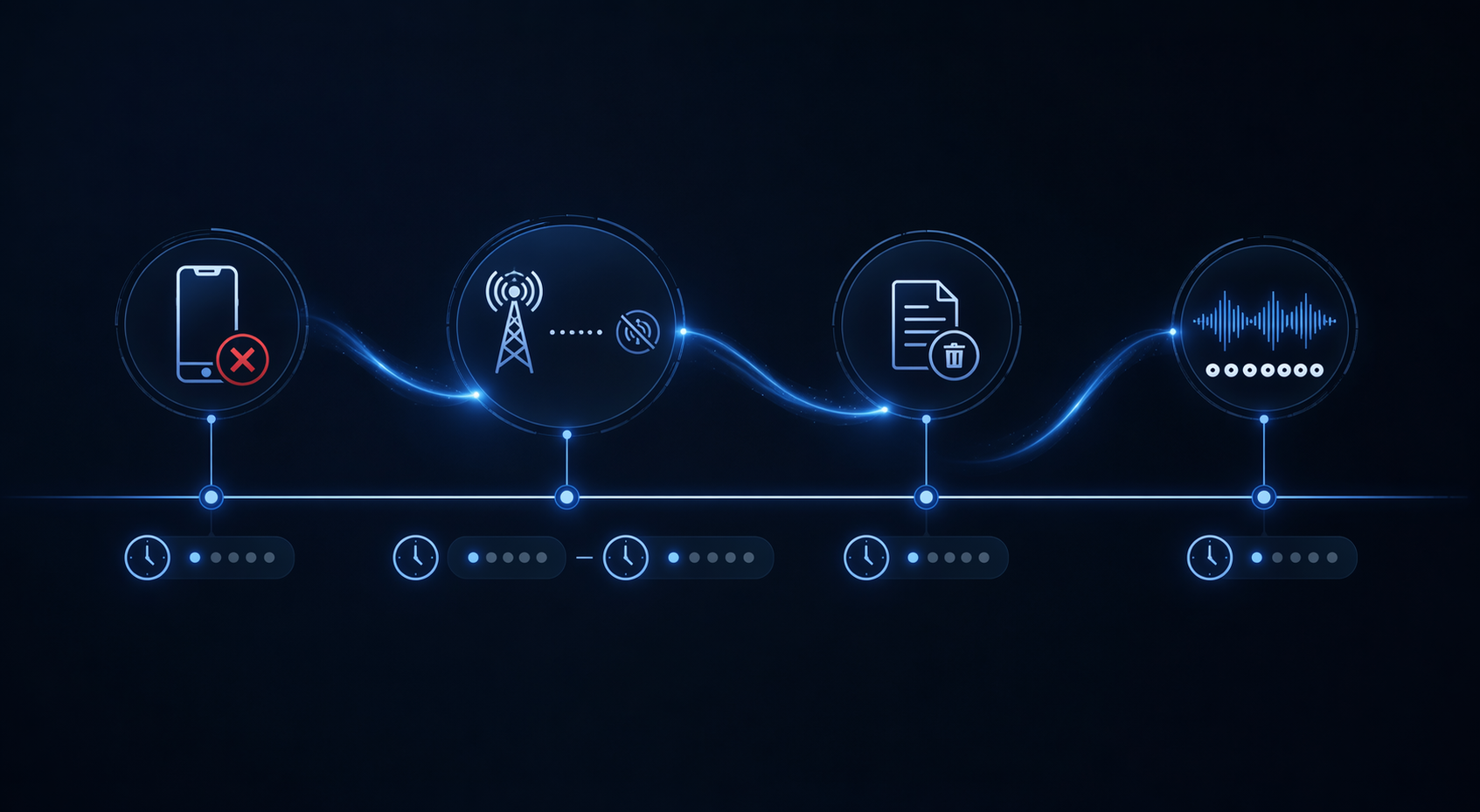
There was one piece of non-digital corroboration that mattered: an audio recording described in trial coverage as capturing eight loud bangs around 8:30 p.m.[3] That evidence had narrative force, but it was not the structure holding the case upright. The structure was the sequence: Maya’s device terminates, remains associated with the home in testing, Larry’s device goes silent for a long window, and records later disappear after law enforcement pressure becomes formal.
What the Jury Accepted on July 9
On July 9, 2026, a jury convicted Larry Millete of first-degree murder after about five hours of deliberation.[3] That date matters because the case is still young in procedural terms. As of July 19, 2026, sentencing and any appeal remain pending. The verdict tells us what this jury accepted. It does not yet tell us what reviewing courts will do with the cell-site methodology, the deletion evidence, or the way California’s corpus delicti rule was satisfied in a no-body homicide.
The prosecution did not merely argue that Larry behaved suspiciously. It used device inactivity, cell tower evidence, deleted records, surveillance mapping, and corroborating audio to build an independent account of death. That distinction is crucial. Suspicion can explain why police investigate. Corpus delicti requires something more: independent evidence that a crime occurred before a defendant’s statements or admissions can carry the case.
The spellcasting and hex-search evidence, along with domestic-violence history, belonged mostly to motive and intent. Those facts gave jurors a way to understand hostility and planning, but they were not the cleanest answer to the missing-body problem. A search history can be ugly without proving death. A phone that stops forever at 1:25 a.m., in the setting prosecutors described, does more evidentiary work.
The Digital Timeline Replaced the Usual Physical Anchors
The prosecution’s theory depended on accumulation rather than any single technological flourish. Cell-site evidence placed limits on where Maya’s phone could plausibly have been. Device inactivity narrowed the time window. Larry’s phone silence created a competing absence that prosecutors treated as incriminating. Deleted emails and chat logs became evidence of conduct after law enforcement attention sharpened. Surveillance mapping then helped investigators test movements and gaps against the geography of the case.
| Evidence Point | What It Could Prove | What It Could Not Prove Alone |
|---|---|---|
| Maya’s phone stopped activity at 1:25 a.m. | A fixed endpoint for her known digital life | The cause of death or the identity of a killer |
| Replicability testing tied the phone to the home | A location-based inference that the phone did not leave after termination | Perfect certainty about every radio-frequency variable |
| Larry’s phone had no activity for 12 hours | A suspicious absence during the critical period | What he physically did during that entire window |
| Emails and chat logs disappeared after warrant service | Possible consciousness of guilt or post-warrant conduct | Automatic proof that the deleted material was incriminating |
| Eight loud bangs were captured around 8:30 p.m. | Non-digital corroboration consistent with violence | A complete crime scene reconstruction |
That table shows why the case is legally interesting. Each item is partial. None is the body. None is the weapon. None is a room photographed as a homicide scene. But together they allowed prosecutors to argue that Maya did not simply vanish from public view; her ordinary digital existence stopped at a particular time and place, and the surrounding conduct made innocent explanations less plausible.
Device silence is always a delicate form of proof. People forget phones, batteries die, networks fail, and records can be incomplete. The prosecution’s advantage was not that phone silence is inherently damning. Its advantage was that Maya’s phone silence had a timestamp, a location theory, and follow-on evidence. Larry’s 12-hour gap had force because it sat beside that fixed endpoint, not because inactivity by itself is a confession.

Why Corpus Delicti Was the Real Test
California’s corpus delicti rule is often reduced to a phrase, but in a no-body homicide it becomes the central gatekeeping question. CALCRIM 359 tells jurors that a defendant may not be convicted based on an out-of-court statement alone unless there is other evidence showing that the charged crime was committed; the other evidence may be slight and need only support a reasonable inference that a crime occurred.[4]
The rule does not require the prosecution to produce a body. California’s Supreme Court said as much in People v. Manson, rejecting the idea that a killer who successfully disposes of a body is entitled to acquittal for that reason.[5] The Millete prosecution lived inside that principle. Its problem was not doctrinal permission; California law already allows no-body homicide prosecutions. Its problem was proof: could the digital record independently show that Maya was killed rather than missing, hiding, or unreachable?
The jury’s answer was yes. The independent evidence did not have to prove every element by itself before jurors considered the full case. It had to clear the corpus delicti threshold and permit a reasonable inference that a homicide occurred. The prosecution’s strongest route to that threshold was not Larry’s alleged interest in spells or the emotional deterioration of the marriage. It was the harder, less theatrical proposition that Maya’s phone ceased in a way that testing tied to the home, that Larry’s own device went dark during the key period, and that records later disappeared after warrant service.
That is why the difference between acceptance and reliability matters. The jury accepted the prosecution’s timeline. Future litigants will ask whether each technical step was reliable enough, documented enough, and reproducible enough to justify the weight placed on it.
The Defense Attacks Were Technical, Not Cosmetic
The defense did not have to prove where Maya went. In a case like this, the defense’s cleanest work is to make the inference chain look less like a chain and more like a set of adjacent assumptions. Cross-examination attacked the cell tower methodology by pointing to the unknown operating system on Maya’s phone, possible antenna differences between the test phone and the actual device, potential tower configuration changes over the seven months between the disappearance and testing, and topography that could affect signal behavior.[1]
Those points are not technical trivia. The phrase “same phone model and carrier” sounds comforting, but cell-site work depends on more than the retail name of a handset and the company on the bill. Operating-system behavior can influence how a device interacts with networks. Antenna characteristics can vary. Tower sectors and configurations can change. Terrain can make a neat map less neat in the field. If replicability testing is going to substitute for physical evidence, the replication has to be treated as an experiment with variables, not as a courtroom animation with a badge.
The defense lost this argument at trial. That does not make the argument frivolous. It identifies the appellate and future-trial risk: digital evidence can be persuasive precisely because it appears fixed, but the methods that produce the inference may rest on conditions that changed, were not measured, or were not preserved well enough for a later adversary to retest.
Deletion Evidence Helped, But Only Because of Timing
Deleted records are easy to overstate. In ordinary life, people delete messages for reasons that have nothing to do with homicide. In criminal litigation, deletion becomes more probative when timing supplies pressure. Here, investigator testimony placed the disappearance of emails and chat logs after service of a search warrant on Larry.[2] That timing gave prosecutors a cleaner argument: the deletion was not merely digital housekeeping; it occurred after formal notice that law enforcement was looking.
Even then, deletion evidence does not prove what the deleted material said unless it is recovered or otherwise established. Its strongest role is conduct evidence. It can support an inference that the defendant understood the evidentiary significance of the records, especially when paired with a timeline that already suggests death. It is an accelerant, not the foundation.
This distinction matters for future prosecutions. If deletion is presented as consciousness of guilt, the record should make clear what was deleted, when deletion occurred, who had access, what preservation notices or warrants existed, and whether the content or metadata was recovered elsewhere. Without that sequencing, deletion can look more dramatic than probative.
No-Body Homicide Was Not Invented by This Case
The Millete case fits within an older no-body homicide tradition. An FBI Law Enforcement Bulletin article published in 2016 described a BAU database of more than 660 no-body homicide prosecutions in the United States, including more than 477 since 1995.[6] Those figures are useful context, but they should not be inflated into current trend proof. The article drew on earlier work, including a 2012 symposium, and the total number today is likely higher without that source itself establishing the current count.[6]
What feels contemporary in Millete is not the absence of a body. It is the way the substitute body of proof was assembled. The investigation reportedly involved 67 search warrants and 87 interviews before Larry was charged in October 2021.[7] That scale matters, but the case did not turn on scale alone. It turned on whether thousands of investigative acts could be reduced to a trial record that answered one question: what independent evidence shows Maya was killed?
For lawyers and forensic practitioners, that reduction is the lesson. A large digital case is not automatically a strong digital case. The evidence has to be sorted into legal functions. Some facts establish time. Some establish place. Some establish motive. Some establish consciousness of guilt. Some merely explain why investigators kept looking. The corpus delicti showing depends on keeping those functions separate enough that the court can see the independent proof.
What Future Cases Will Need to Preserve
Millete will be cited for the proposition that digital evidence can carry a no-body homicide. The safer reading is narrower: digital evidence can satisfy corpus delicti when the timeline is dense, the crucial timestamps are fixed, the location theory is tested, and non-digital corroboration is present even if limited. That is a meaningful holding in practical terms, but it is not a license to treat every phone gap as a corpse.
Future prosecutors should expect the defense to ask for the test phone specifications, operating-system information, carrier records, tower-sector documentation, drive-test or replication methodology, terrain assumptions, date gaps between the event and testing, and all known changes in network configuration. Future defense lawyers should press those points early enough to affect expert discovery, not merely closing argument. Legal technology teams handling similar evidence may want to read this case beside questions raised in AI timeline tools and complex criminal evidence, because the hardest problem is not collecting digital events; it is proving why the selected events deserve legal weight.
Discovery practice will matter as much as forensic presentation. A prosecution that relies on device records, deleted communications, and mapping work must be able to show what was extracted, what was not recovered, what assumptions were built into the timeline, and what potentially favorable gaps were disclosed. That is the same pressure point explored in AI discovery and Brady compliance in large digital cases: digital volume does not reduce constitutional obligations; it increases the number of places where an undisclosed inconsistency can hide.
The Millete verdict gives prosecutors the central answer they wanted. A jury can find homicide without a body, weapon, or crime scene when the digital record is dense enough and independently verified enough to satisfy CALCRIM 359. The case’s durability will depend on a less dramatic question: whether the cell-site testing and related forensic methods were documented with enough precision to survive the next court’s review.
References
- Cell phone evidence testimony in Larry Millete murder trial, NBC 7 San Diego
- Investigator testimony on deleted evidence in Larry Millete murder trial, NBC 7 San Diego
- Closing arguments report in Larry Millete murder trial, Times of San Diego
- California Corpus Delicti Rule: CALCRIM 359, Eisner Gorin LLP
- People v. Manson, Supreme Court of California, 1977
- No-Body Homicide Cases: A Practical Guide to Investigating, Prosecuting, and Winning Cases When the Victim Is Missing, FBI Law Enforcement Bulletin, 2016
- Disappearance of Maya Millete, Wikipedia
Comments
Join the discussion with an anonymous comment.