
Full profile
The point of the Millete investigation, for lawyers, is not simply that prosecutors secured a murder conviction without recovering a body. The more useful fact is the machinery underneath it: investigators executed 67 search warrants, interviewed 87 witnesses, and followed roughly 128 tips while building a record across consumer cloud accounts, carrier systems, vehicle data, Navy systems, and border databases.[1] That is not a single digital breakthrough. It is a warrant campaign.
That distinction matters because digital evidence tends to look cleaner in closing argument than it does in litigation. A Google return can suggest account manipulation. A cell-site chart can place a phone in a corridor of movement. A vehicle extraction can challenge an alibi. Government database hits can widen the timeline. None of those categories proves itself. Each comes with a collection method, a scope problem, an interpretation step, and a witness who has to explain why the inference is fair.

The Warrant Stack Came Before the Narrative
In a conventional body-found homicide, the physical scene often supplies the first organizing principle: location, injuries, weapon evidence, time of death, trace material. In the Millete case, the public trial record described through news coverage shows a different kind of organizing principle. The state had to make the absence of a recovered body less central by showing that multiple independent systems pointed toward the same factual sequence.
That is why the number of warrants is important, but only up to a point. Sixty-seven warrants can mean disciplined sequencing, or it can mean scattershot accumulation. The trial coverage suggests the former was at least the prosecution’s theory: Google accounts and calendars supplied behavioral and timeline artifacts; carrier records supplied phone connectivity patterns; vehicle systems supplied movement evidence; NCIS and CBP sources supplied additional device, identity, license plate, and border-related data points.[1][2]
For a prosecutor, the attraction is obvious. If no one source has to carry the whole case, weaknesses in one category can be framed as ordinary limits rather than fatal gaps. For defense counsel, the answer is just as obvious: resist the merged story. Break the campaign back into its component parts. Ask what each warrant authorized, what each provider returned, what each analyst did next, and whether the conclusion depends on an inference the witness is qualified to make.
Google Records Made Ordinary Account Behavior Look Evidentiary
The Google material is the most accessible part of the record because most jurors understand the basic vocabulary: accounts, calendars, search history, location settings, deletion. That accessibility is useful in court, but it is also dangerous. Familiarity can make a juror overread an artifact that still needs technical and behavioral context.
NBC 7 San Diego reported that DA Investigator Jose Villaver testified Larry Millete deleted one Google account 10 days after Maya disappeared, while a second account had location history set to auto-delete. Villaver described the pattern as “atypical” based on dozens of similar Google warrant returns he had reviewed.[1] That testimony does more than identify account changes. It tries to convert account administration into consciousness-of-guilt evidence.
The move is legitimate only if the steps are kept separate. First, the state has to show what happened to the account and when. Second, it has to tie the relevant account to the defendant. Third, it has to explain what the setting or deletion would do to retrievable data. Fourth, it has to justify why the timing supports an inference of concealment rather than ordinary privacy behavior, device replacement, storage cleanup, or some other benign explanation.
The same problem appears with calendar artifacts. Trial coverage reported Google Calendar entries including “Maya Moved Out” dated May 11, 2020, and notations of her store visits.[1] These entries are not just calendar entries once they enter a homicide trial. They become evidence of attention, tracking, relationship deterioration, planning, or state of mind, depending on how the sponsoring witness and lawyers frame them. The evidentiary fight is not whether Google Calendar exists. It is whether the calendar entry means what the proponent says it means.
Search history carried a similar load. FOX 5 San Diego reported testimony and exhibits concerning searches that included terms such as roofies and directions to Arizona.[3] Search terms can be powerful because they feel close to intent. But a search record still needs timestamp handling, account attribution, device context, and some explanation of whether the search was isolated, repeated, opened, acted upon, or merely returned in a broader query history.
| Google artifact | Prosecution use | Defense pressure point |
|---|---|---|
| Deleted account | Timing and possible concealment | Who controlled the account, what deletion removed, and whether the timing has benign explanations |
| Auto-delete location setting | Loss or limitation of location history | Whether the setting was manually changed, when it was enabled, and how common the setting was among users |
| Calendar entries | Relationship timeline and monitoring behavior | Authorship, context, ambiguity, and whether the entry reflects fact, belief, or private shorthand |
| Search history | Planning, intent, or consciousness of guilt | Attribution, completeness, search context, and whether the search was connected to any act |
This is where cloud evidence becomes both attractive and vulnerable. It is attractive because it preserves mundane conduct in a way people rarely anticipate. It is vulnerable because the state often wants to move quickly from “this account did this” to “this defendant meant that.” Cross-examination lives in that gap.
The Cell-Site Evidence Was the Load-Bearing Method
The cell evidence deserves more attention than the vehicle or database material because it shows the real procedural lesson of the case. Investigators did not merely receive carrier records and publish a map. According to NBC 7 San Diego’s trial coverage, Maya’s phone terminated service at 1:25 a.m. on January 8, 2021, in San Miguel Ranch and never reconnected. Larry Millete’s phone showed a roughly 12-hour connectivity gap from 6:33 a.m. to 6:35 p.m. that same day, during the claimed beach alibi period.[2]
Those are stark facts if accepted at face value. A phone that stops forever is not a body, but it is a hard event in a timeline. A long connectivity gap is not proof of murder, but it is an invitation to test the alibi against every other system. The prosecution’s problem was turning those carrier events into something more precise than a set of disconnected logs.
Villaver’s validation method is what makes this part of the case worth studying. NBC 7 reported that he purchased the same phone model, activated service with the same carrier, and drove through multiple communities to establish a “distinct profile of cell site connections.”[2] In practical terms, that is a field test designed to compare known travel with observed tower behavior, then use the pattern to evaluate disputed historical records.
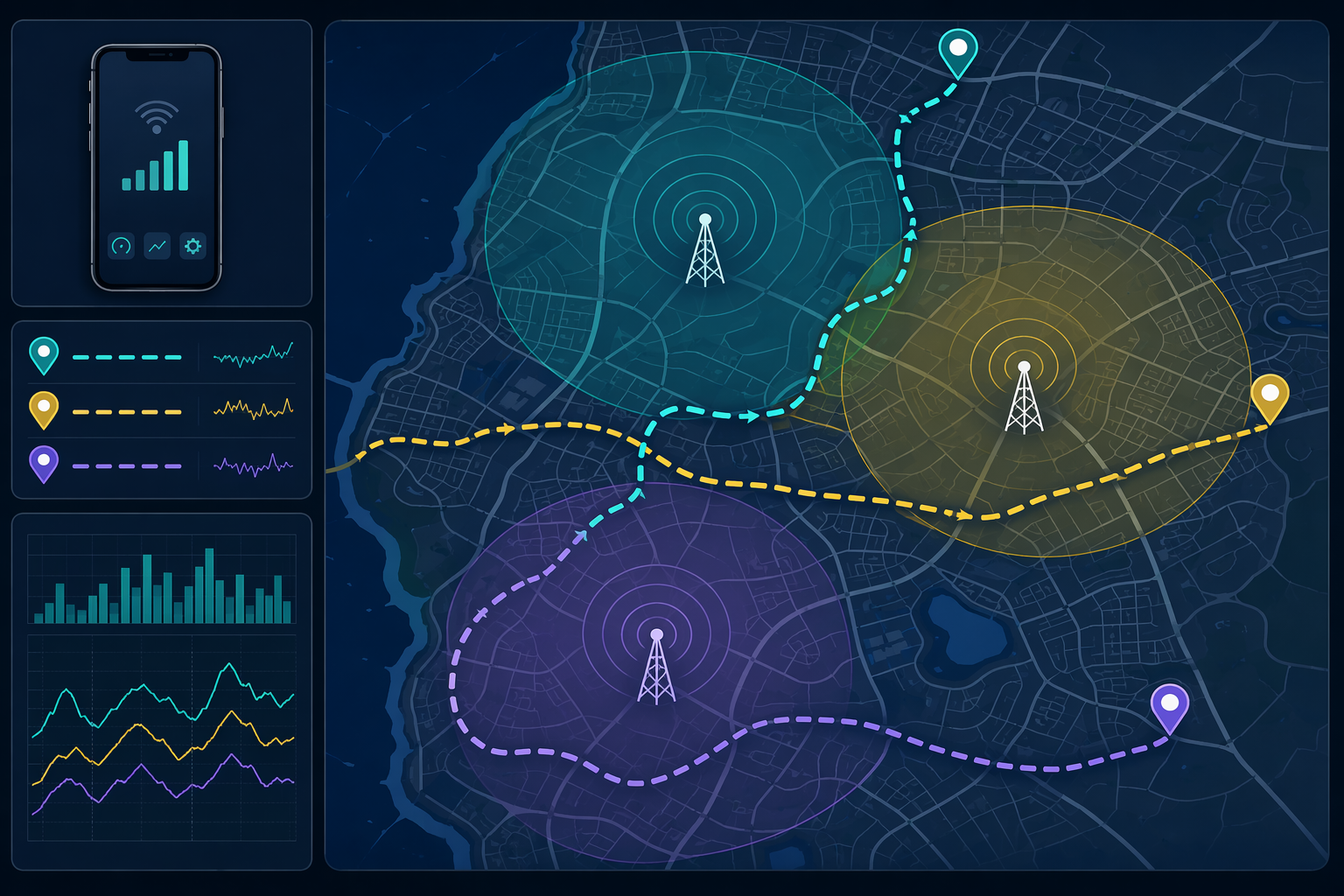
That sort of test can be persuasive because it answers a common criticism of cell-site evidence: tower records do not behave like GPS. A device may connect to a tower for reasons that include distance, load, antenna orientation, terrain, radio conditions, and network management. A drive test does not eliminate those variables, but it gives the witness a locally observed baseline instead of relying only on generalized statements about coverage.
The same feature makes it cross-examinable. The defense challenged the test over operating system differences, antenna variances between phone revisions, construction changes, and seasonal foliage that could affect tower propagation.[2] Those are not cosmetic objections. They go directly to whether the validation test actually validates the historical inference or merely creates a demonstrative comparison that looks scientific.
A serious cell-site examination would not stop at “same model, same carrier.” It would ask whether the hardware revision matched, whether the operating system and modem firmware differed, whether the SIM and plan affected provisioning, whether towers had changed between the event date and the test date, whether the test route matched the alleged route closely enough, and whether the investigator documented failed connections as carefully as successful ones. The public reporting does not resolve all of those methodological disputes; it shows that they were live issues.
That is the part litigators should not flatten. A jury may ultimately credit the pattern. The method may survive the relevant admissibility threshold. But if the state depends on a reconstructed coverage profile, the defense is entitled to attack the reconstruction, not merely complain that cell-site evidence is imperfect. The more creative the validation method, the more detailed the foundation must be.
What the Validation Test Was Trying to Prove
The important legal distinction is between a carrier record and the interpretation of that record. A carrier can authenticate business records showing that a device connected to a given cell site at a given time. The harder testimony begins when an investigator uses those records to infer a route, a zone, or the implausibility of an alibi.
In the Millete trial coverage, the validation drive appears to have served three functions. It gave jurors a way to visualize recurring tower behavior across communities. It allowed the state to compare a known test device’s movement with disputed historical records. And it gave the prosecution an answer to the expected defense argument that tower selection is too variable to support the proposed inference.[2]
Those functions are not identical. Visualization is not validation. Similarity is not identity. Rebutting a generic criticism is not the same as proving a defendant’s actual path. A careful direct examination has to keep those layers clean, because a careful cross-examination will try to show that the state slid from one layer to the next without earning it.
Where Cross-Examination Has Real Room to Work
The strongest defense attacks are usually not speeches about technology being unreliable. They are narrow questions about fit. Was the test phone truly equivalent to the historical phone? Were tower locations and sectors the same? Were new buildings present during the test but absent during the event, or the reverse? Did trees or seasonal conditions affect signal behavior? Did the investigator conduct the drive at a comparable time, under comparable network load, and with comparable device settings?
Some of those questions may have good answers. Some may not matter much in a given geography. But they are not side issues. They are the difference between a method that helps a jury understand records and a method that risks overstating what the records can bear.
Vehicle and Government Data Expanded the Frame
The vehicle evidence appears to have played a corroborating role rather than the methodological centerpiece. Available accounts describe a Lexus GX 460 infotainment extraction that revealed 444 unaccounted miles and navigation entries inconsistent with stated movements, though the most direct reporting on the exhibit was not publicly available in the same way as the NBC and FOX trial accounts. That caveat matters. A number can be widely repeated and still require exhibit-level verification before counsel treats it as settled.
As a category, vehicle infotainment data is useful because it can sit between cloud and carrier records. It may capture paired devices, navigation destinations, call logs, contacts, routes, or system events depending on the vehicle and extraction. But it also introduces its own foundation problems: who drove the vehicle, whether the system clock was reliable, whether data came from the vehicle itself or a synced device, and whether an extraction tool interpreted proprietary data correctly.
The government database material widened the investigation again. Trial coverage described NCIS digital forensic examiner Amy Voight decrypting Maya’s Navy-issued encrypted laptop and cloning the data. Available accounts also identify CBP database material, including license plate reader and border crossing logs, and military ID tracking system queries.[1] Those sources do not all answer the same question. A decrypted laptop may speak to communications or stored files. License plate readers may speak to vehicle presence. Border logs may speak to travel. Military ID systems may speak to access or movement within controlled environments.
They are valuable because they are institutionally generated and often time-stamped. They are vulnerable because institutional generation is not the same as litigation clarity. Each database has rules about what triggers an entry, what does not trigger an entry, retention limits, possible false reads, and the meaning of a missing record. Absence in one government system can be probative in the right context, but it is rarely self-explanatory.
Multi-Source Evidence Does Not End Alternative-Perpetrator Litigation
One useful interruption in the case is the third-party culpability fight. The defense sought to introduce evidence involving alternative suspect Jamey Laird under California’s People v. Hall framework. The available reporting does not provide a complete transcript-level account of how every evidentiary ruling was reasoned, so the safer lesson is procedural rather than case-specific: digital proof does not remove alternative-perpetrator litigation. It changes the terrain.
If the prosecution’s theory is built from accounts, devices, towers, vehicles, and databases, a defense alternative-perpetrator theory has to do more than name another person. It has to find admissible connections in the same kind of record or explain why the absence of those connections should not defeat the theory. Conversely, prosecutors cannot answer every alternative theory by pointing to the size of the digital record. The question remains whether the proffered evidence has the required tendency to connect another person to the crime, not whether the state’s database campaign was impressive.
The Conviction Shows Persuasion, Not Automatic Transferability
The jury deliberated for about five hours before finding Larry Millete guilty of first-degree murder on July 9, 2026.[4] That verdict is an important endpoint, but it should not be mistaken for a universal endorsement of every digital method used in the case. A verdict tells us the evidence persuaded this jury under the instructions and rulings in this trial. It does not eliminate the need to examine each category’s foundation in the next case.
The practical template is narrower and more useful. Start with a theory, but do not let the theory outrun the warrants. Use cloud records to identify behavior, settings, searches, and calendar artifacts. Use carrier records to test movement and phone activity. Validate cell-site interpretations locally when the inference matters. Use vehicle and government databases to corroborate or contradict claimed movements. Then be prepared to defend every interpretive step as its own evidentiary event.
For prosecutors, the Millete investigation shows why sequencing matters. A later warrant should not merely add volume; it should confirm, contradict, or refine what an earlier source suggested. For defense lawyers, the same sequence supplies the attack plan. Identify which source first generated the suspicion, which source supposedly validated it, and where the state filled a gap with inference rather than data.
The lesson is not that digital evidence wins bodyless homicide cases. The lesson is that digital evidence can replace some of what a body and scene ordinarily provide only when the state can explain how each warrant source was scoped, collected, validated, and defended. Cloud records, carrier logs, telematics, and government databases may converge on a compelling narrative. In court, convergence still has to be proved one source class at a time.
References
- Investigator testifies that Larry Millete deleted potential evidence – Millete murder trial Day 19, NBC 7 San Diego
- Cellphone evidence back on the stand in the Millete murder trial, NBC 7 San Diego
- Millete murder trial: Larry's Google searches for roofies and directions to Arizona, FOX 5 San Diego
- Recap: Jury finds Larry Millete guilty of 1st-degree murder, NBC 7 San Diego
Comments
Join the discussion with an anonymous comment.