
Full profile
Texas voter registration does not appear to be a self-executing bar to Mike Lindell filing for governor of Minnesota. That is the short answer. The more useful answer is narrower and less comforting for a campaign: Texas registration, a reported move to Texas, and a reported statement that Lindell was a “Texas citizen” could become evidence in a Minnesota eligibility challenge. The question is not whether the facts look politically awkward. It is whether they defeat the Minnesota constitutional and statutory tests that actually govern a candidate for governor.
This is legal analysis for information, not legal advice about any filing, challenge, or litigation strategy. The available materials also leave important gaps: the underlying Texas court filing described in press coverage was not independently reviewed here, the original Star Tribune reporting was accessed through secondary reporting, and no Minnesota court decision directly resolving this precise fact pattern appears in the research materials.
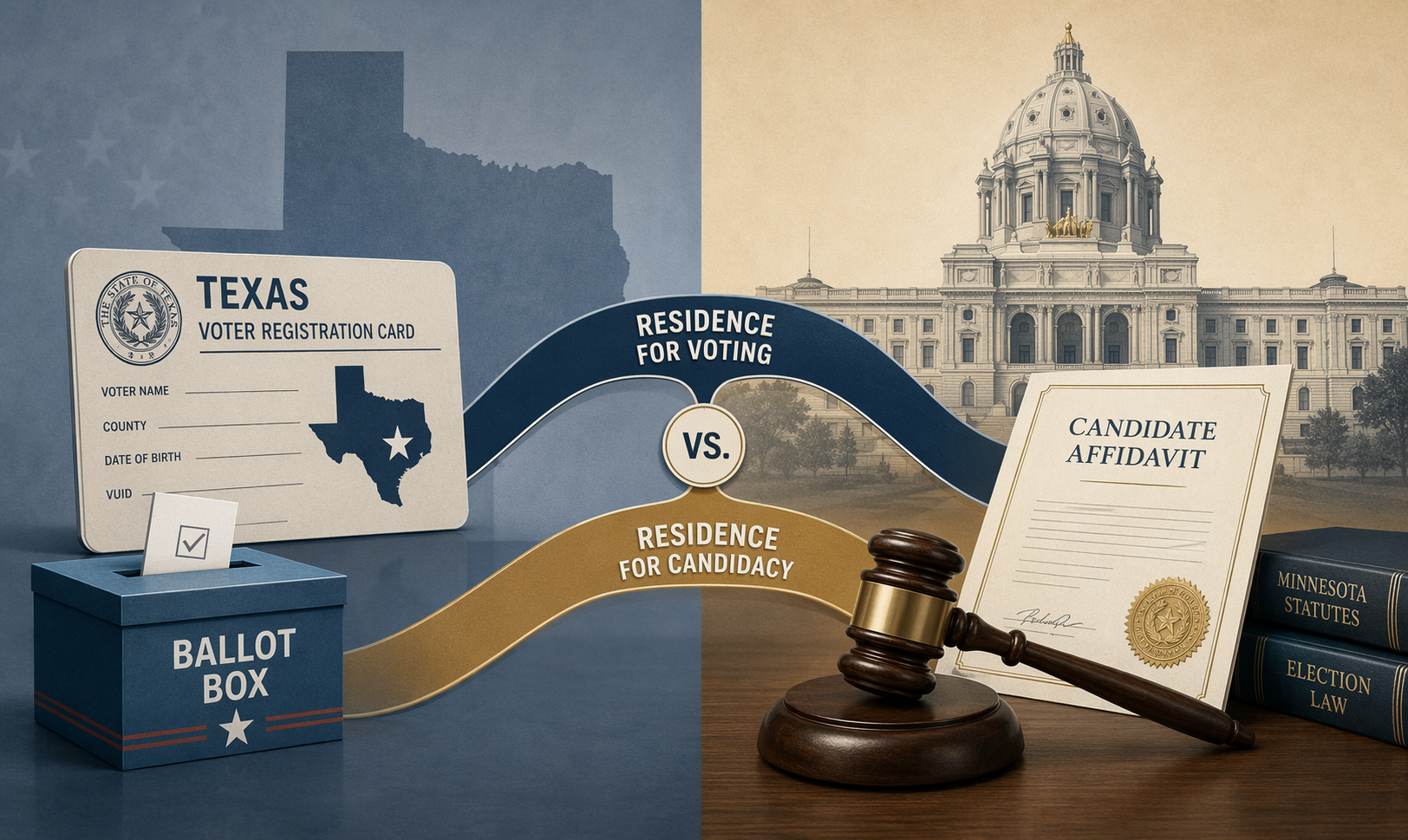
Start With The Minnesota Text, Not The Texas Label
Minnesota’s Constitution separates the voter-residence rule from the officeholder-residence rule. Article V, section 2 says that a person is entitled to vote for state executive officers if the person has been a resident of Minnesota for 30 days next preceding the election. The same section then provides that each state executive officer, including the governor, must have been “a bona fide resident of the state for one year next preceding his election.”[1]
That one-year phrase matters because it makes the general election the natural endpoint for the durational-residency inquiry. For the 2026 governor’s race, the constitutional question is not simply where Lindell was registered when the primary season began. It is whether he can truthfully satisfy, and if challenged prove, bona fide Minnesota residence for the one-year period before the November 2026 general election.
The affidavit statute uses similar timing, but with a filing-stage formulation. Minn. Stat. § 204B.06 requires an affidavit of candidacy to state that the candidate “is an eligible voter” and, for an office with a residency requirement, “will be” a resident of the relevant district or state for the required period by the general election day.[2] The statute does not say that a candidate must already have completed the full one-year period on filing day. It asks the candidate to make a forward-looking sworn statement tied to the general election.
| Question | Minnesota Source | What It Requires |
|---|---|---|
| Can the person vote? | Minn. Const. art. V, § 2 | Residence in Minnesota for 30 days before the election |
| Can the person serve as governor? | Minn. Const. art. V, § 2 | Bona fide Minnesota residence for one year before election |
| What must the candidate swear when filing? | Minn. Stat. § 204B.06 | That the candidate is an eligible voter and will meet the durational residency requirement by general election day |
That structure is why the phrase “registered in Texas” cannot do all the legal work. Minnesota’s constitutional test for governor is bona fide residence, not the location of a voter-registration record standing alone. But the record is not meaningless. A person who told Texas election officials, or a Texas court, facts inconsistent with Minnesota domicile or citizenship has created evidence. Evidence is different from automatic disqualification, but in candidate litigation it may be the difference between a routine affidavit and a factual fight.
The Reported Lindell Facts Cut In Different Legal Directions
The New York Times reported that Lindell registered to vote in Texas in early 2023, last voted in Minnesota in 2022, moved to Texas in 2024, returned to Minnesota in 2025, and had not registered to vote in Minnesota ahead of the August 2026 primary.[3] Those facts do not each have the same legal weight.
The early-2023 Texas registration is relevant because voter registration normally carries a representation about residence or voting eligibility. It is not, by itself, proof that Lindell could not later become a bona fide Minnesota resident for the required year. The last Minnesota vote in 2022 is similarly modest evidence: it may show a break in Minnesota voting activity, but voting history is not the constitutional officeholding test. The reported move to Texas in 2024 and return to Minnesota in 2025 are more important, because they go directly to continuity, intent, and the start date of any renewed Minnesota residence.
The most litigation-useful reported fact is the Daily Beast’s account that Lindell described himself as a “Texas citizen” in a 2025 court filing.[4] If accurately quoted and contextually relevant, that statement is not just a stale voter-registration artifact. It is a recent self-description in a legal filing that an opponent could place next to a Minnesota affidavit of candidacy. The immediate question would be whether the phrase was jurisdictional shorthand, careless wording, or a substantive admission inconsistent with bona fide Minnesota residence.
The reported absence of Minnesota voter registration before the August 2026 primary is weaker as a disqualification theory. Minnesota allows election-day voter registration, and the Times described that same-day mechanism as a way Lindell could register for the primary even while the Texas registration remained active.[3] That does not answer the one-year bona fide residence question. It does, however, make it harder to argue that lack of Minnesota pre-registration alone defeats the statutory statement that the candidate “is an eligible voter.”
Eligible Voter Is Not The Same Inquiry As Bona Fide Resident For Governor
The affidavit statute creates two related but distinct pressure points. First, the candidate must state that he “is an eligible voter.” Second, he must state that he “will be” a one-year resident by general election day.[2] In an ordinary filing, those statements sit quietly on the form. In a contested filing, they become statements a challenger can test against outside evidence.
An “eligible voter” attestation looks at whether the person is qualified to vote under Minnesota law. Because Minnesota has same-day registration, a person’s name missing from the Minnesota rolls before the primary is not necessarily fatal. A challenger would need more than the administrative fact of non-registration; the stronger argument would be that the candidate was not actually a Minnesota resident entitled to register and vote when the affidavit was made.
The governor-specific bona fide residency requirement is more demanding. It asks whether the candidate’s Minnesota residence is genuine for the one-year period before election. “Bona fide” is not satisfied by a mailing address if the surrounding life facts point elsewhere. Nor is it defeated automatically by a prior out-of-state registration if the candidate can show a timely and genuine return to Minnesota. The legal fight would likely be over the quality of the return: when it happened, whether it was accompanied by intent to remain, and whether inconsistent statements undercut that account.
That is where “will be” in the statute does real work. If Lindell filed before the full one-year period had elapsed, the statute’s wording appears to contemplate a candidate who has not yet completed the period but will have done so by general election day.[2] A challenger still could argue that the sworn prediction is false because the candidate’s own facts make the one-year claim impossible. But the statutory language does not read like an automatic filing-day requirement that the candidate already possess one completed year of residence.
Dual Registration Prevents A Bad Shortcut
There is a common shortcut in public discussion of these disputes: if a person is registered in two states, something unlawful must already have happened. That is too fast. The National Conference of State Legislatures distinguishes double voting from dual registration; the violation is voting more than once in the same election, not merely appearing on voter rolls in more than one state.[5]
That point should not be overstated in the other direction. Dual registration may be legally permissible in the abstract and still relevant evidence in a residency dispute. If a candidate maintains Texas registration while claiming Minnesota residence, the registration is part of the record a challenger would cite. It just does not supply the missing legal rule: “registered in Texas” is not the same as “constitutionally ineligible in Minnesota.”
What A Challenge Would Have To Prove
A serious challenge would not stop at the voter-registration screenshot. It would try to show that Lindell’s sworn Minnesota affidavit cannot be reconciled with his actual residence and legal representations during the relevant period. The strongest version would tie together a timeline: Texas registration in early 2023, a move to Texas in 2024, a 2025 statement of Texas citizenship, and an alleged return date that does not leave a full year of bona fide Minnesota residence before the 2026 general election.[3][4]
The defense would likely press the opposite distinctions. It would argue that voter registration is not conclusive of candidate residence, that same-day registration keeps the eligible-voter attestation from turning on pre-registration status, that the statute uses “will be” for the one-year requirement, and that a 2025 return to Minnesota can satisfy the constitutional clock if it occurred early enough and was genuine.[1][2][3]
On the present materials, the unknowns matter. “Returned to Minnesota in 2025” is not a legal conclusion. It needs a date and facts. Where did the candidate actually live? What address appeared on government, tax, business, court, vehicle, and campaign records? What did he do with the Texas residence? Did he take steps consistent with making Minnesota his fixed home again? None of those questions is answered by the phrase “Texas voter registration,” but all of them become relevant once that phrase is placed in a candidate-eligibility file.
The Tuberville Comparison Is Useful Only Up To A Point
The July 2026 dismissal of a lawsuit challenging Sen. Tommy Tuberville’s eligibility to run for Alabama governor is a useful caution against treating every residency allegation as judicially decisive. PBS NewsHour reported that a judge dismissed the suit on July 9, 2026, in a dispute over Tuberville’s Alabama gubernatorial eligibility.[6] The comparison is not Minnesota authority, and Alabama’s legal framework is not Minnesota’s.
Its limited value is procedural temperament, not doctrine. Courts are often reluctant to remove candidates from ballots on thin or poorly fitted theories. But reluctance is not immunity. A Minnesota court presented with a concrete statutory mechanism, a sworn affidavit, and documentary statements inconsistent with Minnesota residence would still have to apply Minnesota’s constitution and statutes. The Alabama dismissal does not answer whether a “Texas citizen” statement would matter in Minnesota; it only warns against assuming that residency disputes resolve themselves because they sound politically embarrassing.
The Better Reading: No Automatic Bar, Real Evidentiary Exposure
The cited Minnesota materials do not establish an automatic rule that active Texas voter registration blocks a Minnesota gubernatorial candidacy. The constitutional provision asks whether the governor has been a bona fide Minnesota resident for one year before election, and the filing statute asks the candidate to swear that he is an eligible voter and will satisfy the durational residence requirement by general election day.[1][2]
That conclusion should not be inflated into “the Texas registration does not matter.” It matters as evidence. It matters more when paired with a reported move to Texas and a reported legal filing describing Lindell as a Texas citizen.[3][4] If those facts are accurately reported and properly presented, they give an opponent a plausible basis to contest whether the Minnesota affidavit is true.
The central distinction is operational, not rhetorical: automatic disqualification is different from evidentiary vulnerability.
References
- Constitution of the State of Minnesota, Minnesota Revisor of Statutes.
- Minnesota Statutes 204B.06, Minnesota Revisor of Statutes.
- Mike Lindell, MyPillow Founder, Wants to Be Minnesota Governor, The New York Times, July 18, 2026.
- Trump’s Pick for Minnesota Governor Mike Lindell Still Can’t Vote for Himself, The Daily Beast.
- Double Voting, National Conference of State Legislatures.
- Judge dismisses suit challenging Sen. Tuberville’s eligibility to run for Alabama governor, PBS NewsHour, July 9, 2026.
Comments
Join the discussion with an anonymous comment.