
Full profile
The NCAA's fifth-year eligibility litigation did not begin in 2025, but that is when the current cycle started to harden into a governance problem. By Q3 2026, the fight has moved from waiver files and emergency roster decisions into state courts, federal class actions, removal disputes, and injunction orders that schools have to implement before anyone has a final appellate answer.
The promised simplification was straightforward enough on paper. On June 23, 2026, Division I adopted an age-based eligibility model that gives athletes five years to compete, beginning at initial enrollment or at age 19, with waivers largely eliminated except for pregnancy, military service, and religious missions. The rule did not retroactively restore eligibility for athletes who had exhausted eligibility by the end of the 2025-26 academic year.[1]
That last sentence is doing much of the work. For the NCAA, no retroactivity limits administrative reopenings. For athletes whose final season closed just before the new model took effect, it is the difference between a possible roster spot and a closed file. For compliance offices, it is the sort of line that looks clean in a bylaw memo and immediately becomes messy when a coach, donor, athlete, and outside counsel are all asking whether the school can safely list a player as eligible.
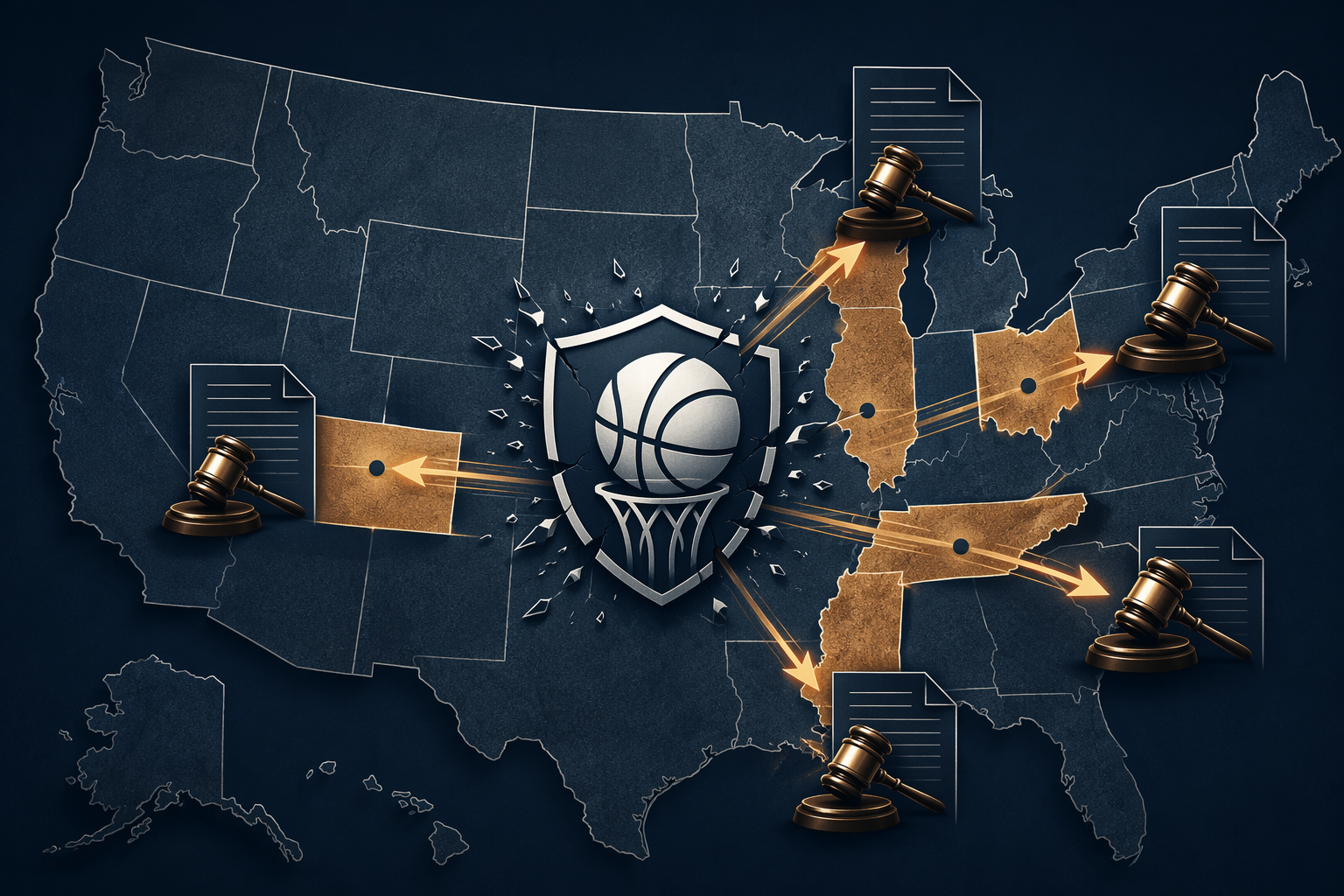
The Litigation Map Is Already Too Uneven for a Single Rule Memo
The safest count is not a single dramatic number. Morgan Lewis reported in March 2026 that more than 50 NCAA eligibility cases had been filed since November 2024, before the June 2026 age-based model was adopted.[2] Sportico later reported more than 70 eligibility lawsuits in April 2026, also before the June rule change.[3] Those figures should not be stacked as if they describe separate pools of cases. They show the same institutional condition from different reporting points: eligibility litigation was already active before the NCAA tried to replace discretionary waiver practice with a bright-line age rule.
The post-June filings matter because they attack the replacement rule itself. The current landscape is not just old waiver litigation continuing under a new label; it now includes direct challenges to the grandfathering exclusion and to the economic consequences of denying another season in a revenue-sharing era.
| Forum or Case | Main Claim Posture | Current Procedural Signal |
|---|---|---|
| Campbell v. NCAA, N.D. Illinois | Federal class action asserting Sherman Act Sections 1 and 2 theories against the age-based rule and no-retroactivity line | Filed June 25, 2026; complaint-stage litigation, with discovery and motion practice not yet resolved in the available materials |
| Colorado federal class action | Division I athletes challenge exclusion from the new five-year model | Filed by 11 athletes across multiple sports; outcome not yet reported in the available materials |
| Ohio grandfathering order | Athletes seek immediate application of the new eligibility model despite the NCAA's exclusion of 2025-26 graduates | Court ordered the NCAA to grandfather 24 basketball plaintiffs into the model |
| Mississippi Chambliss litigation | State-law challenge to NCAA waiver denial under bylaws, third-party beneficiary, and good faith theories | Preliminary injunction granted for a sixth year of eligibility |
| Tennessee Aguilar litigation | State antitrust theory under Tennessee law | Temporary restraining order dissolved after the court found the statute did not apply to nationwide NCAA rules |
That map is not a merits scorecard. A filed complaint is not an injunction. A preliminary injunction is not a final judgment. A state-law win for one athlete does not automatically become a national antitrust rule. But the NCAA does not need to lose everywhere for its uniform governance model to suffer. It needs only enough athlete-specific orders, in enough recruiting and roster windows, to make national administration conditional.
Campbell Puts the Bright-Line Rule Into Antitrust Terms
Campbell v. NCAA is the most ambitious federal framing in the available post-rule record. Filed June 25, 2026 in the Northern District of Illinois, No. 1:26-cv-07467, the proposed class action challenges the June 2026 age-based eligibility model on behalf of athletes who exhausted eligibility by spring 2026 and were excluded from the new five-year window.[4]
The complaint asserts Sherman Act Section 1 and Section 2 theories, characterizing the no-retroactivity rule as an unreasonable restraint of trade and part of monopolistic control over college athletics opportunities.[4][5] The theory is not merely that a rule is unfair. It is that eligibility limits now operate in a market where another season may carry revenue-sharing, name-image-likeness, scholarship, transfer, and professional-development consequences.
That is a more complicated claim than the soundbite version suggests. The NCAA will not be wrong to say that eligibility rules are central to organizing college competition. Plaintiffs will not be wrong to say that eligibility rules can have labor-market effects. The hard question is where a court places this specific rule: as a legitimate competition rule that rationalizes administration after years of waiver fights, or as a coordinated limit on athletes' ability to access compensation-linked opportunities.
The House settlement context raises the stakes without answering the legal question. The settlement includes a $2.8 billion damages component and permits schools to share up to $20.5 million annually with athletes, making the value of an additional season more concrete than it would have been under an older amateurism model.[9] Still, revenue context is pressure, not proof. Campbell will have to survive the ordinary antitrust work: market definition, restraint analysis, NCAA justifications, class issues, and causation.
The State-Court Orders Are Creating the Immediate Compliance Problem
Federal antitrust claims may shape the long-term law, but the near-term disruption is coming from state-court orders that tell the NCAA and schools what to do with named athletes now. The Ohio grandfathering order is the cleanest example. On July 9, 2026, a court ordered the NCAA to grandfather 24 basketball plaintiffs into the new eligibility model, with reporting describing the ruling as finding that the NCAA applied its rules in an arbitrary and capricious manner.[6]
From a campus counsel's seat, that order matters less as rhetoric than as instruction. If an athlete is grandfathered, the institution needs eligibility certification, roster treatment, scholarship administration, conference communication, and competition planning to line up quickly. If the order is later narrowed or reversed, the school still has to explain the intervening choices it made while the order was operative.
Mississippi points in the same practical direction through a different legal route. In Chambliss, a state court granted a preliminary injunction allowing a sixth year of eligibility after finding the NCAA's waiver denial unreasonable under its own bylaws and crediting state-law third-party beneficiary and implied good faith theories.[8] That is not the same as holding the NCAA liable under federal antitrust law. It is more immediate than that: the court treated the association's own rule structure and decision-making process as judicially reviewable enough to preserve a season.
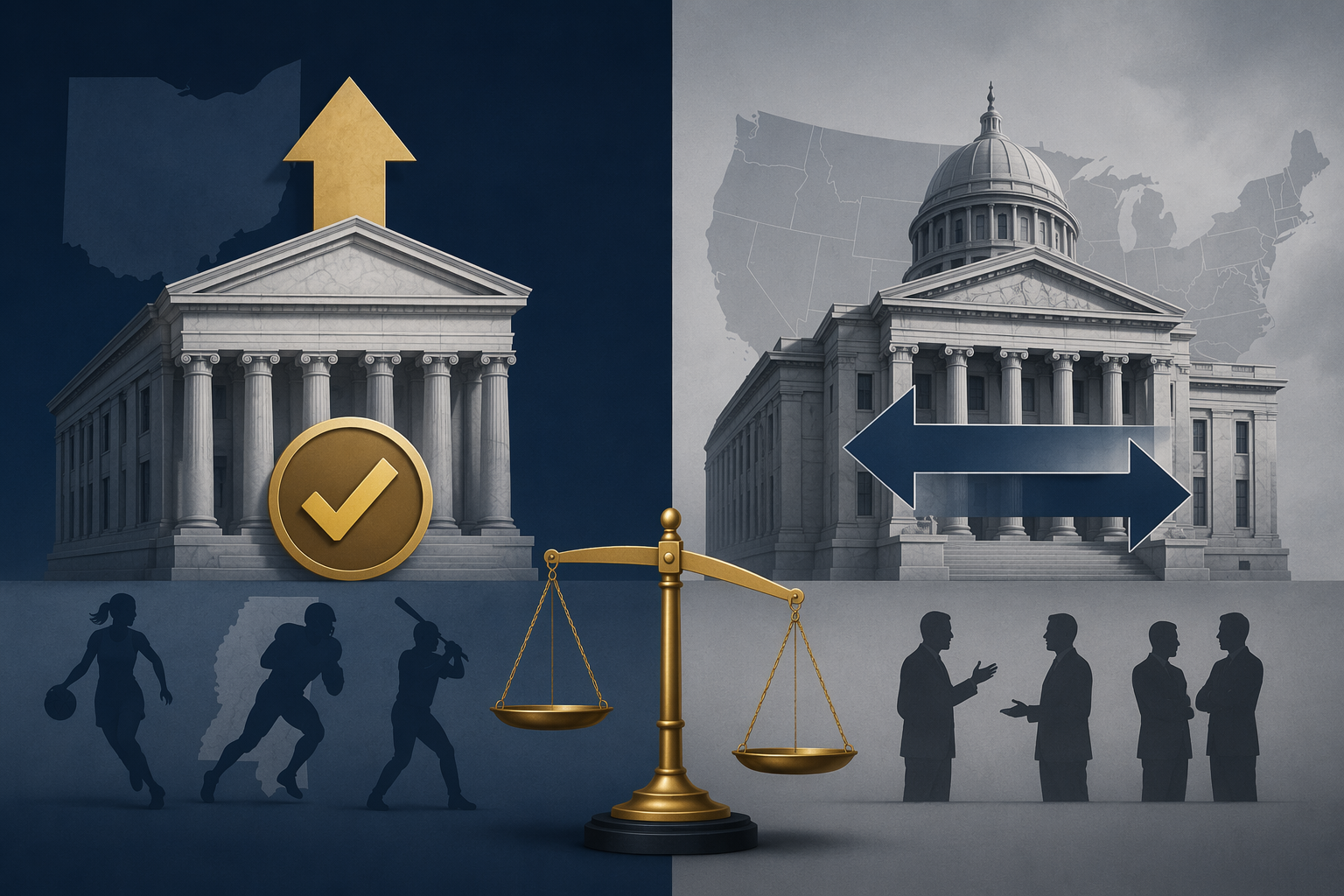
Tennessee shows the limit of that strategy. In Aguilar, the state court dissolved a temporary restraining order after concluding that Tennessee's Trade Practices Act did not apply to nationwide NCAA eligibility rules.[8] That result is a useful corrective against assuming that state courts are uniformly plaintiff-friendly or that every state antitrust statute can be stretched across a national association's rulebook.
Colorado and the Grandfathering Fight Keep the Class Question Alive
The Colorado federal class action sits between Campbell's broad antitrust architecture and the athlete-specific injunction cases. Yahoo Sports reported that 11 Division I athletes across multiple sports filed a class-action lawsuit after being excluded from the five-year eligibility model.[7] The shared grievance is the same practical one: athletes just outside the rule's effective line say the NCAA changed the system but denied them the benefit.
That posture makes class treatment attractive and difficult at the same time. The common issue is the NCAA's no-retroactivity decision. The individualized issues include sport, season timing, enrollment history, prior waiver posture, transfer decisions, scholarship availability, and whether a particular athlete can show irreparable harm before the competitive window closes.
Those details can look fussy from outside a compliance office. They are not. Eligibility is administered athlete by athlete, term by term, before games are played. A court can frame a rule as classwide and still leave schools performing individualized implementation under emergency deadlines.
Why State and Federal Outcomes Are Diverging
Morgan Lewis observed before the June rule that athletes had found more success in state court than in federal court, while the NCAA had prevailed in most eligibility cases overall.[2] That distinction still matters. The plaintiffs' story is not one of across-the-board judicial rejection of NCAA eligibility limits. It is a story of selective losses that carry outsized operational consequences because they arrive at the point of certification.
The divergence is partly about legal theory. Federal antitrust cases ask courts to evaluate restraints, markets, justifications, and competition effects. State-law cases can turn on narrower questions: whether a waiver denial followed the association's own bylaws, whether an athlete can claim third-party beneficiary status, whether good faith obligations constrain rule application, or whether a state antitrust statute reaches a national eligibility rule.
It is also about timing. A federal court managing a proposed class action may wait for briefing on dismissal, class certification, or preliminary relief. A state court facing a named athlete's expiring season may see irreparable harm in calendar terms. Once a season starts, a later damages theory is a poor substitute for actual competition.
None of this makes the NCAA's bright-line instinct irrational. Waiver-heavy eligibility systems invite inconsistent outcomes, lobbying pressure, sympathetic one-off records, and emergency filings. The problem is that a late bright line, without retroactive relief for the cohort most likely to sue, can convert administrative simplification into litigation triage.
The July 31 Deadline Turns Legal Ambiguity Into Campus Work
The waiver deadline adds the sort of bureaucratic pressure that does not always show up in headline litigation coverage. Varnum reported a July 31, 2026 deadline for institutions to preserve eligibility arguments under former rules.[9] That date gives schools very little time to decide whether to pursue old-rule preservation, new-rule arguments, litigation-backed exceptions, or some combination of all three.
For a university, the risky move is not merely choosing wrong. It is documenting the choice badly. Schools need to know which athletes are relying on pending litigation, which are covered by an actual order, which are only potential class members, which have exhausted administrative remedies, and which have no preserved argument if the NCAA later insists on strict enforcement.
- An injunction should be logged as temporary relief, not as a final eligibility determination.
- A complaint filing should not be treated as authority to compete unless a court or NCAA directive says so.
- Athlete communications should distinguish waiver preservation from litigation participation.
- Roster decisions should identify who bears the consequence if relief is narrowed after competition begins.
- Conference and NCAA communications should be retained with the same discipline as litigation hold material.
That is an unglamorous list, but it is where the governance dispute lands. Coaches want available athletes. Athletes want a season that cannot be recreated later. Compliance staff need to keep a school from turning uncertainty into an avoidable violation.
Removal Fights and Forum Selection May Become the Next Front
The state-federal split gives both sides incentives to fight over forum. Morgan Lewis noted NCAA removal efforts in the broader eligibility litigation environment, with athletes generally faring better in state court than in federal court.[2] That dynamic is likely to intensify when a plaintiff's best theory is framed around state contract, good faith, arbitrary-and-capricious, or state antitrust principles, while the NCAA sees federal court as the better place to argue national uniformity and preemption-like practical concerns.
Forum strategy is not a side issue here. It affects the remedy. A state judge focused on one athlete's disappearing season may be more willing to preserve eligibility temporarily. A federal judge managing national claims may be more reluctant to create exceptions before resolving class and merits issues. Neither posture is inherently lawless; they are different judicial responses to the same compressed calendar.
What the NCAA Has Already Lost, Even If It Wins Many Cases
The NCAA may still win many of these cases. The available materials do not support saying that courts have broadly invalidated the age-based model. They support a narrower and more important conclusion for Q3 2026: the NCAA has not achieved uniform implementation of the model at the moment implementation matters most.
Ohio produces grandfathered basketball plaintiffs. Mississippi produces a sixth-year preliminary injunction under state-law theories. Tennessee produces a dissolved TRO. Campbell and Colorado keep federal class theories alive without yet producing final merits rulings. The result is a temporary, jurisdiction-dependent eligibility environment layered over a national association rulebook.
That is the governance problem to watch, not an easy prediction about who ultimately wins. The professional questions are narrower and more useful: whether federal courts consolidate or cabin the antitrust claims; whether state-court injunctions continue to create athlete-specific exceptions; how aggressively the NCAA responds through removal and forum challenges; and whether schools preserve eligibility arguments without treating temporary orders as settled law.
References
- Division I adopts age-based eligibility model — NCAA.org, June 23, 2026.
- Recent NCAA Eligibility Rulings Highlight Expanding Judicial Role in College Athletics Governance — Morgan Lewis, March 2026.
- NCAA Eligibility Rules Spark Lawsuits, Reforms and Political Moves — Sportico, April 2026.
- NCAA hit with class action over new age-based sports eligibility rule — Reuters, June 26, 2026.
- Class Action Lawsuit Claims June 2026 NCAA Age-Based Rule Unfairly Limits Collegiate Athlete Eligibility — classaction.org.
- Judge Orders NCAA to Grandfather Athletes Into New Eligibility Model — Front Office Sports, July 9, 2026.
- 11 D-I athletes file class-action lawsuit against NCAA — Yahoo Sports, June 2026.
- One More Season: Student-Athlete Challenges to the NCAA's Eligibility Rules Continue — BakerHostetler.
- NCAA Age-Based Eligibility Rule Faces Antitrust Challenge — Varnum LLP / National Law Review.
Comments
Join the discussion with an anonymous comment.