
Full profile
In childbirth malpractice litigation, a “never maneuver” is an emergent term for an obstetric maneuver alleged to be so contraindicated that performing it falls below the standard of care in all circumstances. The phrase is useful because it focuses the standard-of-care question on conduct: what the clinician did during delivery, whether authoritative obstetric materials prohibit that act, and whether case law has treated the act as categorically unacceptable.
The caveat matters. As of Q3 2026, “never maneuver” is not a codified statutory term, not an ACOG classification, and not a formal appellate term of art. Its current legal force comes from how lawyers, experts, trial records, and some prior case authority describe particular delivery maneuvers—not from a standalone doctrine carrying its own elements.

Why the Term Became Searchable in July 2026
The phrase gained practical visibility after the July 2026 verdict in Lake v. WakeMed, a North Carolina obstetric malpractice case that ended in an $18.2 million jury verdict: $2.2 million in economic damages and $16 million in noneconomic damages. The trial lasted five weeks before Judge Winston C. Gilchrist, and a 12-person jury unanimously found negligence after evidence that a resident performed fetal vertex rotation during shoulder dystocia, resulting in a global pan-plexus avulsion of the child’s left brachial plexus—all five nerves ripped from the spinal cord.[1][2]
That is the kind of record detail that gives a term legs in malpractice research. The alleged maneuver was specific. The injury description was specific. The plaintiff’s account tied the two together. Plaintiff attorney Lisa Weinstein described the injury mechanism as “ripping a plug out of a wall,” language that is vivid but also anchored to the alleged traction-and-rotation mechanism the trial team wanted the jury to understand.[1]
The resident’s own documentation also mattered. According to the verdict coverage, the defense argued that the injury occurred in utero, before the delivery maneuver. But the resident’s charting confirmed that she performed the rotation, giving the plaintiff a documented act to test against standard-of-care testimony rather than leaving the case at the level of generalized birth trauma.[1][2]
Lake is still a jury verdict, not appellate law. It may be cited for what a jury accepted and for how plaintiffs are framing fetal vertex rotation during shoulder dystocia, but it should not be treated as if a reviewing court has adopted “never maneuver” as a rule. That distinction is not academic. A mediation memo can use the verdict as persuasive trial evidence; an appellate brief needs a different weight class of authority.
The Stronger Appellate Anchor: Michigan’s “Never Acceptable” Language
The best appellate support in the current materials does not use the exact phrase “never maneuver.” It comes from a 2018 Michigan Court of Appeals decision, COA 333135, described in plaintiff-side commentary as holding that “it is never acceptable to angle an infant’s head toward the floor when encountering a shoulder dystocia or to pull hard.”[3]
That language is legally more important than the label. It does not create a universal “never maneuver” doctrine, but it supplies appellate-level support for the narrower proposition that certain directions or degrees of traction during shoulder dystocia are not merely risky, debated, or disfavored. They are outside acceptable management.
There is also a source-hierarchy problem to keep clean. The accessible discussion of the Michigan case comes through plaintiff firm commentary, not the opinion text itself. That does not make it useless; it does mean the proposition should be attributed carefully unless the underlying appellate opinion is pulled and quoted directly in the litigation file.
The Three Maneuver Categories Now Carrying the Label
In current malpractice usage, “never maneuver” usually points to one of three obstetric conduct categories: fetal vertex rotation during shoulder dystocia, fundal pressure or the Kristeller maneuver during shoulder dystocia, and excessive or laterally directed traction on the fetal head. They are related, but they are not interchangeable. Each asks a different factual question in the record.
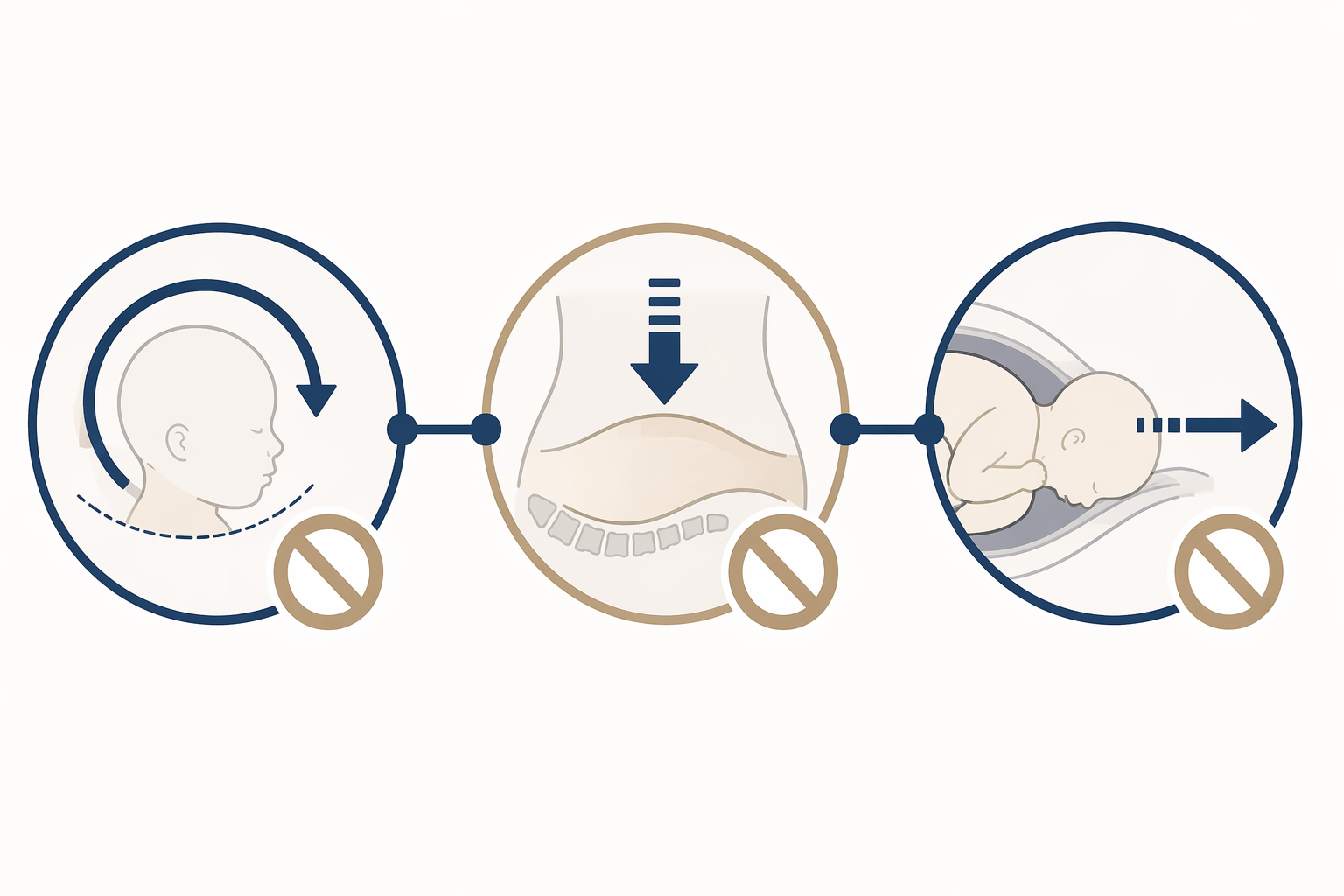
| Category | Record Question | Why It Matters Legally |
|---|---|---|
| Fetal vertex rotation | Was the fetal head rotated after shoulder dystocia was encountered? | Lake makes this the most visible current use of the “never maneuver” label. |
| Fundal pressure / Kristeller maneuver | Was downward pressure applied to the uterine fundus to force delivery? | Clinical guidance treats it as contraindicated or to be avoided in shoulder dystocia. |
| Excessive or lateral traction | Was the head pulled hard, angled downward, or pulled laterally beyond ordinary traction? | Michigan authority and obstetric literature connect this conduct to unacceptable shoulder dystocia management. |
Fetal Vertex Rotation
Fetal vertex rotation is the category most directly linked to Lake. In the delivery setting described in the verdict coverage, the alleged conduct was not simply that the resident used traction or failed to resolve shoulder dystocia quickly. The alleged “never” act was rotating the fetal head—the vertex—during shoulder dystocia, with the plaintiff connecting that rotation to a global pan-plexus brachial plexus avulsion.[1][2]
The clinical support is not limited to the verdict. An AJOG shoulder dystocia tutorial gives explicit proscriptive instructions to avoid more than usual traction, avoid laterally directed traction, and avoid torsion of the fetal head; it also discusses cadaver work indicating that torque combined with elongation force from fetal vertex rotation is the most injurious loading pattern for the brachial plexus.[4]
For case screening, that means the operative question is not “Was shoulder dystocia present?” Shoulder dystocia is the emergency context. The litigation question is whether the notes, deposition testimony, expert review, or delivery-room witnesses identify head rotation or torsion after the shoulder became impacted.
Excessive or Laterally Directed Traction
Excessive traction is the older and more familiar malpractice allegation, but the “never maneuver” framing narrows it. It is not enough to say that some traction occurred; some traction may be part of delivery. The record has to support that the force, angle, or direction crossed into hard pulling, downward angling, or lateral traction during shoulder dystocia.
That is where the Michigan appellate language is useful. The reported holding that it is never acceptable to angle the infant’s head toward the floor during shoulder dystocia or to pull hard gives lawyers a concrete formulation to compare against testimony, not a vague claim that the delivery was “rough.”[3]
The AJOG tutorial points in the same direction clinically. Its warnings against more than usual traction and laterally directed traction are not phrased as malpractice law, but they help show why a legal argument might treat particular traction patterns as categorically outside proper shoulder dystocia management.[4]
Fundal Pressure and the Kristeller Maneuver
Fundal pressure is different from traction because the force is applied externally, downward on the top of the uterus, rather than through the fetal head. In shoulder dystocia litigation, the allegation is usually that this pressure worsened the impaction instead of freeing the shoulder.
The accessible clinical materials are unusually direct. StatPearls lists fundal pressure as contraindicated in shoulder dystocia and warns that improper clinician response may become a mechanism of greater maternal and neonatal injury.[5] ACOG Practice Bulletin No. 178, reaffirmed in 2024, states that fundal pressure should be avoided because it does not help deliver the fetal shoulders and may worsen shoulder impaction or increase the risk of uterine rupture, as reflected in secondary clinical summaries of the bulletin.[6][5]
That source mix is enough to make fundal pressure a serious “never maneuver” candidate in the right case. It still needs proof. The chart may not use the words “Kristeller maneuver.” It may describe staff pushing on the mother’s abdomen, downward pressure from above, or a witness account that needs to be translated carefully into the obstetric terminology.
What the Term Does—and Does Not—Prove
A “never maneuver” theory can sharpen a malpractice case because it changes the evidentiary target. Instead of arguing broadly that the delivery was mishandled, the lawyer can ask whether a prohibited act occurred: rotation, torsion, fundal pressure, hard pulling, downward angling, or lateral traction after shoulder dystocia appeared.
But the label does not prove causation. Lake was powerful because the alleged maneuver, resident documentation, and injury description lined up in a way the jury accepted. In another case, the defense may argue that the brachial plexus injury occurred before delivery, resulted from endogenous forces, or cannot be tied to the accused maneuver. Lake itself included an in-utero injury defense theory, even though the jury rejected negligence defenses at trial.[1][2]
The label also does not replace expert analysis. Clinical literature can establish that a maneuver is contraindicated or should be avoided; malpractice law still requires proof of duty, breach, causation, and damages under the governing jurisdiction’s rules. ACOG, AJOG, WHO-aligned guidance, RCOG-style prohibitions, and StatPearls can support the standard-of-care frame, but they do not themselves create state malpractice law.
Do Not Confuse “Never Maneuver” With NQF “Never Events”
The wording invites a bad shortcut. “Never maneuver” sounds related to the National Quality Forum’s “never events” framework, but the two concepts do different work.
NQF never events classify serious reportable outcomes, including maternal death or serious injury associated with low-risk pregnancy. The focus is the outcome category. A “never maneuver” focuses on the alleged conduct during delivery. It asks whether a clinician performed a maneuver that obstetric authorities and case law treat as contraindicated, regardless of whether the injury is being discussed inside an NQF reporting taxonomy.
That distinction protects the legal argument. Calling fetal vertex rotation, fundal pressure, or excessive traction a “never event” may make a filing look imprecise. Calling it a “never maneuver,” with the Lake verdict, Michigan appellate language, and clinical guidance separated by source type, is a cleaner way to preserve the point.
Present Legal Status as of Q3 2026
As of Q3 2026, “never maneuver” is best treated as litigation shorthand, not doctrine. It is useful in intake notes, expert issue lists, mediation statements, and trial themes when the record supports one of the recognized conduct categories. It should be used with more caution in appellate briefing unless tied directly to authority that says the particular act is never acceptable.
The strongest current legal foundation is two-tiered: Lake supplies a recent, high-value trial example involving fetal vertex rotation and a catastrophic brachial plexus injury; the Michigan Court of Appeals language supplies appellate support for the narrower proposition that hard pulling or angling the infant’s head toward the floor during shoulder dystocia is never acceptable.[1][3]
The clinical foundation is broader than the legal label. AJOG supports avoiding torsion and laterally directed or excessive traction; StatPearls and ACOG-linked summaries support avoiding fundal pressure in shoulder dystocia.[4][5][6] Those sources help define the standard-of-care context. They do not convert “never maneuver” into a formal medical or legal category by themselves.
The precise definition, then, is narrow: a “never maneuver” in childbirth malpractice law is an alleged obstetric maneuver—currently most often fetal vertex rotation, fundal pressure during shoulder dystocia, or excessive/lateral traction on the fetal head—that available authority treats as categorically contraindicated and below the standard of care when performed. The phrase is persuasive when the record identifies the act. It is vulnerable when used as a substitute for proof.
References
- Grant & Eisenhofer Wins Record $18.2M Jury Verdict for Birth Injuries, Lawdragon, July 15, 2026
- How a Plaintiffs Team Went Against Conventional Wisdom to Secure $18.2M OB-GYN Med-Mal Verdict, Law.com, July 16, 2026
- Improper Obstetric Maneuvers Cause Birth Injuries, Fieger Law
- Shoulder dystocia: an evidence-based approach to training and management, American Journal of Obstetrics & Gynecology, 2024
- Shoulder Dystocia, StatPearls, 2026
- Shoulder Dystocia, American College of Obstetricians and Gynecologists, 2017
Comments
Join the discussion with an anonymous comment.