
Full profile
Three Parallel Tracks
The litigation map matters more than any headline. In the multistate case before Judge Talwani in D. Mass., the court has already entered summary judgment for 23 states and the District of Columbia, holding that the ballot-processing provisions in Executive Order 14399 exceed federal authority and conflict with the Elections Clause. In the NAACP case before Judge Sullivan in D.D.C., the D.C. Circuit has paused a nationwide injunction while appeal proceeds. In the DSCC case before Judge Nichols, preliminary relief was denied as premature. For election administrators, county counsel, and ballot vendors, the immediate issue is not who won the press cycle; it is which order is operative, where, and for how long.[1][2][3]
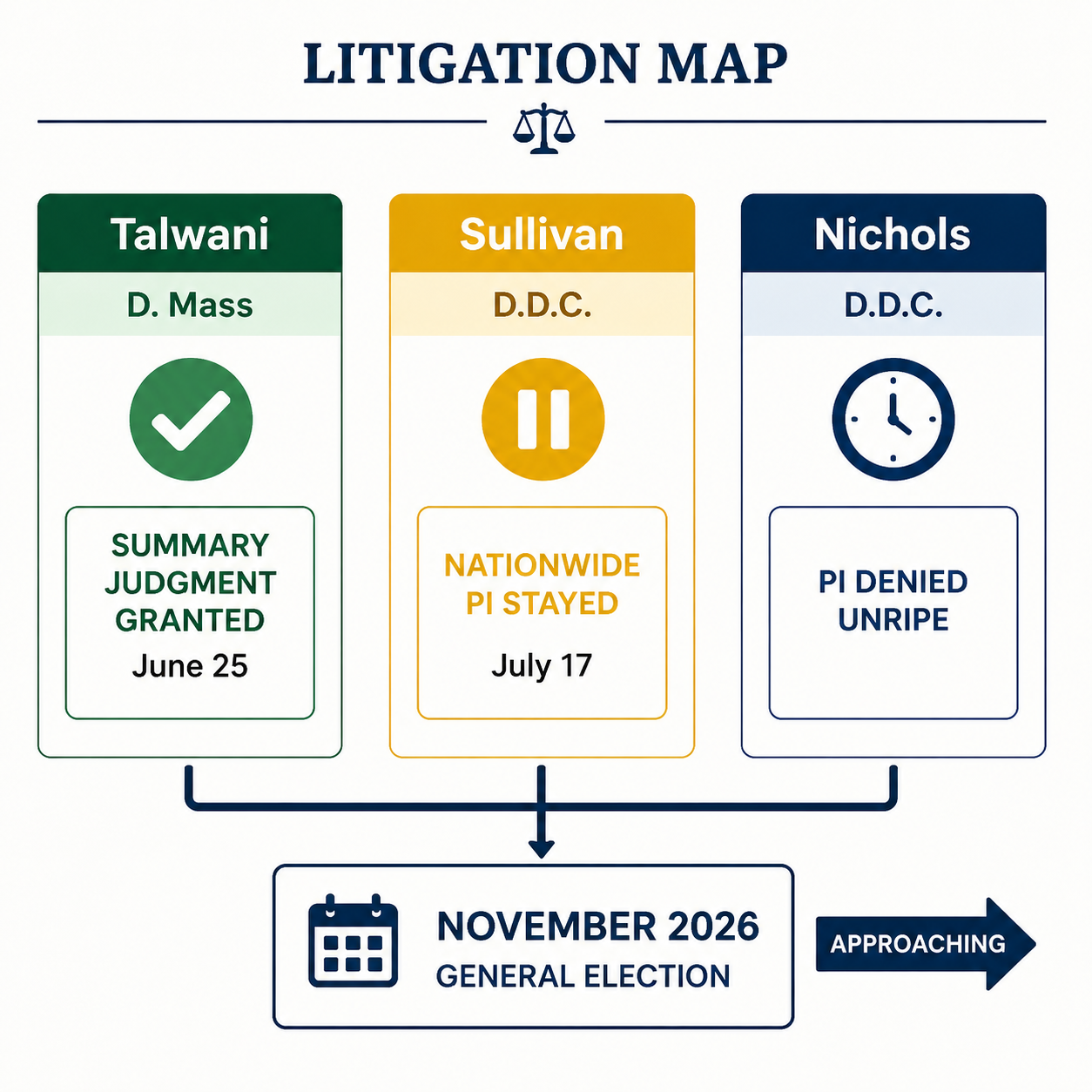
| Track | Court | Current posture | Why it matters next |
|---|---|---|---|
| Talwani | D. Mass. | Summary judgment granted to 23 states and DC; central EO provisions blocked as ultra vires and unconstitutional under the Elections Clause.[1] | Strongest merits ruling, but it binds only the plaintiff jurisdictions. |
| Sullivan | D.D.C. | Nationwide preliminary injunction stayed on July 17 while appeal proceeds; the panel found USPS likely to succeed on ripeness and settlement-scope arguments.[2] | No live nationwide block while the stay remains in place. |
| Nichols | D.D.C. | Preliminary injunction denied as premature.[3] | Confirms the same timing problem from a different docket. |
The proposed rule is still not final, which is why the docket posture keeps mattering. The Federal Register version published on June 2 would require ballot mailers to provide sender manifests that match state voter rolls, a compliance feature that turns the dispute from abstract constitutional theory into an operational question for vendors and election offices.[4]
Talwani Has the Broadest Merits Ruling
Talwani is the order practitioners will keep returning to because it actually reaches the merits. The ruling accepts the states' position that Congress did not delegate to USPS any free-standing authority to police state ballot rules, and it treats the EO's ballot-processing, SAVE-check, and state-record-sharing provisions as an intrusion on state election administration protected by the Elections Clause.[1] That makes the opinion valuable even outside the plaintiff group, because it is the only ruling in the record that squarely resolves the authority question rather than deferring it.
The practical limit is just as important. The order binds the 23 plaintiff states and the District of Columbia, not every jurisdiction in the country, so nonparties cannot treat it as a universal injunction. What it does do is give compliance teams a live merits ruling to measure against the proposed rule and against any later appellate narrowing. In a deadline-driven election calendar, that is enough to change risk allocation even before the appeal runs its course.
Sullivan Shows the Ripeness Problem
Judge Sullivan's case is moving on a very different axis. The D.C. Circuit's July 17 order did not decide the merits; it paused the nationwide injunction while the appeal is pending and signaled that USPS is likely to prevail on ripeness and settlement-scope theories.[2] The panel's focus on whether the USPS proposal is final matters because a settlement-enforcement theory can collapse if the agency action being challenged has not yet matured into a reviewable rule.
That leaves the underlying NAACP case active but procedurally unsettled. The stay does not cleanse the rule; it simply removes the nationwide block for now. For state lawyers and vendors, the result is a sharper question than the merits debate: if one court has enjoined a rule and another court of appeals says the case may not even be ripe, do you prepare for immediate compliance, hold position, or wait for the next order? The answer will depend on which jurisdiction the actor serves and which injunction, if any, is actually in force.
Nichols Confirms the Timing Problem
Judge Nichols's denial of preliminary relief in the DSCC case reinforces the same point from the other side of the country. If the rule is still proposed and the administrative record is still moving, a court may treat emergency relief as premature rather than as a vehicle for immediate nationwide control.[3][4] That is not a merits win for USPS so much as a reminder that timing can defeat relief even where the underlying constitutional argument remains live.

The Supreme Court Changed the Background, Not the Docket
Watson v. RNC removed one related dispute by holding that states may count ballots received after Election Day if they are postmarked by Election Day.[5] That does not answer the USPS ballot-rule challenges, but it does narrow the surrounding battlefield by making clear that ballot-counting rules and ballot-mailing rules are not the same problem.
Trump v. Slaughter is more structurally important. By eliminating for-cause removal protections for USPS Board of Governors members, the Court changed the independence premise that often underlies USPS rulemaking arguments.[6] Lower courts have not yet worked through how that holding interacts with Talwani's view of USPS authority, and that unresolved overlap is now part of the case law landscape whether litigants want it there or not.
USPS v. Konan matters less as a direct ballot-rule case than as a backdrop on deterrence. The Court's February decision limiting FTCA damages for intentional nondelivery of mail removes one tort route for recovering losses, which makes reliability debates harder to translate into damages leverage.[7] It does not decide the legality of the ballot rule, but it does help explain why some plaintiffs are pressing for injunctions instead of waiting for post hoc remedies.
What Still Matters Before November
The remaining operational clues are less dramatic than the headline litigation, but they are the ones election lawyers cannot ignore. Postmaster General Steiner told the Senate on June 24 that USPS would refuse ballot delivery to states that did not comply with the agency's demands and that the agency had $8.2 billion in cash, roughly 33 days of runway, at its $15 billion statutory borrowing limit.[8] That is the kind of statement that makes compliance timing, not just legal theory, immediately relevant.
The SAVE issue cuts in the same direction. Brookings pointed to a 14% error rate in one Texas county that misidentified citizens as noncitizens, which is a serious due-process warning even if it is only a single-county example and not a national average.[9] When a rule asks election offices and vendors to cross-check manifests, voter rolls, and federal databases on a compressed timetable, the legal fight stops being abstract very quickly.
The result is a split procedural map: a merits ruling in one district court, a stayed nationwide injunction in another circuit, and a third case saying the fight arrived too early. Slaughter adds a structural question that lower courts have not yet resolved. For the 2026 general election, that leaves compliance decisions tied to venue, posture, and the next appellate order.
References
- Judge Talwani grants summary judgment in multistate challenge to USPS ballot rule — Votebeat, June 25, 2026
- D.C. Circuit stays Judge Sullivan's nationwide injunction in NAACP settlement-enforcement case — Democracy Docket, July 17, 2026
- Order denying preliminary injunction in DSCC v. USPS — U.S. District Court for the District of Columbia
- Postal Service Ballot Mail Rule, Proposed Rule 2026-10968 — Federal Register, June 2, 2026
- Watson v. Republican National Committee — Supreme Court of the United States, June 29, 2026
- Trump v. Slaughter — Supreme Court of the United States, June 29, 2026
- United States Postal Service v. Konan — Supreme Court of the United States, February 2026
- Postmaster General Steiner Senate testimony on USPS ballot delivery and finances — Brookings, June 24, 2026
- Brookings analysis of SAVE error rates in one Texas county — Brookings
Comments
Join the discussion with an anonymous comment.