
Full profile
By mid-2026, the hard part of buying privacy impact assessment legal AI tools is no longer finding software that can route a questionnaire. There are plenty of platforms willing to intake answers, prefill fields, generate drafts, and produce a dashboard. The harder question is whether the resulting assessment file will help the legal team defend the decision later: why the PIA was triggered, which jurisdictions were considered, what evidence supported the risk rating, who reviewed the working papers, and whether privileged legal analysis was kept in the right lane.
That distinction matters because the market is expanding quickly. Guideflow’s June 2026 inventory describes 12 privacy impact assessment software options and cites Dataintelo’s projection that the PIA software market will grow from $314.8 million in 2025 to $1.065 billion by 2034.[1] Useful context, but not a buying answer. A growing market does not tell a legal team which tool can preserve a legal record, handle state-by-state PIA triggers, or assess an AI system whose risks include bias, hallucination, explainability gaps, data poisoning, and model theft.

The Comparison Frame Legal Teams Actually Need
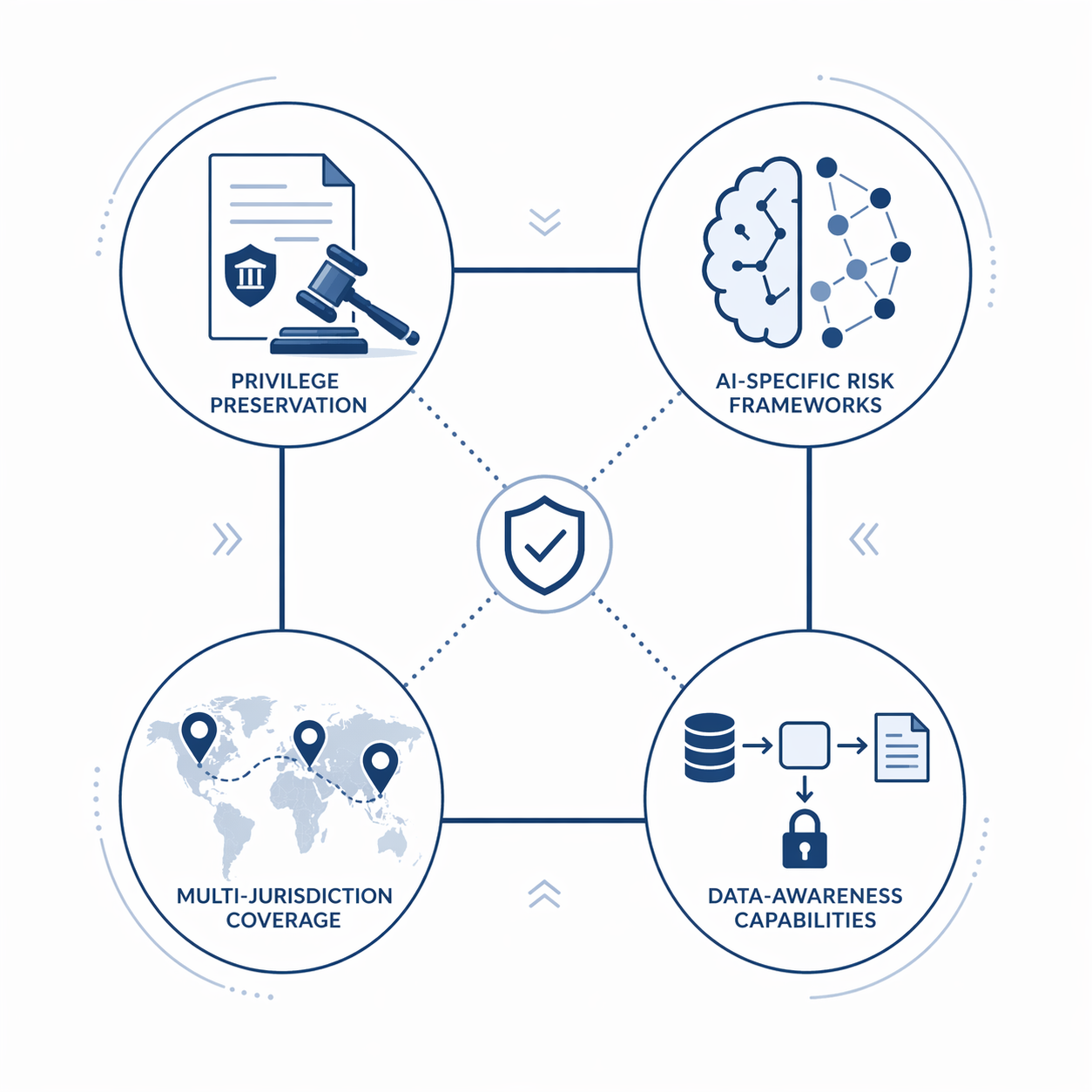
A legal team can start with the usual procurement questions — security, integrations, pricing, implementation effort, audit logs, support model — and still miss the issues that make PIA software legally useful. The comparison has to separate ordinary workflow automation from legal assessment infrastructure.
| Evaluation question | Why it matters for legal | What to look for in the tool |
|---|---|---|
| Does it support AI-specific assessment work? | An AI PIA is not just a privacy questionnaire renamed for machine learning. | Templates or workflows mapped to AI-risk frameworks, model governance, explainability, bias, hallucinations, and data-integrity risks. |
| Can it preserve privilege-sensitive work? | PIA files can contain legal analysis, risk judgments, and remediation advice. | Role-based workspaces, legal-review stages, segregated notes, export controls, privilege labels, and jurisdiction-aware process design. |
| Does it map legal triggers across jurisdictions? | State PIA and risk-assessment obligations do not use identical thresholds or terminology. | Configurable trigger logic, state-law coverage, review prompts, and evidence of legal-update maintenance. |
| Does it rely only on self-reported answers? | Business owners often describe intended data use, not actual data movement. | Data discovery, data-flow mapping, system integrations, and evidence links that can challenge or confirm questionnaire responses. |
| Can legal govern the workflow? | The value of a PIA file depends on who reviewed what, when, and under which standard. | Assignment rules, audit trails, approvals, version history, exception handling, and defensible documentation. |
Those criteria turn a vendor demo into a legal review. They also change how the tool landscape should be read. A platform that is excellent at survey routing may be a poor fit for AI governance. A data-discovery platform may produce better evidence about actual processing but still need careful legal workflow design. A free tool may impose discipline on a small team, while still leaving privilege, jurisdictional change management, and enterprise approvals mostly outside the system.
Privilege Is Not a Feature Checkbox
The most under-discussed issue in PIA software comparisons is not whether the platform can generate a report. It is whether the process around that report protects the legal team’s working papers where privilege may be available.
ArentFox Schiff’s 2023 discussion of PIAs under attorney-client privilege is useful because it does not pretend there is a universal answer. It highlights a concrete divergence: Colorado CPA Rule 8.02 recognizes that some PIA-related materials may be protected by attorney-client privilege, while the California CPRA framework treats risk assessments differently and does not provide the same simple assurance.[2] The practical lesson is narrow but important: a legal team cannot assume that placing a PIA inside a software platform makes every draft, comment, and risk judgment privileged.
This is where generic automation can create a bad file faster. If the business owner completes an intake, the privacy team comments inside the same shared thread, outside counsel adds legal analysis, and the platform exports everything as one operational report, the tool may have improved speed while blurring the distinction between factual collection and legal advice. Whether privilege applies will depend on jurisdiction, purpose, participants, confidentiality controls, and the actual content of the communications. Software cannot solve that by placing a shield icon next to the word “legal.”
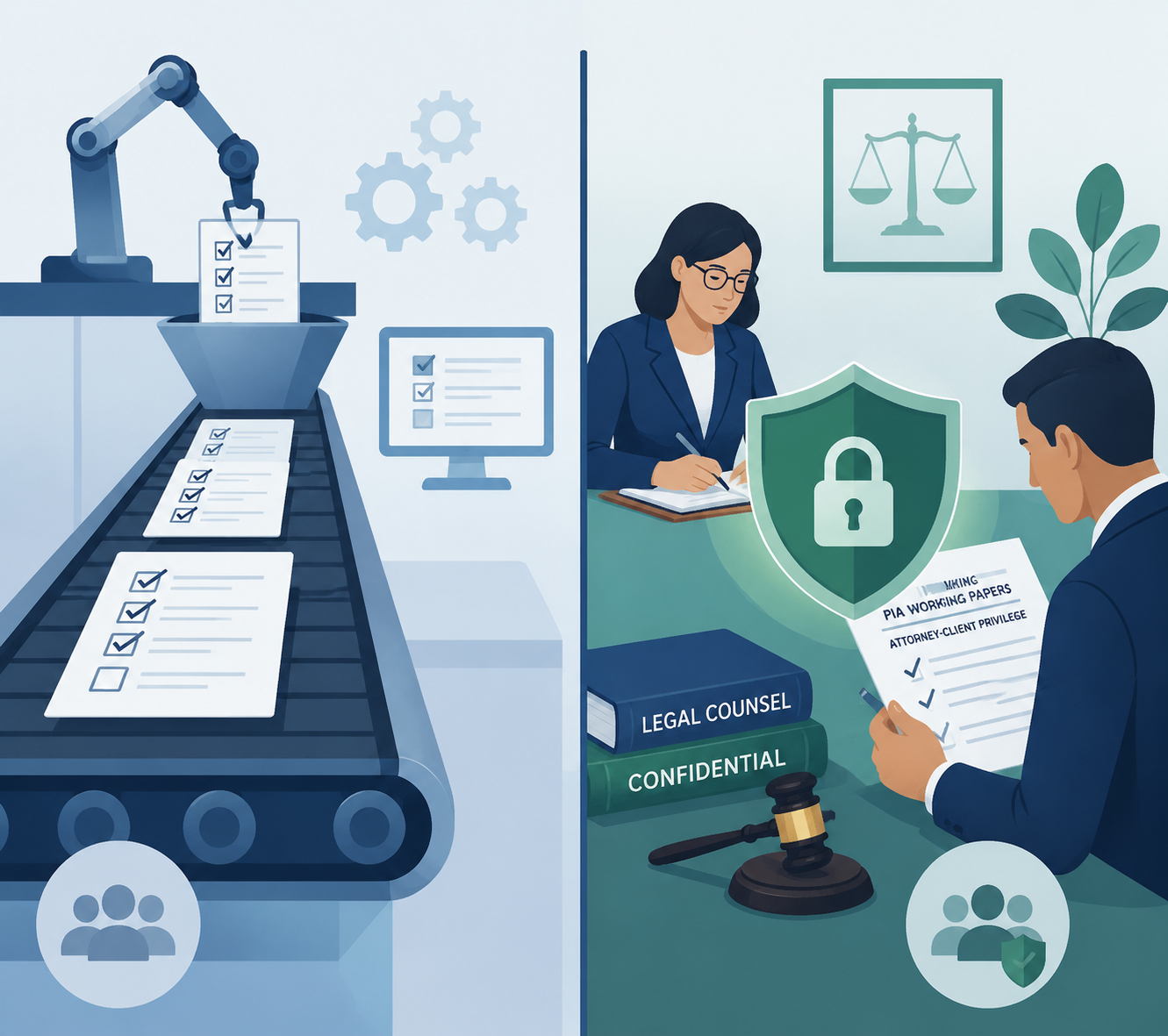
In procurement, the privilege questions should be operational. Legal should ask where privileged notes live, who can see them, whether they can be excluded from routine exports, whether drafts and comments are separately permissioned, how version history is retained, and whether the platform supports a workflow in which counsel directs the assessment rather than merely receives the final form. The answer may still be “we need a process outside the tool for legal advice.” That is acceptable. What is not acceptable is discovering after implementation that every sensitive legal judgment has been mixed into an ordinary compliance record.
Multi-State PIA Coverage Requires Trigger Logic, Not Just Templates
US state privacy laws have made PIA scoping harder to delegate to a static form. OneTrust’s July 2023 guidance frames the issue around when to conduct a privacy impact assessment and what such assessments should include under US privacy laws.[3] Red Clover Advisors separately notes that at least 10 states require PIAs, while also treating AI-related assessments as part of a broader privacy-risk mitigation program.[4]
The count itself should be handled carefully. Some statutes use explicit PIA language; others impose risk-assessment or data protection assessment obligations under related terminology. For a legal team, that means the tool should not merely advertise “multi-state coverage.” It should show how it decides whether an assessment is required, which processing activities trigger review, which state rule is being applied, and when the legal content was last updated.
A credible platform should let legal configure triggers for sensitive data processing, targeted advertising, sale or sharing, profiling, automated decision-making, children’s data, and other high-risk activities where applicable. It should also preserve the “why not” record: why the team concluded a full PIA was not required, who approved that conclusion, and what facts the decision rested on. A skipped PIA can become just as important as a completed one if the processing later draws regulatory or litigation attention.
AI-Specific Support Is the Main Separator in 2026
The phrase “AI-powered PIA” can mean two very different things. In one version, AI helps administer the PIA process by drafting answers, classifying responses, suggesting risk ratings, or routing tasks. In the more legally important version, the tool helps assess AI systems themselves. Legal teams need to know which claim the vendor is making.
TrustArc’s 2023 discussion of elevating PIAs to AI governance identifies AI-related vulnerabilities that ordinary privacy questionnaires often do not capture well: data poisoning, model theft, explainability gaps, bias, and hallucinations.[5] Nelson Mullins’ January 2026 analysis similarly places PIAs in a broader movement toward algorithmic accountability.[6] Those materials support a practical conclusion: a privacy assessment for an AI system has to ask about the model lifecycle, not only the personal data fields.
For legal teams, NIST AI RMF alignment is helpful only if it changes the questions asked and the evidence collected. A vendor slide that says “aligned to NIST” is not enough. The platform should help the team identify the system’s intended use, affected populations, training and input data sources, human oversight points, testing evidence, known limitations, monitoring obligations, and escalation paths when the system behaves unexpectedly.
| AI-risk area | Assessment evidence legal should expect | Weak signal in a vendor demo |
|---|---|---|
| Explainability gaps | Documentation of what users, reviewers, and affected individuals can understand about outputs. | The demo says the model is “transparent” without showing review artifacts. |
| Bias and disparate impact | Testing approach, affected groups considered, mitigation decisions, and owner accountability. | The tool asks one yes/no question about fairness. |
| Hallucinations or unreliable outputs | Use-case limits, human review requirements, confidence thresholds, and incident handling. | The platform treats AI output as a productivity feature but not as an assessment risk. |
| Data poisoning | Controls over training, fine-tuning, retrieval sources, and data validation. | The assessment only asks whether personal data is used. |
| Model theft or misuse | Access controls, vendor responsibilities, logging, and contractual restrictions. | Security is handled in a separate questionnaire with no connection to the AI PIA. |
Michalsons’ AI PIA methodology also points toward action steps rather than labels: define the AI system and its context, identify personal information and affected people, assess necessity and proportionality, evaluate risks, document mitigation, and keep the assessment current.[7] A tool that supports that workflow can be useful. A tool that merely adds “AI” to a standard privacy template will leave too much judgment outside the record.
Reading the Tool Market by Platform Type
Guideflow’s June 2026 inventory is useful as a market map, not because every listed platform should be treated as interchangeable. Its list includes enterprise privacy and governance platforms, PIA and assessment workflow tools, and vendors emphasizing data discovery or automated data-flow intelligence.[1] Comparitech’s April 2026 list adds breadth by including paid and free options, including CNIL’s PIA tool.[8]
For legal procurement, the better comparison is by capability pattern.
Enterprise privacy governance platforms
Enterprise platforms are usually strongest where the PIA process has to connect to records of processing, vendor management, consent or preference systems, data subject rights, policy management, and reporting. They are often the better fit for legal teams that need one system of record across privacy operations and want assessment outcomes to feed remediation tasks and governance reporting.
The procurement risk is that breadth can hide gaps. A broad platform may have a PIA module, but legal still needs to test whether that module handles privilege-sensitive review, jurisdiction-specific triggers, AI-risk templates, and evidence links. If the PIA workflow is mostly a configurable survey engine, the legal team will have to build much of the defensibility itself.
Data-aware platforms
Data-aware approaches deserve extra attention because they can reduce dependence on self-reporting. Guideflow’s inventory identifies BigID and Securiti among tools with data discovery or discovered-data-flow capabilities relevant to PIA work.[1] That matters because a business questionnaire often captures what a product manager believes the system does. Discovery and data-flow mapping can show what data is actually present, where it moves, and which systems touch it.
This does not make discovery a substitute for legal judgment. A scan may identify data stores, flows, classifications, and access patterns; it will not decide whether a particular use is proportionate, whether an exception applies, or how a state-law trigger should be interpreted. The advantage is evidentiary. If the assessment says no sensitive data is processed, but discovery indicates otherwise, the tool gives legal a reason to stop the workflow before the file becomes inaccurate.
Assessment workflow and questionnaire automation tools
Workflow tools can be valuable when the legal team’s immediate problem is inconsistent intake. They can standardize questions, assign reviews, capture approvals, and keep assessment status visible. For a small or mid-sized team moving from spreadsheets and email, that improvement is real.
The limitation is equally real. A questionnaire engine usually knows only what people tell it. Unless it connects to data inventories, legal-rule mapping, AI governance artifacts, and controlled legal workspaces, it may produce a tidy record without improving the quality of the assessment. IAPP’s warning that automation is not a silver bullet for underlying PIA process issues is directly relevant here.[9]
Free and lightweight tools
Free or lightweight tools, including options such as CNIL’s PIA tool noted in Comparitech’s 2026 list, can help teams impose structure where no process exists.[8] They may be especially useful for training, baseline methodology, or smaller organizations that need a repeatable way to document privacy risks.
They should not be treated as enterprise controls unless they actually support the enterprise requirements at issue: access control, legal-review segregation, state-law trigger updates, data-flow evidence, AI-risk frameworks, and auditability. A free tool can improve discipline. It does not automatically create a defensible legal operating model.
A Practical Selection Logic by Legal Team Profile
There is no universal best platform for privacy impact assessment legal AI tools. The right answer depends on which risk the legal team most needs the tool to reduce.
| Team profile | Prioritize | Be cautious about |
|---|---|---|
| In-house legal team handling multiple US state privacy laws | Jurisdictional trigger logic, legal-update process, approval history, and defensible no-PIA decisions. | Static templates that do not show how state-law thresholds are applied. |
| Privacy operations team drowning in intake volume | Workflow routing, task ownership, status visibility, reusable questionnaires, and escalation to counsel. | Treating faster completion as proof of better legal analysis. |
| Company deploying or procuring AI systems | AI PIA templates mapped to risk frameworks, model-lifecycle questions, human oversight, testing evidence, and post-deployment monitoring. | Vendor claims of “AI-ready” without concrete assessment artifacts. |
| Data-rich enterprise with complex systems | Discovery, data-flow mapping, integrations with data inventories, and evidence links into the PIA file. | Assessment records based only on business-owner self-reporting. |
| Small team building a first PIA process | Clear methodology, repeatable templates, training value, and manageable review discipline. | Assuming a lightweight tool will handle privilege, multi-state updates, or enterprise AI governance. |
For most legal teams, the strongest procurement exercise is a scripted demo using one real or realistic assessment scenario. Pick a processing activity that crosses business functions: a new AI-enabled customer support tool, a targeted advertising change, a sensitive-data analytics project, or a vendor-hosted profiling system. Ask the vendor to show the full path from intake to trigger analysis, legal review, evidence collection, remediation, approval, and export.
The demo should expose where legal judgment lives. If the vendor cannot show how counsel comments are segregated, how factual evidence is distinguished from legal advice, how state triggers are applied, or how AI-specific risks are documented, the team has learned something useful. The software may still be worth buying for operations, but not on the theory that it solves legal risk management.
Questions to Put in the RFP
- Show how the platform determines whether a PIA, data protection assessment, or similar risk assessment is required for a processing activity in specific US states.
- Identify which AI-risk frameworks, including any NIST AI RMF mapping, are built into the assessment workflow and which require customer configuration.
- Demonstrate how privileged legal notes, drafts, comments, and outside-counsel communications can be segregated from ordinary operational records.
- Explain whether assessment answers can be validated against discovered data flows, data inventories, system scans, or integrations.
- Provide the process for updating legal content, templates, and jurisdictional rules when privacy or AI-governance requirements change.
- Show the audit trail for risk-rating changes, reviewer approvals, remediation decisions, exceptions, and final signoff.
- Clarify what the platform’s own AI features do with customer assessment data, including retention, model training, access, and logging.
That last question is easy to overlook. If the platform uses AI to summarize PIA answers, draft risk language, or recommend classifications, the legal team should assess the tool’s AI use as part of the procurement review. The vendor’s automation may touch sensitive business plans, system architecture, data categories, security controls, and legal analysis. A privacy tool can become a privacy issue.
Where the Buying Decision Should Land
The most defensible choice in 2026 is not the platform with the smoothest questionnaire demo. It is the platform that best fits the legal team’s actual exposure: the jurisdictions it faces, the AI systems it reviews, the evidence it can collect, and the record it may later need to defend.
A mature enterprise may need a data-aware privacy governance platform that connects PIAs to discovered data flows and remediation. A team with heavy AI adoption may need deeper AI-risk templates and model-governance workflows, even if that requires integration with a broader GRC stack. A smaller team may reasonably start with a lighter tool to impose process discipline, provided it does not mistake that tool for privilege protection or multi-jurisdiction legal coverage.
Legal should buy PIA software for the assessment file it creates, not the intake form it accelerates. The file should show why review was triggered, what law or framework was applied, what evidence supported the decision, who reviewed the risk, where legal advice was handled, and what will be monitored after launch. If the tool cannot make that record easier to trace, assign, update, and defend, its AI features are decoration.
References
- 12 best privacy impact assessment software for 2026, Guideflow, June 2026.
- Develop a Process to Create Privacy Impact Assessments Under the Attorney-Client Privilege, ArentFox Schiff, May 2023.
- US Privacy Law: When to Conduct a Privacy Impact Assessment and What to Include, OneTrust, July 2023.
- Leveraging Privacy Impact Assessments to Mitigate AI Risk, Red Clover Advisors.
- Elevating Privacy Impact Assessments (PIAs) to AI Governance, TrustArc, 2023.
- From Privacy Impact Assessments to Algorithmic Accountability, Nelson Mullins, January 2026.
- Privacy Impact Assessments for AI Systems: Actionable Steps, Michalsons.
- 8 Best PIA Software and Tools for 2026 (Paid & Free), Comparitech, April 2026.
- Automation is not a silver bullet for underlying PIA process issues, IAPP.
Comments
Join the discussion with an anonymous comment.