
Full profile
The first mistake in reading the July 2026 student-visa changes is to put them in separate files: one labeled “duration of status,” the other labeled “public charge.” For an F-1 or J-1 student, the two rules meet on the same calendar. DHS published both final rules on July 16, 2026. The rule ending duration-of-status admission for F, J, and I nonimmigrants takes effect September 15, 2026; the public charge rescission takes effect September 18, 2026.[1][2]
That three-day gap matters less as trivia than as workflow. A student can be admitted into a fixed-period system and face a broader public charge framework in the same week. The same advising file may contain an I-20 program end date, a dissertation delay, a STEM OPT plan, a consular renewal question, a spouse’s benefits history, and an employment-based adjustment strategy. Those are no longer cleanly separate risk boxes.
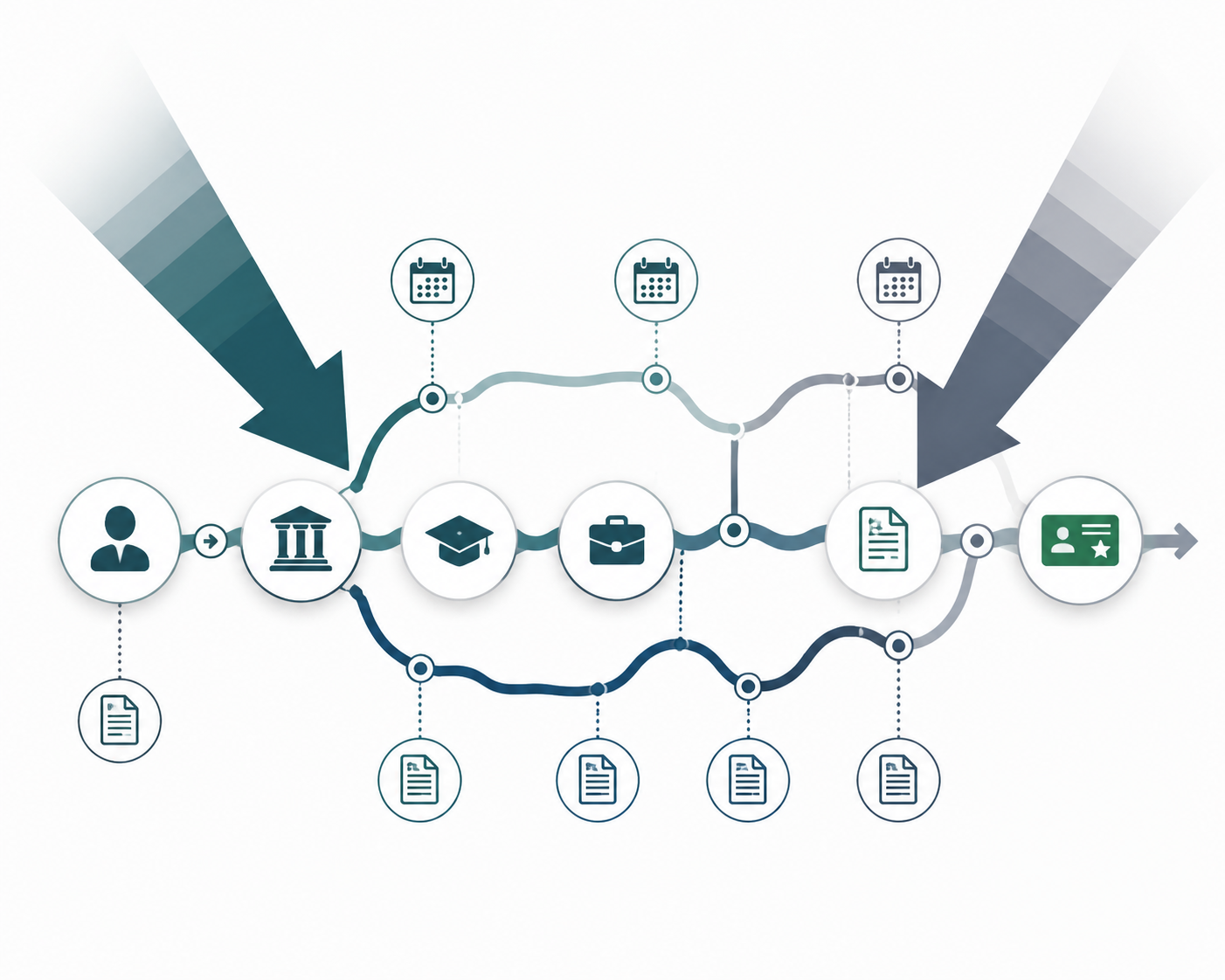
The Decision Map Changed Before the Degree Did
The practical question for advisors is not simply whether a student is “in status” today. It is where the student will next need the government to say yes: admission, extension, visa renewal, employment authorization, change or adjustment, or immigrant visa processing. The July rules shift the timing and evidentiary burden at several of those points.
| Student pathway point | What now changes | Why it compounds |
|---|---|---|
| Initial F-1/J-1 admission | Admission is no longer organized around open-ended duration of status once the D/S rule is effective. | Program planning must account for a fixed authorized period before academic uncertainty has played out. |
| Degree runs beyond initial period | F-1 admission is capped at four years under the D/S rule, with extensions routed through USCIS. | A normal academic extension becomes an immigration adjudication. |
| Visa renewal abroad | Consular public charge screening has already been moving toward broader discretionary review. | Travel decisions become harder when renewal, health, finances, benefits history, and family facts may be reviewed outside the campus advising environment. |
| OPT or employment transition | Status timing, extension timing, and employer sponsorship timing become more tightly linked. | A delay in one handoff can narrow options in the next. |
| Adjustment of status | The public charge rescission removes the 2022 bright-line protections, while USCIS has separately reframed adjustment as extraordinary relief. | The green-card transition point becomes more discretionary at the same time the student may have a longer immigration paper trail. |
The table is deliberately ordinary. It is not built around the rare disciplinary case or the student who intended to overstay. It is built around the doctoral student whose experiment fails, the undergraduate whose major sequence does not fit into eight uninterrupted semesters, the J-1 researcher whose funding letter needs updating, and the graduating student whose employer and counsel are trying to time a nonimmigrant-to-immigrant transition.
A Four-Year Admission Cap Meets Longer Academic Calendars
The D/S rule is the part of the July package that reaches the registrar’s calendar most directly. DHS says the final rule ends what it calls foreign student visa abuse by replacing duration-of-status admission with fixed periods for F, J, and I nonimmigrants; for F-1 students, the admission period is capped at four years.[1]
That design treats the need for additional time as a controlled exception. Academic data make the exception look routine. Forbes, citing federal education data, reported a 5.7-year median time to doctorate completion using NSF data and a 4.3-year median bachelor’s completion time using NCES data.[3] A four-year cap therefore does not merely catch unusually slow programs. It reaches the median doctoral student and a significant share of bachelor’s students before accounting for leave, funding gaps, course sequencing, lab setbacks, clinical placements, advisor changes, or transfer credits.
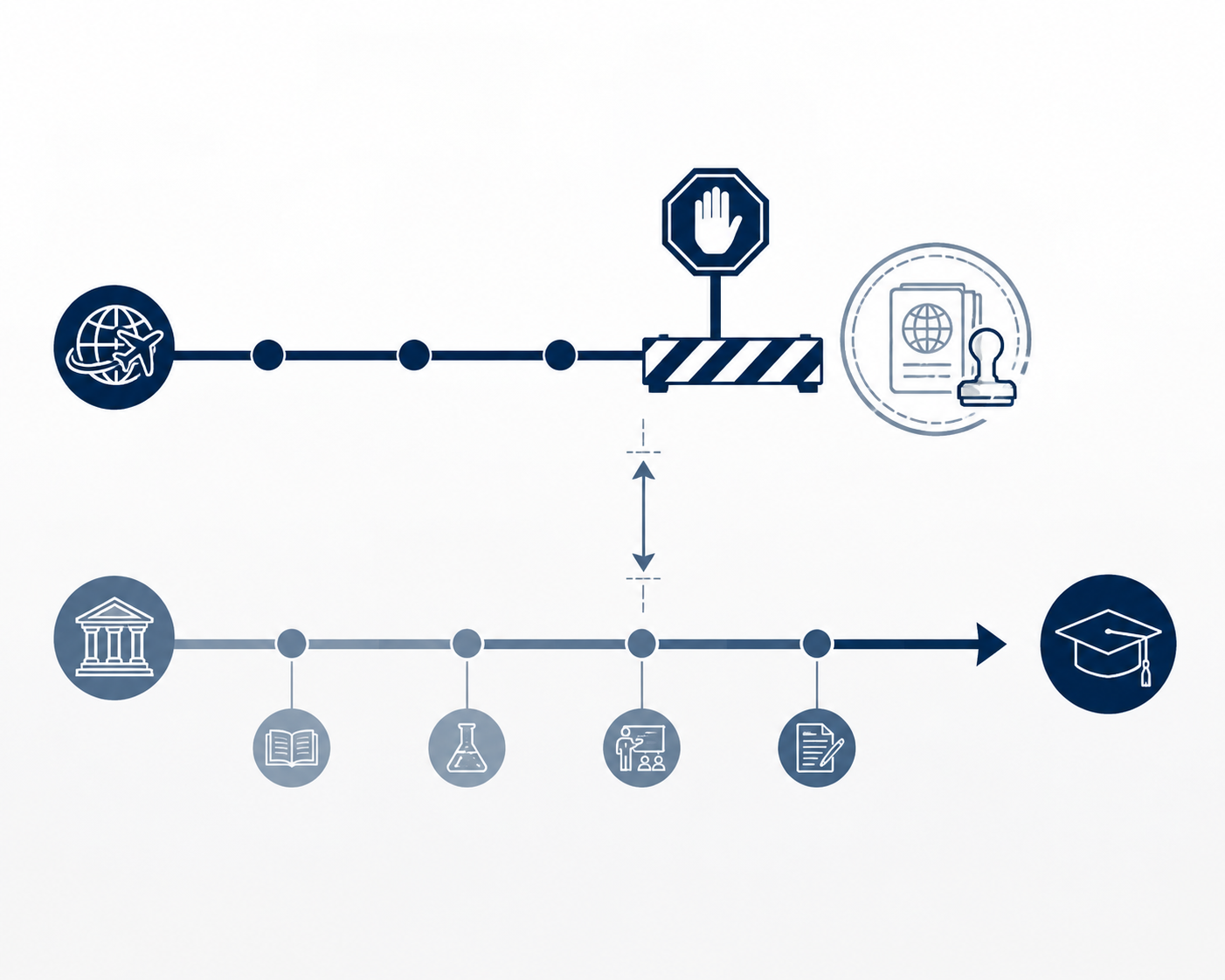
The administrative consequence is the key point. Under duration of status, an F-1 student’s lawful stay was tied to the continuing course of study and SEVIS compliance. Under the fixed-period model, the student must watch a government end date that may arrive before the academic end date. If the degree continues, the student needs an extension. If the extension is late, questioned, delayed, or denied, the academic problem has become an immigration problem.
This is also where institutional advice becomes more fragile. A DSO can explain program dates, full-time enrollment, reduced course loads, CPT and OPT eligibility, and SEVIS recordkeeping. A DSO cannot turn USCIS discretion into a guaranteed extension. University counsel can build protocols, but the moment a student’s dissertation timeline depends on a USCIS extension, the advising conversation moves from campus compliance into adjudication risk.
DHS received roughly 22,000 comments on the D/S rule, made limited changes, and acknowledged that enrollment could decline while saying it could not quantify the extent.[3] That combination is striking. The agency is confident enough to impose a fixed-period architecture on a population whose academic timelines are visibly uneven, but not able to measure the enrollment effect. For campus planning, that means the operational burden arrives before the enrollment forecast does.
Extension Dependency Is the New Advising Category
The useful dividing line is not undergraduate versus graduate, or STEM versus non-STEM. It is extension dependency. A student whose academic plan can realistically fit inside the fixed admission period has one kind of file. A student whose ordinary program design is likely to exceed that period has another.
- Low extension dependency: short master’s programs, exchange programs, or undergraduate plans with strong sequencing control and no expected interruption.
- Moderate extension dependency: bachelor’s students in programs where required courses, transfer evaluation, clinical placements, or financial interruptions commonly stretch completion.
- High extension dependency: doctoral students, research-based master’s students, students with dependent funding renewals, and students whose programs require external placements or advisor-controlled milestones.
That triage should happen earlier than the traditional “program end date is approaching” reminder. The student who will likely need an extension should know that before choosing travel dates, changing funding, taking a leave, delaying a qualifying exam, or assuming OPT timing will remain untouched.
Public Charge Now Sits Inside the Student-to-Green-Card File
The public charge rule is easy to misread as a separate issue affecting only low-income immigrant families. That misses its placement in the student pathway. Many international students never apply for public benefits and never file an adjustment application. But for the student who moves from F-1 study to OPT, employer sponsorship, and eventually an employment-based green card, public charge is part of the transition file, not an abstract welfare-policy debate.
USCIS announced on July 16, 2026, that it was rescinding the 2022 public charge regulation, with an effective date of September 18, 2026.[2] The 2022 framework had supplied narrower definitions and clearer exclusions. Its rescission removes those bright-line protections and restores broader officer discretion in determining whether an applicant is likely to become a public charge.[2]
Under the 2025 proposal that preceded the rescission, advocates warned that adjudicators could consider any means-tested benefit, including SNAP, Medicaid, and housing assistance, and could also consider benefit use by family members in assessing the applicant.[4] That family-member point is not a footnote for student advising. A student may have a U.S.-citizen child, a spouse in another status, or a household member whose benefits history was never treated as part of the student’s future employment-based case.
The statutory public charge ground has long existed. What is changing is not the presence of INA 212(a)(4), but the enforcement posture around who is scrutinized, which facts matter, and how much certainty advisors can give. Historical practice rarely made public charge the central issue in F-1 advising. The new environment makes it difficult to keep public charge out of the student file once the student begins planning renewal abroad or permanent residence.
The Forum Matters: USCIS Is Not the Only Gatekeeper
The public charge analysis is not confined to adjustment of status inside the United States. A November 2025 State Department cable instructed consular officers to consider age, health, obesity, mental health, chronic disease, and English proficiency in public charge assessments; February 2026 guidance explicitly covered student visa applicants.[4] That makes travel and renewal planning more consequential, especially for students who assume that maintaining SEVIS status is the only real issue in a visa interview.
Illinois International Student and Scholar Services warned that even benefits technically exempt from public charge consideration, including Medicaid for prenatal care, could make a student visa renewal abroad “more difficult or even impossible.”[5] That warning should be read carefully. It is not a statement that every exempt benefit will produce a denial. It is a practical advisory signal: consular review may not map neatly onto the benefit categories students have been told are safe in other contexts.
The result is a travel-advising problem as much as a green-card problem. If a student leaves the United States to renew a visa after September, the file may be read through a broader public charge lens at the consulate. If the student stays, the fixed-period D/S system may still require USCIS extension planning. Either way, the student’s next gatekeeper may ask for evidence the campus office does not control.
Adjustment of Status Becomes the Narrowest Handoff
The third layer is not one of the July 16 rules, but it belongs in the same file. In May 2026, USCIS issued policy guidance reframing adjustment of status as a form of “extraordinary” relief rather than a routine benefit for eligible applicants.[6] For international students moving through employment sponsorship, this is the point where years of compliant study, work authorization, employer petitioning, medical examination, financial documentation, and admissibility screening converge.
That reframing matters because adjustment is where several assumptions meet. The student may assume that a clean SEVIS record and an approved employment petition carry the case. The employer may assume that sponsorship is mainly a labor-market and petition process. The university may have exited the file at graduation or OPT reporting. But adjustment is a discretionary adjudication, and the May memo makes that discretion more explicit.[6]
Layer the public charge rescission onto that posture and the evidentiary field widens. The question is no longer only whether the applicant falls within a narrow list of counted benefits under the 2022 rule. Counsel may need to evaluate income, assets, health insurance, household composition, prior or current means-tested benefits, family-member benefit use, and any consular history that could have framed the applicant as financially vulnerable. The exact weight of those facts remains discretionary, which is precisely why they cannot be ignored.
Timing also matters. Applications postmarked or submitted electronically before September 18, 2026, remain governed by the 2022 public charge rule unless litigation or agency action changes the timeline.[2] That does not mean every eligible applicant should rush a filing. It does mean attorneys need to identify which cases are already document-ready, which cases depend on missing employer or medical evidence, and which cases would be harmed by filing before the record is mature.
The Broader Risk Atmosphere Is Real, but the Data Do Different Jobs
The July rules land in a climate already marked by declining confidence in U.S. student mobility. Brookings projected a 29% decline in F-1 visa issuance for 2025 based on the first eight months of data.[7] That is a projection, not a final-year count. It is still relevant because consular behavior, student perception, and institutional planning respond to partial-year signals before annual data are complete.
Other numbers should be used with the same discipline. The Institute of International Education reported a 17% new-enrollment drop across a survey of 828 universities, while NAFSA projected a $1.1 billion decline in economic contributions and 23,000 job losses.[7] Those figures describe survey results and economic estimates, not a direct causal measurement of the two July rules. They are best read as evidence of pressure on the student pipeline, not proof that any single rule has already produced a specific enrollment loss.
The public charge side has its own chilling-effect history. The Migration Policy Institute has warned that a broader public charge rule would amplify harms to immigrant families, while NILC has emphasized how expanded benefit consideration can deter eligible families from using services.[4][8] For student advisors, the relevant point is not only whether a benefit is legally counted. It is whether students and family members change behavior because they cannot predict how the fact will be read later.
The January 2026 visa-ban context adds another layer but should not be collapsed into the July rules. Brookings reported that a 75-country visa ban blocked immigrant visa issuance using public charge reasoning and noted that the State Department issued nearly 19,000 F-1 visas in 2024 to students from those countries.[7] That policy is being challenged in court and may change. Its immediate value for this analysis is narrower: public charge reasoning is no longer confined to the final green-card interview in the way many student files once assumed.
What Advisors Should Reassess Before September
The safest September planning posture is not panic and not reassurance. It is file sorting. The cases that need earlier attorney review are the ones where a fixed period of stay, public charge discretion, consular renewal, or adjustment timing can interact.
- Time-to-completion risk: identify students whose realistic academic timeline extends beyond the fixed admission period, especially doctoral and research-based programs.
- Extension dependency: determine whether the student is likely to need a USCIS extension and what evidence will support the academic need, funding, and continued eligibility.
- Travel and renewal exposure: flag students planning visa renewal abroad after the September effective dates, especially where health, finances, English proficiency, or benefits facts may invite public charge questioning.
- Benefits history: ask carefully about the student’s own use of means-tested benefits and avoid treating prior “safe” advice as automatically sufficient under the rescinded framework.
- Family-member facts: review whether a spouse, child, or household member’s benefit use could become relevant under broader discretionary public charge analysis.
- Adjustment assumptions: reassess employment-based green-card plans in light of the May 2026 USCIS memo and the loss of the 2022 public charge bright-line protections.
DSOs and ROs do not need to become public charge lawyers. They do need a handoff trigger. A student who is on track to finish within the fixed period, has no travel planned, no benefits complications, and no near-term adjustment strategy may need monitoring more than legal escalation. A student with a delayed dissertation, expiring admission period, planned consular renewal, household benefit history, and employer sponsorship timeline belongs in a different queue.
Litigation may alter the deadlines or narrow enforcement. Planned challenges to the public charge rescission and pending challenges to related visa restrictions should be watched. But waiting for litigation to settle is not an advising strategy for a student whose extension, renewal, or adjustment filing is already on the calendar.
The practical impact on international students is therefore not limited to whether a student has personally received public benefits. It is the way public charge discretion now meets fixed-period student admission, consular renewal risk, and a more discretionary adjustment framework. The file review has to start where the student actually stands: academic time left, immigration time left, travel plans, family facts, funding evidence, and the next government decision that must go right.
References
- Trump Administration Issues Final Rule to End Foreign Student Visa Abuse — DHS, July 16, 2026
- US Citizenship and Immigration Services Rescinds 2022 Public Charge Regulation — USCIS, July 16, 2026
- DHS Finalizes Immigration Rule That Imperils Status Of Many Students — Forbes, July 17, 2026
- Public Charge: What Advocates Need to Know About the November 2025 Proposed Rule — NILC
- Public Charge – International Student and Scholar Services — UIUC ISSS
- USCIS Announces New Policy on Adjustment of Status — UW ISS
- How the Trump administration is eroding the immigrant talent pipeline — Brookings, May 2026
- Trump Administration Public-Charge Rule Would Amplify Harms to Immigrant Families — Migration Policy Institute
Comments
Join the discussion with an anonymous comment.