
Full profile
The compliance problem raised by President Trump’s election-integrity speech and the SAVE America Act is not simply that Congress may ask states to verify voter eligibility more aggressively. It is that the proposed verification architecture would push election officials toward DHS database integration, photo-ID scanning, and expanded identity-matching systems while the federal body publishing AI guidance for election administrators says it has no authority to certify AI tools. The official who signs the rejection notice, answers the voter, or faces a penalty may have no control over the model, the matching threshold, the training data, the audit trail, or the vendor’s error-handling design.
That distinction matters after President Trump’s July 2026 election-security speech. FactCheck.org treated several of the speech’s factual claims as disputed or unsupported, including the administration’s claim involving 278,000 noncitizens and the separate claim that Chinese actors had obtained 220 million voter files; Nevada and Pennsylvania officials disputed the noncitizen figure, DHS had not disclosed its methodology, and the Chinese-voter-file claim came from an administration release without independent corroboration identified in the article.[1] A verification mandate built on contested threat narratives is still a legal mandate. The question is whether the statute supplies a reliable way to turn a database hit into an administratively defensible decision.
First, Do Not Collapse the Bills Into One
Issue One’s comparison is a useful guardrail because the names invite confusion. The SAVE Act, the SAVE America Act, and the MEGA Act are related election measures, but they are not interchangeable; they differ in scope, procedural posture, and the mechanisms they would use to change voter-registration and election-administration rules.[2] For lawyers, that is not a naming nicety. A claim about proof-of-citizenship registration requirements does not automatically answer a claim about DHS data-sharing, and a claim about executive enforcement does not automatically answer a claim about state official liability.
The legislative posture is also unsettled. As of Q3 2026, the legislative record shows House passage twice — April 2025 by 220–208 and February 2026 by 218–213 — while Senate efforts failed through insufficient cloture, a 48–50 amendment rejection, a MIRVing defeat, and exclusion from DHS funding in June 2026.[2] That is enough movement to justify compliance planning, but not enough to treat the final statutory language as fixed.
The Verification Chain the Statute Would Create
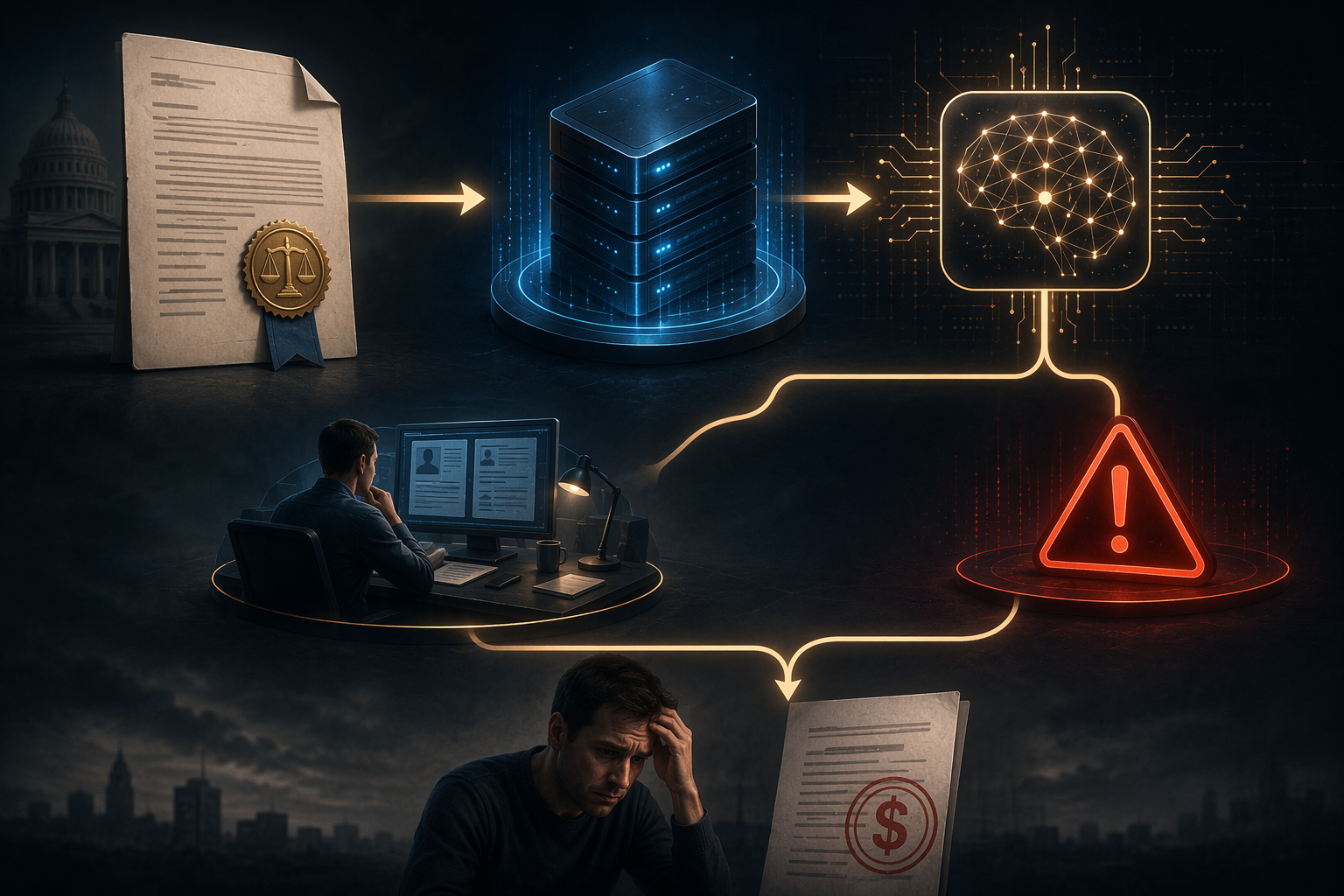
A voter-verification mandate does not operate in a courtroom. It runs through clerks, state database teams, help desks, vendor portals, batch files, queue dashboards, and notices. A typical chain under a more aggressive statutory regime would look something like this:
- A state or local official receives a statutory obligation to verify citizenship, identity, or eligibility before accepting or maintaining a voter record.
- The jurisdiction queries a federal or state database, scans an ID document, or runs a voter record through matching software.
- An automated system returns a match, nonmatch, confidence score, duplicate flag, or exception.
- A human reviewer either investigates the exception, relies on the automated output, or lacks enough time and information to do more than process the queue.
- The voter receives a notice, must produce additional documentation, is moved into a provisional process, or is removed or blocked.
- If the outcome is wrong, the voter bears the immediate burden, the official bears the public and statutory burden, and the vendor may face procurement, warranty, or misrepresentation exposure.
The point is not that every tool in that chain is artificial intelligence in the same way. Some systems use rules-based matching, some use probabilistic matching, some use computer vision, and some use machine-learning classifiers. The legal problem appears when an automated or semi-automated output is treated as if it were a verified legal fact, even though the statute has not specified what accuracy level is acceptable, what demographic testing is required, what logs must be preserved, or who may override the system.
The EAC Has Guidance, Not Certification Authority
The Election Assistance Commission’s June 2026 AI materials are practical and useful in the way nonbinding tools often are: they collect case studies, warn officials to evaluate AI uses carefully, and provide a toolkit for election offices considering AI systems. But the EAC also states that it does not have regulatory authority to certify AI tools used in election administration.[3] That leaves a gap between advice and legal assurance.
For voting systems, federal certification has at least created a recognizable compliance vocabulary. An official, vendor, court, or procurement officer can ask whether a system was tested against a standard. AI verification tools do not sit inside an equivalent federal certification regime. A county can ask a vendor for documentation. A state can impose contract terms. A court can demand records after the fact. None of that is the same as Congress defining the baseline before the tool changes a voter’s status.
Known Error Patterns Are Already Administrative Facts
The available research does not support the comforting assumption that identity tools simply remove human messiness from the process. Brennan Center guidance on AI in election administration reports that AI signature-matching tools have shown accuracy ranging from 74% to 96% in controlled conditions, and warns that performance can decline in actual deployment when operational data differs from the data used to train or test the system.[4] A controlled-condition result is not a warranty for a county office processing uneven scans, aging signatures, rushed submissions, name changes, inconsistent handwriting, and records entered years apart.
The same concern appears in voter-list maintenance. Brennan Center analysis of Wisconsin voter-list records found that minority voters, especially Hispanic and Black voters, were more than twice as likely to be inaccurately flagged as potentially ineligible. That finding does not prove that every future SAVE database workflow would reproduce the same disparity. It does show that ordinary administrative matching can distribute error unevenly, which is exactly the kind of issue a statute should address before scaling database-driven eligibility checks.
The DHS SAVE program examples collected by FactCheck.org also cut against any claim that federal database verification is self-validating. FactCheck.org described a 0.04% flag rate, Utah’s reported one-in-2-million finding, and a Kansas example involving a 12% false-block rate.[1] Those figures point in different directions, which is the point: a database system’s legal risk depends on how the query is framed, what records are included, how a nonmatch is interpreted, and what review process follows.
A small error rate can still produce serious legal consequences when the action is denial, removal, or forced documentation. A high false-block rate in a particular implementation is not proof that all database verification is unusable. The legally relevant conclusion is narrower and more useful: database status is evidence to be evaluated, not a final adjudication by itself.
What a Defensible AI Verification System Would Have to Show
The Brennan Center’s AI CPR framework — Choose, Plan, Review — reads like the beginning of a governance model, not a procurement slogan. It asks election officials to choose tools carefully, plan their deployment, and review performance and outcomes.[4] That is sensible. It is also nonbinding. If Congress mandates technology-assisted verification without turning comparable safeguards into enforceable standards, the framework becomes something a careful office may cite and an overburdened office may lack the money, time, or leverage to implement.
| Control Point | What It Should Answer |
|---|---|
| Documented accuracy | What the tool measures, on what data, and under what operating conditions |
| Demographic testing | Whether false matches or false flags fall unevenly across protected or politically salient groups |
| Human review | Who may override the tool and what evidence is required before voter impact |
| Audit logs | Whether the office can reconstruct the query, model output, threshold, reviewer action, and notice |
| Vendor responsibility | What the contract says about testing, updates, defects, indemnity, and cooperation in disputes |
| Voter notice and cure | How a person learns of the problem and what process exists before loss of voting access |
These are not abstract best practices. They determine whether an election office can prove that it made an individualized decision rather than laundering an automated score through a human signature. They also determine whether a vendor can defend its product as fit for an election use case rather than merely accurate in a demo environment.
The Liability Does Not Follow the Engineering
The sharpest legal exposure falls where responsibility and control separate. If an election official is required to use a verification system and faces penalties for accepting or rejecting the wrong registration, the official needs a legally recognized safe path: what records to check, when to escalate, when to pause action, and when a system output is too uncertain to support voter impact. Without that path, the official becomes the visible actor for an invisible chain of design decisions.
Criminal or quasi-criminal provisions intensify the problem. Fault is hard to prove and harder to defend when the underlying mistake begins in a vendor tool or federal database the official did not build. A prosecutor, plaintiff, or agency may focus on the final administrative act. The official may need to explain model behavior, training-data limits, threshold settings, API changes, or database lag that were never disclosed in usable form.
Vendors should not treat that gap as someone else’s problem. If a company sells verification infrastructure into elections, ordinary enterprise-AI assurances are not enough. Counsel should expect questions about express and implied warranties, fitness for election-administration use, bias testing, update control, audit-log retention, indemnity, cybersecurity representations, public-records obligations, and cooperation when a voter challenges an adverse decision. A contract that says the customer remains responsible for all election-law compliance may allocate paper risk, but it will not make a defective or poorly documented tool easier to defend.
Unredacted Rolls Raise a Different Set of Objections
The proposed sharing of unredacted voter rolls with DHS should be analyzed separately from model accuracy. Brennan Center materials, Issue One’s explainer, and state officials’ refusals to comply have identified privacy and constitutional concerns around federal access to voter-roll data.[2][5] Even a perfectly accurate matching tool would not answer whether the data transfer is authorized, proportionate, adequately secured, or compatible with state-law limits on voter information.
Here the legal issue is not only whether a voter is correctly identified. It is whether the government has built a data pipeline that exposes more information than the verification task requires. Once unredacted rolls move into a federal system, later use, retention, breach, secondary matching, and public-records disputes become part of the election-administration risk surface.
The Technology Emphasis Is Narrower Than the 2026 Threat Picture
There is also a mismatch between the Act’s technological energy and the broader 2026 election threat landscape. Check Point’s 2026 threat reporting has emphasized campaign systems — email, fundraising infrastructure, and AI-driven phishing — as primary midterm targets, not voting machines. That does not make voter-roll integrity irrelevant. It does mean a technology-heavy statute aimed mainly at voter verification should not be mistaken for a comprehensive election-security program.
States have been more concrete in one adjacent AI domain. Brennan Center documentation shows that 14 states enacted AI deepfake or disinformation laws in 2024. Those laws are not a model for voter-verification systems in every respect, but they show that lawmakers can regulate election AI with attention to a specific use case. The federal verification debate remains less developed on certification, testing, auditability, and who bears the cost of error.
What Lawyers Should Be Looking For in Amendments or Procurement
If the SAVE America Act, an appropriations rider, or a related bill moves again in Q3 2026, the most important questions are not whether the word “AI” appears. Many consequential systems will be described as database verification, identity matching, signature review, document scanning, or eligibility screening. The functional question is whether an automated system supplies information that changes a voter’s legal position.
- Does the bill define which systems are covered, including probabilistic matching and vendor-hosted tools?
- Does it require independent testing before deployment and after material updates?
- Does it require demographic performance analysis rather than aggregate accuracy alone?
- Does it preserve logs sufficient to reconstruct an adverse decision?
- Does it give officials a safe harbor when they follow required review procedures?
- Does it give voters notice and a meaningful cure process before denial or removal?
- Does it allocate vendor responsibility for defects, undocumented changes, and refusal to cooperate in litigation or administrative review?
Those questions are more useful than a general argument over whether AI is good or bad for election administration. Some automated tools can reduce clerical drift, identify duplicate records, and help officials prioritize review. But a statute that mandates verification without certification does not become safe because some uses are helpful. It merely moves unverified technical judgment into a legally consequential workflow.
The Q3 2026 Legal Posture
As of July 19, 2026, the SAVE America Act sits in an unsettled posture: enough House support to remain a live compliance concern, enough Senate failure and appropriations uncertainty to make final obligations unpredictable, and enough technology detail to expose the missing quality-control architecture. Any amendment or enactment should be read against that vacuum. The unresolved issue is not whether election officials may verify eligibility. It is whether Congress will require them to rely on systems that federal law has not certified, while leaving them to absorb the legal consequences when those systems are wrong.
References
- FactChecking Trump's Election Security Speech, FactCheck.org, July 2026.
- Explainer: SAVE, SAVE America and MEGA Acts, Issue One.
- Artificial Intelligence (AI) and Election Administration, U.S. Election Assistance Commission.
- Safeguards for Using Artificial Intelligence in Election Administration, Brennan Center for Justice.
- The SAVE Act and the Election Power Grab, Brennan Center for Justice.
Comments
Join the discussion with an anonymous comment.