
Full profile
In a June 26, 2026 World Cup incident between Iran and Egypt, a 93rd-minute goal was disallowed by SAOT, and the unsettling part was not the offside line itself but the question of whose judgment anyone was accepting; Opinio Juris uses that episode as an illustration, though it has not been independently verified through FIFA's official match reports. [1]

What the alert changed
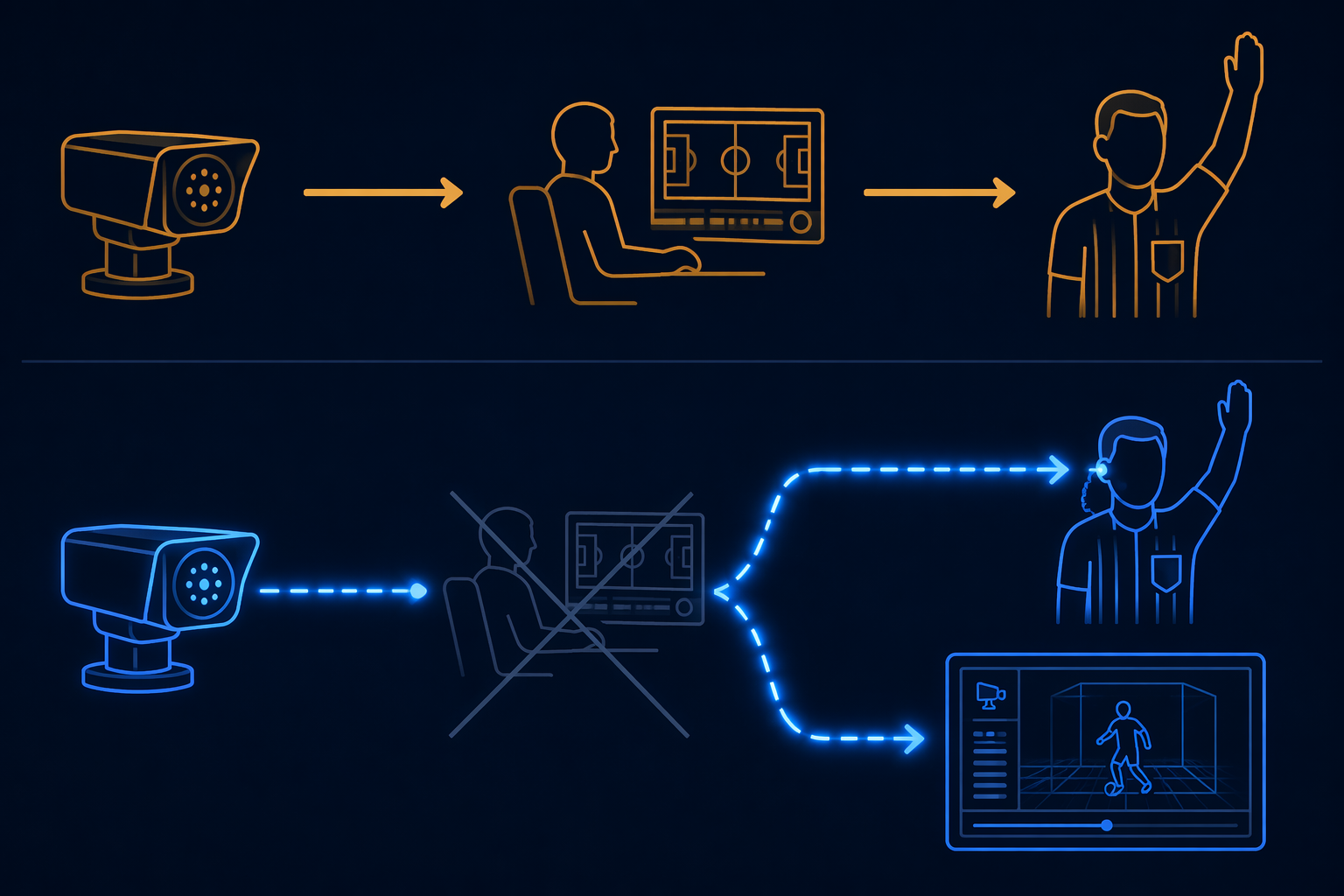
That scene matters because the 2026 FIFA version of semi-automated offside is not just a faster assistant. FIFA says the World Cup configuration uses 12-16 cameras and a ball sensor, and it can push clear offside alerts of more than 10 cm directly to the referee's earpiece. The accountability chain is different from the traditional VAR model because the human intermediary who used to absorb, translate, and sometimes hesitate over the machine output is no longer doing that work in the same way. [2][3][5]
That difference matters even more because SAOT is not one fixed setup. The Premier League's version is described differently, with 30 cameras and no ball sensor, so any legal or governance claim has to stay tied to the specific competition configuration being discussed rather than to 'SAOT' in the abstract. [2][8]
Formal authority, thinner judgment
IFAB Law 5 still leaves the referee with formal authority, and that is exactly why the setup is revealing. A rulebook can preserve the referee's name on the decision, but it cannot by itself restore the referee's independent judgment when the operative signal has already been narrowed by an algorithm and then broadcast simultaneously to the earpiece and to public visual outputs, including 3D avatar-style displays. [1][4]
The CAS field-of-play doctrine assumes a very different world: a decision emanates from an identifiable human will that can deviate, err, or be disciplined. That assumption is workable when a referee makes a call and another official reviews it; it is much less convincing when the decisive input comes from a non-auditable machine process and the human on the field can only relay, ratify, or explain what the system has already framed. [1]
Can the legal frameworks still name someone
GDPR Article 22 is often invoked because it limits solely automated decisions with legal or similarly significant effects, but SAOT sits awkwardly beside that language. The match is still officiated by humans in formal terms, even when the machine supplies the decisive signal, so Article 22 is a blunt fit for a situation in which responsibility is distributed across system design, live operation, and rapid human transmission rather than concentrated in one decision-maker. [5][6]
The EU AI Act gets closer on oversight, documentation, and high-risk governance, but procedural oversight is not the same as accountable judgment. Requiring a person to be 'in the loop' does not answer whether that person can actually contradict the system, understand its basis, or later defend the call in a meaningful review. Once the human role is reduced to accepting an opaque output under time pressure, the legal form of oversight starts to look like a label attached to a process the human no longer controls. [5][6]
US accountability proposals point in a similar direction. They focus on disclosure, audits, and impact assessment, which are useful tools, but they do not solve the deeper problem of naming a responsible agent when a consequential decision is generated by a distributed system and then carried forward by people whose role is mostly administrative. Vanderbilt's analysis of AI referees treats criminal sentencing, hiring, and credit scoring as versions of the same pattern: the machine shapes the outcome, the institution keeps a human in the chain, and the person affected still cannot say who actually made the judgment. [7]
The same structure elsewhere
That is why sports is useful here. A disallowed goal is public, immediate, and easy to narrate, but the underlying structure is familiar in criminal justice, hiring, and credit scoring: the algorithm drives the result, the institution retains a human name somewhere in the process, and accountability diffuses until no one can be made to own the decisive act in a way that can be defended, reviewed, or blamed. SAOT does not create that problem; it makes it visible at match speed. [7]
Seen from that angle, the Iran-Egypt incident is less a football controversy than a governance test. It shows how quickly a call can move from a person who can be questioned to a process that can only be described, and why a human name in the chain is not the same thing as a human judgment that still bears responsibility. [1]
References
- Algorithmic Refereeing at the 2026 World Cup — Opinio Juris, July 15, 2026
- Semi-automated offside technology — FIFA
- Faster offside decisions, referee body cams — FIFA
- Semi-automated offside is coming for the World Cup — The Guardian, June 8, 2026
- Legal implications of SAOT in professional football — O'Connors Law
- AI in elite sport - key legal considerations — Brabners, March 2026
- Artificial Intelligence Referees: Offsides and Out of Bounds — Vanderbilt Law School
- Semi-automated offside technology: What you need to know — Premier League
Comments
Join the discussion with an anonymous comment.