
Full profile
A hostage incident in the Shasta-Trinity National Forest sounds, at first pass, like the kind of case that should turn on geography: Did anyone cross a state line? Was the trailer on federal land? Did the hold last long enough to trigger a federal presumption? Those are natural questions, and in this case they are mostly the wrong ones.
The reported facts are already severe enough without adding statutory folklore. Two U.S. Forest Service employees were conducting field work near Gumboot Lake in Northern California when they were allegedly restrained with zip ties, held at gunpoint in a trailer for more than 12 hours, and later rescued after a federal response that included the FBI Hostage Rescue Team. Joseph Henrichsen and Phoenix Henrichsen, described in news reports as father and son, were taken into custody and charged after the incident.[1]

For the legal implications of the Shasta-Trinity Forest Service hostage incident, the central fact is not the remoteness of the site or the length of the standoff. It is that the alleged victims were federal employees performing official duties. That fact points to 18 U.S.C. § 1201(a)(5), a part of the federal kidnapping statute that is easy to miss if one learned federal kidnapping through the older interstate-transportation frame.
The Charging Choice Does Not Depend on State Lines
Section 1201(a) is not a single jurisdictional theory. It is a menu of federal hooks. Subsection (a)(1) covers certain kidnappings involving interstate or foreign commerce. Subsection (a)(2) covers special maritime and territorial jurisdiction. Subsection (a)(3) covers special aircraft jurisdiction. Subsection (a)(4) covers foreign officials and internationally protected persons. Subsection (a)(5), the one that matters here, covers kidnappings where the victim is among the officers and employees described in 18 U.S.C. § 1114.[2]
That last clause changes the jurisdictional analysis. It does not ask whether the abductors crossed into Oregon or Nevada. It does not ask whether a national forest boundary supplies territorial jurisdiction. It asks whether the person seized was a covered federal officer or employee. Section 1114 reaches “any officer or employee of the United States or of any agency in any branch of the United States Government” while that person is engaged in, or on account of, official duties.[3]
Forest Service employees are not outside that language because they are not FBI agents, marshals, or armed law enforcement officers. The cross-reference is broad. If the reported victims were U.S. Forest Service employees doing field work, the victim-status hook is not an afterthought; it is the charging engine.
What Prosecutors Still Have to Prove
A complaint under § 1201(a)(5) still has elements. The government cannot simply say “federal employee” and stop. The kidnapping statute reaches a person who “unlawfully seizes, confines, inveigles, decoys, kidnaps, abducts, or carries away” another person and holds that person for ransom, reward, or otherwise, when the jurisdictional condition in the charged subsection is met.[2]
In the Shasta-Trinity allegations, the seizure-and-holding component is supplied by the reported use of zip ties, a firearm, a trailer, and a confinement lasting more than 12 hours.[1] The federal hook is supplied by the victims’ employment status and official-duty context. Those are separate ideas, and good analysis keeps them separate.
| Issue | What matters under § 1201(a)(5) |
|---|---|
| Seizure or holding | The alleged restraint, confinement, abduction, or holding of the victims |
| Covered victim status | The victim must be an officer or employee described in § 1114 |
| Official-duty connection | The victim must be engaged in, or targeted on account of, official duties |
| Interstate movement | Not required for the § 1201(a)(5) theory |
| Twenty-four-hour hold | Not required for the § 1201(a)(5) theory |
That division matters for defense counsel as much as prosecutors. A lawyer who attacks only the absence of interstate transportation is arguing against a charge the government does not need to bring. The more relevant disputes, if supported by the record, would concern the factual basis for seizure or confinement, the defendants’ alleged conduct and intent, the victims’ official-duty status at the time, identification, mental state, admissibility of statements, and any procedural defenses that emerge after discovery.
The Interstate Kidnapping Habit Is the Trap
The Lindbergh-era shorthand around federal kidnapping still distorts the conversation. Many readers hear “federal kidnapping” and assume the government must prove interstate movement. Sometimes it must. Under § 1201(a)(1), federal jurisdiction can depend on transportation in interstate or foreign commerce, or on the use of a means, facility, or instrumentality of interstate or foreign commerce.[2]
But § 1201(a)(5) is not § 1201(a)(1). Congress put multiple jurisdictional routes in the same statute. When the charged route is the kidnapping of a § 1114 federal officer or employee, the government’s theory does not rise or fall on whether anyone left California.
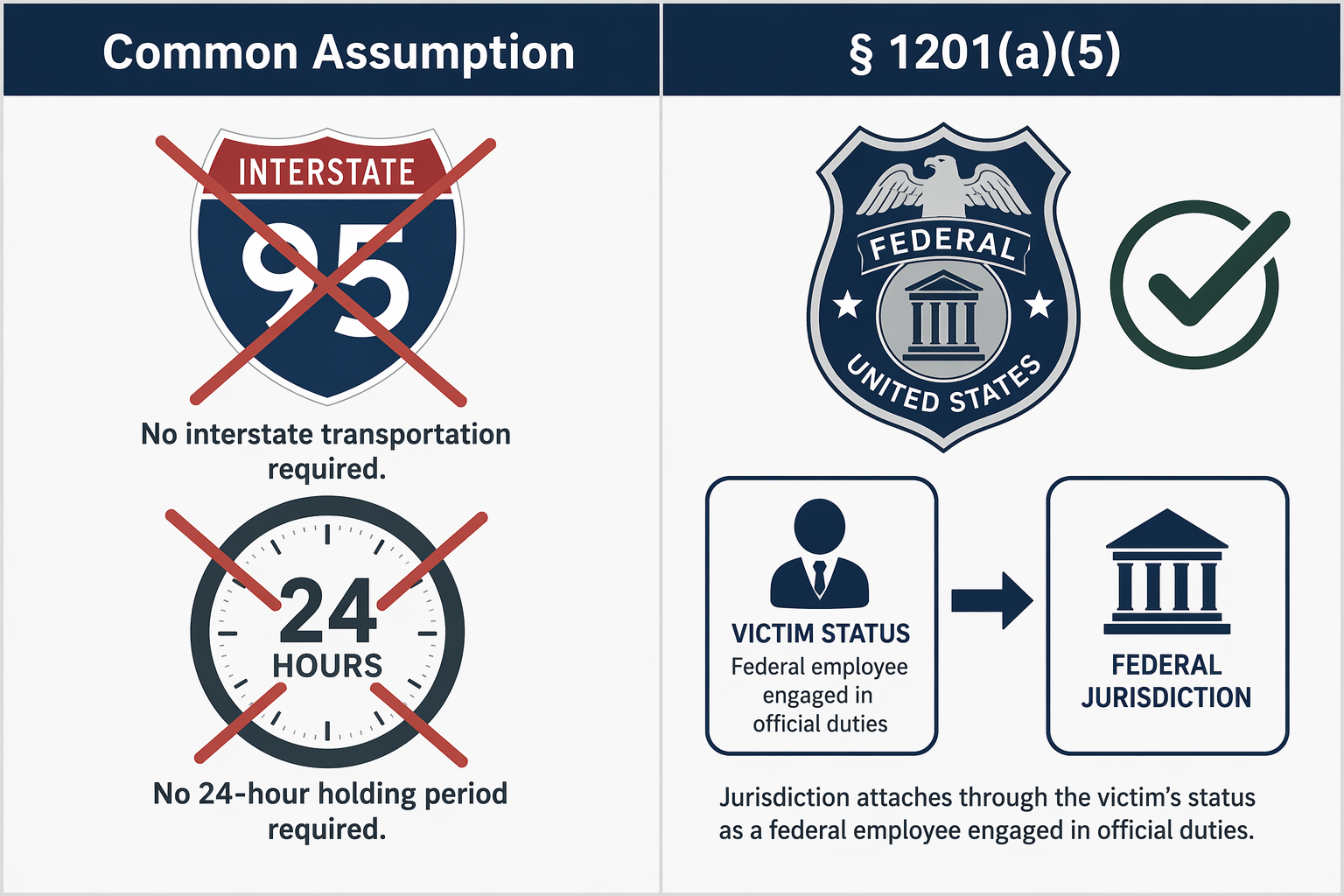
The same caution applies to the supposed “24-hour rule.” Section 1201(b) creates a presumption that, for purposes of subsection (a)(1), a victim who has not been released within 24 hours after being unlawfully seized has been transported in interstate or foreign commerce. The text ties that presumption to subsection (a)(1).[2] It is not a general federal-kidnapping waiting period, and it is not a requirement that prosecutors must satisfy before charging § 1201(a)(5).
That distinction is not academic in the Shasta-Trinity case. Reports say the employees were held for more than 12 hours.[1] That duration is grave evidence of a prolonged confinement, but it does not have to become a 24-hour presumption problem. If the victims were covered federal employees acting in their official capacity, the federal basis exists without waiting for the clock to reach a full day.
DOJ Guidance Confirms the Statutory Reading
The Justice Manual’s discussion of kidnapping a federal employee or officer treats § 1201(a)(5) as its own basis for federal jurisdiction, keyed to the victim category described in § 1114.[4] That guidance is not the statute, and it is not binding in the way statutory text is binding. But it confirms the ordinary reading: the employee’s federal status is the point.
Federal response protocols point in the same direction without doing the legal work themselves. The federal kidnapping regulations in 28 C.F.R. Part 64 address the designation of federal employees for protection and the federal response structure.[5] They help explain why a reported hostage incident involving Forest Service employees would draw federal resources, but the criminal charge still depends on § 1201 and § 1114.
Nor does National Forest System land turn the case into a pure territorial-jurisdiction exercise. California may retain concurrent criminal jurisdiction in national forests under the public-lands framework, and state charges can sometimes coexist in theory with federal charges. But that is a nuance, not the central federal hook here. The federal case does not need to prove that the land itself was the source of exclusive federal criminal jurisdiction if the charged theory is kidnapping federal employees under § 1201(a)(5).
The Exposure Is Severe, but It Is Still Exposure
The penalty language is stark. A kidnapping conviction under § 1201(a) may be punished by imprisonment “for any term of years or for life,” and if the death of any person results, the statute authorizes death or life imprisonment. The maximum fine identified for these charges is $250,000 per count.[2]
That is statutory exposure, not a sentence prediction. It does not account for the Sentencing Guidelines, criminal history, acceptance of responsibility, disputed facts, mental-health litigation, victim impact, firearms issues, grouping, departures, variances, or the eventual charging instrument. As of July 19, 2026, the posture described in the available materials is still the early complaint stage, with no indictment, plea, trial date, or guideline calculation identified.
Conspiracy does not make the exposure trivial. Section 1201(c) provides that if two or more persons conspire to violate the kidnapping statute and one or more of them does any overt act to effect the object of the conspiracy, each shall be punished as provided in subsection (a).[2] In plain terms, a kidnapping conspiracy count can carry the same potential statutory punishment as the substantive kidnapping count.
The difference between maximum exposure and likely punishment is where a great deal of federal criminal practice lives. A statutory maximum defines the outer legal ceiling. It does not tell the defendant, the victims, or the court where the case will land if there is a conviction. Treating the life maximum as a forecast would be as sloppy as treating the absence of state-line movement as a defense.
Competency Is a Procedural Question, Not a Ready Explanation
The Guardian reported that Joseph Henrichsen had previously been found incompetent to stand trial in an earlier hate-crime case.[6] If that history is substantiated in court, it may matter. Competency can affect whether a defendant can proceed, whether evaluations are ordered, and how counsel approaches litigation strategy.
It should not be treated as a portable explanation for the alleged Shasta-Trinity conduct. A prior incompetency finding in another case does not decide competency now, does not resolve criminal responsibility, and does not erase the statutory elements. It is a possible procedural issue to be developed through filings, medical records, expert evaluation, and judicial findings if the defense raises it or the court sees cause.
What Counsel and Analysts Should Take From the Case
For prosecutors, the Shasta-Trinity allegations fit the cleanest available federal theory only if the official-duty facts are solid. The complaint narrative needs to show not merely that the victims worked for the Forest Service, but that they were engaged in the kind of federal work § 1114 protects when they were seized. The reported field-work setting supplies that point, at least at the complaint stage.[1][3]
For defense counsel, the statute narrows the useful battlefield. There may be serious factual, evidentiary, mental-health, and sentencing issues. There may be disputes over what each defendant did, whether the government can prove agreement for conspiracy, what statements are admissible, and how the alleged restraint unfolded. But a defense theory that begins and ends with “this happened in California” or “the victims were not moved across state lines” misses the charged jurisdictional route.
For legal analysts, the case is a reminder to read the charged subsection before explaining the charge. Federal kidnapping is not one jurisdictional rule wearing different labels. In § 1201(a)(5), the decisive jurisdictional fact is not how far the victims were moved or whether the confinement crossed 24 hours. It is who they were and what they were doing when they were seized.
References
- Two US Forest Service employees rescued after being zip-tied, held hostage at gunpoint, NBC News
- 18 U.S. Code § 1201 - Kidnapping, Legal Information Institute
- 18 U.S. Code § 1114 - Protection of officers and employees of the United States, Legal Information Institute
- 1573. Kidnapping—Federal Employee/Officer—18 U.S.C. § 1201(a)(5), U.S. Department of Justice
- 28 CFR Part 64 - Designation of Offenses and Authorization of Federal Bureau of Investigation to Investigate Certain Crimes, Electronic Code of Federal Regulations
- Kidnapped US Forest Service employees released, The Guardian
Comments
Join the discussion with an anonymous comment.