
Full profile
For a practitioner tracking a South Africa deportation case legal update in July 2026, the first point is both simple and easy to mishandle: the Immigration Amendment Act 2026 has been signed, but its commencement depends on presidential proclamation. The new detention-review architecture is therefore the framework to prepare for, not a provision to assume is already live in every file without checking the proclamation and current Department of Home Affairs practice.
Once commenced, the Act changes the center of gravity in deportation detention. A detained undocumented foreign national must be brought before a court within 48 hours; further detention is no longer adequately described as an internal executive continuation decision. It must pass through a court order, first for a period of up to 30 calendar days and then, if justified, through a further order for up to 90 additional days, with independent judicial assessment built into the sequence. The reform has been presented as the legislative response to the Constitutional Court’s 2017 ruling in Lawyers for Human Rights v Minister of Home Affairs after a long implementation delay.[1][2][3]

The 48-hour point is now the practitioner’s first deadline
The practical shock is not that courts have appeared somewhere in the deportation process. South African constitutional law had already required judicial control over immigration detention. The practical shock is that the amended statutory sequence gives lawyers a calendar: 48 hours, then a possible 30 calendar days, then a possible 90 additional days. Miss the first window and the damage is procedural before the merits of removal are even reached.
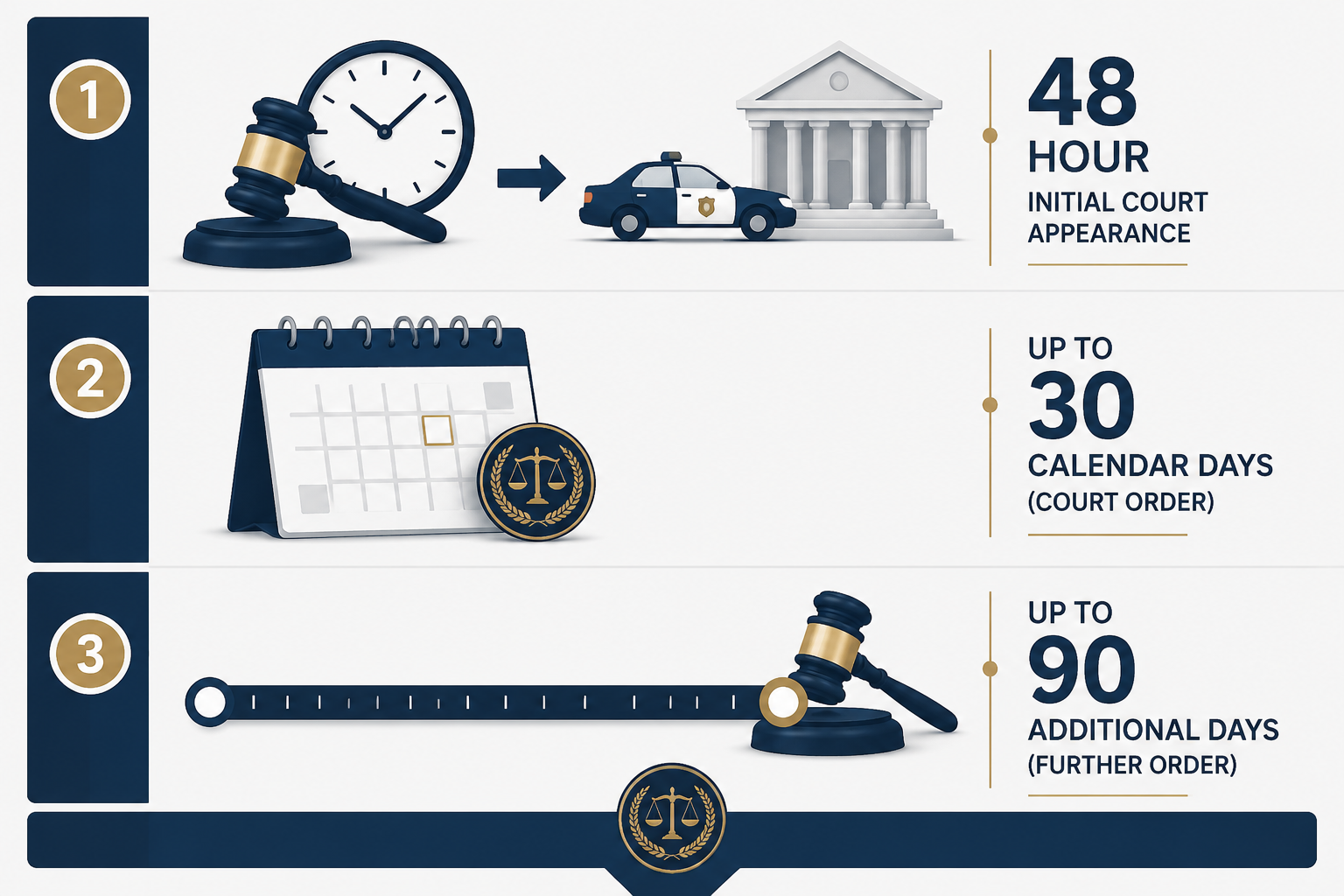
| Stage | What must happen | Practice consequence |
|---|---|---|
| Initial detention | Court appearance within 48 hours | Confirm time of apprehension, detention location, access to the detained person, and whether a court appearance has been scheduled. |
| First continued-detention period | Court may authorize detention for up to 30 calendar days | Prepare to test the legal basis for detention, identity or documentation issues, removal feasibility, asylum-related facts, and access-to-counsel problems. |
| Further continued-detention period | Court may authorize up to 90 additional days on further order | Require a fresh justification, not a mechanical rollover of the first order. |
That sequence matters because detention authority and removal administration are no longer the same question. A person may be removable under immigration law, but continued detention still requires judicial authorization within the statutory limits. The court is not merely receiving a file after the Department has finished the decisive work; it is being placed inside the detention timetable.
The distinction should affect intake immediately. Counsel should ask for the arrest or apprehension time, not only the date. A Friday evening detention, a public holiday, or transfer between facilities may decide whether the 48-hour issue is live. The file also needs a separate chronology for court production, detention orders, attempted removal steps, asylum-related communications, and interpreter access. Those facts do not all answer the same legal question.
The Act responds to Lawyers for Human Rights, but commencement still controls
The Lawyers for Human Rights litigation is the constitutional reason the 2026 amendments cannot be treated as routine housekeeping. The Constitutional Court held in 2017 that detention under the Immigration Act required judicial oversight, and commentary before the 2026 Act continued to identify due process risk in deportation without timely court supervision.[3]
The statute is also a reminder that signature and operation are different legal events. Business Day and practitioner commentary reported that the Immigration Amendment Act 2026 was signed in May 2026 and would take effect on a date set by presidential proclamation.[1][2] As of the July 2026 materials used for this update, practitioners should not assume that every operational Department of Home Affairs change contemplated by the amendment is fully in effect.
The safe advice is therefore conditional in form: if the relevant provisions have commenced for the file, the 48-hour court-production requirement and the court-ordered detention periods must be treated as operative constraints; if commencement has not occurred, the constitutional judgment and existing statutory position still have to be analyzed, but the new section 34 framework should not be cited as though it were already in force.
Virtual Priority Court sessions are operational, but labels matter
The government’s court-facing enforcement work is already visible. The Department of Justice and Constitutional Development described a Virtual Priority Court at Durban/Sherwood, with Deputy Minister Andries Nel visiting the site in June 2026.[4] Government statements also referred to special arrangements connected to immigration matters, including planned court capacity at OR Tambo International Airport.[5]
Those arrangements should not be described too loosely. The materials support the existence of special court sessions or operational priority arrangements for immigration matters; they do not, on their own, establish a fully separate statutory immigration court system. For jurisdictional objections, forum authority, appeal routes, and record requests, that distinction is not cosmetic. A “dedicated immigration court” label may be operationally useful and legally imprecise at the same time.
The reported volumes explain why the state has moved toward priority court processing. Official statements said the Durban/Sherwood Virtual Priority Court was processing about 80 matters per day and had finalized 2,640 deportation cases between 1 June and 9 July 2026, with 2,173 matters from the eThekwini special courts alone.[4][5] Those are official figures, not independently audited case outcomes, and they should be cited that way.
Official enforcement figures show scale, not independent verification
The enforcement numbers in the public statements are large enough to affect legal workload. GCIS reported that, by 11 July 2026, 53,449 foreign nationals had been processed for deportation or repatriation through the Temporary Repatriation Processing Centre in Musina.[5] A separate government statement reported 2,519 joint compliance operations from April to June 2026, resulting in 15,398 deportations.[6]
Those figures are useful for understanding pressure points: detention centers, border processing, employer inspections, court rolls, interpreter capacity, and the speed at which files may move before a lawyer has complete documents. They should not be converted into independent findings about legality, accuracy of status determinations, or compliance with non-refoulement obligations. A processing number measures administrative throughput. It does not answer whether each person had a lawful hearing, whether an asylum claim was properly identified, or whether removal was permissible.
For representatives, the operational consequence is that the court file and the Home Affairs file may not move at the same pace. The court may see a detention question inside a high-volume list; Home Affairs may be managing identity verification, travel documents, detention logistics, and removal arrangements; counsel may be trying to obtain instructions from a person who has already been transferred. The 48-hour rule makes those coordination failures legally significant.
Asylum decisions now sit in a tighter constitutional space
Two Constitutional Court developments complicate the deportation file that also contains asylum history. In Irankunda, decided on 12 May 2026 under CCT 214/24, the Court addressed repeat asylum applications. In Scalabrini, decided in July 2026 under CCT 126/25, the Court reaffirmed the force of non-refoulement even where entry was illegal.
The cautious reading is that these decisions do not collapse into a single rule. Limits on repeat asylum applications do not license removal in breach of non-refoulement. At the same time, non-refoulement does not make every later asylum-related assertion procedurally identical to a first application. A deportation lawyer needs the application history, refusal history, appeal or review status, and any new protection facts before deciding which judgment carries the immediate procedural weight.
This is also where the new detention timetable can matter most. If protection issues exist, they must be raised before detention authorization becomes routine. The first appearance may be the first practical opportunity to force the record to show that removal is contested on protection grounds, that documents are missing, or that Home Affairs has treated an asylum-related issue as an administrative inconvenience rather than a legal bar.
The employment bill is a separate proposed-law track
The Employment Services Amendment Bill 2026 belongs in the same compliance conversation, but not in the same legal box. As of late June 2026, it was still at the public participation stage; its employer obligations and civil penalty provisions were proposed, not enacted.[5][6] It should not be pleaded or advised as though it were already part of the Immigration Amendment Act 2026.
For in-house counsel and compliance officers, that line is important. Immigration status verification, right-to-work checks, document retention, and response plans for inspections are already practical necessities. Proposed employment-law penalties may increase the cost of failure if enacted, but proposed penalties are not current liabilities merely because enforcement rhetoric has intensified.
What should change in files now
The immediate adjustment is procedural discipline. A practitioner should verify commencement before citing the amended detention framework, but should prepare as though court-supervised detention will be the working model in new matters. That means building the file around time, authority, and reviewability from the first call.
- Verify whether the relevant Immigration Amendment Act 2026 provisions have commenced by presidential proclamation before relying on the new section 34 process.
- Record the exact time and place of apprehension, not only the date of detention.
- Ask whether a court appearance has occurred within 48 hours and obtain the order, transcript, or court record where possible.
- Separate removability, detention authority, asylum protection, and employer-compliance exposure into distinct issues.
- Treat Virtual Priority Court and OR Tambo references as operational court arrangements unless a statutory source establishes something more.
- Attribute deportation, processing, and court-volume figures to GCIS, DOJCD, or the relevant government statement rather than presenting them as independently verified data.
The largest risk in the transition period is overstatement in either direction. It is wrong to ignore the 2026 framework because proclamation and implementation details still need checking. It is also wrong to advise that every announced operational practice has already become a commenced statutory rule. The file should show which source is doing the work: enacted amendment, commenced provision, court judgment, official operational statement, or proposed bill.
References
- Immigration law reform gives courts greater role in deportations, Business Day, 10 June 2026.
- Beware! Breaching South Africa's immigration laws has its consequences, Cliffe Dekker Hofmeyr, 22 June 2026.
- Deportation without due process? Rethinking constitutional compliance in immigration law, De Rebus, November 2025.
- Deputy Minister Nel's visit to the Virtual Priority Court, Department of Justice and Constitutional Development, 17 June 2026.
- Inter-Ministerial Committee update on the comprehensive approach on migration, GCIS, 13 July 2026.
- Media statement by the Inter-Ministerial Committee on migration, South African Government, 26 June 2026.
- 2025 Overview: Developments in South African Immigration Law, Cliffe Dekker Hofmeyr, 10 November 2025.
Comments
Join the discussion with an anonymous comment.