
Full profile
What the reporting says, and what it does not
On July 17, 2026, Reuters and Bloomberg Law reported that SpaceX was in talks to supply the Pentagon with computing power, with no final terms public and the negotiations still open.[1][2] That is not the same thing as a software-access deal. The Pentagon's May 2026 agreements with eight AI companies were about bringing AI onto classified networks; this one points to the compute layer itself, which is a different legal and operational problem.[3][4]
Why the vehicle matters
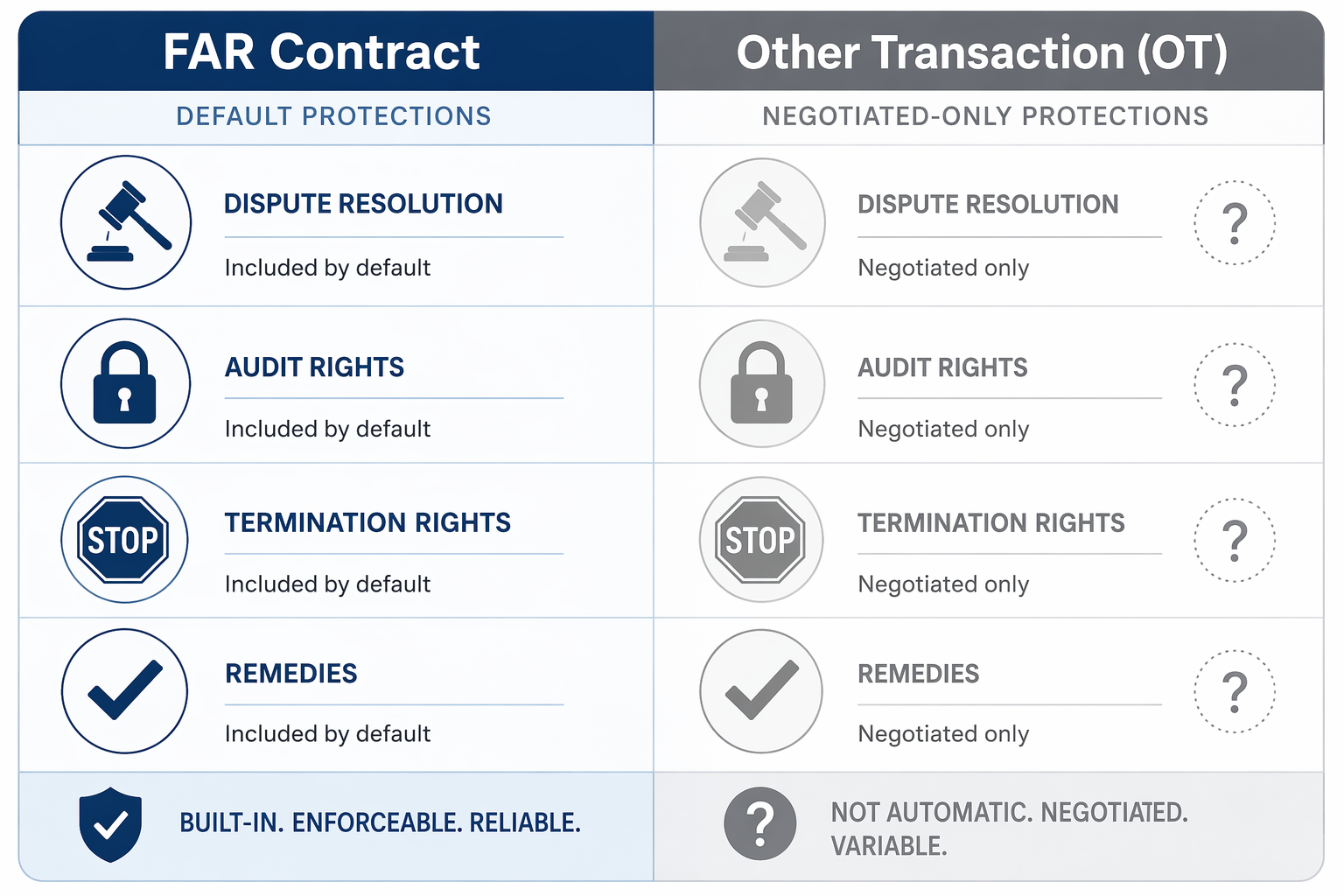
The legally important assumption to test is that this will be structured as an Other Transaction. That is the pattern the Pentagon has used repeatedly for recent AI work, and it matters because OTs are negotiated instruments, not FAR contracts with ordinary default enforcement machinery baked in.[5][7] Tillipman's contract-governance point is blunt: once deployment runs through an infrastructure provider, the real rights may be spread across several layers, so the government's direct agreement with the vendor is only part of the picture.[5][6]
- Disputes: an OT does not automatically bring the Contract Disputes Act framework with it; the disagreement process has to be written into the deal.[5][6]
- Termination: exit rights, cure periods, and remedy paths exist only to the extent the parties negotiated them.[5][6]
- Audit and access: if the government wants visibility or operational reach, those rights have to be drafted across the relevant layers instead of assumed from procurement law defaults.[5][6]
That distinction is not abstract. Conetta's February 2026 review of OT use found that DIU uses OTs for 88% of its transactions, and that CDAO can award AI OTs up to $200 million.[7] In other words, the Pentagon has already moved a lot of its AI buying into a negotiated-rights model. The question in the SpaceX talks is not whether that model is legal. It is what leverage it actually gives the government when the service it is buying sits inside a contractor-controlled stack.
Why SpaceX is a harder case than a pure software vendor
SpaceX is not only a launch company or a model reseller. It already shows up as a defense contractor with a large existing footprint: Space News reported in May 2026 that SpaceX won a $2.29 billion Space Force SDN Backbone OTA, with a fully operational prototype due by the end of 2027, and a House Oversight Committee letter from April 2025 put SpaceX's active defense contracts at least $9.5 billion, including a $1.8 billion classified NRO contract.[8][9] SpaceX also operates the Colossus 1 data center and has a multi-year cloud arrangement with Google involving about 110,000 Nvidia chips. That matters because the government is not just buying access to code. It is dealing with a contractor that already has defense-business gravity, infrastructure control, and a record of operating in classified environments.

Once the bargain depends on physical compute capacity, the enforcement question gets sharper. If the relevant chips, network paths, or facility access sit under SpaceX's control, a Pentagon lawyer can negotiate for termination rights, audit rights, service continuity, and use restrictions at one layer and still discover that the operational choke points live somewhere else. That is the classic contract-as-governance problem, but here the infrastructure owner is also the party the government depends on to make the system usable at all.[5][6]
What the other AI deals do, and do not, prove
The May 2026 eight-company classified-network agreements show that the Pentagon is already normalizing AI procurement through negotiated arrangements rather than a single uniform software contract.[3][4] But those deals mostly illustrate the range of bargaining positions, not a turnkey enforcement model. OpenAI publicly described an agreement that preserved its own discretion over classifiers, while the ongoing Anthropic fight shows how quickly disputes turn into questions about who controlled what the paper actually said.[10][11] Those examples are useful only as contrasts: they show that public policy language and actual contract rights are not the same thing.
So the narrow conclusion is the one that matters. If the SpaceX computing deal is an OT, the Pentagon's leverage will come from whatever termination, audit, dispute, access, and continuity terms were actually negotiated across the relevant layers. When a contractor also controls the infrastructure, enforceability is not a synonym for policy preference. It is the text of the deal, and the stack underneath it.
References
- Reuters, July 17, 2026: Musk's SpaceX in talks to supply the Pentagon with computing power
- Bloomberg Law, July 17, 2026: SpaceX in Talks to Sell Computing Power to Pentagon, WSJ Says
- The Guardian, May 1, 2026: Pentagon inks deals with eight AI companies for classified military work
- Nextgov, May 2026: Pentagon makes agreements with 8 companies to add AI to classified networks
- Tillipman, Lawfare, March 2026: Military AI Policy by Contract: The Limits of Procurement as Governance
- Tillipman, Nextgov, March 2026: What rights do AI companies have in government contracts?
- Conetta, JOLT Richmond, February 2026: OTA: The Government's Favorite Tool for Acquiring Innovative Technology
- Space News, May 2026: SpaceX wins $2.29 billion Space Force contract for military data network
- House Oversight Committee, April 2025: Reps. Lynch and Connolly investigation letter citing $9.5B in SpaceX defense contracts
- OpenAI, 2026: Our agreement with the Department of War
- Digital Applied, 2026: Anthropic vs Pentagon: Legal Battle Reshaping Federal AI Policy
Comments
Join the discussion with an anonymous comment.