
Full profile
A Subaru owner looking up subaru recall legal options for owners after the July 2026 recall should start with the least dramatic answer: this recall likely gets the owner a corrected certification label, not an automatic lemon law claim. The useful legal fact is narrower. Subaru has now admitted a federal nonconformity tied to specified vehicles and a specified recall number, and that admission has a date, a scope, and a notice schedule.
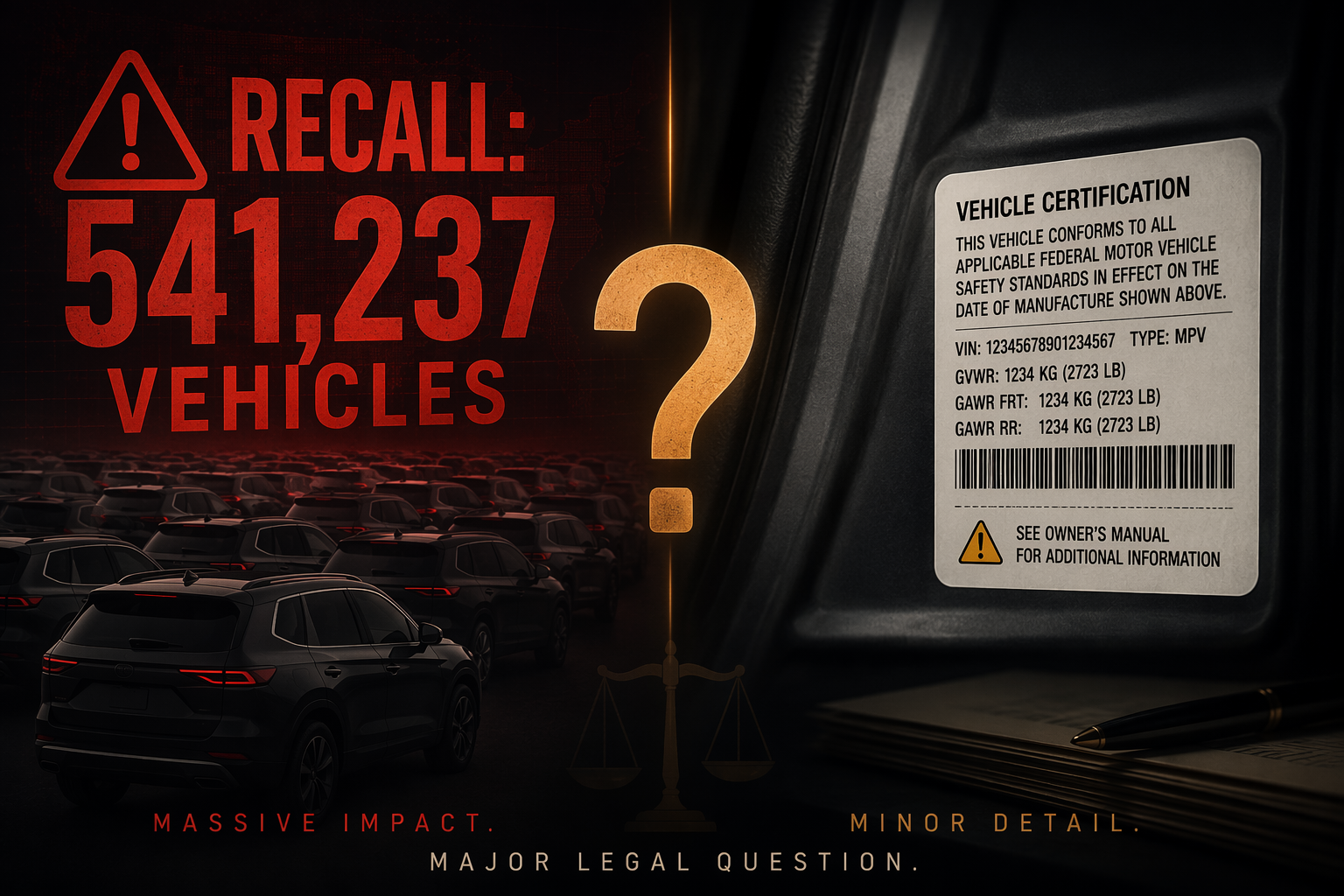
That distinction matters because the recall is large but the alleged defect is not a failed transmission, braking system, battery module, or software platform. NHTSA recall 26V436000, Subaru recall code WRH-26, covers 541,237 vehicles because the vehicle certification labels may show incorrect maximum load capacity information, creating a noncompliance with Federal Motor Vehicle Safety Standard 110. Reported coverage includes 383,800 2019–2026 Ascent vehicles, 49,849 2025–2026 Forester vehicles, 77,504 2025–2026 Forester Hybrid vehicles, and 29,297 2026 Crosstrek Hybrid vehicles; owner notification letters are scheduled to begin August 25, 2026.[1]
What the Recall Proves, and What It Does Not
The recall proves that Subaru identified a label nonconformity affecting the listed model years and that owners should receive a recall remedy through the federal recall process. It does not, by itself, prove that an owner’s vehicle is unusable, unsafe in operation, worth less in a compensable way, or repeatedly unrepairable under a state lemon law. A weight-rating label defect can matter, especially if an owner relies on the label for loading decisions, but it is not the same evidence as a repair order documenting repeated CVT shudder complaints or a battery that repeatedly dies while parked.
For claim evaluation, the recall creates a clean documentary anchor. It identifies the manufacturer’s admission, the affected population, the federal standard involved, and the point at which owner notice begins. If the client’s only problem is the sticker, the remedy analysis usually stays close to the recall campaign. If the client also has a repair history for a covered defect, the same recall file may become part of a broader chronology rather than the case itself.
| Question | Why it matters |
|---|---|
| Is the vehicle in the WRH-26 recall population? | It determines whether the owner has the federal recall remedy for the label nonconformity. |
| Has Subaru or a dealer already corrected the label? | A completed sticker remedy may leave little recall-specific dispute unless another defect exists. |
| Are there repair orders for mechanical, electrical, or driver-assistance complaints? | Those records, not the label recall alone, usually drive lemon law and warranty analysis. |
| Which state’s law applies? | State lemon laws differ on notice, repair attempts, time, mileage, presumptions, and remedies. |
| Is the alleged defect already in a pending or closed class action? | Class posture can affect strategy, deadlines, releases, and whether an owner should pursue an individual claim. |
The Repair History Is Where the Case Usually Changes
The owner who has made one visit for a corrected certification label is in a different position from the owner who has three repair orders for transmission shudder, two battery replacements, and a dealer note saying the vehicle operates as designed. The first owner may have a recall completion issue. The second owner may have a warranty or lemon law file, with the recall serving only as one piece of context.
Subaru owner complaints that commonly appear in lemon law advertising and warranty litigation discussions include CVT transmission shudder, excessive oil consumption, battery or electrical drain, Starlink software failures, and EyeSight malfunctions. Those categories are distinct from the July 2026 label recall, and they should not be merged into it merely because the same owner or model family is involved.[2][3][4]
The practical sorting exercise is blunt. A sticker-only owner needs recall completion. An owner with a persistent drivability or electrical complaint needs the warranty file: purchase or lease date, in-service date, mileage at each visit, repair orders, technician notes, parts replaced, software updates, days out of service, and any communications with Subaru. Without that paper trail, a large recall number does very little work.
Federal Recall Rights Come First, but They Are Narrow
The recall channel answers a limited question: what must be done to correct the recalled noncompliance. For WRH-26, the reported remedy is tied to the incorrect weight-rating label, and owners should receive notice beginning August 25, 2026.[1] If a dealer refuses the recall repair, cannot confirm recall applicability, or leaves the campaign unresolved, that is a different problem from proving that the vehicle is a lemon.
This is where some owner-facing messaging becomes unhelpful. A recall can coexist with a lemon law claim, but it does not automatically create one. Lemon law theories generally depend on whether a defect substantially impairs use, value, or safety; whether the manufacturer received a reasonable opportunity to repair; and whether the claim satisfies the controlling state statute. A mislabeled load-capacity sticker may be actionable as a recall noncompliance, but the available record does not support treating every recalled Ascent, Forester, Forester Hybrid, or Crosstrek Hybrid as a repurchase candidate.
Pending Subaru Class Actions Are a Map, Not a Payout Promise
Two May 2026 filings make the broader Subaru litigation landscape more complicated than the label recall alone. Hall v. Subaru of America, filed May 11, 2026 in the District of New Jersey as case number 1:26-cv-05266, alleges that EyeSight autonomous emergency braking systems in 2022–2026 Subaru vehicles can engage in phantom braking or fail to activate. The complaint also points to at least 12 Subaru technical service bulletins concerning EyeSight issues since 2012.[5]
A separate class action filed May 14, 2026 alleges a sleep-state electrical defect in 2019–2025 Subaru vehicles, claiming batteries drain while vehicles are parked.[6] For an attorney evaluating a current owner, that filing may matter if the client’s complaint is repeated no-start events, battery replacements, parasitic draw testing, or dealer statements that the vehicle passed inspection despite recurrent failure.
Neither filing should be treated as a resolved finding of defect or liability. A complaint alleges; it does not prove. But complaints can still be useful in intake and legal operations work because they identify pleaded defect theories, model-year ranges, technical documents, and recurring fact patterns to compare against an individual repair file.
The older EyeSight settlement belongs in the chronology, but not in a current claims pitch. The settlement received final approval on November 5, 2025, covered model year 2013–2024 Legacy, Outback, Impreza, Crosstrek, Forester, Ascent, WRX, and 2022–2024 BRZ vehicles, and provided a warranty extension of four years or 48,000 miles at 75% cost coverage, along with 75% reimbursement for certain past repairs. It excluded items such as brake pads, rotors, windshields, and environmental causes. The claim deadline was September 27, 2025, and it is now closed.[7][8]
There is also a pending Ahdoot & Wolfson investigation into alleged pre-collision braking defects in 2023–2026 Subaru models, but the available material describes an investigation rather than a filed complaint. That makes it a lead to monitor, not a litigation event to cite as if it had already survived a pleading challenge.[9]
How an Attorney Sequences the Options
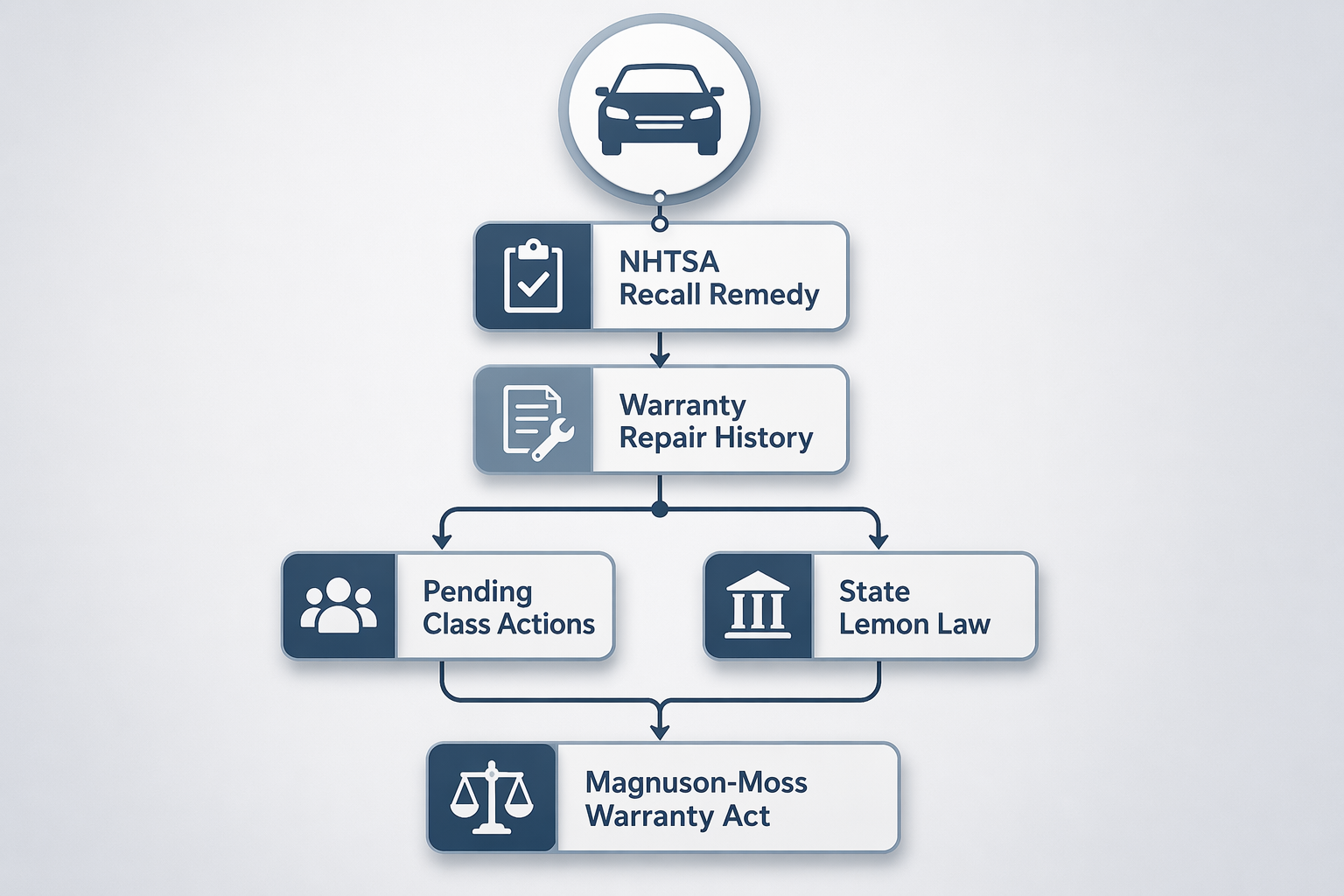
The cleanest sequence is not the most exciting one. First, confirm the recall. Second, collect the warranty record. Third, check whether the defect overlaps with active or closed class litigation. Fourth, apply the relevant state lemon law. Fifth, consider Magnuson-Moss if the warranty facts support a federal claim.
| Channel | Best use | Main limitation |
|---|---|---|
| NHTSA recall remedy | Corrects the admitted label nonconformity for covered vehicles | Does not itself prove repeated repair failure or substantial impairment |
| Warranty repair history | Shows what the owner complained about, what Subaru attempted, and whether the defect persisted | Weak records can sink otherwise plausible owner narratives |
| Pending class action | Identifies common defect theories and affected model-year allegations | Allegations are not findings, and individual owners may have different strategic interests |
| Closed settlement | May explain prior releases, deadlines, or historical warranty extensions | Missed deadlines and settlement scope can bar or limit benefits |
| State lemon law | Can support repurchase, replacement, damages, fees, or penalties where statutory requirements are met | Rules vary materially by state and often depend on timing, mileage, notice, and repair attempts |
| Magnuson-Moss Warranty Act | Provides a federal warranty overlay when covered defects are not repaired within a reasonable period | Still depends on a viable warranty defect and proof of failed repair |
This sequencing avoids a common category error. The July 2026 recall may be the event that sends a Subaru owner to counsel, but the owner’s legal options often turn on a different defect. A lawyer may begin with WRH-26, then spend most of the file on whether the CVT complaint was duplicated, whether a battery draw test was performed, whether an EyeSight calibration failed, or whether Starlink software repairs changed anything.
State Lemon Law Analysis Cannot Be Flattened
State lemon laws are not interchangeable. Some statutes use presumptions tied to repair attempts or days out of service. Some require defects to arise within a particular time or mileage window. Some treat notice, arbitration, civil penalties, and fee shifting differently. The research base here is strongest for selected states, not for a full 50-state survey, so a responsible evaluation stops short of universal claims.
California deserves a concrete note because Subaru publishes a specific pre-suit notice procedure for civil penalties under the Song-Beverly Consumer Warranty Act. Before filing a civil action seeking civil penalties, the consumer must provide written notice at least 30 days before suit, sent by certified or registered mail to Subaru’s Customer Advocacy Department or by email to [email protected].[10]
That notice requirement is procedural, but it is not clerical. A California case that might otherwise have leverage can lose value if the notice step is mishandled. The notice should not be treated as a formality to complete after the complaint is drafted; it belongs in the early case calendar with the purchase documents, repair orders, warranty materials, and correspondence log.
Magnuson-Moss Is the Federal Overlay, Not a Shortcut Around Proof
The Magnuson-Moss Warranty Act can matter when a Subaru owner has a covered defect that the manufacturer or dealer failed to repair within a reasonable period. Unlike state lemon law statutes, the federal warranty framework is not defined by the same state-specific age, mileage, or repair-attempt caps, although the claim still depends on warranty coverage, defect proof, and the repair history.[11]
Magnuson-Moss does not convert a label recall into a mechanical-defect case. It helps most when the owner’s documents show a covered problem that persisted through reasonable repair opportunities: recurring battery drain after replacement, repeated EyeSight complaints after calibration or software work, continuing transmission symptoms after dealer intervention, or unresolved oil consumption concerns. The recall file can sit beside that proof, but it cannot replace it.
Where the July 2026 Recall Fits in a Real File
A useful Subaru file after this recall has two timelines. The first is the recall timeline: affected model, recall code, notice date, remedy availability, and completion. The second is the defect timeline: first symptom, first dealer visit, mileage, repair attempt, recurrence, escalation to Subaru, and any days out of service. The legal analysis changes only when those timelines intersect in a way that affects use, value, safety, warranty performance, or statutory compliance.
If the owner’s only Subaru problem is an incorrect certification label, the likely path is the recall remedy. If the owner also has repeated service visits for CVT shudder, oil consumption, battery drain, Starlink failures, or EyeSight malfunction, the recall becomes one dated admission in a larger evidentiary record. The July 2026 Subaru recall is not a standalone lemon-law trigger, but it can become useful evidence when it is paired with documented repair history and the correct state or federal claim framework.
References
- Subaru recalls more than 541,000 vehicles over incorrect weight capacity labels, CBS News, July 2026.
- Subaru Lemon Law, Ginsburg Law Group.
- Subaru Lemon Law Lawyer, Mousavi Law.
- Subaru Lemon Law, Quill & Arrow Law.
- Subaru Class Action Says EyeSight Automatic Braking Defect Can Cause Sudden Stops, Crashes, ClassAction.org, May 2026.
- Subaru Class Action Alleges Electrical Defect Drains Vehicle Batteries While Parked, ClassAction.org, May 2026.
- Subaru EyeSight Settlement, EyeSightSettlement.com.
- Subaru EyeSight Class Action Settlement, ClaimDepot.
- Subaru Pre-Collision Braking Defect Investigation, Ahdoot & Wolfson.
- California Written Notice Claims, Subaru.
- Vehicle Recalls and Your Legal Rights, FindLaw.
Comments
Join the discussion with an anonymous comment.