
Full profile
The Sullivan Cromwell AI hallucination filing is not troubling because an AI tool produced bad legal output. That part is now familiar. The harder fact is that the filing came from Sullivan & Cromwell in a Southern District of New York Chapter 15 case, after the firm had mandatory AI training, tracked completion, repeated hallucination warnings, and an instruction that lawyers should “trust nothing and verify everything.” Even with that infrastructure, the firm had to tell Judge Martin Glenn that a court filing submitted on April 9, 2026 contained extensive citation problems, then file an April 18 apology and correction before an April 22 hearing.[1][2]
The error count is not perfectly settled across the public reporting, and it should not be treated as if it is. ABA Journal described “around three dozen” errors; CNN reported more than 40 errors in a three-page ledger of citations.[2][3] The underlying problem, however, is not in doubt: some authorities were reportedly fabricated, while others were real cases misquoted or used for propositions they did not support.[2][3]
The Filing Was Not a Low-Stakes Experiment
The filing arose in the Prince Global Holdings Chapter 15 bankruptcy proceeding, a matter connected to a roughly $9 billion bitcoin seizure and a Department of Justice forced-labor indictment.[1][4] That context matters because it changes the risk profile. This was not a stray research memo, an internal sandbox, or a lawyer testing a new product in isolation. It was a federal court filing in a contested, high-profile proceeding.
It also matters that the problem did not surface because the firm’s controls caught it before filing. According to the public reports, opposing counsel at Boies Schiller Flexner identified the errors, after which Sullivan & Cromwell voluntarily alerted the court.[1][2] That sequence is the risk lesson. A written policy may have existed inside the firm, but the operative detection point was outside it.
April 9 to April 22: The Short Window That Exposed the Review Chain
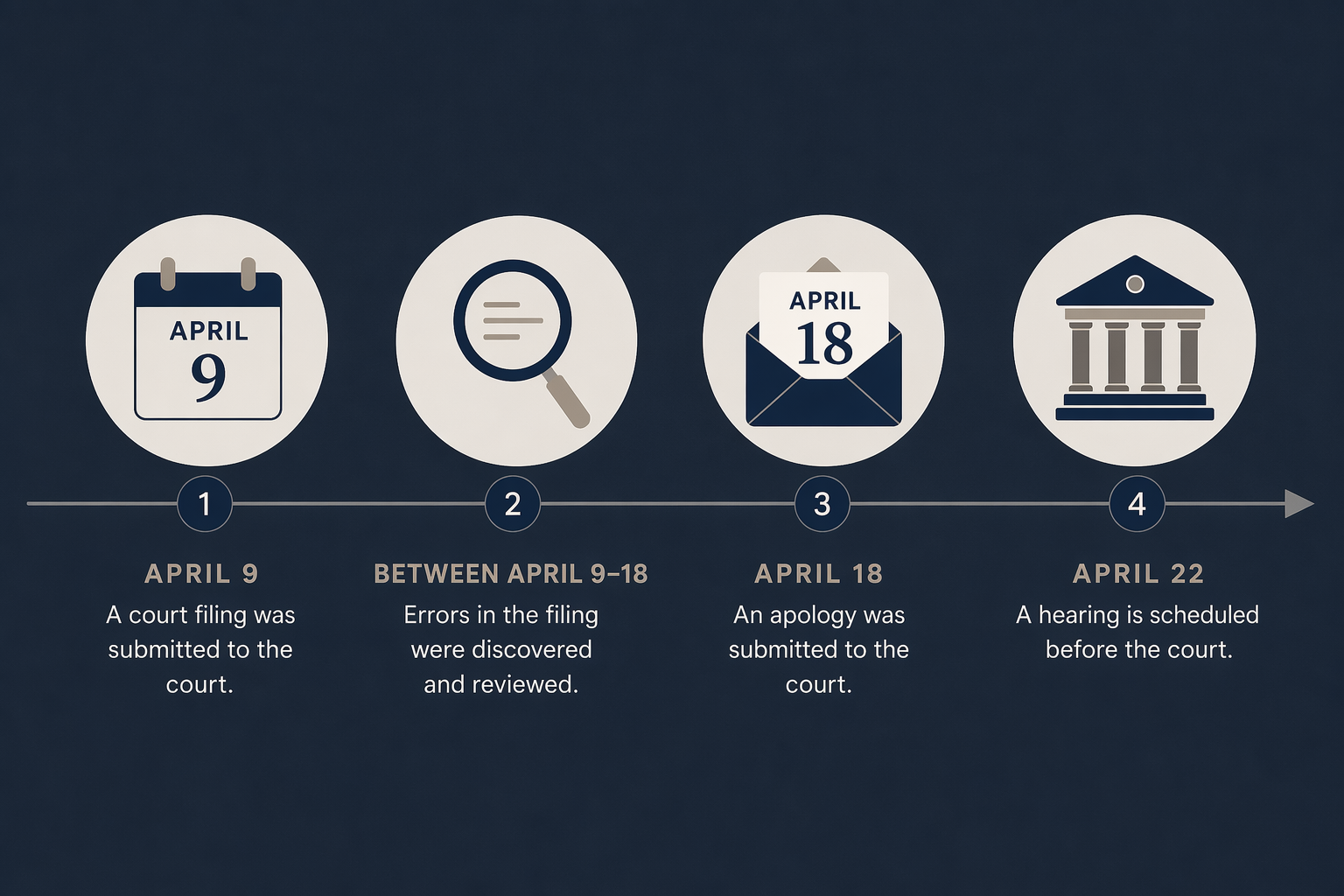
The timeline is compact enough to look almost procedural, but it is exactly where the failure becomes visible. Sullivan & Cromwell submitted the filing on April 9. Opposing counsel later found citation errors. The firm voluntarily notified the court and, on April 18, partner Andrew Dietderich submitted an apology letter with a corrected redline. Judge Glenn held a hearing on April 22.[1][2][3]
The firm’s response was not evasive in the materials reported. Dietderich’s apology acknowledged the problem, offered corrected papers, and described existing safeguards as well as promised enhancements to review procedures.[1][2] That candor matters. It also does not answer the operational question: how did a filing with so many citation defects make it through review in the first place?
As of the April reporting, Judge Glenn had not imposed sanctions or issued a final sanctions ruling tied to the incident.[1][3] That should restrain the analysis. The public record supports discussion of a serious filing failure and a public repair effort. It does not support treating sanctions as already decided.
What Was Wrong With the Citations
The reported defects were not all the same kind of mistake. Some citations allegedly pointed to cases that did not exist. Others involved real authorities that were misquoted or mischaracterized.[2][3] That distinction is important for risk review because fabricated authority and distorted authority create different verification burdens. A cite-check can catch a non-existent case. A lawyer still has to read the case closely enough to know whether the quoted proposition is actually there.
This is where “AI hallucination” can become too soft a phrase. The downstream effect is not merely that a machine generated unreliable text. The court received a filing with a defective record of legal authority. Opposing counsel had to spend time locating and documenting the defects. The firm then had to correct the filing publicly. Those are litigation costs, not just technology glitches.
Sullivan & Cromwell Had the Kind of Policy Many Firms Are Still Trying to Build
The uncomfortable feature of the Sullivan Cromwell AI hallucination filing is that the firm was not operating in a governance vacuum. In the apology materials described by Bloomberg Law and ABA Journal, Sullivan & Cromwell said it had mandatory AI training with two modules, tracked and verified completion, repeated warnings about hallucinations, and an instruction to “trust nothing and verify everything.”[1][2]
Those are not trivial controls. They are the kinds of measures law firm risk committees now discuss when they try to translate professional responsibility guidance into everyday practice: training, documented completion, user warnings, and express verification duties. But this incident shows the limit of treating policy presence as policy performance.
The firm also did not disclose which AI tool was used or identify which specific lawyers prepared the filing, according to the reporting.[1][2] That leaves an important boundary around the facts. This incident should not be turned into a tool-specific indictment. The better-supported reading is about workflow: whatever tool produced or influenced the defective material, the filing process did not force citation-level verification before submission.
The Failure Point Was Not the Written Warning
A warning that AI can hallucinate is useful only if the next step in the workflow makes verification unavoidable. Otherwise, it becomes one more instruction competing with timing pressure, drafting pressure, partner review pressure, and the ordinary habit of trusting work that has already passed through respected hands.
The apparent gap in this matter sits at the handoff. Someone or some team generated, incorporated, or relied on AI-contaminated legal material. The filing then moved forward without a review mechanism that reliably tested each cited authority against the proposition for which it was used. A partner-level review can be searching on strategy, tone, and argument structure while still missing citation-level defects if no one is assigned to verify every authority as a condition of filing.
That is why reducing the episode to “one lawyer failed to check the cites” is too neat. It may be satisfying, but it avoids the more useful governance question. In a large firm, the filing is the product of a chain: drafting, research, cite collection, revision, partner review, finalization, and filing. A policy can tell every person in that chain what should happen. A workflow decides whether the chain can continue when it has not happened.
Candor Helped the Repair, but It Did Not Undo the Event
Sullivan & Cromwell’s voluntary alert and apology are part of the record and should not be brushed aside.[1][2] There is a real difference between a firm that discloses and corrects a problem and a firm that waits for the court to uncover it. But candor operates after the defective filing has already entered the system. It can mitigate a response; it cannot make the court’s lost time, opposing counsel’s burden, or the public correction disappear.
Other hallucination cases show the same narrow point without predicting what Judge Glenn will do here. In the Sixth Circuit’s Farris matter, Norton Rose Fulbright reported that an attorney faced consequences including removal from a Criminal Justice Act panel and loss of compensation despite candor and a long clean record.[5] That comparison is useful only up to a point. Different court, different facts, different procedural posture. The shared lesson is that disclosure may matter greatly, but it is not a reset button.
The Broader Hallucination Numbers Add Scale, Not the Main Proof
The legal profession no longer needs the Sullivan & Cromwell incident to prove that hallucinated filings exist. Damien Charlotin’s AI Hallucination Cases Database listed 1,696 hallucination cases globally and 459 involving U.S. lawyers as of July 3, 2026.[6] Norton Rose Fulbright’s 2026 litigation update separately reported more than $145,000 in AI hallucination sanctions in the first quarter of 2026, describing it as a record quarterly total.[5]
Those figures are useful context, not official court statistics. They come from third-party tracking and reporting, and they should be read that way. Their value here is to show that the Sullivan & Cromwell episode landed in an already visible pattern. Its significance is narrower and sharper: an elite firm with formal controls still produced a public filing failure in a major federal case.
What This Means for Firms That Already Have AI Policies
The lesson is not that law firms cannot use AI without courting disaster. The record does not support that broad claim. It is also not that training is pointless. Training gives lawyers the vocabulary and warning signs they need. The Sullivan & Cromwell incident instead exposes a more practical failure: policy did not translate into a hard stop before filing.
For a firm risk committee, the relevant questions are concrete. Who verifies that each cited case exists? Who confirms that each quoted proposition appears in the case? Who reviews changes after a redraft? What happens if a partner approves the argument but no one has completed the cite-level check? Can the filing be submitted anyway? If the answer to that last question is yes, the AI policy is still depending on informal discipline at the moment when formal process is most needed.
That distinction matters beyond AI. Litigation teams have always depended on handoffs. AI raises the stakes because it can produce plausible-looking authority at scale, and because a reviewer may see clean formatting, confident phrasing, and familiar legal cadence before seeing the missing foundation. A traditional typo usually looks like a typo. A hallucinated citation can look like research until someone checks it.
The Sullivan Cromwell AI hallucination filing should therefore make firms less comfortable with governance artifacts that live outside the filing path. Training records, warnings, and written directives are necessary evidence of seriousness. They are not the same as a workflow that prevents submission until verification is complete. Elite infrastructure is not self-executing. A policy can tell lawyers to verify everything; a filing workflow has to make verification unavoidable before the document leaves the firm.
References
- Sullivan & Cromwell Apologizes to Judge for AI Hallucinations — Bloomberg Law
- Elite Wall Street law firm apologizes for error-laden motion created by AI — ABA Journal
- Another hallucinated court filing highlights the difference between Silicon Valley and the rest of the world — CNN
- Sullivan & Cromwell Alerts SDNY To AI Errors In Ch. 15 Case — Law360
- AI in litigation: Update on Gen AI sanctions in 2026 — Norton Rose Fulbright
- AI Hallucination Cases Database — Damien Charlotin
Comments
Join the discussion with an anonymous comment.